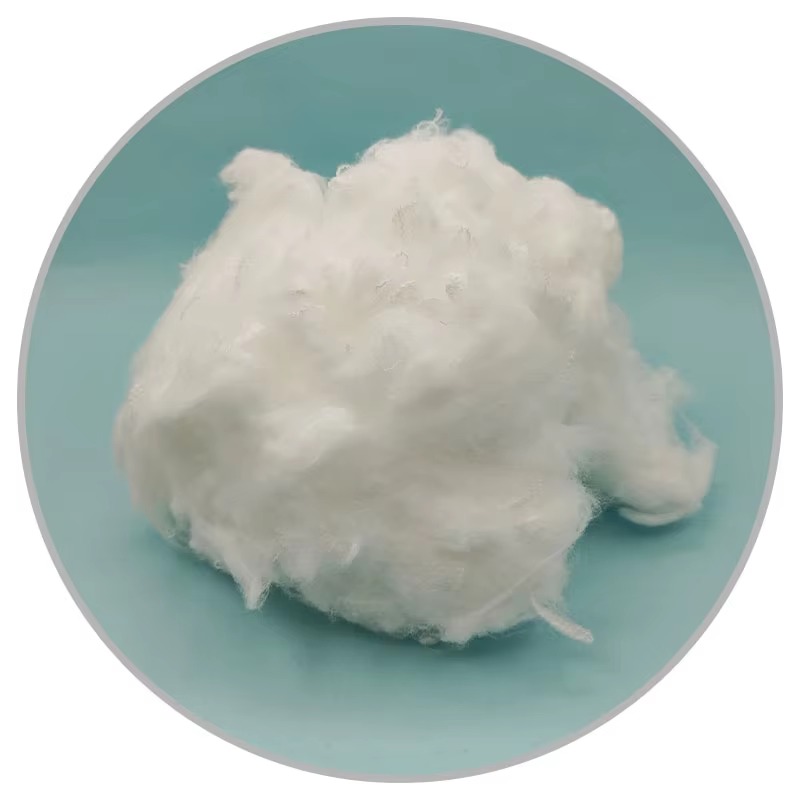
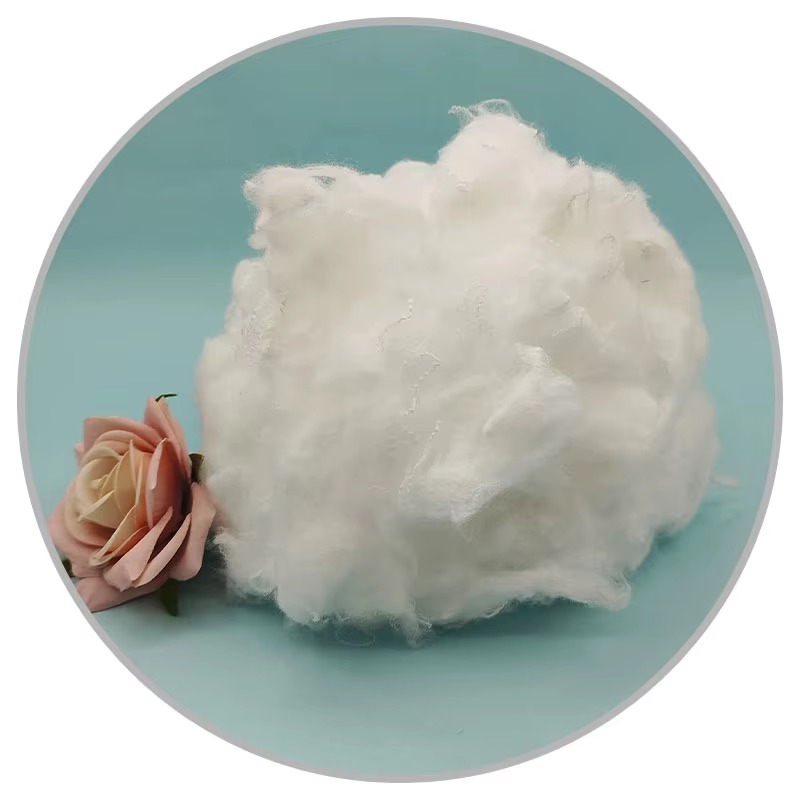
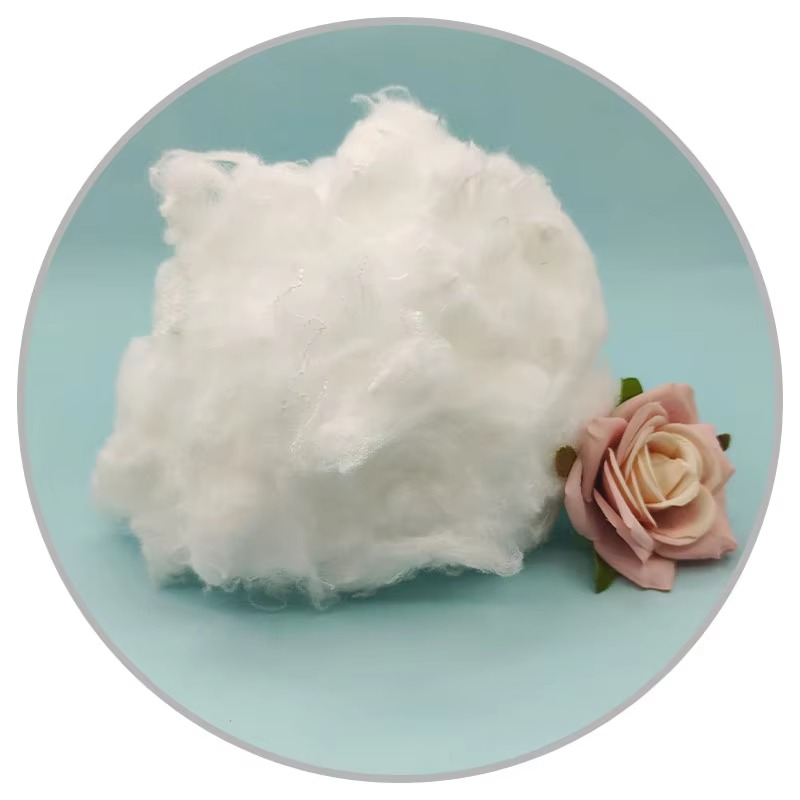
PLA Biodegradable Fill Fiber — Compostable Polyester Alternative for Eco-Certified Products
- PLA fiber is a plant-based synthetic fill fiber that is industrially compostable under EN 13432 or ASTM D6400 conditions, making it the only commercially available compostable synthetic fill material.
- Unlike recycled polyester, PLA focuses on end-of-life biodegradability rather than recycled content, but it requires industrial composting infrastructure to realize its environmental benefits.
- PLA-filled products also require special care labeling because the fiber has lower heat resistance than conventional polyester.
PRODUCT DETAIL
PLA Biodegradable Fill Fiber — Compostable Polyester Alternative for Eco-Certified Products
What PLA Fill Fiber Is — and Why It Is the Only Genuinely Compostable Synthetic Fill
PLA (polylactic acid) is a thermoplastic polyester produced not from petroleum — as conventional PET is — but from lactic acid fermented from plant starch (corn, sugarcane, cassava, or beet). The lactic acid monomer is polymerized to polylactic acid, which is then melt-spun into fiber using the same extrusion and drawing process as standard PET. The resulting PLA fiber has a similar hand feel and fill performance to polyester fill at equivalent denier, but fundamentally different end-of-life behavior.
PLA is industrially compostable: it biodegrades to carbon dioxide, water, and biomass under industrial composting conditions — elevated temperature (58–70°C), high moisture, and an active microbial community — certified to EN 13432 (European) or ASTM D6400 (US) within 90–180 days. This is the only commercially available synthetic fill fiber with verified compostability. Polyester fill (including GRS-certified recycled polyester) does not biodegrade under any practical end-of-life conditions within a human timeframe.
The commercial case for PLA fill: brands and retailers making genuine end-of-life biodegradability claims on filled products — pillows, cushions, stuffed toys, or nonwoven products intended for composting programs — have no alternative to PLA fill fiber if they want their claims to be technically accurate. ‘Made from recycled polyester’ and ‘biodegradable‘ are not equivalent claims — they address different sustainability dimensions. For brands committing to the biodegradability dimension, PLA is the specification.
Industrial Composting vs Home Composting vs Landfill: The Critical Distinctions
PLA biodegradability claims require precise communication to avoid misrepresentation — the conditions under which PLA biodegrades are specific and not equivalent to home garden composting or landfill disposal:
- Industrial composting (certified, EN 13432 / ASTM D6400): Temperature maintained at 58–70°C, high moisture, active microbial community, regular turning. PLA degrades to 90%+ CO₂, water, and biomass within 90–180 days. This is the certified claim and the genuine environmental benefit. Industrial composting infrastructure exists in Belgium, Netherlands, UK, Germany, and some US regions but is not universally available.
- Home composting at ambient temperature: PLA does NOT reliably home compost. At ambient temperatures (15–25°C), PLA’s glass transition temperature (~58°C) is not reached — the polymer remains solid and degrades very slowly. Home composting of PLA products can take years or decades, not months. Do not use ‘home compostable’ claims for PLA fill products unless you have EN 13432 Part 2 or AS 5810 home composting certification specifically.
- Landfill disposal: PLA does NOT biodegrade effectively in landfill. Modern landfills are anaerobic and relatively dry — conditions that slow PLA degradation dramatically. PLA in landfill can persist for years to decades, similar to conventional PET. The environmental benefit of PLA is fully realized only when the end-of-life pathway is industrial composting.
- Honest marketing guidance: The correct claim for PLA fill fiber is ‘industrially compostable’ with EN 13432 certification cited. Claims of ‘biodegradable‘ without qualification, or ‘compostable’ without specifying industrial composting conditions, may be misleading and are subject to regulatory challenge under FTC Green Guides (US), EU Green Claims Directive (EU), and equivalent consumer protection regulation.
PLA vs GRS Recycled Polyester: Choosing the Right Sustainability Claim
PLA fill and GRS-certified recycled polyester fill address different sustainability dimensions. The choice depends on which sustainability commitment your brand is making:
- Choose GRS recycled rPSF if: Your sustainability commitment is recycled content — diverting post-consumer plastic waste from landfill and giving it a second life as fiber. GRS-certified rPSF has verified recycled content (post-consumer PET bottles), 60–70% lower GHG emissions than virgin PSF, and widely recognized retail certification. The fill does not biodegrade but the raw material is recovered waste.
- Choose PLA fill if: Your sustainability commitment is end-of-life biodegradability — ensuring the fill fiber returns to the biosphere rather than persisting as synthetic material. PLA has biogenic carbon (the carbon is from the atmosphere via plant photosynthesis, not from fossil reserves), lower GHG than virgin PET, and verified industrial compostability. Requires industrial composting infrastructure at end of life.
- Important: they are different claims. A brand cannot substitute ‘made from recycled polyester’ for ‘compostable fill’ — these are claims about different phases of the product’s life cycle. If your retail buyer or consumer requires compostability specifically, only PLA fill meets that requirement.
PLA Care Requirements — Critical for Label Compliance
PLA fiber has different temperature limits than polyester that must be reflected in care labeling:
- Maximum wash temperature: 40–50°C gentle cycle. PLA’s glass transition temperature is approximately 55–60°C — above this temperature, PLA fiber can soften and deform. Standard polyester can be washed at 60°C; PLA cannot. Care labels for PLA-filled products must specify 40°C maximum.
- Tumble drying: Air dry or tumble dry on the lowest heat setting only. High-heat tumble drying (above 60°C drum temperature) can cause PLA fiber deformation and wadding collapse.
- Ironing: Do not iron PLA fill products — the fill cannot withstand ironing temperatures.
Applications
- Eco-certified biodegradable pillow: Industrial composting end-of-life claim. Must be paired with consumer education about composting drop-off programs.
- Biodegradable stuffed toy fill: For sustainable toy brands with compostable product programs. OEKO-TEX Class I available.
- Compostable cushion fill: Interior design brands with circular product take-back and composting programs.
- Agricultural applications: Seedling protector fill, horticultural padding — PLA composts naturally in agricultural compost systems.
- Medical single-use nonwoven fill: Where compostable disposal is specified for biohazard reduction in medical waste streams.
The composting program requirement: PLA’s biodegradability benefit is only realized if the product actually reaches industrial composting at end of life. Brands specifying PLA fill should simultaneously develop a consumer communication and product take-back strategy that connects end-of-life PLA-filled products with industrial composting infrastructure. Without this, PLA-filled products in most markets will end up in landfill — where PLA’s composting benefit is not realized. VNPOLYFIBER can connect brands with composting scheme operators as part of our sustainable supply chain partnership.
Frequently Asked Questions
Q: Is PLA fill fiber warmer or cooler than polyester fill at equivalent denier?
PLA fill has similar warmth-to-weight ratio to standard polyester fill at equivalent denier and hollow cross-section. The difference is not perceptible to consumers in normal bedding use. The important practical difference is care temperature, not warmth performance: PLA fill products must be laundered at 40°C maximum and air-dried, versus 60°C wash and tumble-dry for polyester fill. This care restriction is significant for hotel and institutional applications where commercial laundering at 60°C is standard — PLA fill is not suitable for institutional laundering cycles.
Q: Is PLA fiber from renewable resources a guaranteed lower carbon footprint?
PLA has a lower cradle-to-gate carbon footprint than virgin PET — approximately 1.8–2.7 kg CO₂e/kg versus 5–6 kg CO₂e/kg for virgin PET. The biogenic carbon in PLA (from the atmosphere via crop photosynthesis) gives it a carbon accounting advantage. However, PLA production still requires land for crop growing, energy for fermentation and polymerization, and transport. The specific carbon footprint depends on the PLA producer, the feedstock crop, and the agricultural practices used. Request life cycle assessment (LCA) data from your PLA fiber supplier for accurate carbon footprint calculation.
Q: Can PLA and polyester fill be blended in the same product?
Yes — PLA and standard HCS can be blended in any ratio. Blending allows a partial biodegradability claim (proportional to PLA content) while maintaining some polyester fill performance advantages. However, a blended PLA/PET fill is NOT industrially compostable — the PET component does not compost and would need to be separated from the composted PLA residue, which is not practical in a blended fill. For a credible ‘compostable fill’ claim, the fill must be 100% PLA or other certified compostable fiber. A blend claim should be stated accurately as ‘50% PLA compostable fill, 50% polyester’ rather than ‘compostable fill.’
Technical Parameter
Product Specifications
| Grade | Specification | Application and Notes |
| PLA standard fill | PLA 4D×51mm siliconized | EN 13432 compostable. OEKO-TEX available. Standard pillow and cushion fill. |
| PLA fine fill | PLA 2D–3D×51mm siliconized | Finer, softer. Premium biodegradable fill. Children’s products. |
| PLA firm fill | PLA 6D×51mm siliconized | Firmer fill. Structured cushion and toy applications. |
| PLA wadding | PLA 4D HCS + PLA LMF (80/20) | PLA thermal bonding wadding. Both components compostable. |
FAQ
1. What do you offer?
We supply a comprehensive range of fibers, including recycled hollow conjugated (both siliconized and non-siliconized) polyester staple fiber, hollow fiber, microfiber, virgin polyester staple fiber, and low-melt fiber.
2. What is it used for?
Our fibers are versatile and widely utilized across both the filling and non-woven industries, providing essential loft, durability, and texture for various consumer and industrial applications.
3. Are you a factory or a trading company?
We are primarily a manufacturer specializing in polyester staple fiber with years of industry expertise. To better serve our clients, we also operate a dedicated trading division that allows us to act as a one-stop solution provider.
In addition to our own fiber production, we source high-quality textile components (such as yarn and low-melt fibers) and finished goods (including foam, pillows, cushions, toys, and down/feather products) to ensure our customers have access to a comprehensive supply chain.
4. Where is your factory location?
To maintain a robust and flexible global supply chain, our manufacturing facilities are strategically located throughout Asia, specifically in Vietnam, China, Malaysia, Thailand, and Indonesia. If you would like to visit one of our sites, please contact your sales representative, and we will be happy to arrange transportation for you.
5. Can you accept free sample?
Yes, we provide free hand samples for quantities under 1 kilogram. Once a price is confirmed, we can prepare and dispatch your sample within 2–3 business days. Please note that while the sample is free, the freight costs are the responsibility of the client.
6. Can you provide ODM service?
Absolutely. We specialize in ODM (Original Design Manufacturing). This means we can customize the material composition, dimensions, quantity, packaging, and branding to meet your specific requirements. Your logo and unique specifications will be integrated into the final product.
7. How about your quality? What’s the minimum order Quantity (MOQ)?
We invite you to place a trial order to experience our quality firsthand. Our standard MOQ is 23,000 kilograms per order.
Regarding pricing, we maintain a no-bargain policy. We believe in transparency and efficiency, so we provide our most competitive offer upfront to save you time and ensure a straightforward procurement process.
8. Can I mix different items in one order?
Yes, for your convenience, we allow for a maximum of two different items to be mixed within a single container.
9. How can you guarantee the product quality?
Quality is the cornerstone of our business. We employ an experienced QC team that monitors every stage of production, from raw material inspection to the final manufacturing process. We utilize a range of advanced testing instruments to ensure our fibers meet strict industry standards.
Our business philosophy is simple: We aim to serve one customer 1,000 times, rather than 1,000 customers once. We prioritize long-term partnerships built on consistent excellence.
10. What’s the payment terms?
L/C at sight, 30% TT in advance are mostly accepted; other terms shall be negotiable by both sides
For more information, please feel free to contact :
Tony Tan
Mobile number: +84 90 466 5251 (Whatsapp/Wechat/Viber/Signal)