Hollow Fiber vs Microfiber Fill: Complete Buyer’s Guide to HCS, Hollow Slick, Solid and Microfiber Polyester Fill Fiber
Choosing the right polyester staple fiber for fill applications — pillows, duvets, mattress toppers, stuffed toys, sleeping bags — is one of the most practically important specification decisions in the bedding and home textile supply chain. The choice between hollow conjugated siliconized (HCS) fiber, hollow slick fiber, solid fiber, and microfiber determines the finished product’s softness, loft, warmth-to-weight ratio, loft recovery after compression, durability through washing, and ultimately the consumer experience that drives brand reputation and repeat purchase.
Yet this choice is frequently made by habit or price alone rather than by matching fiber properties to product requirements. A pillow filled with the wrong fiber grade will flatten prematurely, feel scratchy, clump after washing, or feel too dense — not because polyester fill fiber is inherently poor, but because the specification was wrong for the application. This complete guide explains what each fill fiber type is, how it differs from the others, the precise properties of each, which denier specification suits which application, and where VNPOLYFIBER’s product range fits in the landscape.
VNPOLYFIBER supplies the complete range of fill and wadding fiber grades — HCS siliconized, hollow slick, solid, and microfiber PSF — in both virgin and GRS-certified recycled grades, with OEKO-TEX Standard 100 Class I (for babies and children) and Class II (for adults) certification. This guide reflects direct manufacturing and supply chain knowledge of what makes fill fiber perform at the level that premium bedding brands and contract manufacturers require.
The Four Polyester Fill Fiber Types
| Fiber Type | Definition and Key Characteristic |
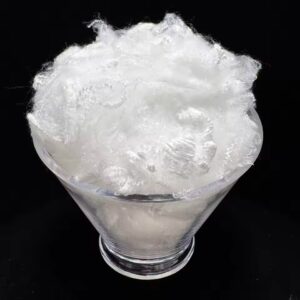
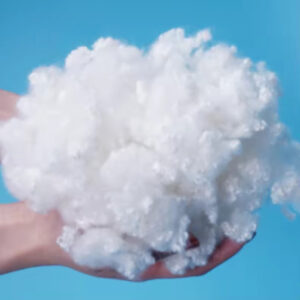
| HCS — Hollow Conjugated Siliconized | The premium fill fiber standard. Hollow = air channel in fiber cross-section. Conjugated = permanent 3D helical spiral crimp from bicomponent side-by-side spinning. Siliconized = silicone surface finish preventing fiber clumping and enabling free redistribution. The combination produces the best-performing fill fiber — maximum loft, superior loft recovery, softest feel, longest useful life. VNPOLYFIBER’s flagship fill product. |
| Hollow Slick (non-siliconized hollow) | Same hollow cross-section and conjugate crimp as HCS, but without the silicone surface finish. Fiber-to-fiber friction is higher — fill compacts more readily and redistributes less freely than siliconized grades. Lower cost than HCS. Used where silicone finish is not desired or a slightly firmer feel is an advantage. |
| Solid Fiber | Round or multi-lobal solid cross-section — no air channel. Heavier per unit volume than hollow fiber. Typically uses 2D mechanical crimp rather than 3D conjugate crimp. The entry-level fill fiber — lower per-kg cost, adequate for budget applications, but inferior loft recovery and shorter useful life than HCS. Often more expensive per finished product than HCS due to higher fill weight requirement. |
| Microfiber PSF (<1 denier) | Individual filament denier below 1.0 dpf — significantly finer than standard hollow or solid fill fiber. Produces exceptionally soft, fine-textured fill with the highest warmth-to-weight ratio of any synthetic fill. The down-alternative specification for ultra-premium products. Higher cost than HCS. |
The Hollow Cross-Section: Why It Matters
The air channel running through hollow fiber’s cross-section is an engineering design feature — not a defect or cost-saving measure. It changes three things fundamentally:
- Lower density per unit volume: The air channel displaces polymer — a hollow fiber contains less polymer mass than a solid fiber of the same outer diameter. More fibers per kilogram fill weight, more loft per gram. Hollow fiber fill requires less total weight to achieve equivalent loft versus solid fiber.
- Trapped air insulation: The air channel within the fiber itself adds to the still air trapped between fibers in the fill mass — the combination gives hollow fiber fill higher thermal insulation per gram than solid fiber fill. This is why down-alternative products use hollow fiber: they are trying to replicate the insulation architecture of natural down’s hollow shaft.
- Better crush resistance: The hollow cross-section acts as a structural micro-arch — it resists compression more effectively than a solid cross-section. This is amplified in HCS fiber by the conjugate crimp, which adds spring-like elastic recovery on top of the hollow’s inherent compression resistance.
The Conjugate Crimp: The Most Important HCS Property
The single most commercially important property of HCS fiber is the conjugate 3D helical crimp — and understanding why it outperforms mechanical crimp is understanding why premium pillows hold their loft for years while budget pillows go flat within months.
Mechanical Crimp (Standard Solid and Some Hollow Fiber)
Standard hollow fiber and solid fill fiber use mechanical crimping — the drawn fiber tow is compressed through a stuffer-box crimper, creating a 2D zigzag waveform. This mechanical crimp provides initial bulk but is not permanently set into the polymer crystal structure. Under sustained compression — a pillow slept on every night — the crimp gradually relaxes. The fiber straightens, the fill compacts, and the pillow progressively loses loft. By 6–12 months of regular use, a mechanically crimped solid fiber pillow has often lost 30–40% of its initial height.
Conjugate Crimp (HCS)
HCS fiber uses a side-by-side bicomponent spinneret — two PET polymer streams with slightly different intrinsic viscosities are extruded adjacent to each other. When drawn and heat-set, differential shrinkage between the two components causes the fiber to coil permanently into a 3D helical spiral — like a microscopic metal spring. This helix is locked into the fiber’s crystal structure during the drawing process. It cannot be removed by compression alone.
Measured loft recovery difference: Premium HCS fiber with conjugate crimp recovers 85–95% of initial loft height after 5,000 standardized compression-recovery cycles. Standard hollow or solid fiber with mechanical 2D crimp typically recovers 60–75% of initial loft after the same test. Consumers experience this as the difference between a pillow that ‘stays fluffy for years’ and one that ‘goes flat after a few months.’ The crimp type — not the fill weight, not the brand — is the primary determinant of this performance difference.
Siliconization: The Anti-Clump Technology
Silicone emulsion applied to HCS fiber before cutting — typically 0.3–0.8% silicone pickup by fiber weight — reduces fiber-to-fiber surface friction dramatically. This single treatment determines whether fill fiber behaves well through washing and extended use:
- Redistribution during use: Siliconized fill fibers slip freely against each other — when a pillow is adjusted or plumped, the fill redistributes smoothly to where it is needed. Non-siliconized fill tangled and clumped, resisting redistribution and creating cold spots and lumps.
- Wash behavior: Machine washing agitates fill fibers intensely — siliconized fibers’ smooth surfaces prevent fiber-to-fiber bonding during agitation. The pillow emerges from the wash machine fully redistributed and lofted. Non-siliconized fill emerges clumped into dense, hard masses that must be manually broken apart — and may never fully recover loft after washing.
- Processing behavior at filling machines: Siliconized fiber flows freely through pillow and toy filling machine nozzles without bridging or clogging. Poorly siliconized or non-siliconized fiber clogs nozzles, slows production, and creates uneven fill distribution.
- Silicone level is a specification variable: Higher silicone level = slipperier, better anti-clump. Too high and processing on some filling machines is difficult (fiber blows out instead of packing). Specify silicone level to match downstream filling machine type and product requirements.
Microfiber Fill: Down-Alternative Performance at Cost Premium
Microfiber PSF below 1.0 dpf achieves premium fill performance through extreme fineness rather than the hollow cross-section approach of HCS. Far more individual fibers per gram of fill weight means far more total fiber surface area per gram — more air trapping, finer texture, softer feel.
- Warmth-to-weight: Highest of any synthetic fill — fine fibers trap more air per gram than coarser fibers, producing sleeping bag and duvet temperature ratings competitive with natural down at equivalent fill weights.
- Softness: Outstanding — the finest achievable surface texture in synthetic fill. The closest synthetic fiber gets to the hand feel of natural down.
- Cost: Significantly higher than HCS — typically 20-40% cost premium. Fine spinneret holes, slower extrusion rates, more demanding quality control all contribute to the premium.
- Crimp type matters as much as denier: Microfiber fill without conjugate crimp has disappointing loft recovery despite its fine denier. Premium microfiber fill specifications require confirming that conjugate crimp (bicomponent side-by-side) is used rather than mechanical crimp.
Complete Comparison: All Four Fill Fiber Types
| Property | HCS Siliconized | Hollow Slick | Solid Fiber | Microfiber <1D |
| Cross-section | Hollow — air channel | Hollow — air channel | Solid — no channel | Ultra-fine solid filaments |
| Crimp type | 3D conjugate — permanent | 3D conjugate — permanent | 2D mechanical — relaxes | 2D or 3D (grade dependent) |
| Silicone finish | Yes — 0.3-0.8% | No | No | Yes (premium) / No (budget) |
| Loft per gram | Highest | High | Lowest | Very high |
| Loft recovery | 85–95% — excellent | 80–90% — very good | 60–70% — poor | Good (conjugate) / Moderate (mechanical) |
| Softness | Excellent | Very good | Moderate — can feel scratchy | Outstanding — finest texture |
| Warmth-to-weight | High | High | Moderate | Very high — maximum |
| Anti-clump (wash) | Excellent | Moderate | Poor | Excellent (siliconized) |
| Fill weight for loft | Lowest | Low | Highest | Very low |
| Cost per kg | Mid-premium | Mid | Lowest | Highest |
| Cost per product | Competitive — less fill needed | Competitive | Often higher — more fill needed | Higher — fiber premium |
| Typical denier | 3D, 4D, 6D, 7D | 3D, 4D, 6D | 3D, 4D, 6D, 7D | 0.5D, 0.7D, 0.9D |
| OEKO-TEX Class I | Available | Available | Available | Available |
| GRS recycled grade | Widely available | Available | Available | Limited availability |
Denier Selection: Which Denier for Which Application
| HCS Denier | Fill Character | Best Applications |
| 0.9D–1.5D (microfiber) | Ultra-fine, ultra-soft, maximum warmth-to-weight | Premium down-alternative sleeping bags. Luxury duvet fill. Pillows positioned against natural down. Highest cost. |
| 2D–3D | Fine, very soft, high loft per gram | Premium branded pillows. Down-alternative outerwear fill. Children’s products requiring OEKO-TEX Class I. |
| 4D | Standard premium — best value premium fill | Most widely specified premium grade. Quality consumer pillows and duvet fill. Best balance of softness, loft, recovery, cost. |
| 6D | Medium, slightly firmer, good loft | Value-mid market pillows. Budget down-alternative duvet. Entry point for branded fill. |
| 7D | Medium-firm, economical, durable | Hotel and institutional pillows — durable through commercial laundering. Slightly firmer feel. Standard mattress quilting layer. |
| 10D–12D | Firm, structured | Firm orthopedic pillows. Mattress topper wadding. Car seat cushion backing. |
| 15D | Coarse, heavy | Industrial wadding. Automotive insulation. Packaging fill. Not for consumer bedding. |
Application Specification Guide
| Product | Recommended Fiber | Key Specification Notes |
| Premium retail pillow (soft) | HCS 4D siliconized | 800–1,200g fill / standard 50×75cm pillow. Loft: min 50mm uncompressed/100g. OEKO-TEX Class II min. |
| Premium retail pillow (medium-firm) | HCS 6D–7D siliconized | 900–1,400g fill. Suitable for back sleepers. Good loft retention. |
| Luxury / down-alternative pillow | HCS 3D or microfiber 0.9D–1.5D | Maximum softness. Fine denier, lower fill weight. Premium positioning. |
| Children’s pillow / stuffed toy | HCS 4D–6D siliconized | OEKO-TEX Standard 100 Class I mandatory. GRS recycled with Class I available. |
| Hotel / institutional pillow | HCS 7D siliconized | Commercial laundering durability. 800–1,000g standard fill. 60°C wash rated. |
| Budget retail pillow | Hollow slick 6D or solid 6D | Lower cost. Higher fill weight compensates for lower loft efficiency. |
| Premium all-season duvet | HCS 3D–4D siliconized | 300–500g/m² for 10.5–13.5 tog. Conjugate crimp essential. OEKO-TEX Class II. |
| Children’s duvet | HCS 4D siliconized | OEKO-TEX Class I mandatory. Lighter weight for child safety. GRS recycled available. |
| Hotel duvet | HCS 6D–7D siliconized | Commercial laundering. 300–450g/m². Institutional silicone specification. |
| 3-season sleeping bag (0°C+) | HCS 3D–4D siliconized | 200–300g/m² fill weight. Fine denier for warmth-to-weight efficiency. |
| Winter sleeping bag (-10°C+) | Microfiber 0.7D–1.5D siliconized | 350–500g/m². Maximum warmth-to-weight. Only option competing with down at this rating. |
| Mattress topper wadding | HCS 4D–7D + LMF 15–20% (bonded) | Thermally bonded sheet, not loose fill. 200–500g/m². Conjugate crimp for loft recovery. 60°C wash rated. |
Quality Specifications to Require from Your Fill Fiber Supplier
- OEKO-TEX Standard 100 certificate: Class I for babies and children under 36 months. Class II for adult products. Verify certificate number at oeko-tex.com — confirm it is current and covers the specific fiber grade.
- Crimp type confirmed in writing: Conjugate 3D helical (from bicomponent side-by-side spinning) vs mechanical 2D zigzag. Request production method confirmation. This is the most commercially significant specification — do not assume.
- Silicone level: Specify minimum silicone pickup % by fiber weight. Typical: 0.3–0.5% standard fill; 0.5–0.8% premium anti-clump. Request extraction test report.
- Denier tolerance: ±5% of nominal. Wider tolerances cause fill weight and loft inconsistency.
- Staple length: 51mm standard for most fill applications. 64mm for premium loft. Specify to match filling machine requirements.
- Loft test result: Request loft measurement (mm uncompressed height per standard fill weight in standardized chamber). Minimum 50mm per 100g for 4D HCS standard.
- Loft recovery test: For premium specifications: request recovery % after compression cycles. Premium HCS should show >85% recovery after standardized compression test.
- GRS Transaction Certificate (recycled grades): Required per shipment for verified recycled content claims — scope certificate plus TC per delivery.
Conclusion: Specification, Not Price, Determines Performance
The difference between a pillow that holds its loft for three years and one that flattens within three months is determined almost entirely by fill fiber specification — specifically the crimp type (conjugate vs mechanical) and the silicone finish. These are not marketing features; they are measurable, testable engineering properties that directly determine the consumer experience over the product’s lifetime.
For the majority of consumer bedding applications, HCS siliconized fiber with conjugate crimp in 3D–7D (matched to the softness/firmness requirement) is the correct specification. For ultra-premium down-alternative applications, microfiber below 1.0 dpf is the specification that bridges the gap to natural down. Solid fiber and non-siliconized grades are correct for budget applications where long-term loft retention is not the product promise.
VNPOLYFIBER’s HCS siliconized fiber covers 0.9D through 15D, in virgin and GRS-certified recycled grades, with OEKO-TEX Standard 100 Class I and II. We provide detailed fiber specification sheets, loft and loft recovery test data, and full certification documentation. Contact us with your fill application specification for technical recommendations and commercial quotations.