Low Melt Fiber (LMF): The Complete Buyer’s Guide — Specifications, Processing, Blend Ratios and Applications
Low melt fiber (LMF) is one of the most commercially important specialty fibers in the nonwoven and technical textile industry — yet it is also one of the most frequently misunderstood, misnamed, and incorrectly specified products in textile procurement. Buyers encounter it under multiple names: low-melt fiber, bico fiber, bicomponent binder fiber, thermal bonding fiber, conjugate fiber. Some of these names refer to the same product; some refer to different products that are sometimes confused with each other.
The commercial significance of LMF is straightforward: it is the binder that holds thermally bonded nonwoven fabric together without any chemical adhesive. When LMF is blended with structural fiber (most commonly HCS siliconized polyester) and passed through a through-air bonding oven, the LMF sheath melts and bonds the structural fibers at their crosspoints — creating a coherent, lofty, resilient fabric used in quilted jacket insulation, mattress toppers, duvet batting, automotive door panel insulation, stuffed toy fill, and hygienic coverstock.
This complete guide covers what LMF is, how it differs from other bicomponent fibers, the four major polymer combinations and their different applications, processing parameters, blend ratios, quality specifications, and how to source correctly.
VNPOLYFIBER supplies LMF bicomponent fiber across the full specification range: co-PET/PET (sheath melt point 110°C, 120°C, 130°C, 150°C), PE/PET, and PE/PP grades, in 2D–6D × 38–64 mm. OEKO-TEX Standard 100 Class I and II certified. GRS-certified recycled grades available.
What Is Low-Melt Fiber? Clarifying the Terminology
The terminology around LMF and bicomponent fiber is genuinely confusing — partly because different markets and manufacturers use different names, and partly because LMF is a specific type of bicomponent fiber, not a completely separate product category. Understanding the hierarchy eliminates the most common sourcing confusion:
| Term | What It Means |
| Bicomponent fiber (broad category) | Any fiber produced by simultaneously extruding two chemically distinct polymers through the same spinneret. LMF is one specific type. Conjugate self-crimping fiber (HCS production) is another type. Sea-island microfiber is another. All are bicomponent; they serve completely different functions. |
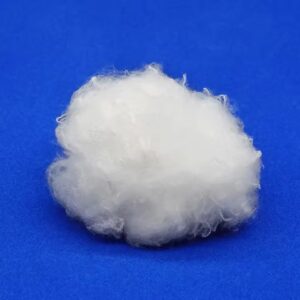
| Low-melt fiber (LMF) | A bicomponent fiber specifically designed for thermal bonding — with a sheath polymer that melts at a significantly lower temperature than the core polymer. The sheath bonds structural fibers at their crosspoints when heated; the core maintains structural integrity. This is the product this guide covers. |
| Binder fiber / bonding fiber | Alternative industry names for LMF — emphasizing its function (binding structural fibers) rather than its melting point characteristic. Same product. |
| Thermal bonding fiber | Another functional name for LMF. Used interchangeably with binder fiber and LMF in most commercial contexts. |
| Conjugate fiber | In Chinese textile industry usage, this often refers specifically to side-by-side bicomponent fiber that self-crimps (used in HCS premium fill fiber production) — NOT LMF. This is the source of significant confusion: ‘conjugate fiber’ in Chinese PSF trade typically means self-crimping fill fiber, not thermal bonding binder fiber. |
| ES fiber | A specific LMF variant: PE (polyethylene) sheath / PP (polypropylene) core bicomponent. ‘ES’ is a Japanese industry abbreviation. Standard for hygiene nonwoven through-air bonding (diaper coverstock). Distinct from co-PET/PET LMF used in wadding and batting. |
The most important clarification for buyers: when a Chinese PSF supplier quotes you ‘conjugate fiber’ or ‘bico fiber,’ always confirm whether they mean (a) self-crimping side-by-side bicomponent fiber for fill applications, or (b) sheath-core LMF for thermal bonding. These are fundamentally different products with different polymer combinations, different melting points, and entirely different functions. Specifying the wrong one creates processing failures.
How LMF Works: The Thermal Bonding Mechanism
LMF works through a precisely engineered melting point differential between its two polymer components. The sheath polymer is formulated to melt at a temperature significantly below the core polymer — typically 80–150°C below. When a blend of LMF and structural fiber is heated to a temperature within this melting window, the following sequence occurs:
- Sheath melts: The LMF sheath polymer softens and flows at the bonding temperature (typically oven set point 130–180°C depending on LMF grade). The molten sheath material flows by capillary action to fiber-to-fiber contact points within the web.
- Core remains intact: The LMF core polymer, with its significantly higher melting point, remains solid and maintains the fiber’s physical structure and dimensional integrity throughout the bonding process.
- Bonds form at crosspoints: Where the molten sheath contacts adjacent fibers (structural PSF or other LMF fibers), it wets and adheres to the fiber surfaces. The contact area and bonding pressure determine bond strength.
- Cooling sets the bonds: As the web exits the oven and cools, the sheath polymer re-solidifies — forming solid polymer bridges at fiber crosspoints throughout the nonwoven structure. These bridges are the bonds that give the thermally bonded nonwoven its coherence, shape retention, and mechanical integrity.
The result is a nonwoven that is coherent and dimensionally stable without any chemical binder — the thermal bonds are clean, durable, and do not leach chemical residues into the fiber structure. This chemical cleanliness is why thermal bonding with LMF has largely replaced chemical bonding (latex binders) in hygiene, fill, and consumer nonwoven applications where skin contact safety is important.
The Four Major LMF Polymer Combinations
LMF is not one fiber — it is a family of bicomponent configurations with different polymer combinations that produce different melting temperatures, different bonding strengths, and different application profiles. The four commercially significant LMF types:
| LMF Type | Sheath / Core | Sheath Melt Point | Key Properties and Applications |
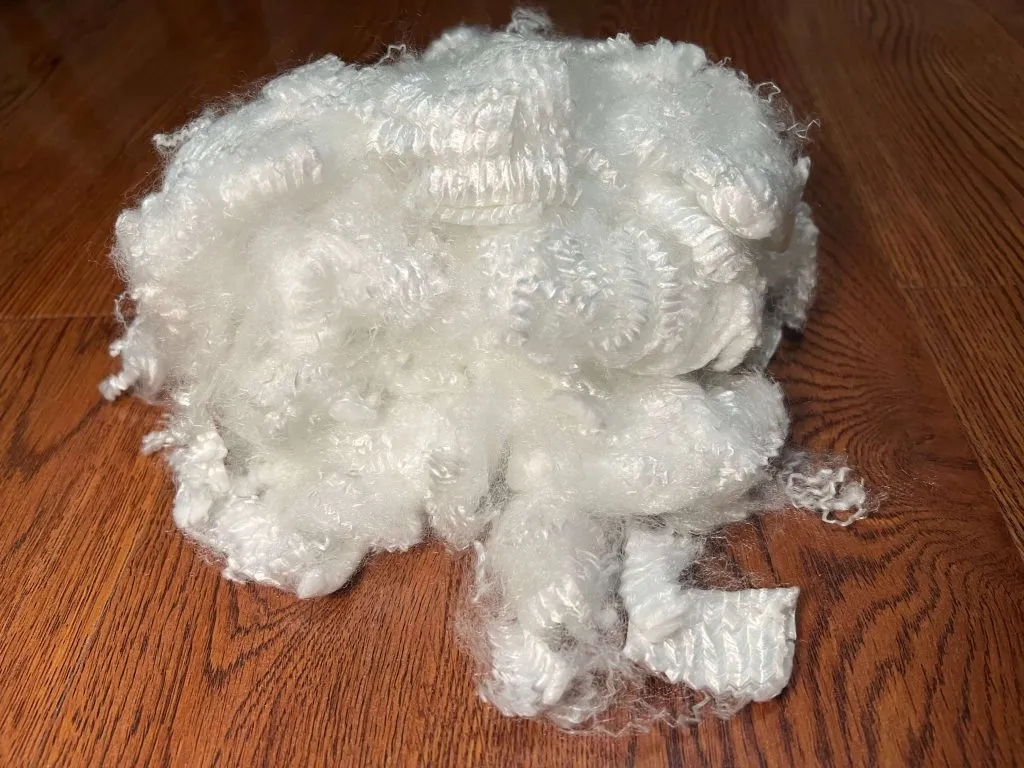
| co-PET / PET (standard) | Co-polyester sheath / PET core | 110°C, 120°C, 130°C, or 150°C options | The dominant LMF for polyester nonwoven wadding and batting. Co-PET sheath bonds PET structural fiber (HCS, solid PSF) in through-air bonding ovens. Soft bonding, good loft, low odor. Standard for quilted jacket insulation, mattress toppers, duvets, stuffed toys. Multiple sheath melt point options allow matching to different oven configurations. |
| PE / PET (hygiene-compatible) | Polyethylene sheath / PET core | ~130–135°C | Softer, more pliable bond than co-PET/PET. PE sheath produces very soft bonding suitable for fine hygiene nonwoven applications. Higher elongation than co-PET/PET bonds. Used in some hygiene coverstock and medical nonwoven applications. |
| PE / PP (ES fiber — hygiene standard) | Polyethylene sheath / PP core | ~130–135°C | The standard for hygiene nonwoven through-air bonding: diaper top sheet (coverstock), feminine hygiene cover, baby wipe substrate. PP core provides lightness (0.91 g/cm³ — lightest standard fiber); PE sheath provides soft, skin-gentle bonding at low temperature. Cannot be dyed conventionally — solution-dyed only. The designation ‘ES fiber’ (Japanese standard abbreviation) refers specifically to PE/PP. |
| PP / PP (homocomponent) | Lower-melt PP sheath / higher-melt PP core | ~140–155°C | All-polypropylene construction for applications requiring PP throughout — chemical resistance, specific melt behavior, or where PET or PE components are undesirable. Used in some geotextile and industrial filter nonwoven applications where chemical resistance of the complete fiber is required. |
LMF Specifications: What to Specify When Ordering
Correct LMF specification requires defining all of the following parameters — each of which affects processing behavior and finished product properties:
| Parameter | Common Options | How to Choose |
| Polymer combination | co-PET/PET; PE/PET; PE/PP; PP/PP | Match to structural fiber and application: co-PET/PET for polyester wadding (most common); PE/PP for hygiene coverstock; PE/PET for soft hygiene or medical. |
| Sheath melt point | 110°C, 120°C, 130°C, 150°C (co-PET/PET); ~130°C (PE grades) | Match to processing equipment oven temperature capability and structural fiber. Lower sheath melt = gentler bonding = softer product but requires well-controlled oven. Higher sheath melt = more robust bonding = higher oven temperature required. |
| Denier (dpf) | 2D, 4D, 6D (most common); also 1.5D, 3D for specialty | Lower denier = finer fiber = more bonding points per gram = softer, more uniform bond. 4D is the standard for most wadding applications. 2D for fine hygiene coverstock. 6D for coarser structural bonds. |
| Staple length | 38 mm, 51 mm, 64 mm | Match to structural fiber staple length and carding system. 51 mm is the most common standard. 38 mm for cotton-system carding. 64 mm for heavy needlepunch-weight carding. |
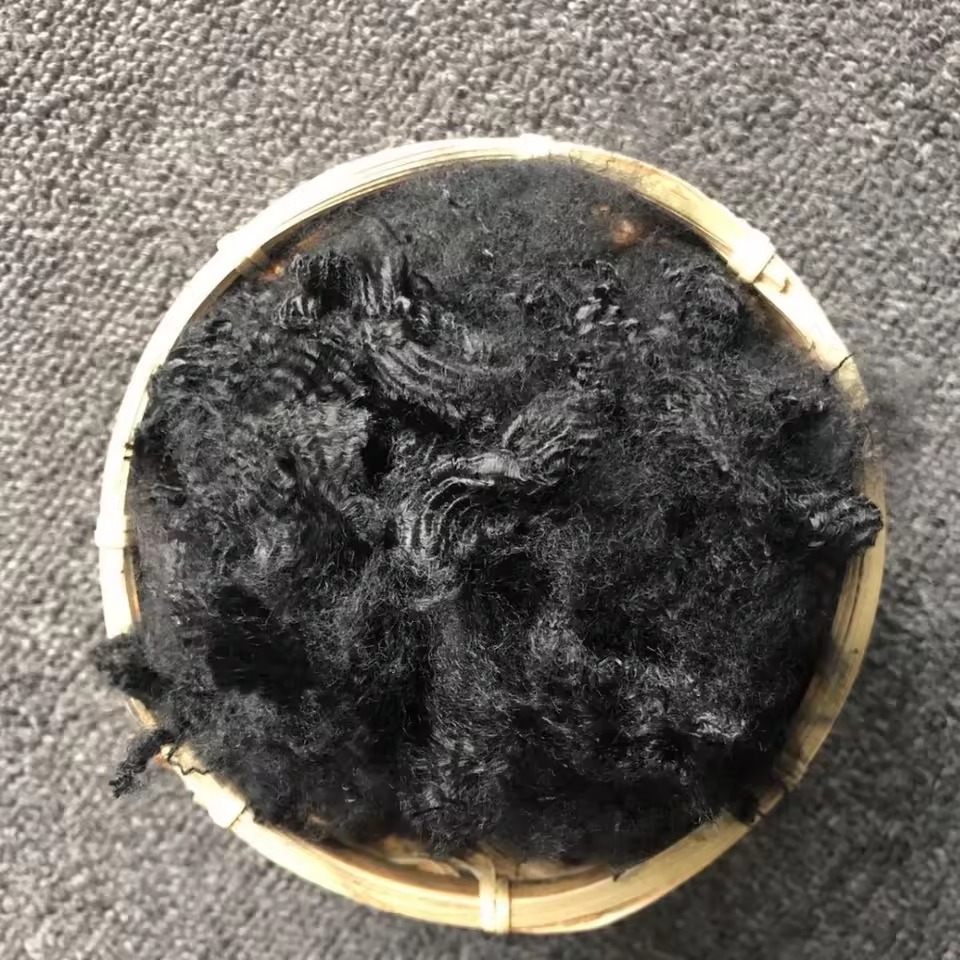
| Color | Raw white (RW) standard; dope-dyed black available | White for standard white wadding. Dope-dyed black or dark colors for automotive nonwoven where color matters. |
| Crimp | Standard 2D mechanical crimp for most LMF | Some LMF is produced without crimp (flat bico) for specific wet-laid and airlaid applications. Standard carded thermal bond wadding uses crimped LMF. |
| Certification | OEKO-TEX Standard 100 (Class I for babies, Class II adults); GRS for recycled content | Children’s products and hygiene: Class I mandatory. Adult home textiles: Class II standard. Recycled content claims: GRS scope and transaction certificate. |
Processing Parameters: The Temperature Window
The most critical processing parameter in thermal bonding with LMF is the oven temperature — and specifically the relationship between oven temperature, sheath melt point, and core melt point. This creates a defined temperature window within which bonding must occur:
| Temperature Zone | What Happens — and Why It Matters |
| Below sheath melt point | Sheath does not melt. No bonding occurs. Web passes through oven without forming any fiber-to-fiber bonds. Fabric has no coherence — falls apart when handled. Result: product failure. |
| Sheath melt point to sheath melt point + 20°C | Partial bonding zone. Sheath begins to soften and flow but bonding is incomplete. Some bonds form; others do not. Product is weak and inconsistent. Avoid this zone for production — it indicates oven temperature too low. |
| Optimal bonding window (sheath + 20°C to core − 30°C) | Complete sheath melting with good flow and bonding. Core remains solid. Full, consistent bond formation throughout web thickness. This is the target processing zone. Width of this window is typically 50–100°C depending on LMF grade — wider window = more process forgiveness. |
| Within 30°C of core melt point | Core begins to soften. Dimensional stability decreases. Fiber structure may distort. Product may lose loft and feel dense/boardy. Approach this zone only deliberately for specific dense, stiff nonwoven applications. |
| Above core melt point | Core melts. Complete fiber degradation. Fabric collapses, loses all structure. Spinneret-like re-fusion of fibers. Product destroyed. Equipment contamination risk. |
For standard co-PET/PET LMF with 130°C sheath melt point and 255°C PET core melt point, the optimal bonding window is approximately 150–225°C oven air temperature — a wide, forgiving window that makes this the most common specification. For 110°C sheath melt point LMF (used where gentler bonding and lower oven temperatures are required), the optimal window is approximately 130–200°C, which requires more precise oven control.
Practical tip for nonwoven manufacturers: if your thermally bonded product is too soft and falls apart (bonds not forming), the oven temperature is below the optimal window — increase temperature or reduce line speed. If your product is too stiff, dense, and boardy (not lofty enough), the oven temperature is at the upper end of the window — reduce temperature or increase line speed. If the product has a burned or degraded smell, the temperature is above the core melt point — reduce immediately.
Blend Ratios: How Much LMF to Use
The proportion of LMF in the fiber blend is the second most important processing variable after oven temperature. Too little LMF and bonds are sparse — the product lacks coherence. Too much LMF and the product is over-bonded — dense, stiff, lacking the loft and softness that are the point of thermal bonding for fill and wadding applications.
| LMF Blend % | Typical Application | Effect on Product Properties |
| 10–15% LMF | Lightweight hygiene coverstock; ultra-soft fine products | Minimal bonding — fabric coheres but has very low peel strength. Very soft, very lofty, maximum HCS character. Requires precise oven control as bond margin is narrow. Used where loft and softness are paramount and structural integrity requirement is low. |
| 15–20% LMF | Standard wadding for outerwear insulation (30–150 gsm) | Standard range for premium fill wadding. Good balance of loft retention and structural integrity. Quilted jacket insulation standard. Sleeping bag fill wadding. High softness retained. |
| 20–25% LMF | Medium-weight wadding; mattress topper; duvet batting | Moderate bonding density — product holds shape well through quilting and cutting operations. Better dimensional stability for mattress applications where the wadding layer must not shift during use. |
| 25–30% LMF | Heavier wadding; automotive insulation; firmer products | Higher bonding density — product is firmer, more structured. Less lofty per gsm but higher compression resistance. Automotive door panel insulator, car seat back pad. Products where structural firmness matters alongside thermal insulation. |
| 30–50% LMF | Specialty stiff nonwoven; hat brim stiffener; shoe component | High bonding density — produces relatively stiff, dimensionally stable fabric more similar to a molded composite than a soft batting. Not used for pillow or apparel fill — too stiff. |
| 100% LMF (pure) | Specific stiff component fabrics; some filter media | All-bico construction melts and re-solidifies as a dense, smooth film-like nonwoven. Used for specific technical applications requiring a defined surface. Not for fill or standard wadding. |
Through-Air Bonding vs Calendar Bonding: Which Process for LMF?
LMF can be bonded in two fundamentally different ways, and the process choice determines the character of the finished product:
Through-Air Bonding (TAB) — For Lofty, Soft Wadding
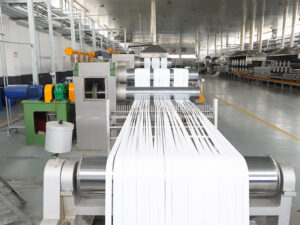
In through-air bonding, heated air is drawn through the fiber web perpendicular to its surface by suction fans below a perforated belt conveyor. The web is heated uniformly throughout its thickness without any compression or pressure — the fiber structure remains open and lofty during bonding. This is the correct process for wadding and batting applications where maximum loft is the product objective.
TAB is the standard process for all premium fill wadding production: quilted jacket insulation, duvet batting, mattress toppers, and stuffed toy fill. The absence of mechanical compression during bonding is what preserves the three-dimensional conjugate crimp of HCS fiber — and therefore the loft recovery performance that premium fill requires.
Calendar Bonding — For Flat, Structured Nonwoven
In calendar bonding, the web passes between heated roller pairs that apply heat and pressure simultaneously. The pressure compresses and partially densifies the web — producing a flat, denser, more rigid nonwoven than through-air bonding. Calendar bonding is faster and cheaper per metre of production but produces a fundamentally different product: flat, stiff-surfaced, lower loft.
Calendar bonding with LMF is appropriate for interlining fabrics, shoe component stiffeners, book binding materials, and flat nonwovens where structural rigidity matters more than loft and softness. It is not appropriate for premium fill wadding or soft hygiene coverstock.
Application Guide: LMF by End Product
| End Product | LMF Type | Blend % | Key Specification Notes |
| Premium quilted jacket insulation | co-PET/PET 110°C or 120°C | 15–20% | HCS 3D–4D siliconized + LMF. Target: 30–150 gsm. Through-air bonding. Loft specification: minimum 40 mm uncompressed at 100 gsm. OEKO-TEX Class II minimum. |
| Budget jacket insulation | co-PET/PET 130°C | 20–25% | Solid or HCS 6D–7D + LMF. 30–120 gsm. Adequate loft; lower cost than premium. |
| Mattress topper / pillow topper | co-PET/PET 130°C | 20–25% | HCS 4D–7D + LMF. 200–400 gsm. Through-air bonding. Resilience after compression critical. GRS recycled option popular. |
| Duvet batting | co-PET/PET 120°C or 130°C | 15–20% | HCS 3D–6D + LMF. 100–300 gsm. Through-air bonding. Must survive quilting process without delamination. |
| Stuffed toy fill wadding | co-PET/PET 110°C or 120°C | 15–20% | HCS 4D–6D + LMF. OEKO-TEX Class I mandatory. Pre-cut sheet or injection-fill grade. |
| Diaper/hygiene top sheet | PE/PP (ES fiber) 130°C | 100% ES fiber or blended with PP staple | Through-air bonding at 140–150°C. Very fine (2D) ES fiber. Hydrophilic surface treatment. Ultra-soft, skin-gentle. OEKO-TEX Class I mandatory. |
| Automotive door panel insulation | co-PET/PET 130°C or 150°C | 25–30% | Solid 7D–12D + LMF. 100–400 gsm. Calendar or through-air bonded. FR (flame retardant) finish for passenger compartment. Low VOC (VDA 270). Thermoformable for moulded shapes. |
| Automotive headliner | co-PET/PET 150°C | 20–25% | HCS or solid 4D–7D + LMF. 80–200 gsm. Must be thermoformable. Low odour specification. Sound absorption performance (NRC value). |
| Shoe component stiffener | co-PET/PET 130°C | 35–50% | Higher LMF ratio for stiffer product. Calendar bonded for flat, firm fabric. 80–300 gsm. |
LMF vs Chemical Bonding: Why Thermal Bonding Dominates Modern Production
Until the widespread adoption of LMF and thermal bonding technology from the 1980s onward, most nonwoven fabric was bonded using liquid chemical binders — acrylic latex, SBR (styrene-butadiene rubber), or PVA (polyvinyl alcohol) applied to the fiber web by spraying, padding, or foaming, then cured in an oven. Chemical bonding remains in use for specific applications today, but thermal bonding with LMF has largely displaced it for most fill, wadding, and hygiene applications:
| Factor | Thermal Bonding with LMF | Chemical Bonding (Latex/Acrylic) |
| Bond cleanliness | No chemical residues — bonds are pure polymer. Clean for skin contact and hygiene applications. | Binder residues remain in the fabric — potential for chemical release, odor, and skin sensitivity in sensitive applications. |
| Softness | Bond points are relatively soft polymer — preserved loft and hand feel | Binder can stiffen fiber structure, reducing softness and loft particularly at higher add-on levels. |
| Environmental profile | No liquid effluent; no VOC from binder chemistry; cleaner production | Binder application and curing generates liquid waste and potentially VOC emissions; more complex wastewater treatment required. |
| OEKO-TEX compliance | Straightforward — no binder chemistry to restrict | Requires verification of binder RSL compliance; some binder chemistries are restricted. |
| Production speed | High — thermal bonding ovens run at 10–80 m/min | Similar speed but wastewater treatment and binder handling add complexity. |
| Product range | Limited to thermoplastic fiber systems — cannot bond natural fiber webs without adding LMF | Can bond any fiber type including natural fibers and glass — broader feedstock flexibility. |
| Cost | LMF adds material cost; but simpler oven-only process | Binder chemistry cost plus application and wastewater treatment equipment cost. |
| Best for | Fill wadding, hygiene coverstock, automotive, toy fill — any application where cleanliness and softness matter | Specialty filter media, natural fiber bonding, specific adhesion properties not achievable thermally. |
Quality Specifications: What to Request from Suppliers
When sourcing LMF, require these quality parameters and supporting documentation:
- Polymer combination confirmed in writing: co-PET/PET or PE/PP — not just ‘bico fiber.’ The polymer combination determines the sheath melt point and application compatibility.
- Sheath melt point (DSC test): Differential scanning calorimetry (DSC) measurement of the sheath polymer melting onset and peak temperatures. This is the definitive test of bonding temperature — do not rely on nominal specifications alone. Request DSC curves for each production lot.
- Core polymer melt point: Confirmed by DSC — establishes the upper limit of safe processing temperature and the width of the processing window.
- Denier and staple length tolerance: Denier ±5% of nominal; staple length ±3 mm. Wider tolerances cause inconsistent blending and bonding performance.
- Crimp frequency and stability: Crimps per 25 mm; crimp stability >70% retained after boiling water treatment.
- Moisture content: Below 0.5% at delivery — excess moisture affects thermal bonding behavior.
- OEKO-TEX Standard 100 certificate: Specify Class I for children’s products and hygiene applications. Certificate number verifiable at oeko-tex.com.
- GRS Transaction Certificate (for recycled grades): Required per shipment if making recycled content claims. Scope certificate from supplier plus TC per delivery.
Conclusion
Low-melt fiber is the enabling technology behind the modern thermally bonded nonwoven industry — the clean, chemical-free bonding agent that allows HCS polyester and other structural fibers to be converted into coherent wadding, batting, and hygiene fabrics without liquid binders. Getting LMF specification right requires understanding the polymer combination (co-PET/PET for wadding, PE/PP for hygiene), the sheath melt point and its relationship to processing temperature, the correct blend ratio for the target product softness and structural integrity, and the bonding process (through-air for lofty soft products, calendar for flat structured products).
VNPOLYFIBER supplies LMF across the complete specification range — co-PET/PET in 110°C, 120°C, 130°C, and 150°C sheath melt point options; PE/PP (ES fiber) for hygiene applications; 2D through 6D; 38–64 mm staple lengths; raw white and dope-dyed black; OEKO-TEX Standard 100 certified; GRS-certified recycled grades available. Contact us with your wadding or nonwoven LMF specification for technical and commercial quotations.