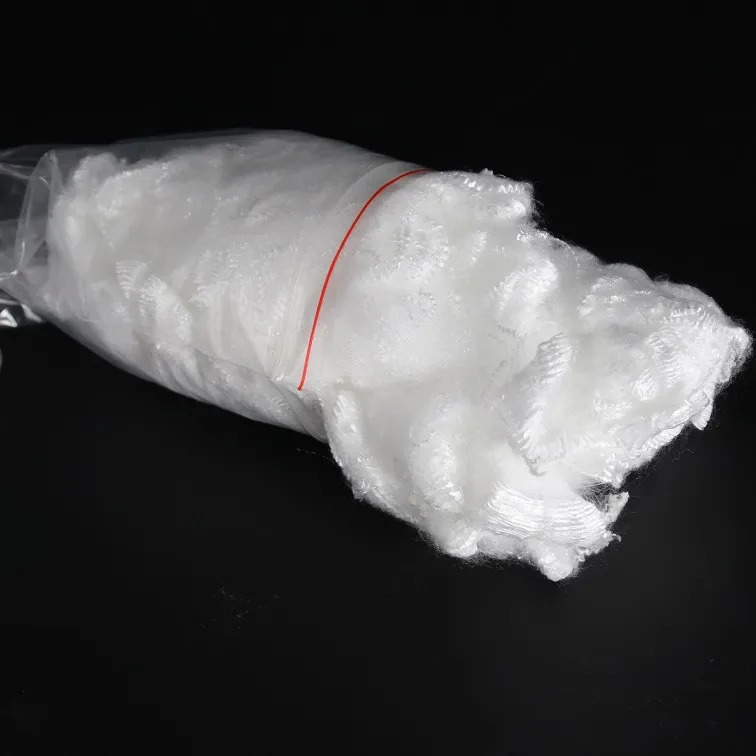
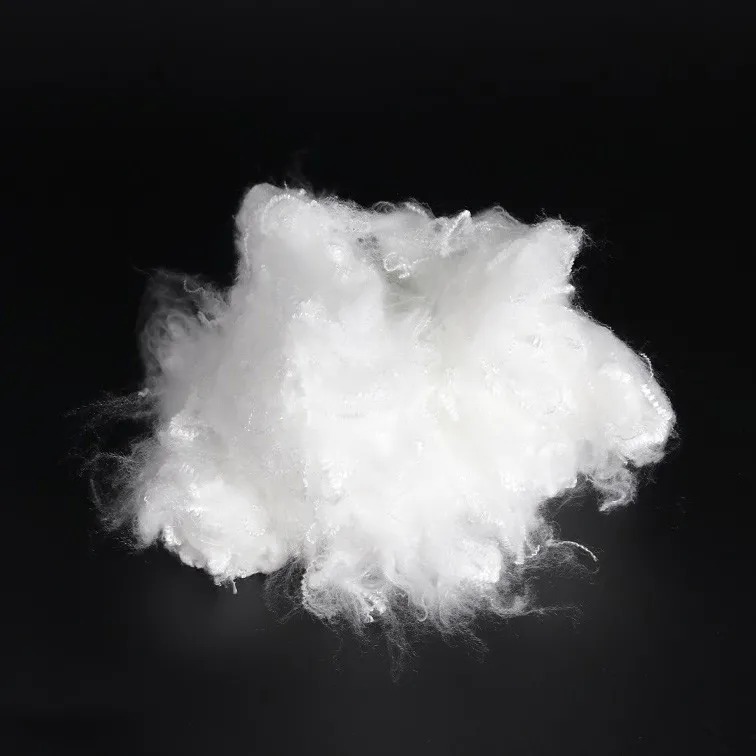
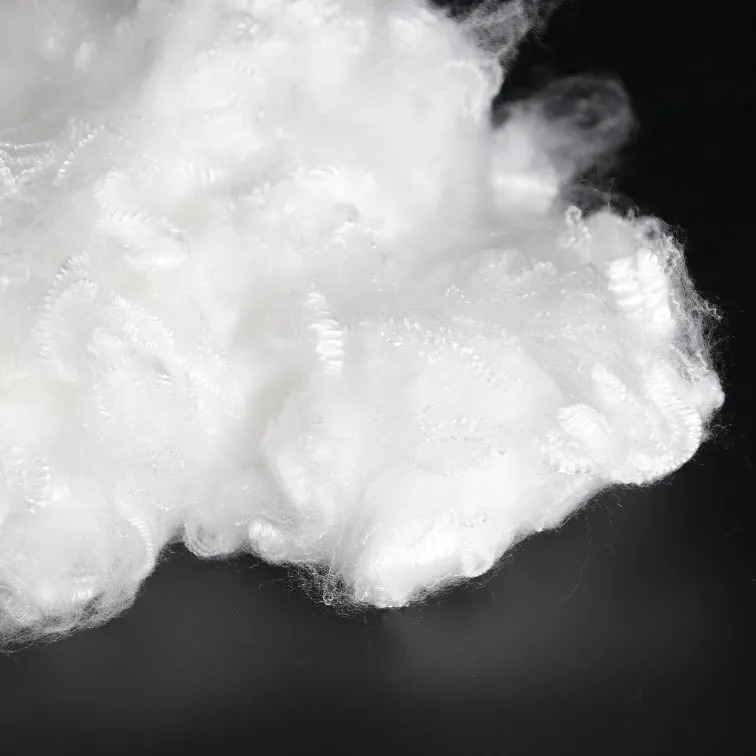
Cationic Dyeable Polyester Fiber — CDP Fiber for Two-Tone and Differential Dyeing
PRODUCT DETAIL
Cationic Dyeable Polyester Fiber — CDP Fiber for Two-Tone and Differential Dyeing
What Cationic Dyeable Polyester Is — and Why It Creates Two-Tone Effects
Cationic dyeable polyester (CDP) — also called anionic polyester, modified polyester, or acid-dyeable polyester — is produced by incorporating a sulfonate comonomer (typically sodium 5-sulfoisophthalate, abbreviated SIPM) into the PET polymer backbone during polymerization. This third monomer introduces negatively charged sulfonate groups into the polymer chain — groups that attract and bind positively charged (cationic) dye molecules with high affinity.
Standard PET fiber has no ionic charge sites — it can only be dyed with disperse dyes, which diffuse into the polymer matrix at 130°C under pressure. CDP fiber has both the standard PET structure (still dyeable with disperse dyes) and the new sulfonate sites (dyeable with cationic/basic dyes at lower temperature). This dual dyeability is the foundation of CDP fiber’s commercial value.
The two-tone effect: when CDP fiber and standard PET fiber are blended in a yarn or mixed in a fabric, and the fabric is dyed with both cationic and disperse dyes simultaneously in a single dyebath, the two fiber types take on different colors. CDP fiber takes the cationic dye (color A) and standard PET fiber takes the disperse dye (color B). The result is a yarn or fabric where individual fibers are visibly different colors — producing heather, marled, two-tone, or space-dye visual effects without printing, without separate dyeing steps, and without weaving two separately dyed yarns together.
The Chemistry Behind Cationic Dyeing
- Standard PET + disperse dye: Disperse dye molecules are small, nonpolar, and diffuse into the amorphous regions of the PET polymer at 130°C under 3–4 bar pressure. The dye is physically trapped inside the fiber when it cools. This is why polyester dyeing requires high temperature and pressure.
- CDP + cationic dye: Cationic (basic) dye molecules carry a positive charge. They are electrostatically attracted to the negatively charged sulfonate groups in the CDP polymer chain and bind with ionic bonds — a different and stronger interaction than disperse dye physical trapping. Cationic dyeing of CDP typically occurs at 90–110°C without pressure — significantly milder conditions than disperse dyeing.
- Combined dyebath for two-tone: In a single dyebath containing both cationic dye (for CDP) and disperse dye (for standard PET), the two fiber types selectively take their respective dyes. The cationic dye has no affinity for standard PET; the disperse dye has very low affinity for CDP’s sulfonate sites. The result is selective, simultaneous dyeing — two colors from one bath.
CDP Blend Ratio Guide for Two-Tone Effects
- 10–20% CDP: Subtle tone-on-tone heather effect — the two colors are close in tone, producing a soft, natural variation rather than a strong contrast. Common in premium casual apparel where understated texture is the aesthetic.
- 30–40% CDP: Clear two-color heather — the two fiber types are distinctly different colors and the heather visual effect is clearly visible. This is the most commercially common CDP blend ratio for mainstream heather effect fabric.
- 50% CDP: Strong two-tone contrast — at equal proportions, both colors are equally represented and the fabric has a bold, high-contrast visual effect.
- 70%+ CDP: CDP-dominant blend — the cationic dye color is the dominant color and the disperse-dyed PET is the secondary tone. Useful when a deep, rich CDP color is the featured color and the standard PET color provides a subtle depth.
Applications
- Two-tone polyester spun yarn: The primary CDP application. 30–50% CDP blended with standard PET at ring spinning or open-end. One dyebath, two distinctly colored fiber components in the finished yarn and fabric.
- Heather effect knitted fabric: 30% CDP blend produces the natural heather visual without printing. Used in T-shirts, sportswear, and casual knitwear where heather texture is a fashion aesthetic.
- Space-dye and marled yarn: CDP in differential distribution across yarn cross-section creates space-dye visual effects at the yarn stage, before knitting or weaving.
- Automotive interior yarn with tonal variation: Subtle tonal two-tone for seat fabric and trim yarn. More sophisticated visual than single-color, less demanding than pattern weaving.
- Performance fabric with visual differentiation: Technical performance fabrics (moisture wicking, stretch) with visual texture achieved by CDP blending rather than printing.
Processing note: CDP fiber requires a different dyeing approach than standard PET. The dyehouse must use cationic dyes compatible with CDP alongside disperse dyes compatible with standard PET. The dyebath pH, temperature profile, and auxiliaries must be selected for compatibility with both dye types. Standard PET dyeing conditions (130°C, pH 4–5 with acetic acid) are also compatible with cationic dyeing of CDP in a combined bath. Work with your dyehouse on dye selection for the specific target colors — the cationic dye and disperse dye colors are chosen to achieve the target two-tone combination after simultaneous application.
Frequently Asked Questions
Q: Can I achieve any color combination with CDP two-tone dyeing?
The two-tone color combination is constrained by the dye chemistry. Cationic dyes produce a range from pale pastels to deep, rich tones — they are particularly strong in blue, violet, red, and green families. Disperse dyes on standard PET cover the full color spectrum. In practice, the most commercially successful CDP two-tone combinations achieve contrast between a rich cationic color (deep blue, burgundy, forest green) and a lighter or different-tone disperse color (grey, beige, lighter blue). Very bright, saturated two-tone combinations can be achieved but require careful cationic dye selection. Work with your dyehouse on color achievability trials before committing to production specifications.
Q: Does CDP fiber have the same tensile properties as standard PET?
CDP fiber has slightly lower tenacity than standard PET at equivalent denier — approximately 10–15% lower, because the SIPM comonomer modification slightly disrupts the crystalline order of the PET polymer chain. For spun yarn blending applications where the yarn’s tensile performance is adequate with standard PET contribution, this difference is not practically significant. For technical applications where maximum tenacity is required, specify standard PET rather than CDP. Request tenacity data (cN/dtex) for any CDP grade you are specifying for tensile-sensitive applications.
Q: Is CDP fiber OEKO-TEX certifiable?
Yes. The SIPM (sodium 5-sulfoisophthalate) comonomer used in CDP fiber production is an approved compound under OEKO-TEX Standard 100. CDP fiber can be OEKO-TEX certified at Class I (babies) or Class II (adults) provided the full production process chemistry — including any dyeing auxiliaries applied at the fiber stage — is within OEKO-TEX limits. Request OEKO-TEX certificate for any CDP fiber specification intended for skin-contact or children’s product applications.
Q: What is the minimum order for CDP staple fiber?
CDP staple fiber typically requires a higher minimum production run than standard PET due to the modified polymer specification. VNPOLYFIBER’s minimum for CDP grades is typically one 20-foot container per specification (denier + staple length combination). For new customers, pre-production samples of up to 500 kg are available against confirmed commercial order commitment to allow dyehouse trials and product development before full container commitment.
Technical Parameter
Product Specifications
| Grade | Specification | Application |
| CDP fine staple (spun yarn) | CDP 1.5D–3D×38–51mm | Blended with standard PET for two-tone spun yarn. Ne 20–40 count yarn. |
| CDP medium staple | CDP 3D–6D×38–51mm | Medium denier for broader blended yarn and nonwoven applications. |
| CDP standard staple | CDP 6D–12D×51–64mm | Coarser blends and technical applications with differential dyeing. |
| CDP fill fiber | CDP 4D×51mm hollow | Fill applications where shell-to-fill color differentiation is required. |
FAQ
1. What do you offer?
We supply a comprehensive range of fibers, including recycled hollow conjugated (both siliconized and non-siliconized) polyester staple fiber, hollow fiber, microfiber, virgin polyester staple fiber, and low-melt fiber.
2. What is it used for?
Our fibers are versatile and widely utilized across both the filling and non-woven industries, providing essential loft, durability, and texture for various consumer and industrial applications.
3. Are you a factory or a trading company?
We are primarily a manufacturer specializing in polyester staple fiber with years of industry expertise. To better serve our clients, we also operate a dedicated trading division that allows us to act as a one-stop solution provider.
In addition to our own fiber production, we source high-quality textile components (such as yarn and low-melt fibers) and finished goods (including foam, pillows, cushions, toys, and down/feather products) to ensure our customers have access to a comprehensive supply chain.
4. Where is your factory location?
To maintain a robust and flexible global supply chain, our manufacturing facilities are strategically located throughout Asia, specifically in Vietnam, China, Malaysia, Thailand, and Indonesia. If you would like to visit one of our sites, please contact your sales representative, and we will be happy to arrange transportation for you.
5. Can you accept free sample?
Yes, we provide free hand samples for quantities under 1 kilogram. Once a price is confirmed, we can prepare and dispatch your sample within 2–3 business days. Please note that while the sample is free, the freight costs are the responsibility of the client.
6. Can you provide ODM service?
Absolutely. We specialize in ODM (Original Design Manufacturing). This means we can customize the material composition, dimensions, quantity, packaging, and branding to meet your specific requirements. Your logo and unique specifications will be integrated into the final product.
7. How about your quality? What’s the minimum order Quantity (MOQ)?
We invite you to place a trial order to experience our quality firsthand. Our standard MOQ is 23,000 kilograms per order.
Regarding pricing, we maintain a no-bargain policy. We believe in transparency and efficiency, so we provide our most competitive offer upfront to save you time and ensure a straightforward procurement process.
8. Can I mix different items in one order?
Yes, for your convenience, we allow for a maximum of two different items to be mixed within a single container.
9. How can you guarantee the product quality?
Quality is the cornerstone of our business. We employ an experienced QC team that monitors every stage of production, from raw material inspection to the final manufacturing process. We utilize a range of advanced testing instruments to ensure our fibers meet strict industry standards.
Our business philosophy is simple: We aim to serve one customer 1,000 times, rather than 1,000 customers once. We prioritize long-term partnerships built on consistent excellence.
10. What’s the payment terms?
L/C at sight, 30% TT in advance are mostly accepted; other terms shall be negotiable by both sides
For more information, please feel free to contact :
Tony Tan
Mobile number: +84 90 466 5251 (Whatsapp/Wechat/Viber/Signal)