GRS Certification: The Complete Guide for Textile and Fiber Buyers
GRS certification — the Global Recycled Standard — is the most important third-party certification in the recycled textile supply chain, and the standard that buyers must understand when sourcing recycled polyester staple fiber (rPSF), recycled polyester yarn, or any textile product making verified recycled content claims. Yet GRS is frequently misunderstood: confused with other certifications, applied incorrectly, or cited without the specific documentation that makes a claim legally defensible.
This guide explains GRS precisely — what it covers, what it does not cover, how it differs from related standards, what documentation it generates, and how brands and manufacturers can use it correctly to make substantiated sustainable product claims. If your company sources recycled fiber or markets products with recycled polyester content, this is the certification framework your team needs to understand thoroughly.
What Is GRS and Who Administers It?
The Global Recycled Standard (GRS) is an international, voluntary, full supply chain standard that sets requirements for third-party certification of recycled content, chain of custody, social and environmental processing practices, and chemical restrictions. It was originally developed by Control Union Certifications in 2008, and is now owned and managed by Textile Exchange — the non-profit organization that also administers the Organic Content Standard (OCS), the Responsible Down Standard (RDS), and the Responsible Wool Standard (RWS).
GRS is used across many material types — recycled polyester, recycled nylon, recycled cotton, recycled wool, and others — but recycled polyester (primarily from post-consumer PET bottles) accounts for the overwhelming majority of GRS-certified volume globally. The standard is updated periodically; the current version as of 2024 is GRS v4.0.
GRS is the certification that brands and retailers specify when they require verified recycled content in their supply chains. Without GRS certification at every stage of the supply chain — from the recycling facility through to the finished product manufacturer — a brand cannot make auditable ‘GRS-certified recycled content’ claims on products or in marketing materials.
What GRS Covers: The Full Scope
GRS certification has four pillars — each covering a different dimension of sustainability assurance:
- Recycled content verification (primary function): GRS verifies that a product contains a specified minimum percentage of recycled material, traced back to certified post-consumer or pre-consumer recycled sources. For rPSF from PET bottles, the recycled source is post-consumer — bottles collected after consumer use.
- Chain of custody: GRS tracks material at every stage from the recycling facility through all processing steps (fiber spinning, yarn spinning, fabric production, garment manufacturing) to the final product. Every facility that handles the material must be GRS-certified to maintain the chain.
- Social requirements: All certified facilities must meet basic social compliance criteria — prohibition of child and forced labor, fair wages, safe working conditions, freedom of association. These are assessed during the GRS audit.
- Chemical restrictions: GRS includes a restricted substances list (RSL) that prohibits certain hazardous chemicals in certified products. This is less comprehensive than OEKO-TEX Standard 100 but provides a baseline chemical safety requirement.
GRS vs RCS: The Critical Distinction Most Buyers Miss
Textile Exchange administers two related but importantly different recycled content standards — GRS and RCS (Recycled Claim Standard) — that are frequently confused:
| Dimension | GRS (Global Recycled Standard) | RCS (Recycled Claim Standard) |
| Recycled content minimum | 20% recycled content minimum for certification | 5% recycled content minimum for certification |
| Scope of certification | Full supply chain: recycled content + social + environmental + chemical | Recycled content and chain of custody only — no social or environmental requirements |
| Social requirements | Yes — assessed at audit | No |
| Chemical restrictions | Yes — RSL included | No |
| Label claim | ‘GRS certified’ — implies full multi-pillar assurance | ‘RCS certified’ — recycled content traceability only |
| When to use GRS | When brand or retailer requires the full sustainability assurance package | When only recycled content verification is required; simpler supply chain |
| Market preference | Strongly preferred by major brands and retailers globally | Used where social/environmental audit is not required or feasible |
For most major brand and retailer supply chains — including those of Patagonia, H&M, Nike, Adidas, IKEA, and most European retail groups — GRS is the required standard, not RCS. Buyers sourcing rPSF for these supply chains must ensure their supplier holds GRS certification, not just RCS.
GRS Certification Levels: 100% and Blended
- GRS 100 (or simply ‘GRS Certified — 100% recycled content’): Product contains 100% recycled material (within the permitted tolerance of ±5%). The certified label can state ‘100% recycled’ with GRS certification.
- GRS Blended: Product contains between 20% and 99% recycled material. The certified label must state the actual recycled content percentage — e.g., ‘GRS certified — 50% recycled content.’ The non-recycled portion is not covered by GRS but the recycled portion is verified.
For rPSF, most fiber is supplied at 100% recycled content (GRS 100) because the entire fiber is produced from recycled PET feedstock. Blended GRS applies more commonly in yarn or fabric production where recycled fiber is blended with virgin fiber in a specified ratio — for example, a ‘30% recycled polyester’ fabric uses GRS Blended certification to verify that 30% of the polyester content is certified recycled.
The Two Key GRS Documents: Scope Certificate vs Transaction Certificate
Understanding the difference between a Scope Certificate and a Transaction Certificate is the most practically important GRS knowledge for buyers. One documents that a company is certified; the other documents that a specific shipment contains certified material. You need both.
| Document | What It Is and When You Need It |
| GRS Scope Certificate (SC) | Issued by the certification body to a certified facility. States: which processes are certified (fiber spinning, yarn spinning, fabric production, etc.), which material types are covered, and the validity period (typically 1 year). A Scope Certificate proves that a company IS GRS-certified — but it does not prove that any specific shipment you receive contains certified material. Always verify scope certificates are current (not expired) and cover the specific material type you are purchasing. |
| GRS Transaction Certificate (TC) | Issued by the certification body for a specific transaction — a specific shipment from a certified seller to a certified buyer. The TC states: the exact quantity shipped, the GRS-certified content percentage, the material type, the buyer and seller, and the transaction date. A Transaction Certificate proves that THIS SPECIFIC SHIPMENT contains certified material. This is the document that ultimately substantiates your product claims. Require a TC for every shipment — a standing scope certificate does not substitute. |
Many buyers correctly request a supplier’s GRS Scope Certificate when qualifying a new supplier — this confirms the supplier is certified. The critical next step that is frequently omitted: requiring a Transaction Certificate for every shipment received. Without per-shipment TCs, a buyer cannot verify that what they received matches the certified claim.
How to Verify GRS Certificates
All GRS scope certificates are publicly searchable in the Textile Exchange certification database. The verification process:
- Go to the Textile Exchange certification directory: textileexchange.org
- Search by company name or certificate number: enter the supplier name or the GRS scope certificate number
- Verify the certificate details: confirm the company name matches your supplier, the scope covers your material type (e.g., ‘polyester staple fiber production’), and the validity period includes your shipment date
- Check the certification body: the CB (certification body) that issued the certificate should be an accredited GRS certification body — Control Union, Bureau Veritas, SGS, TUV Rheinland, Intertek, and others
- Verify transaction certificates: request TCs from your supplier for each shipment and confirm TC numbers against the database or directly with the certification body
GRS and OEKO-TEX: Different Scopes, Often Combined
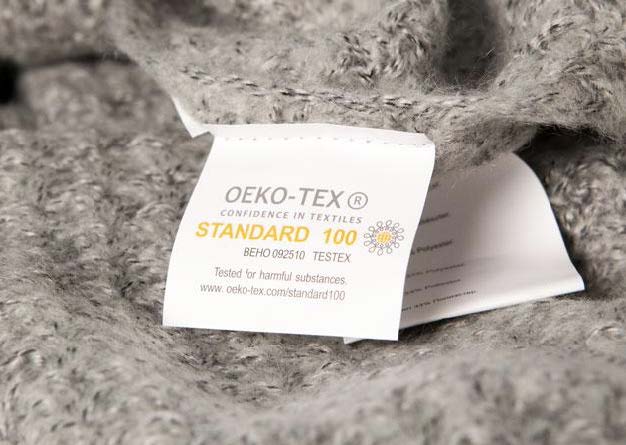
GRS and OEKO-TEX Standard 100 are frequently specified together because they verify different things — and both are often required by major brands:
| Dimension | GRS Certification | OEKO-TEX Standard 100 |
| What it verifies | Recycled content is genuine and traceable from recycling source to product | Fiber/fabric/product is free from harmful chemicals — tested against limit values |
| Scope | Supply chain traceability and social/environmental processing | Chemical safety of the fiber or product itself |
| Testing method | Audit of documentation and processes at each facility | Laboratory testing of the physical product sample |
| Label claim | GRS certified + recycled content % | OEKO-TEX Standard 100 certified — ‘Tested for Harmful Substances’ |
| Class I (babies) | Not applicable (no Class system) | Most stringent limits — for products used by babies under 36 months |
| Class II (skin contact) | Not applicable | Standard limits — for products worn directly against adult skin |
| Renewal | Annual scope certificate renewal; TC per transaction | Annual product certification renewal with lab testing |
| Combined requirement | Required together for premium sustainable fiber claims | GRS alone insufficient for chemical safety; OEKO-TEX alone insufficient for recycled content |
How Brands Use GRS in Product Marketing
GRS certification enables specific, legally defensible marketing claims — but the claim must accurately reflect the actual certified content percentage and the stage of the supply chain covered:
- Correct: ‘Made with GRS-certified recycled polyester fiber‘ — if the fiber used is GRS-certified rPSF and the brand holds GRS certification for the finished product stage
- Correct: ‘Contains 50% GRS-certified recycled polyester’ — if the product is GRS Blended at 50% recycled content with verified TCs
- Incorrect: ‘Made from recycled bottles‘ without GRS certification — this is an unverified claim that creates greenwashing risk and regulatory exposure in markets with strict textile claims regulations (EU, UK, US FTC)
- Incorrect: Claiming GRS certification for a product when only the fiber supplier holds GRS certification — the brand or the product manufacturer must also hold GRS certification for the product-level claim to be valid
The EU Green Claims Directive (expected to apply from 2026) and the UK Green Claims Code already require that environmental claims be specific, accurate, and substantiated with evidence. GRS transaction certificates are the standard evidence that substantiates recycled polyester claims in regulatory compliance contexts.
Conclusion
GRS certification is the infrastructure that makes the recycled polyester market function with integrity — providing the auditable, third-party verified chain of custody that separates genuine recycled content from unverifiable marketing claims. For buyers sourcing rPSF or recycled polyester yarn, understanding GRS means knowing to require both a current Scope Certificate when qualifying a supplier and a Transaction Certificate for every shipment — and knowing the difference between GRS and RCS, between GRS and OEKO-TEX, and between a brand-level GRS claim and a fiber-level one.
VNPOLYFIBER holds GRS chain-of-custody certification covering our full rPSF product range. We issue GRS Transaction Certificates for every shipment of certified recycled fiber and can provide all supporting documentation for our customers’ brand-level GRS certification processes. Contact us for our current GRS scope certificate number and to discuss your certification documentation requirements.