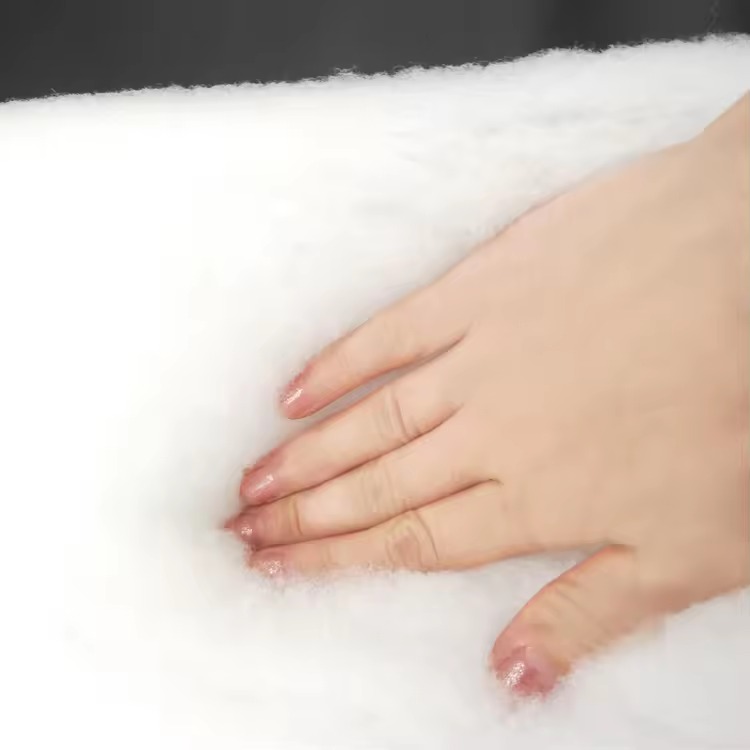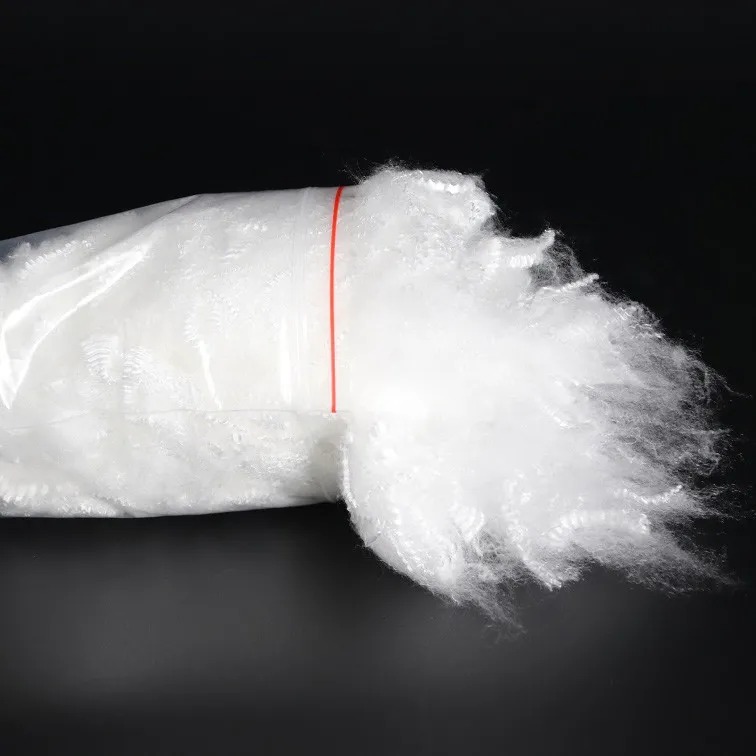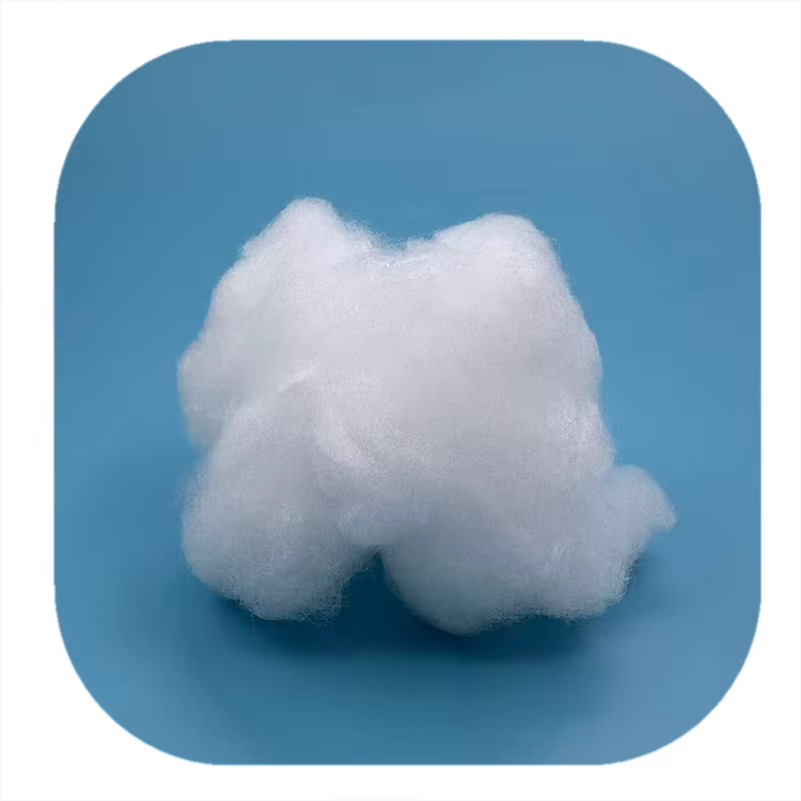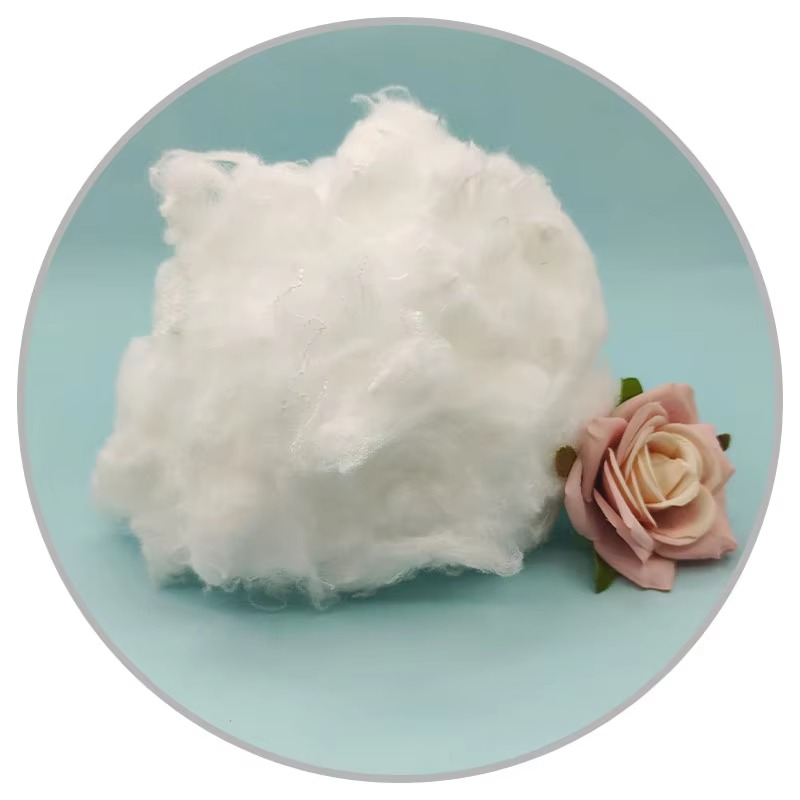
Sleeping Bag Fill Fiber — Lightweight Insulation Polyester for Outdoor Products
- Synthetic fill fiber offers a superior warmth-to-weight ratio while maintaining approximately 75–85% of its insulation performance when wet, providing a critical safety advantage over natural down.
- Additionally, it is a machine-washable and price-accessible alternative that delivers reliable thermal protection at a fraction of the cost of premium down.
PRODUCT DETAIL
Synthetic Fill in Sleeping Bags: The Honest Performance Comparison
Sleeping bag fill fiber is evaluated almost entirely on warmth-to-weight ratio—the amount of warmth delivered per gram of fill weight. Every gram added to achieve a lower temperature rating is a commercial weight budget spent. The specification that reaches the target rating at minimum fill weight is always the winning specification.
- Wet performance—the key advantage over down: Down loses virtually all insulating performance when wet—wet clusters collapse and do not recover until completely dried. A down bag in wet conditions can become dangerously cold. Synthetic fill retains approximately 75–85% of dry insulation performance when wet and dries far faster. For variable-weather camping, this is the primary technical argument for synthetics.
- Machine washable: Sleeping bags with synthetic fill wash in a standard large-capacity household machine. Down requires specialist washing or dry cleaning. For frequent use and convenient maintenance, synthetics are the practical choice.
- Price accessibility: Premium goose down (700–900 fill power) is expensive and price-volatile. Synthetic fill produces weather-appropriate insulation at accessible consumer price points across all market segments.
Fill Weight by Temperature Rating (4D HCS Reference)
- Comfort +15°C (summer): 4D HCS 100–150g/m²
- Comfort +5°C (spring/autumn): 4D HCS 150–220g/m²
- Comfort 0°C (3-season): 4D HCS 220–300g/m²
- Comfort -5°C (winter): 4D HCS 300–380 g/m² or 3D HCS 260–340 g/m²
- Comfort -10°C (winter): 3D HCS 380–480 g/m² or 1.5D microfiber 320–420 g/m²
- Comfort -20°C (expedition): 5D microfiber 450–600 g/m²
Applications
- Consumer retail summer sleeping bag: 6D HCS 120g/m². Lightweight, washable, affordable.
- 3-season camping bag: 4D HCS 250g/m². Core product for camping retailers.
- Winter sleeping bag: 3D HCS 400g/m² or 1.5D microfiber 350g/m².
- Expedition bag: 5D microfiber, 500 g/m²⁺.. Maximum synthetic performance.
- Children’s sleeping bag: 4D HCS OEKO-TEX Class I 200g/m².
- Sustainable outdoor brand: rHCS 4D GRS certified 250g/m². Recycled content brand claim.
- Sleeping bag liner: 4D HCS 80–120g/m². Lightweight inner layer for warmth layering.
EN 13537 / ISO 23537 temperature rating: Sleeping bag temperature ratings are determined by thermal manikin testing of the complete finished sleeping bag construction—shell fabric, fill fiber type and weight, insulation distribution, and hardware—at an accredited laboratory. VNPOLYFIBER provides fill performance guidance. Official EN 13537 ratings must be obtained from an accredited testing laboratory on your finished product.
Frequently Asked Questions
Q: How does 4D HCS compare to 700 fill power down at 0°C?
For 0°C comfort rating: 700 fill power down needs approximately 180–220g/m². 4D HCS needs approximately 220–280g/m². The synthetic bag is 60–100g heavier for a standard mummy bag. But it performs significantly better when wet and dries far faster — advantages that outweigh the modest weight difference for most camping conditions.
Q: What makes microfiber (1.5D) better than standard HCS (4D) at expedition ratings?
At fill weights of 500g/m²+, fiber fineness determines air-trapping efficiency. Finer fibers create more still-air pockets per gram of fill weight. 1.5D microfiber achieves equivalent warmth to 4D HCS at approximately 15–20% lower fill weight—the difference becomes significant at expedition-grade insulation weights.
Q: Can polyester fill sleeping bags achieve the same pack volume as down?
No — polyester does not compress to the same degree as down. A 3-season down bag compresses to approximately 3–5 liters; a synthetic equivalent, to 5–9 liters. This gap narrows with finer denier (1.5D microfiber compresses significantly better than 4D HCS) but does not fully close.
Technical Parameter
Product Specifications
| Grade | Specification | Temperature Rating Reference |
| Summer | 6D×51mm HCS siliconized | 100–150g/m². Comfort +15°C. Lightweight camping. |
| 3-season | 4D×51mm HCS siliconized | 200–300g/m². Comfort 0°C. Core camping retail product. |
| Winter | 3D×51mm HCS siliconized | 350–500g/m². Comfort -10°C. Fine denier essential for warmth efficiency. |
| Expedition | 1.5D×38mm microfiber siliconized | 500g/m²+. Comfort -20°C+. Maximum warmth-to-weight synthetic. |
| Children’s bag | 4D×51mm HCS OEKO-TEX Class I | 200–280g/m². OEKO-TEX Class I mandatory for children’s products. |
| GRS recycled | rHCS 4D or 1.5D rMicrofiber | GRS certified. Same performance. Outdoor brand sustainability credential. |
FAQ
1. What do you offer?
We supply a comprehensive range of fibers, including recycled hollow conjugated (both siliconized and non-siliconized) polyester staple fiber, hollow fiber, microfiber, virgin polyester staple fiber, and low-melt fiber.
2. What is it used for?
Our fibers are versatile and widely utilized across both the filling and non-woven industries, providing essential loft, durability, and texture for various consumer and industrial applications.
3. Are you a factory or a trading company?
We are primarily a manufacturer specializing in polyester staple fiber with years of industry expertise. To better serve our clients, we also operate a dedicated trading division that allows us to act as a one-stop solution provider.
In addition to our own fiber production, we source high-quality textile components (such as yarn and low-melt fibers) and finished goods (including foam, pillows, cushions, toys, and down/feather products) to ensure our customers have access to a comprehensive supply chain.
4. Where is your factory location?
To maintain a robust and flexible global supply chain, our manufacturing facilities are strategically located throughout Asia, specifically in Vietnam, China, Malaysia, Thailand, and Indonesia. If you would like to visit one of our sites, please contact your sales representative, and we will be happy to arrange transportation for you.
5. Can you accept free sample?
Yes, we provide free hand samples for quantities under 1 kilogram. Once a price is confirmed, we can prepare and dispatch your sample within 2–3 business days. Please note that while the sample is free, the freight costs are the responsibility of the client.
6. Can you provide ODM service?
Absolutely. We specialize in ODM (Original Design Manufacturing). This means we can customize the material composition, dimensions, quantity, packaging, and branding to meet your specific requirements. Your logo and unique specifications will be integrated into the final product.
7. How about your quality? What’s the minimum order Quantity (MOQ)?
We invite you to place a trial order to experience our quality firsthand. Our standard MOQ is 23,000 kilograms per order.
Regarding pricing, we maintain a no-bargain policy. We believe in transparency and efficiency, so we provide our most competitive offer upfront to save you time and ensure a straightforward procurement process.
8. Can I mix different items in one order?
Yes, for your convenience, we allow for a maximum of two different items to be mixed within a single container.
9. How can you guarantee the product quality?
Quality is the cornerstone of our business. We employ an experienced QC team that monitors every stage of production, from raw material inspection to the final manufacturing process. We utilize a range of advanced testing instruments to ensure our fibers meet strict industry standards.
Our business philosophy is simple: We aim to serve one customer 1,000 times, rather than 1,000 customers once. We prioritize long-term partnerships built on consistent excellence.
10. What’s the payment terms?
L/C at sight, 30% TT in advance are mostly accepted; other terms shall be negotiable by both sides
For more information, please feel free to contact :
Tony Tan
Mobile number: +84 90 466 5251 (Whatsapp/Wechat/Viber/Signal)