Introduction: Why Fill Material Is the Most Important Decision in Insulation
Whether you are designing a puffer jacket, a premium pillow, a sleeping bag rated for alpine conditions, or an entry-level duvet for the hospitality market — the most consequential decision you will make is your choice of fill material. Everything else — the shell fabric, the baffling design, the stitching — is secondary. The fill is where warmth comes from. It is where weight is determined. It is what your customer will feel every night and wear every winter.
The three fill categories that dominate the global bedding and outdoor gear markets are hollowfibre (hollow fiber polyester), down, and feather. Each has a distinct origin, a distinct physical mechanism for providing warmth, and a distinct set of strengths and weaknesses. Understanding these differences properly is what separates product developers and buyers who consistently make excellent fill decisions from those who rely on habit or price alone.
This guide covers everything you need to know.
Part 1: Hollowfibre — The Engineered Insulator
What Is Hollowfibre?
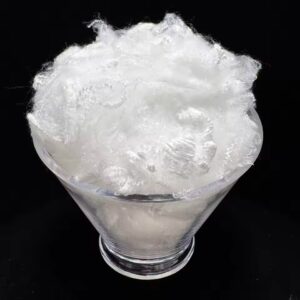
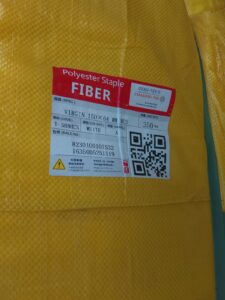
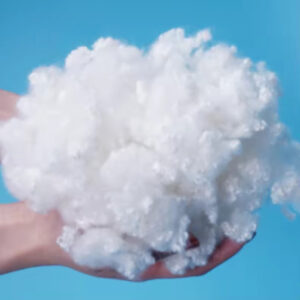
Hollowfibre — also written as hollow fiber, hollow fibre, or hollow fill — is a synthetic insulation material made from polyester staple fiber engineered with one or more continuous air channels running through the length of each filament. These air channels are the key engineering innovation: they reduce the fiber’s weight while adding a permanent insulating air core to every individual filament.
Synthetic down is a type of engineered insulation aimed at mimicking natural down. It’s usually made with polyester and constructed so that the faux fibers branch out in different directions, offering varying sizes and shapes. Like natural down, it keeps you warm by trapping air next to your body and preventing heat from escaping.
Hollowfibre is derived from polyethylene terephthalate (PET) — the same polymer used in plastic bottles — which is melted and extruded through precision spinnerets. The hollow cross-section is created by carefully controlling the spinneret geometry and air pressure during extrusion. After spinning, the fibers are crimped, cut to staple length, and finished with a silicone coating that gives them their characteristic soft, smooth feel.
There are broadly two categories when it comes to synthetic fill products: block insulation, which is essentially a sheet of wadded synthetic fibres used in most sleeping bags and jackets; and loose fills, which are silky tufts of synthetic fibres closer in characteristics to natural down. The latter can be blown into baffles just like down, resulting in synthetic jackets that look and feel a lot like a conventional down jacket. Broadly, however, these are all made from hollowfibre polyester.
Types of Hollowfibre
The hollowfibre category is not monolithic. Different constructions serve different applications:
Standard Hollow Conjugated Siliconized Fiber (HCS) The most widely used hollowfibre for bedding fill. The conjugated structure introduces a spiral, spring-like crimp that gives the fiber its resilience and loft recovery. Siliconization provides the smooth, slick surface that prevents tangling and enables even fill distribution. Used in the vast majority of pillows, comforters, duvets, and cushion fill globally.
Hollow Microfiber Ultra-fine hollowfibre (typically 0.9D–1.2D) that combines the insulating air core of hollow fiber with the exceptional softness of microfiber. The closest synthetic material to natural down in terms of hand feel and loft-to-weight ratio. Used in premium bedding and down-alternative outerwear.
Branded Synthetic Insulations The outdoor gear industry has developed numerous proprietary hollowfibre technologies under branded names. Polarguard® Delta is constructed of hollow-core continuous filaments that are lighter, more durable and more thermally efficient. Quallofil® high-loft polyester insulation has a soft, down-like feel. MicroLoft® is a polyester insulation made of fibers thinner than a human hair — the dense structure traps heat more efficiently than most basic synthetics of equal thickness. These branded synthetics are essentially refined hollowfibre products with specific engineering treatments for outdoor performance applications.
Key Properties of Hollowfibre
Warmth When Wet — Hollowfibre’s Decisive Advantage
This is the single biggest performance advantage of hollowfibre over natural down, and it is not a small difference. Typically made of polyester, synthetic fill is quick-drying and insulates even if wet — something down struggles to do. Because polyester does not absorb water, hollowfibre maintains its loft and insulating air pockets even when saturated — a critical advantage in rain, snow, high humidity, and perspiration-heavy environments.
Hypoallergenic
Hollowfibre contains no animal proteins, feather quills, or organic material that can trigger allergic reactions or harbor dust mites. For allergy sufferers and for hospitality, healthcare, and children’s product applications, this is a significant commercial advantage.
Easy Care
Hollowfibre products are fully machine washable and tumble-dryable without risk of damage or loss of loft. Natural down products, by contrast, typically require specialist cleaning, long dry times, and careful handling. For both consumers and institutional buyers (hotels, hospitals), the care convenience of hollowfibre is a major practical benefit.
Cost-Effectiveness
Hollowfibre is significantly less expensive than natural down. Synthetic fill tends to be less expensive than down insulation. The price is also more stable — hollowfibre is manufactured from PET polymer with predictable raw material costs, while natural down pricing fluctuates with livestock availability, seasonal harvests, and ethical sourcing requirements.
Limitations of Hollowfibre
Despite its advantages, hollowfibre has real limitations that honest product developers should acknowledge. Its warmth-to-weight ratio — the key metric in outdoor gear — does not match premium natural down at the highest end. As an insulator, down remains the clear winner in terms of warmth-to-weight ratios. And over time with repeated compression, hollowfibre loses some loft that it never fully regains — a durability limitation compared to high-quality down, which can maintain its loft for decades when properly cared for.
Part 2: Down — Nature’s Most Efficient Insulator
What Is Down?
A widespread misconception deserves correction immediately: down is not feathers. They come from the same birds — primarily geese and ducks — but they are completely different materials with very different properties.
Natural down is the layer underneath the feathers of waterfowl like geese and ducks, where its main purpose is to keep the birds warm. Unlike regular feathers, which have long, poky quills in the middle, down is usually ultra-soft and fluffy with fibers that fan out in all directions.
Down clusters are lightweight and airy, making them highly efficient at providing warmth by forming tiny air pockets that trap and retain body heat. This makes down a popular choice for bedding like duvets, as well as in winter jackets and outdoor gear like sleeping bags.
Each down cluster is a three-dimensional structure — thousands of ultra-fine filaments radiating from a central point, like a tiny three-dimensional starburst. In every ounce of down, some two million filaments criss-cross in all directions, creating air pockets that trap the bird’s body heat for warmth. This structure is what gives down its extraordinary warmth-to-weight efficiency — no synthetic material has yet replicated it completely.
Understanding Fill Power: The Key Quality Metric for Down
Fill power (FP) is the most important specification number you will encounter when buying or specifying down. It is not optional — it is the primary determinant of quality and warmth-to-weight performance.
Down fill power measures the loft and insulation efficiency of down. It indicates how many cubic inches one ounce of down can fill. Higher fill power, like 800 or 900, traps more air and provides better warmth with less weight, making it a top choice for cold-weather outdoor gear.
In practical terms: a sleeping bag filled with 800 FP down will be lighter than an equivalently warm bag filled with 600 FP down, because the higher fill power down traps more air per ounce — meaning less of it is needed to achieve the same warmth level.
Fill power ranges typically used in commercial products:
Fill Power | Grade | Typical Application |
300–450 FP | Economy | Budget bedding, entry-level pillows |
500–600 FP | Standard | Mid-market bedding, standard outerwear |
650–750 FP | Premium | Premium bedding, quality outdoor gear |
800–900 FP | Superior | Performance outerwear, luxury bedding |
900+ FP | Ultra-premium | Elite outdoor gear, luxury hotel bedding |
If you are in the market for a quilt, sleeping bag, or jacket, anything lower than 850 FP is not going to offer the consistent fluffy warmth that you rely on in the backcountry. Once you go below 850 FP you start to see more quills and broken feathers in the down fill.
Fill Weight: The Other Number That Matters
Fill power measures quality — how efficiently the down insulates per ounce. Fill weight measures quantity — how many ounces of down are actually in the product. Both numbers are needed to understand warmth.
Fill power rates quality, and fill weight signals quantity. While many outerwear brands proudly draw attention to their high fill power, they often fail to mention the fill weight. This is extremely important, as down weight also plays an equal part in determining the product’s warmth. The fill weight is what determines how soft or firm a product is. It is also what determines how well the product compresses.
A jacket with 800 FP down but only 2 oz of fill will be less warm than a jacket with 650 FP down and 6 oz of fill. When evaluating down products, always look for both numbers.
Goose Down vs. Duck Down
Both goose and duck down work on the same physical principle, but they are not equivalent in performance. The key differences come down to cluster size — and cluster size is what determines fill power.
The main difference between duck down and goose down is the size and fill power of clusters. Geese generally have warmer down clusters with higher fill power as compared to ducks. This is because geese are larger than ducks and their down clusters are generally bigger. Also, the cold environments that geese reside in demand that their down clusters be large and fluffy.
Goose Down:
- Larger clusters (typically 25mm diameter in premium grades)
- Higher achievable fill power (up to 900–1,000 FP)
- Softer and less prone to odor (geese are herbivores)
- More expensive — geese are less abundant than ducks
- The standard for premium outdoor gear and luxury bedding
Duck Down:
- Smaller clusters (typically 18mm diameter)
- Lower achievable fill power (typically 300–700 FP)
- Slightly more prone to odor if not thoroughly cleaned (ducks are omnivores)
- More abundant and cost-effective — more ducks are raised for food globally
- Excellent for mid-market bedding and budget outdoor gear
Both types of down insulate equally well and share essentially the same structure that makes down such an astonishingly good insulator. Both types maintain their loft and warmth for many years, if not decades, when properly cared for.
The practical implication: for applications where ultralight warmth and maximum compressibility are priorities — high-performance outdoor gear, premium sleeping bags, luxury hotel bedding — goose down at 750+ FP is the specification. For mid-market bedding, general-purpose duvets, and cost-sensitive applications, quality duck down at 500–650 FP delivers excellent value.
Down’s Limitations
For all its performance advantages, down has real weaknesses that explain why hollowfibre has taken such a significant market share:
The most common criticism of down insulation is its tendency to clump up and lose loft when it gets wet, thereby losing its insulation properties. When down absorbs moisture, its clusters collapse, the air pockets disappear, and the insulation is lost — exactly when you need it most in cold, wet conditions. Treated (DWR-coated) down improves this, but does not eliminate it.
Down also requires careful cleaning — specialist washing or professional cleaning is recommended to preserve cluster structure and loft. It cannot simply be thrown in a standard washing machine and dryer without risk. For institutional buyers who launder bedding at industrial frequency, this is a significant operational constraint.
Finally, ethical sourcing is a genuine concern that is increasingly affecting purchasing decisions. Live plucking — harvesting down from living birds — is a practice that consumer and retailer pressure is working to eliminate. The Responsible Down Standard (RDS) is the most widely recognized third-party certification ensuring that down is sourced only as a byproduct of the food industry, from birds that are not live-plucked.
Part 3: Feather — Support, Not Insulation
What Is Feather and How Does It Differ from Down?
Feather is the outer protective covering of ducks and geese — the firm, quill-bearing structure that gives birds their aerodynamic shape and waterproofing. Because the feathers are on the outside, they are what allows the goose or duck to float, fly, and stay dry. They are much more firm and have quills that act almost as a stem.
This structural difference is critical: feathers have a rigid central quill that gives them shape and stiffness. Down has no quill — it is pure soft filament. This means feather provides physical support and firmness in a fill product, while down provides warmth and loft. They do different jobs.
A comforter filled with feather would feel quite heavy and wouldn’t offer the same insulation as down. Ounce per ounce, down is the most efficient insulator for bedding products. It is not only lighter weight, but also has the unique ability to “breathe,” allowing excess heat and humidity to escape and allowing you to reach an ideal temperature.
The Down-to-Feather Ratio
Most commercial down products are not filled with 100% down — they contain a blend of down and feathers. The down to feather ratio calculates the percentage of down to the percentage of feathers in the product. The numbers are generally 70/30, 80/20, or 90/10. The first number represents the percentage of down, and the second number represents the percentage of feathers. Generally speaking, a higher first number means a higher quality and more expensive product. While down costs more, it is a much better insulator than feathers.
For buyers evaluating down products, the down-to-feather ratio is as important as fill power:
Ratio (Down:Feather) | Grade | Characteristics |
70:30 | Economy | Heavier, less lofty, lower cost |
80:20 | Standard | Good balance of warmth and cost |
90:10 | Premium | Excellent warmth, lightweight, higher cost |
95:5 | Superior | Near-pure down performance |
100:0 | Luxury | Maximum loft, highest cost |
When to Specify Feather
Pure feather fill — typically goose or duck feather without down — is used in specific applications where firmness and physical support are the priority over warmth. Feather pillows are the primary example: a high feather-content pillow can be molded and shaped to support the neck in a way that a down-filled or hollowfibre-filled pillow cannot. Some consumers specifically seek this moldable firmness.
However, the quills in feather fill can poke through pillow shells and garment fabrics over time — a common consumer complaint with low-quality feather products. This is why higher-quality feather products use tightly woven down-proof shells and processed feather with quills trimmed or curled.
Part 4: Side-by-Side Comparison
Hollowfibre vs. Down vs. Feather: The Complete Performance Matrix
Factor | Hollowfibre | Goose Down | Duck Down | Feather |
Warmth-to-weight ratio | Good | Excellent | Very good | Poor |
Insulation when wet | Excellent | Poor (unless treated) | Poor | Poor |
Compressibility | Good | Excellent | Very good | Poor |
Loft and volume | Good | Excellent | Very good | Moderate |
Softness / hand feel | Very good | Excellent | Excellent | Moderate |
Support / firmness | Low | Low | Low | High |
Durability | 3–7 years | 10–20+ years | 10–15 years | 5–10 years |
Washability | Excellent | Difficult | Difficult | Moderate |
Hypoallergenic | Yes | Requires treatment | Requires treatment | No |
Ethical concerns | None | Yes (sourcing) | Yes (sourcing) | Yes (sourcing) |
Sustainability option | Recycled rPET | RDS certified | RDS certified | RDS certified |
Price | Low–Moderate | High | Moderate | Low–Moderate |
Best application | Budget–premium bedding, all-weather outdoor gear | Luxury bedding, premium outdoor | Mid-market bedding, general outdoor | Pillows, featherbeds |
Part 5: Choosing the Right Fill — A Practical Framework
For Bedding Manufacturers
Budget / mass-market pillows and comforters: Hollowfibre (HCS) is the default. It delivers the required loft, warmth, and softness at a cost that makes the product commercially viable for mass retail.
Mid-market to premium bedding: Consider hollow microfiber or a blend of hollow microfiber and HCS for a genuinely down-like hand feel at a fraction of the cost of natural down. For brands targeting the premium natural segment, duck down at 500–650 FP with an 80/20 ratio offers excellent value.
Luxury bedding: White goose down at 750+ FP with a 90/10 or 95/5 ratio is the clear specification. Nothing else delivers the same warmth-to-weight ratio and loft.
Allergy-sensitive or healthcare markets: Hollowfibre exclusively. Its hypoallergenic properties and machine-washability make it the only practical choice for these segments.
For Outdoor Gear Manufacturers
Wet-weather environments (rain, snow, high humidity): Hollowfibre is the superior choice. Continuous-filament insulations use a thicker continuous filament that is lofty, strong and durable. They tend to have a stiffer feel and are less compressible than short-staple insulations, but they stay in place and are less likely to create cold spots. They are very water-resistant and continue to insulate even when wet.
Dry, cold-weather high-performance applications: Premium goose down (800+ FP) remains unmatched for warmth-to-weight and compressibility in dry alpine conditions.
Hybrid approach: Some manufacturers make sleeping bags and jackets with a combination of water-resistant down and synthetic insulation. This hybrid construction provides the benefits of both materials while limiting each material’s imperfections. In some cases, the two types of insulations are blended together throughout the sleeping bag. This is increasingly common in technical outdoor gear.
Budget / entry-level outdoor gear: Quality hollowfibre at the right fill weight delivers reliable warmth and durability at a price point that makes sense for mass-market outdoor products.
Part 6: Sustainability — Where the Industry Is Heading
Both hollowfibre and natural down are adapting to the sustainability demands of consumers and retail buyers.
Recycled Hollowfibre (rPET)
Hollowfibre can be produced from recycled PET (rPET) — primarily from post-consumer plastic bottles. A standard 500ml PET bottle yields enough rPET fiber to fill approximately one small pillow. Recycled hollowfibre carries a GRS (Global Recycled Standard) certification and supports brands’ ESG commitments without any compromise on performance compared to virgin fiber.
Synthetic jackets can be made more sustainably by using recycled polyester fibers in the manufacturing process. Many insulation brands offer a range of different blends, from 100% recycled down to 25% recycled.
Responsible Down Standard (RDS) for Natural Down
For brands and manufacturers committed to natural down, the Responsible Down Standard is the credible, globally recognized certification that ensures down is sourced ethically — only as a byproduct of the food industry, with no live plucking. REI has adopted the Responsible Down Standard (RDS) for 100% of REI Co-op brand products with virgin down and feathers. Many other leading outdoor brands have also adopted the RDS standard.
For manufacturers sourcing natural down, RDS certification is increasingly required by major retailers in North America and Europe. It is not optional for brands targeting these markets.
VNPolyfiber: Your Source for Premium Hollowfibre and Related Products
VNPolyfiber supplies a comprehensive range of hollow polyester fiber products for bedding manufacturers, outdoor gear brands, and home textile producers:
Hollow Conjugated Siliconized Fiber (HCS) The workhorse of the bedding fill industry. Available in 6D–15D, 32mm–76mm cut lengths, virgin and recycled (rPET) grades, siliconized and non-siliconized finishes.
Hollow Microfiber Ultra-fine hollow polyester staple fiber (0.9D–1.2D) for premium down-alternative applications. The closest synthetic fill to natural down in terms of softness, loft, and hand feel.
Hollow Antimicrobial Polyester Fiber Permanently antibacterial hollowfibre for healthcare, hospitality, and premium bedding applications. SGS certified against E. coli and S. aureus.
Hollow Slick Fiber Smooth-finish hollowfibre for applications requiring enhanced flowability in filling machines and silky surface texture in the finished product.
We also supply natural down and feather through our partner network — enabling customers who supply both synthetic and natural fill products to source from a single reliable partner.
Product | Denier Range | Applications |
Standard HCS Hollowfibre | 6D–15D | Pillows, comforters, duvets, cushions, toys |
Hollow Microfiber | 0.9D–1.2D | Premium bedding fill, outerwear, down alternative |
Hollow Antimicrobial | 6D–15D | Healthcare bedding, hospitality, children’s products |
Hollow Slick | 6D–15D | High-end fill products, premium pillows |
👉 Request a Quote | View All Products | Contact Our Team
Frequently Asked Questions
Is hollowfibre as warm as down? For most practical bedding applications, good quality hollowfibre at the right fill weight delivers comparable warmth to mid-grade down (400–600 FP). For extreme performance — ultralight outdoor gear, very cold conditions — premium goose down (800+ FP) still delivers a warmth-to-weight ratio that hollowfibre cannot match at equivalent weights.
What is the difference between hollow fiber and down? Down is a natural material from geese or ducks, consisting of three-dimensional clusters of ultra-fine filaments that trap air. Hollowfibre is a synthetic polyester material engineered with an air channel inside each filament to trap insulating air. Down has a better warmth-to-weight ratio and compressibility; hollowfibre performs better when wet, is hypoallergenic, machine-washable, and more affordable.
What is fill power and why does it matter? Fill power indicates how many cubic inches one ounce of down can fill. Higher fill power traps more air and provides better warmth with less weight, making it a top choice for cold-weather outdoor gear. A higher fill power means a lighter product for the same warmth level — critical in outdoor gear where weight matters.
Is goose down better than duck down? Both types of down insulate equally well and share essentially the same structure. The biggest difference only comes into play when you start looking at fill power. Goose down can achieve higher fill powers due to larger clusters, making it the choice for premium applications. Duck down offers excellent performance at lower cost for mid-market products.
What is the difference between down and feather in a duvet? Down provides warmth and loft; feather provides weight and firmness. A high down ratio (90/10 or 95/5) means a lighter, warmer, loftier product. A higher feather ratio means a heavier, firmer product at a lower cost. Always check the down-to-feather ratio alongside fill power when evaluating natural fill duvets.
Can hollowfibre be recycled? Yes. Hollowfibre produced from rPET (recycled polyester) is available, certified to the Global Recycled Standard (GRS). VNPolyfiber supplies both virgin and recycled hollow polyester fiber to support brands’ sustainability commitments.
Conclusion
Hollowfibre, down, and feather each occupy a distinct and important role in the global insulation market. They are not competing for the same applications — they are complementary materials, each superior for specific combinations of performance requirements, price points, and end-use environments.
Hollowfibre is the versatile, practical, sustainable choice for the vast majority of bedding and mainstream outdoor gear applications. Its moisture resistance, hypoallergenic properties, ease of care, and cost predictability make it the foundation of the modern home textile industry.
Down — particularly premium goose down at high fill powers — remains the gold standard for warmth-to-weight performance and luxury feel. For brands targeting the premium end of bedding and outdoor gear, it is irreplaceable.
Feather plays a supporting role — literally — providing physical support and firmness in blended products where that quality is valued by consumers.
Understanding which material belongs in which product is the foundation of good fill specification. And having a reliable supply partner for all three is what makes that understanding commercially actionable.
Contact us to discuss your hollowfibre, down, or feather requirements — samples, pricing, and technical support available.
Related: Hollow Conjugated Fiber HCS | Microfiber — Down-Like Fiber | Down, Microfiber Fill and Cluster Fiber Fill | All Products