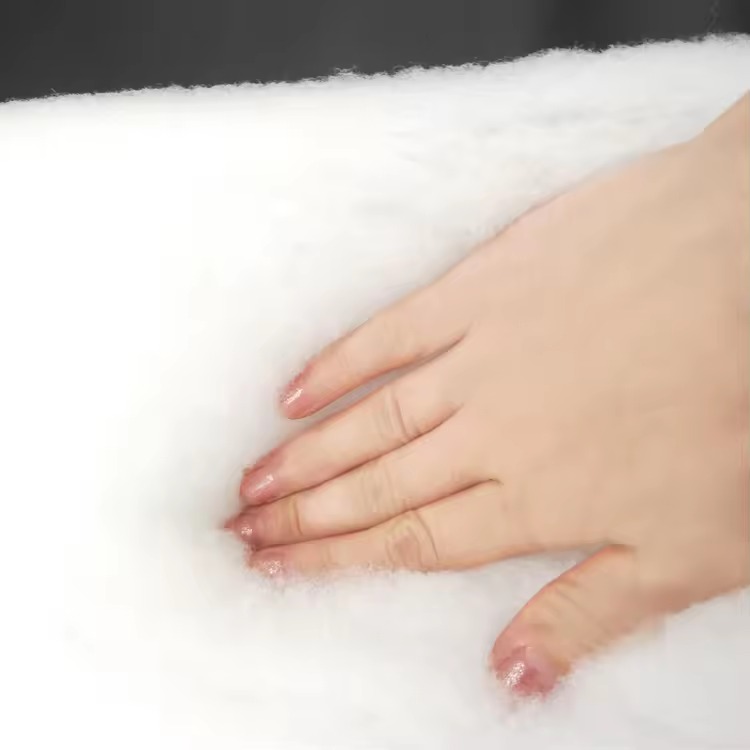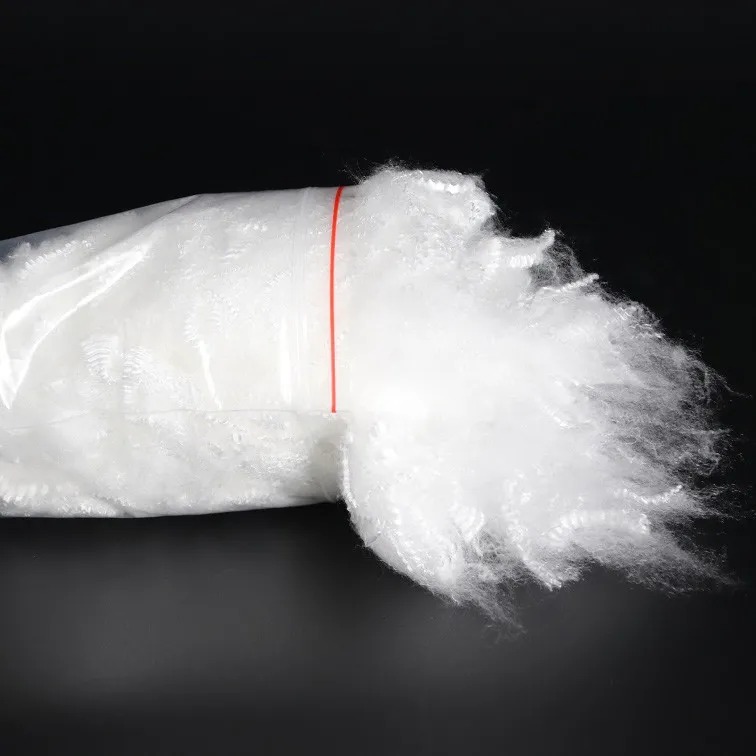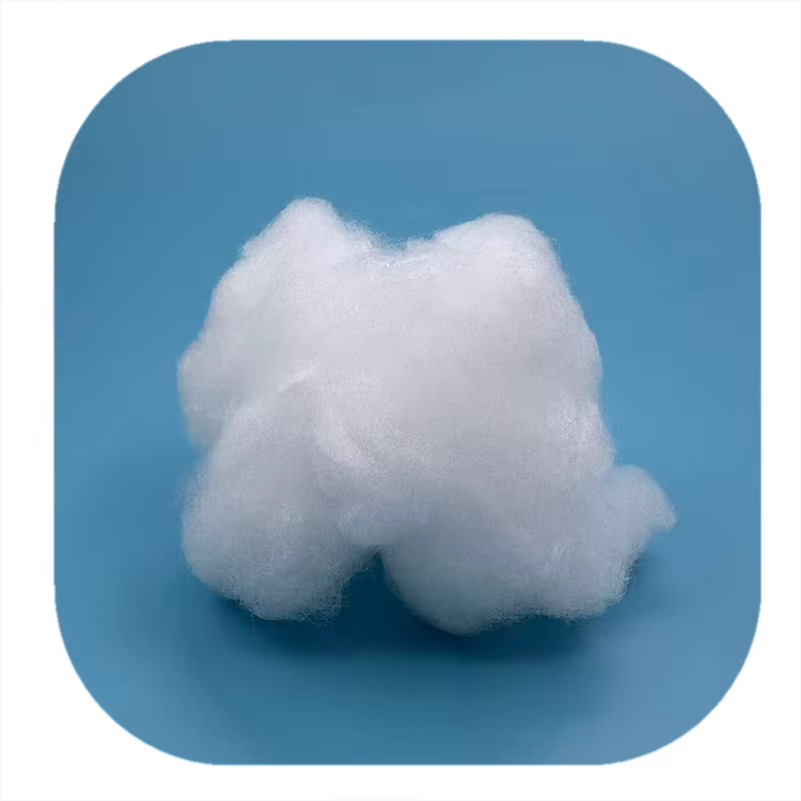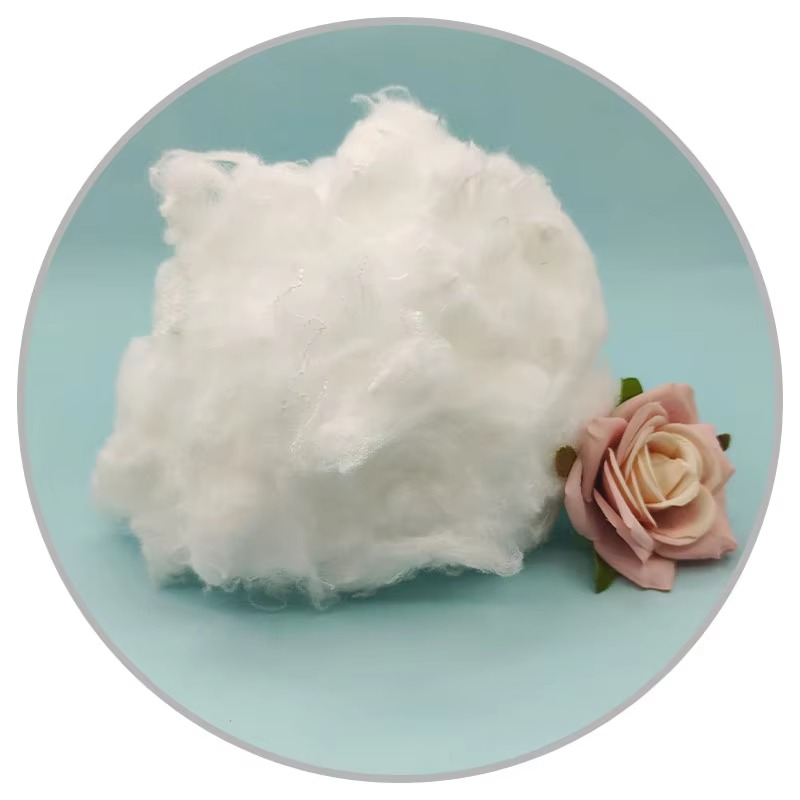
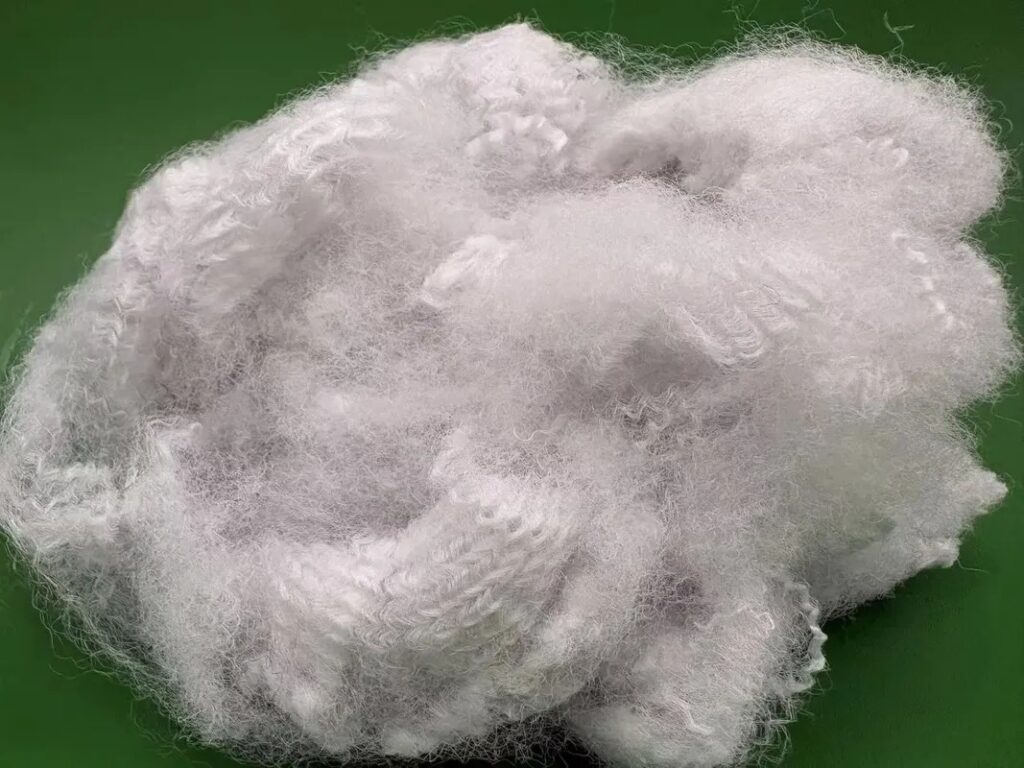
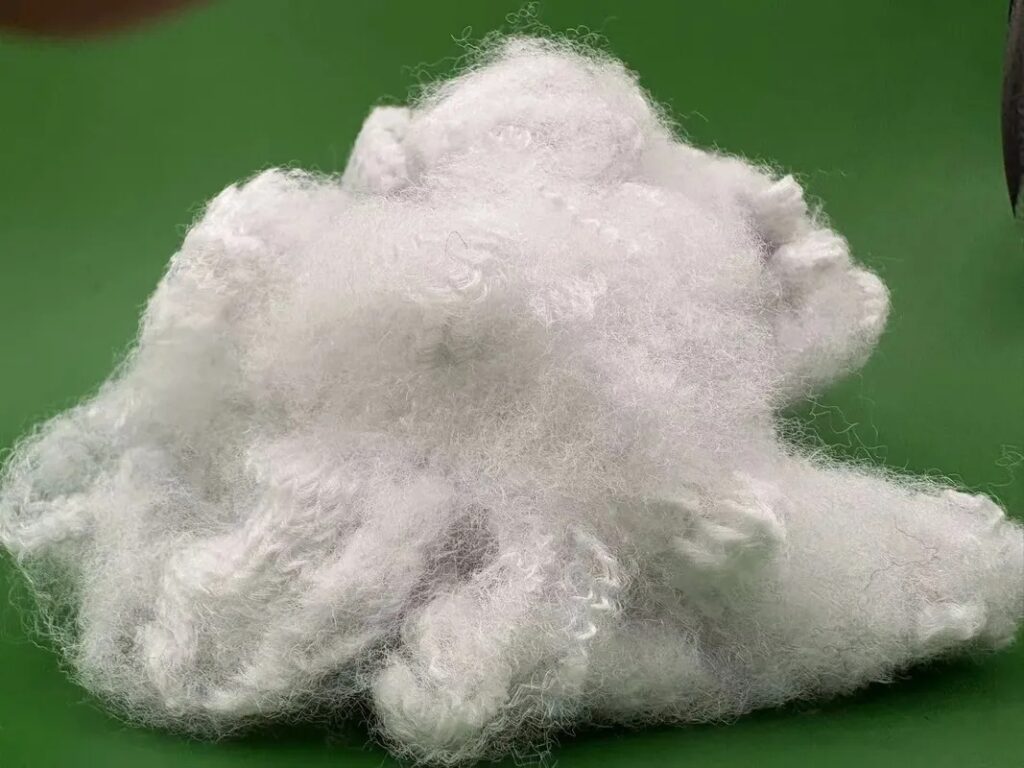
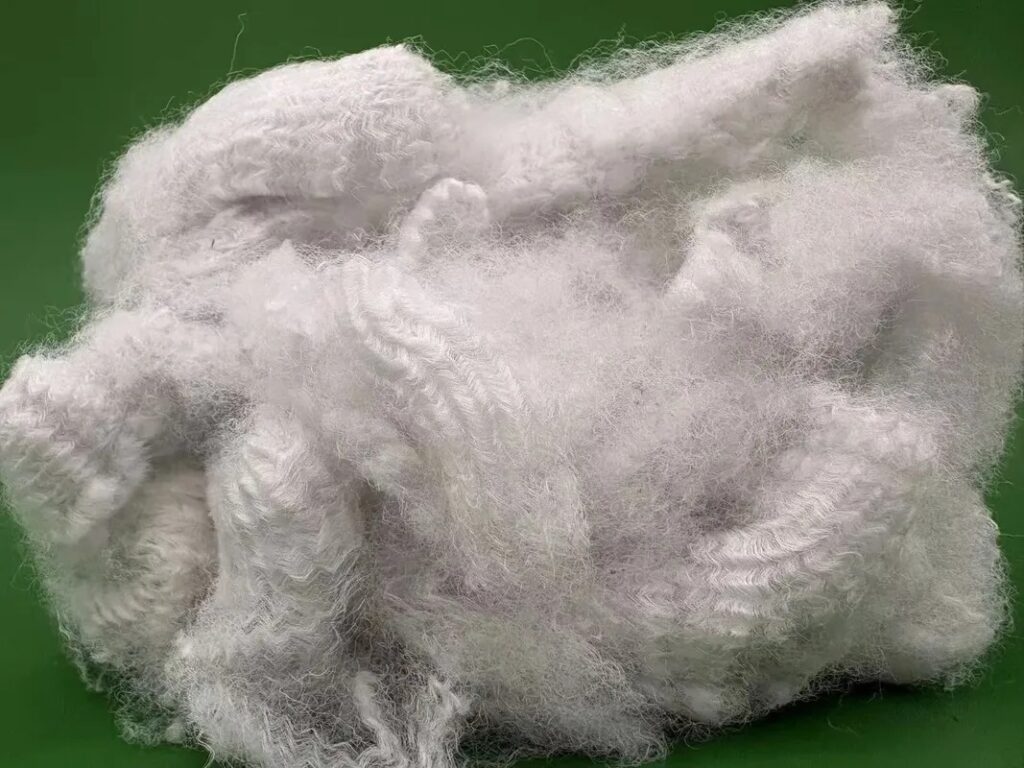
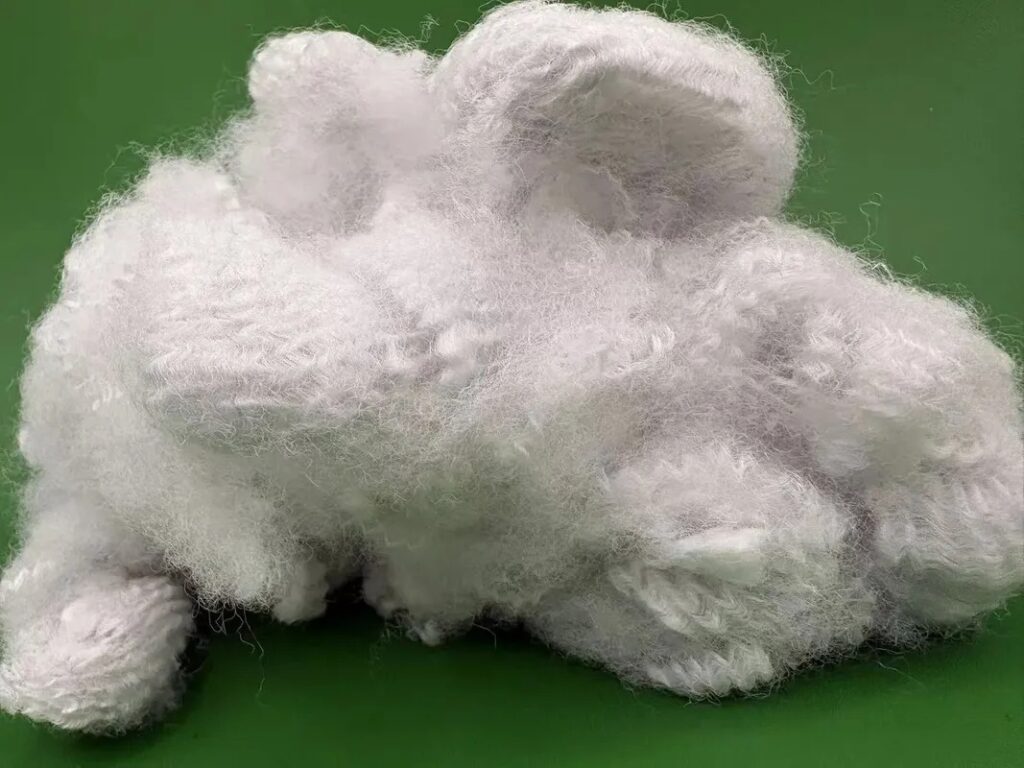
Geotextile Fiber — UV-Stabilized Solid PSF for Needlepunch Geotextile Production
PRODUCT DETAIL
Geotextile Fiber — UV-Stabilized Solid PSF for Needlepunch Geotextile Production
Why PSF Specification Determines Geotextile Performance
Needle-punched polyester geotextile is one of the world’s largest-volume technical textile applications—installed beneath roads, railways, embankments, retaining walls, drainage channels, and landfill systems globally to separate, filter, drain, protect, or reinforce soil and aggregate layers. The geotextile’s performance over a 20–50-year underground service life is determined primarily by the quality of the polyester staple fiber used in its production.
- UV stability for installation exposure: Geotextiles are frequently exposed to sunlight during phased installation—days or weeks between fabric placement and aggregate covering. Unstabilized polyester degrades rapidly under UV exposure: tensile strength can fall 30–50% within 500 hours. UV-stabilized PSF (HALS—hindered amine light stabilizer—compounded into the polymer melt) retains 70%+ tensile strength after 500 hours of Xenon arc exposure—the standard specification for any geotextile with outdoor installation exposure.
- Tenacity drives structural performance: Tensile strength in the finished geotextile is a direct function of fiber tenacity. Higher tenacity fiber produces stronger geotextile at an equivalent basis weight—or allows lighter-weight fabric to meet the same tensile specification, reducing material cost per square meter installed. VNPOLYFIBER supplies standard (4.5–5.5 cN/dtex) and high-tenacity (6.0–7.0 cN/dtex) grades.
- Consistent staple length for uniform needling: Variable staple length causes uneven fiber distribution in the carded web, translating to basis weight variation and strength variation in the finished geotextile. VNPOLYFIBER’s staple length tolerance is ±3 mm of nominal—the consistency required for repeatable production.
PET vs PP Geotextile Fiber Selection Guide
- Choose PET when soil pH is 5–9 (neutral to mildly acidic or alkaline). Higher tensile strength requirement. Inherently better UV stability. Standard road, drainage, and erosion control applications.
- Choose PP when soil pH is below 5 (strongly acidic—mine tailings, peat soils) or above 11 (lime-stabilized, concrete waste, alkaline industrial sites). PP resists both strong acid and strong alkali environments where PET can experience long-term hydrolytic degradation.
- Choose high-tenacity PET when tensile specification requires strength achievable only at very high gsm with standard fiber. HT fiber achieves equivalent strength at 20–25% lower basis weight—reducing material cost per square meter while meeting the EN specification.
EN Standard Reference by Application
- EN 13249: Roads and traffic areas — the most commonly specified geotextile standard.
- EN 13250: Railways—for ballast separation geotextile under railway track.
- EN 13251: Earthworks, foundations and retaining structures.
- EN 13252: Drainage systems — for filtration and in-plane water transmission.
- EN 13253: Erosion control works — slope erosion and coastal protection.
- EN 13254: Reservoirs and dams — protection and drainage.
Applications
- Road and highway subbase stabilization: EN 13249. 6D PET UV-stabilized 150–400 gsm. Separation and filtration function.
- Slope erosion control and revegetation: 8D–10D PET UV-stabilized 200–400 gsm. Drainage and erosion resistance.
- Retaining wall drainage composite: 10D PET 300–500 gsm. EN 13251. Combined with drainage core.
- Landfill liner system protection: 12D–17D PET 500–800 gsm. EN 13254. Protection layer over geomembrane.
- Railway trackbed separation: 6D–10D PET UV-stabilized. EN 13250. High dynamic loading resistance.
- Geosynthetic clay liner (GCL) carrier: 10D PET needlepunched. Carrier for bentonite GCL composite. EN 14196.
- Agricultural drainage: 6D PET or PP 150–250 gsm. Filter over perforated drainage pipe.
UV stabilization testing: VNPOLYFIBER UV-stabilized grades are formulated to retain a minimum of 70% of initial tensile strength after 500 hours of Xenon arc exposure at 0.5 W/m² irradiance (EN ISO 12224). For extended UV exposure requirements—slope erosion control applications left uncovered for months—specify 1,000-hour Xenon arc retention data. Test reports available per grade on request.
Frequently Asked Questions
Q: What staple length should I specify for geotextile PSF?
64–76 mm staple length for standard geotextile needlepunch production—longer staple provides better fiber entanglement in needle looms, producing higher MD/CD tensile strength for equivalent needle density. A 51 mm staple is acceptable for lighter-weight geotextile (100–200 gsm) on higher-speed carding lines where shorter staples process faster. Specify to match your production line’s carding and needling configuration.
Q: Can I use GRS recycled PSF for geotextile production?
GRS-certified recycled solid PSF is suitable for geotextile applications where the end-user specification permits recycled content. For structural geotextiles with demanding tensile specifications (EN 13249 high-strength classes), virgin high-tenacity PSF is typically specified due to more consistent IV and tenacity. For medium-duty separation geotextiles with broader specification tolerance, recycled PSF is viable and allows cost savings with a sustainability certification.
Q: Do I need to test my finished geotextile in addition to fiber certifications?
Yes. Fiber certifications confirm the input quality. The finished geotextile must be tested to EN 29073-3 (tensile strength and elongation), EN ISO 9073-2 (thickness), EN ISO 11058 (water permeability), and EN ISO 12956 (characteristic opening size) to verify EN 13249 or applicable standard compliance at an accredited testing laboratory.
Q: PET or PP for soil with pH 4 (mine tailings)?
PP is the correct specification. Below pH 5, PET can experience hydrolytic degradation that reduces tensile strength over the 20–50-year design life. PP resists both strong acid and strong alkali—it is the standard specification for mine tailings, peat soils, and other strongly acidic environments where PET’s long-term stability cannot be guaranteed.
Internal links to add:
Needlepunch Nonwoven Guide | Needlepunch Production Line | PSF Manufacturing Guide | High-Tenacity PSF Product
Technical Parameter
Product Specifications
| Grade | Specification | Application and EN Standard |
| Light geotextile | PET 4D–6D×51–64mm, UV-stabilized | 100–200 gsm. Road separation and light filtration. EN 13249 standard class. |
| Standard geotextile | PET 6D–10D×64–76mm, UV-stabilized | 200–400 gsm. Highway, drainage, erosion control. Most common specification. |
| Heavy geotextile | PET 10D–17D×64–76mm, UV-stabilized | 400–800 gsm. Retaining walls, landfill, railway. EN 13251/EN 13250. |
| High-tenacity (HT) grade | PET 6D×64mm, UV-stabilized, 6.0–7.0 cN/dtex | Higher strength per gsm. Cost-efficient for demanding tensile specifications. |
| Chemical-resistant grade | PP 6D–12D×64–76mm, UV-stabilized | Acidic or alkaline soil environments where PET hydrolysis risk exists. |
| GCL carrier fabric | PET 10D×76mm, UV-stabilized | Geosynthetic clay liner needlepunched carrier with bentonite. EN 14196. |
FAQ
1. What do you offer?
We supply a comprehensive range of fibers, including recycled hollow conjugated (both siliconized and non-siliconized) polyester staple fiber, hollow fiber, microfiber, virgin polyester staple fiber, and low-melt fiber.
2. What is it used for?
Our fibers are versatile and widely utilized across both the filling and non-woven industries, providing essential loft, durability, and texture for various consumer and industrial applications.
3. Are you a factory or a trading company?
We are primarily a manufacturer specializing in polyester staple fiber with years of industry expertise. To better serve our clients, we also operate a dedicated trading division that allows us to act as a one-stop solution provider.
In addition to our own fiber production, we source high-quality textile components (such as yarn and low-melt fibers) and finished goods (including foam, pillows, cushions, toys, and down/feather products) to ensure our customers have access to a comprehensive supply chain.
4. Where is your factory location?
To maintain a robust and flexible global supply chain, our manufacturing facilities are strategically located throughout Asia, specifically in Vietnam, China, Malaysia, Thailand, and Indonesia. If you would like to visit one of our sites, please contact your sales representative, and we will be happy to arrange transportation for you.
5. Can you accept free sample?
Yes, we provide free hand samples for quantities under 1 kilogram. Once a price is confirmed, we can prepare and dispatch your sample within 2–3 business days. Please note that while the sample is free, the freight costs are the responsibility of the client.
6. Can you provide ODM service?
Absolutely. We specialize in ODM (Original Design Manufacturing). This means we can customize the material composition, dimensions, quantity, packaging, and branding to meet your specific requirements. Your logo and unique specifications will be integrated into the final product.
7. How about your quality? What’s the minimum order Quantity (MOQ)?
We invite you to place a trial order to experience our quality firsthand. Our standard MOQ is 23,000 kilograms per order.
Regarding pricing, we maintain a no-bargain policy. We believe in transparency and efficiency, so we provide our most competitive offer upfront to save you time and ensure a straightforward procurement process.
8. Can I mix different items in one order?
Yes, for your convenience, we allow for a maximum of two different items to be mixed within a single container.
9. How can you guarantee the product quality?
Quality is the cornerstone of our business. We employ an experienced QC team that monitors every stage of production, from raw material inspection to the final manufacturing process. We utilize a range of advanced testing instruments to ensure our fibers meet strict industry standards.
Our business philosophy is simple: We aim to serve one customer 1,000 times, rather than 1,000 customers once. We prioritize long-term partnerships built on consistent excellence.
10. What’s the payment terms?
L/C at sight, 30% TT in advance are mostly accepted; other terms shall be negotiable by both sides
For more information, please feel free to contact :
Tony Tan
Mobile number: +84 90 466 5251 (Whatsapp/Wechat/Viber/Signal)