Needlepunched Nonwoven Fabric: Complete Guide to Production, PSF Specifications and Applications
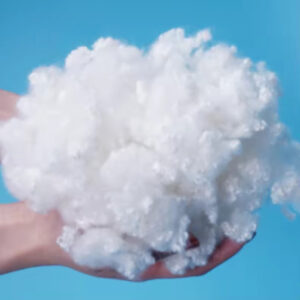
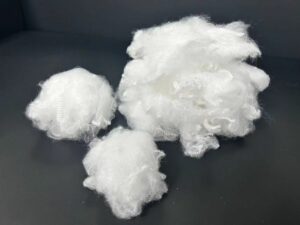
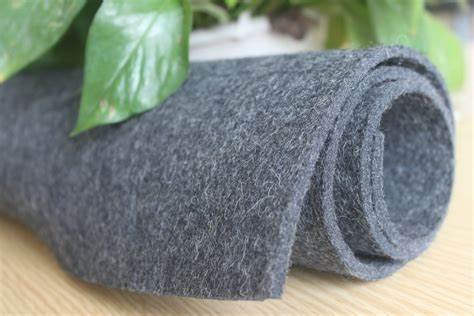
Needlepunched nonwoven fabric is the workhorse of the heavy-duty nonwoven sector — the process that produces the largest volume of nonwoven material by weight globally, feeding applications as diverse as road construction geotextiles, automotive trunk liners, industrial filter bags, carpet underlay, and the substrate layer of synthetic leather used in luxury goods. It is also the nonwoven process most directly and extensively fed by polyester staple fiber (PSF) — solid fiber from 4D to 17D, in staple lengths of 51–76 mm, is the primary raw material for the majority of commercial needlepunch production.
This guide covers the needlepunching process in full technical depth, the PSF and PP fiber specifications that feed each application category, the complete specification table for commercial needlepunched nonwoven products, and a detailed guide to the key application sectors where needlepunch dominates.
VNPOLYFIBER supplies solid polyester staple fiber across the full denier and staple length range for needlepunch production, including UV-stabilized grades for geotextile applications and high-tenacity grades for demanding structural filtration and industrial uses. We also supply needlepunched nonwoven fabric from our manufacturing network for buyers requiring finished fabric.
How Needlepunching Works: The Process in Detail
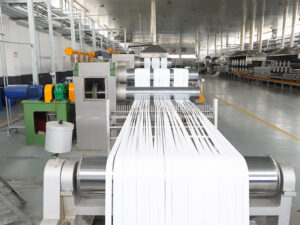
The needlepunching process converts a loose fiber web (batt) into a coherent, mechanically entangled fabric using barbed needles — the oldest commercial nonwoven process and still the dominant process for heavy-weight applications. The production sequence:
- Fiber opening and blending: PSF bales are broken open and fed through a series of opening machines that separate and blend the fibers. Different fiber types (e.g., coarser denier for bulk and strength; finer denier for surface quality) can be blended at this stage.
- Carding: Opened fiber is fed through a carding machine — rotating wire-covered cylinders that align, separate, and form the fibers into a thin, uniform web called a sliver or batt. Carding is the most critical web formation step for needlepunch quality — fiber alignment, weight uniformity, and defect-free structure are established here.
- Cross-lapping: To achieve the target basis weight (gsm) and build the cross-direction (CD) strength needed for most applications, the carded web is cross-lapped — laid back and forth across the production width by a traversing apron — building up multiple layers. The number of layers and the cross-lap angle determine the MD/CD strength ratio of the finished fabric.
- Pre-needling: The loosely assembled cross-lapped web passes through a pre-needle loom with a lower needle density and penetration depth. This light entanglement consolidates the web sufficiently to allow it to be transported to the main needling looms without distortion.
- Main needling: The pre-needled web passes through one or more main needle looms — boards containing thousands of barbed felting needles that punch through the web repeatedly as it advances. The barbs on the needle push fibers from the web surface through the web thickness and return, tangling fibers from different layers. Multiple passes (typically 2–4 needle looms in series) build up the degree of entanglement and determine the fabric’s final density and strength.
- Finishing: Finished needlepunch fabric may receive additional treatments depending on application: heat setting for dimensional stability; hydrophilic or hydrophobic surface treatment; UV stabilizer application for outdoor geotextile grades; calendering for smooth surface finish on synthetic leather substrate; or lamination with geomembrane for composite geosynthetic products.
Needle density and penetration depth are the two primary process variables that control needlepunch fabric properties. Higher needle density = more entanglement = higher strength and lower permeability. Greater penetration depth = more through-thickness fiber migration = better vertical interlocking but potential fiber damage at extremes. The correct combination for each application is critical and is established through production trials.
PSF and PP Fiber Specifications for Needlepunch
The fiber specification for needlepunched nonwoven is the most critical upstream decision — fiber denier, staple length, crimp, tenacity, and finish all directly determine the processing behavior on the needle loom and the properties of the finished fabric:
| Application | Denier | Staple Length | Key Fiber Specification Notes |
| Lightweight geotextile (100–150 gsm) | 4D–6D | 51–64 mm | Standard solid polyester; UV-stabilized for outdoor; minimum tenacity 4.5 cN/dtex for durability underground |
| Standard geotextile (150–400 gsm) | 6D–10D | 51–76 mm | UV-stabilized solid PET or PP; consistent staple length critical for uniform needling; high tenacity preferred |
| Heavy geotextile (400–800 gsm+) | 10D–17D | 64–76 mm | Coarser denier for maximum strength per unit weight; PP grades for chemically aggressive soil environments |
| Carpet underlay (100–300 gsm) | 6D–10D | 51–64 mm | Soft face for felt surface; resilient for underfoot cushioning; recycled PET acceptable for cost reduction |
| Automotive (100–500 gsm) | 4D–12D | 51–76 mm | UV-stabilized; flame retardant (FR) grades for passenger compartment; sound absorption critical for door panel and headliner |
| Filter bags (300–800 gsm) | 6D–12D | 51–64 mm | Dimensional stability critical; high tenacity for pulse-jet cleaning stress; surface finish smooth for cake release |
| Synthetic leather substrate (300–600 gsm) | 2D–4D | 38–51 mm | Fine denier for smooth PU coating substrate; tight needling for low permeability; dimensional stability for PU saturation |
| Geosynthetic clay liner (GCL) | 6D–10D | 51–76 mm | Carrier fabric for sodium bentonite in GCL composites; tensile strength and elongation to EN 13249 specification |
Polyester vs Polypropylene for Needlepunch
| Property | Polyester (PET) Needlepunch | Polypropylene (PP) Needlepunch |
| Tensile strength | Higher — PET tenacity 4.5–7.0 cN/dtex | Adequate — PP tenacity 3.5–6.0 cN/dtex |
| UV resistance | Good with UV stabilizer | Moderate — requires UV stabilizer for outdoor applications |
| Chemical resistance | Good resistance to acids; limited alkali resistance | Excellent — resists both strong acids and alkalis |
| Heat resistance | Higher — suitable up to ~150°C in use | Lower melting point (165°C) — limits high temperature applications |
| Density | 1.38 g/cm³ — higher than water | 0.91 g/cm³ — lightest fiber, lighter fabric per gsm |
| Dyeability | Good — wide colour range with disperse dyes | Cannot be conventionally dyed — solution-dyed only |
| Cost | Slightly higher | Slightly lower — particularly for standard grades |
| Recyclability | GRS-certified recycled PET available | PP recycling infrastructure less developed than PET |
| Best applications | Geotextile, carpet underlay, filter bags, automotive, synthetic leather | Aggressive chemical environments, where lightness matters, some geotextile uses |
Application Deep Dives
Geotextiles — The Largest Application
Needlepunched polyester geotextile is the dominant material for road and highway subbase stabilization, slope erosion control, retaining wall drainage, landfill liner systems, and railway trackbed separation globally. The EN 13249–13253 series of European standards and ASTM D series standards define the key mechanical and hydraulic properties required for each geotextile function:
- Separation: Preventing intermixing of different soil layers — requires minimum tensile strength (typically ≥7.5 kN/m), puncture resistance, and adequate CBR (California Bearing Ratio push-through) strength.
- Filtration: Allowing water to pass while retaining soil particles — requires Apparent Opening Size (AOS/O98) matched to the retained soil particle size distribution.
- Drainage: Transmitting water within the plane of the fabric — characterized by in-plane water flow (transmissivity).
- Protection: Protecting geomembranes from damage by sharp stones — characterized by static puncture resistance (cone drop test) and dynamic perforation resistance.
Geotextile specifications are typically expressed as: ‘NW-300 Geotextile’ meaning needlepunched nonwoven, 300 g/m², with additional mechanical property certifications. UV stability is critical for all geotextile grades that are exposed to sunlight during installation — minimum UV retention of 70% tensile strength after 500 hours Xenon arc exposure is a common specification requirement.
Automotive — The High-Value Application
The automotive sector is the highest-value application for needlepunched nonwoven, consuming significant volumes across multiple vehicle components:
- Trunk liner: Typically 200–350 gsm needlepunched PET with a smooth calendered face and an adhesive-coated back for bonding to the trunk structure. Must meet automotive interior flammability standards (FMVSS 302 / ISO 3795).
- Door panel: Often a composite needlepunch construction — fine face fiber for aesthetic surface with coarser structural fiber for dimensional integrity. Sound absorption properties (NRC — Noise Reduction Coefficient) are specified.
- Under-hood insulation: High-temperature grades required — often blended with ceramic or aramid fiber for temperatures above standard PET or PP tolerance. Acoustic absorption coefficient at multiple frequencies specified.
- Carpet and floor mat backing: Needlepunched nonwoven as the backing and underlay for tufted carpet — provides dimensional stability and cushioning.
Industrial Filtration — The Technical Application
Needlepunched filter bags for pulse-jet dust collection are one of the most technically demanding needlepunch applications. The fabric must withstand repeated mechanical stress from the pulse-jet cleaning cycle (compressed air pulse that forces the collected dust cake off the bag surface) while maintaining filtration efficiency and dimensional stability at operating temperatures up to 150°C (standard PET) or 200°C+ (PPS or glass fiber grades).
Standard industrial filter bag specifications: basis weight 500–800 gsm; tensile strength MD/CD > 1,500/900 N/5cm; air permeability 150–300 L/dm²/min at 200 Pa; surface treatment with PTFE membrane or singeing + calendering for improved cake release.
Needlepunch Product Specification Guide
| Product Grade | Basis Weight | Typical Width | Key Standards and Applications |
| Light geotextile | 100–150 gsm | 4–6 m | EN 13249; road subbase separation; drainage layer |
| Standard geotextile | 200–400 gsm | 4–6 m | EN 13249/13250; slope erosion; retaining wall drainage |
| Heavy geotextile | 500–800 gsm | 4–6 m | EN 13253/13254; reinforcement; landfill protection layer |
| Carpet underlay | 100–300 gsm | 3.6–4 m | Comfort underfoot; thermal insulation; sound reduction |
| Automotive trunk liner | 200–350 gsm | 1.6–2.0 m | FMVSS 302; calendered face; adhesive back available |
| Industrial filter bag | 400–800 gsm | As specified | ISO 11057; pulse jet cleaning rated; PTFE membrane optional |
| Synthetic leather substrate | 300–600 gsm | 1.4–1.6 m | Dense needling; smooth face; PU saturation compatible |
| Geosynthetic composite | Per composite spec | 4–6 m | EN 14196; combined with geomembrane or bentonite |
Conclusion
Needlepunched nonwoven is the structural backbone of the nonwoven industry — the process that converts polyester or polypropylene staple fiber into the heavy, durable fabrics that stabilize road subgrades, insulate vehicles, filter industrial air streams, and provide the substrate for premium synthetic leather. The PSF specification — particularly denier, staple length, tenacity, and UV stability — is the critical upstream variable that determines the needlepunch fabric’s mechanical performance in each of these demanding applications.
VNPOLYFIBER supplies solid polyester staple fiber in the full specification range for needlepunch production — 4D to 17D, 51–76 mm staple lengths, UV-stabilized grades for geotextile, and high-tenacity grades for industrial filtration. We also supply needlepunched nonwoven fabric in geotextile, automotive, and filter grades from our manufacturing network. Contact us for fiber specifications, fabric specifications, test reports, and quotations.