
Dope-Dyed Black PSF — UV-Stable Solution-Dyed Fiber for Automotive and Outdoor Applications
PRODUCT DETAIL
Dope-Dyed Black PSF — UV-Stable Solution-Dyed Fiber for Automotive and Outdoor Applications
What Dope-Dyed (Solution-Dyed) Fiber Is — and Why Color Permanence Matters
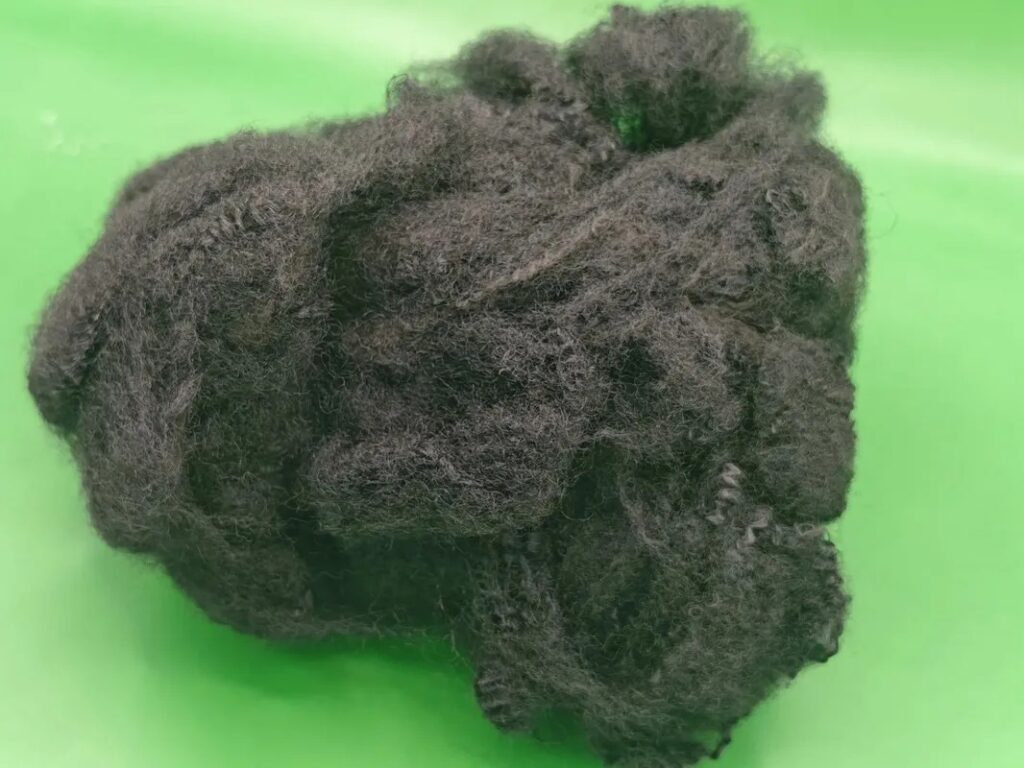
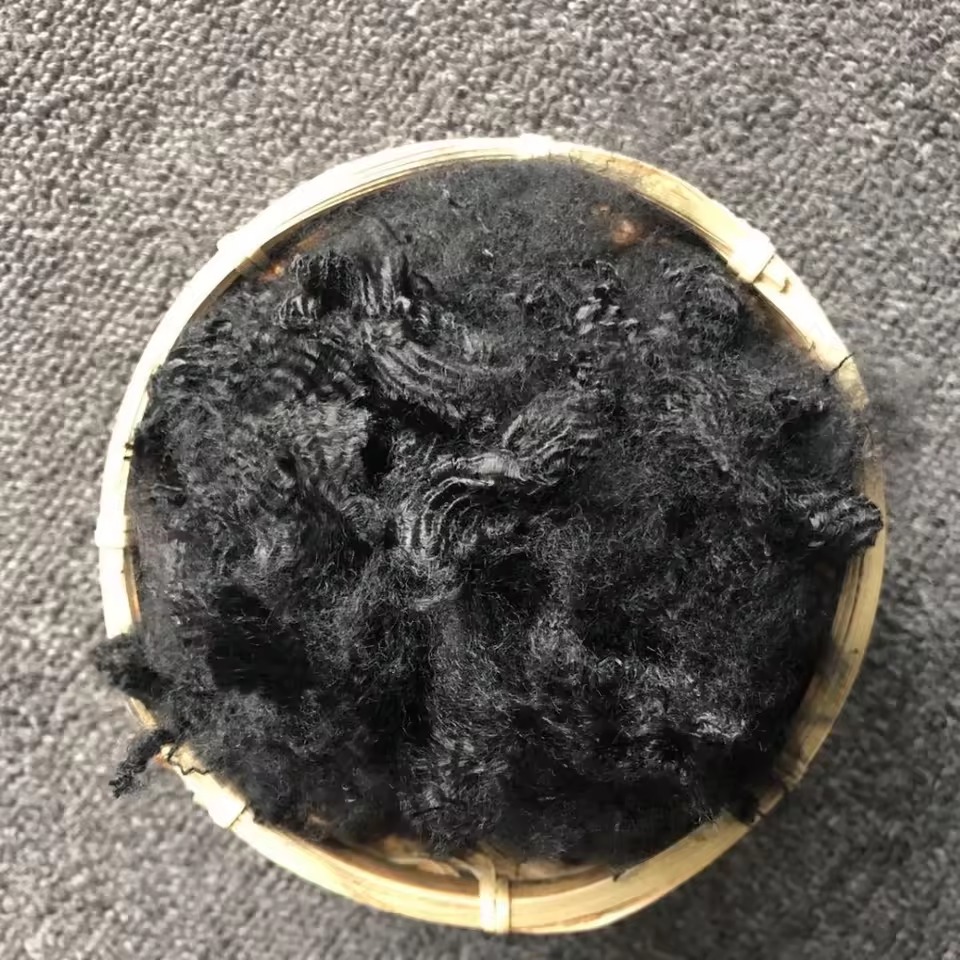
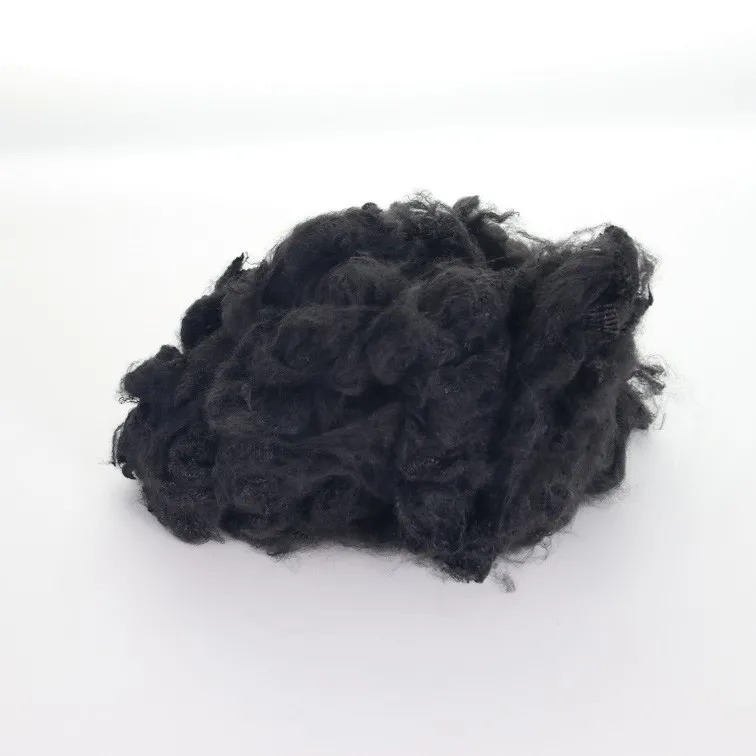
Dope-dyed polyester fiber — also called solution-dyed polyester — is produced by incorporating carbon black or colored pigment masterbatch into the polymer melt before extrusion through the spinneret. The pigment is distributed uniformly throughout the fiber’s entire cross-section during the spinning process. This is the defining difference from all other dyeing methods: the color is inside the fiber, not on its surface.
Every other dyeing approach — piece dyeing (fabric-level dye bath), yarn dyeing (dye applied to the yarn), or fiber dyeing (dye bath applied to loose fiber before spinning) — works by bonding dye molecules to the fiber surface or into the fiber’s outer polymer layers. These surface-associated dye molecules can be removed or degraded by UV radiation, washing with detergent, mechanical abrasion, or chemical exposure. Over time, surface-dyed black becomes grey-brown. The fading is irreversible.
In dope-dyed fiber, the carbon black pigment is incorporated into every cubic micron of the fiber’s polymer matrix. There is no surface coating to degrade, no dye molecules to be displaced, no color gradient from surface to core. UV radiation, commercial washing at 71°C, chemical cleaning agents — none of these can remove the color because the color is the fiber’s material composition, not a treatment applied to it.
Why Automotive Specification Requires Dope-Dyed Black
The automotive industry’s requirement for dope-dyed black in all visible interior nonwoven components — trunk liners, door panel substrates, boot mats, wheel arch liners — is a durability specification, not an aesthetic one. Vehicle interiors are subject to consistent UV exposure through glass throughout the vehicle’s service life. The UV exposure intensity in a vehicle interior at a rear shelf or trunk liner can be comparable to moderate outdoor UV in certain geographic and seasonal conditions.
- Surface-dyed or piece-dyed black nonwoven: Fades visibly from jet black to grey-brown within 12–18 months of UV exposure in a vehicle interior. The fading is uneven — darker in UV-shaded areas, lighter in UV-exposed zones. This creates a mottled, worn appearance that is a quality defect that can trigger warranty claims against automotive tier-1 suppliers.
- Dope-dyed black nonwoven: Maintains jet black color for the vehicle’s entire service life — typically 10–15 years. No UV-induced fading because the carbon black pigment is UV-stable (carbon black has inherent UV absorption properties) and is inside the fiber where UV cannot selectively remove it.
- The specification consequence: Any automotive OEM or tier-1 supplier specifying trunk liner, door panel, or boot mat nonwoven will require confirmation of dope-dyed (solution-dyed) construction — either by asking directly or through UV fastness test data (Grey Scale 4–5 after 500 hours Xenon arc, EN ISO 105-B02). Surface-dyed alternatives typically fail this test at Grey Scale 3 or below.
UV Fastness and Color Fastness Data — What to Specify and Request
- UV fastness — Xenon arc test (EN ISO 105-B02): Standard specification for automotive interior components: Grey Scale 4–5 after 500 hours Xenon arc at 0.5 W/m² irradiance, 65°C black panel temperature. VNPOLYFIBER dope-dyed black grades achieve Grey Scale 4–5 at this specification. Request the test report per grade.
- Wash fastness (ISO 105-C06): Dope-dyed black: Grade 5 (maximum, no change) for wash fastness to color change and staining. This level is not achievable with surface-dyed alternatives. Grade 5 wash fastness means the color is completely unaffected by standard laundering — important for automotive components that may be cleaned with upholstery cleaners.
- Rub fastness — dry and wet (ISO 105-X12): Dry rub: Grade 4–5. Wet rub: Grade 3–4. These values confirm that dope-dyed color does not transfer to surfaces in contact with the fabric — important for automotive seat and door panel substrate fabrics in contact with clothing.
Applications Beyond Automotive
- Outdoor furniture cushion fill: Garden furniture and patio cushions are UV-exposed for the full outdoor season. Dope-dyed black HCS fill maintains its color for 5–7 years of outdoor use. Surface-dyed alternatives fade within the first season.
- Marine and boat upholstery fill: Saltwater, UV, and cleaning chemical exposure simultaneously. Dope-dyed is the only specification that maintains color and structural integrity through these combined stressors.
- Dark-color stuffed toy fill: Black bear, grey rabbit, dark animal plush. Carbon black within OEKO-TEX limits — request test report for compliance verification.
- Technical outdoor nonwoven: Ground cover nonwoven, UV-stable dark color for weed suppression application.
Carbon black concentration and speck quality: VNPOLYFIBER’s dope-dyed black grades use high-dispersion carbon black masterbatch formulated specifically for fiber spinning applications. The key quality concern with dope-dyed black fiber is speck formation — undispersed carbon black aggregates that appear as darker or lighter specks in the finished fabric. Our masterbatch supplier qualification and incoming quality inspection protocols specifically screen for dispersion quality. Request speck count data (microscope count per 10cm² fabric area) if your application has strict appearance requirements.
Frequently Asked Questions
Q: What is the carbon black content of standard dope-dyed black PSF?
Standard commercial dope-dyed black PSF uses 2.0–2.5% carbon black masterbatch by fiber weight. This produces deep, opaque jet black with Grey Scale 4–5 UV fastness. Higher carbon black content (3%+) produces marginally darker color but significantly increases the risk of speck defects if the masterbatch dispersion is not perfect. The 2.0–2.5% range is the industry-standard loading that balances color depth with processing quality. VNPOLYFIBER’s black grades are qualified at 2.0–2.5% loading with dispersion quality verified per production lot.
Q: Can I specify dope-dyed colors other than black?
Yes — dope-dyed PSF is available in dark and medium colors using organic pigment masterbatch. Commercially available automotive-relevant colors: dark navy, charcoal grey, dark olive, burgundy, dark brown. Very light colors (light grey, beige, cream) are technically challenging in dope-dyed and typically achieved more cost-effectively by piece dyeing. Contact VNPOLYFIBER with your target color in RAL, Pantone, or sample swatch format for color development feasibility and minimum order volume for specialty colors.
Q: Is dope-dyed PSF more expensive than standard undyed PSF?
Dope-dyed black PSF carries a 5–15% cost premium over equivalent standard (undyed or white) PSF of the same grade, reflecting the carbon black masterbatch cost and the additional process control required for consistent dispersion quality. Comparing dope-dyed to piece-dyed black PSF: dope-dyed eliminates the post-spin dyeing process (energy, water, dye chemicals, effluent treatment) — the all-in cost difference narrows significantly when the full dyeing process cost is included. For automotive specification where piece-dyed would require UV fastness testing that it would fail, dope-dyed is not an option premium — it is the only compliant specification.
Q: What is the minimum order for dope-dyed black PSF?
VNPOLYFIBER’s standard minimum order for dope-dyed black grades is one 20-foot container, approximately 17–20 MT depending on grade and packing weight. This is the same MOQ as standard undyed grades — dope-dyed black is a standard production grade for us, not a specialty run. For specialty dope-dyed colors other than black, minimum order quantities may be higher due to masterbatch and production run requirements.
Internal links to add:
Functional Fiber Guide |
Technical Parameter
Product Specifications
| Grade | Specification | Primary Application |
| Black solid — automotive standard | Black solid PSF 6D–10D×51–64mm, 2.0–2.5% CB | Trunk liner, door panel, boot mat. 200–400 gsm needlepunch. |
| Black solid — heavy nonwoven | Black solid PSF 10D–15D×64–76mm, 2.0–2.5% CB | Heavy automotive and dark-color geotextile. 400–800 gsm. |
| Black HCS — fill applications | Black HCS 4D–7D×51–64mm, siliconized, 2.0% CB | Automotive seat and furniture fill. Outdoor furniture cushion fill. |
| Black solid — fine grade | Black solid PSF 4D–6D×51mm, 2.0% CB | Finer automotive fabric with smoother needled face. Door panel. |
FAQ
1. What do you offer?
We supply a comprehensive range of fibers, including recycled hollow conjugated (both siliconized and non-siliconized) polyester staple fiber, hollow fiber, microfiber, virgin polyester staple fiber, and low-melt fiber.
2. What is it used for?
Our fibers are versatile and widely utilized across both the filling and non-woven industries, providing essential loft, durability, and texture for various consumer and industrial applications.
3. Are you a factory or a trading company?
We are primarily a manufacturer specializing in polyester staple fiber with years of industry expertise. To better serve our clients, we also operate a dedicated trading division that allows us to act as a one-stop solution provider.
In addition to our own fiber production, we source high-quality textile components (such as yarn and low-melt fibers) and finished goods (including foam, pillows, cushions, toys, and down/feather products) to ensure our customers have access to a comprehensive supply chain.
4. Where is your factory location?
To maintain a robust and flexible global supply chain, our manufacturing facilities are strategically located throughout Asia, specifically in Vietnam, China, Malaysia, Thailand, and Indonesia. If you would like to visit one of our sites, please contact your sales representative, and we will be happy to arrange transportation for you.
5. Can you accept free sample?
Yes, we provide free hand samples for quantities under 1 kilogram. Once a price is confirmed, we can prepare and dispatch your sample within 2–3 business days. Please note that while the sample is free, the freight costs are the responsibility of the client.
6. Can you provide ODM service?
Absolutely. We specialize in ODM (Original Design Manufacturing). This means we can customize the material composition, dimensions, quantity, packaging, and branding to meet your specific requirements. Your logo and unique specifications will be integrated into the final product.
7. How about your quality? What’s the minimum order Quantity (MOQ)?
We invite you to place a trial order to experience our quality firsthand. Our standard MOQ is 23,000 kilograms per order.
Regarding pricing, we maintain a no-bargain policy. We believe in transparency and efficiency, so we provide our most competitive offer upfront to save you time and ensure a straightforward procurement process.
8. Can I mix different items in one order?
Yes, for your convenience, we allow for a maximum of two different items to be mixed within a single container.
9. How can you guarantee the product quality?
Quality is the cornerstone of our business. We employ an experienced QC team that monitors every stage of production, from raw material inspection to the final manufacturing process. We utilize a range of advanced testing instruments to ensure our fibers meet strict industry standards.
Our business philosophy is simple: We aim to serve one customer 1,000 times, rather than 1,000 customers once. We prioritize long-term partnerships built on consistent excellence.
10. What’s the payment terms?
L/C at sight, 30% TT in advance are mostly accepted; other terms shall be negotiable by both sides
For more information, please feel free to contact :
Tony Tan
Mobile number: +84 90 466 5251 (Whatsapp/Wechat/Viber/Signal)