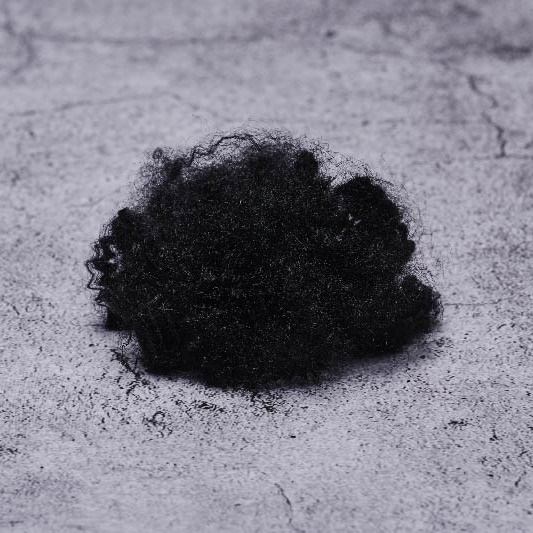
Solid Black Polyester Fiber: The Complete Guide to Recycled Black Fiber, Manufacturing & Applications
PRODUCT DETAIL
Black is the most commercially important color in industrial fiber and nonwoven manufacturing. It is the dominant color specification for automotive trunk liners, exhibition carpets, geotextile products, needle punch floor coverings, acoustic insulation panels, and a broad range of technical nonwovens where a clean, uniform dark appearance is required alongside strong mechanical performance.
Yet producing black textiles through conventional dyeing — applying dye to a fiber or fabric after it has been made — is expensive, water-intensive, chemically demanding, and can produce inconsistent color depth and UV stability. Solid black polyester fiber solves all of these problems simultaneously: by incorporating carbon black pigment directly into the polymer melt during the fiber spinning process, the resulting fiber is black all the way through its cross-section, permanently and uniformly, before a single meter of fabric has been made.
This comprehensive guide covers everything you need to know about solid black polyester fiber — what it is, how it is made, why carbon black pigmentation outperforms conventional dyeing, its full range of industrial applications, how recycled black fiber fits into a sustainable supply chain, and how to specify the right grade for your production needs.
What Is Solid Black Polyester Fiber?
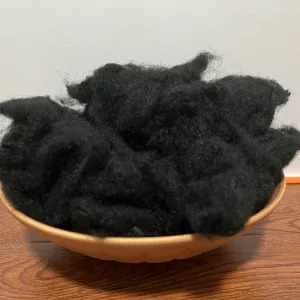
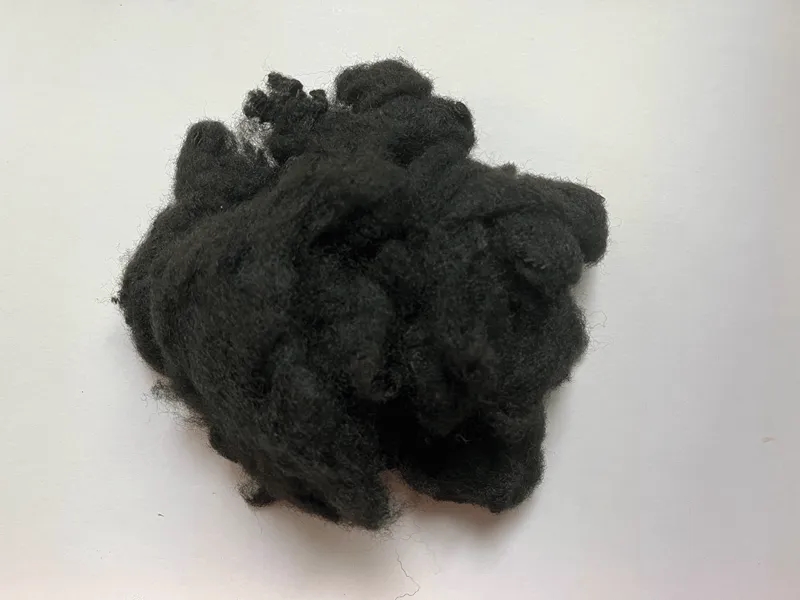
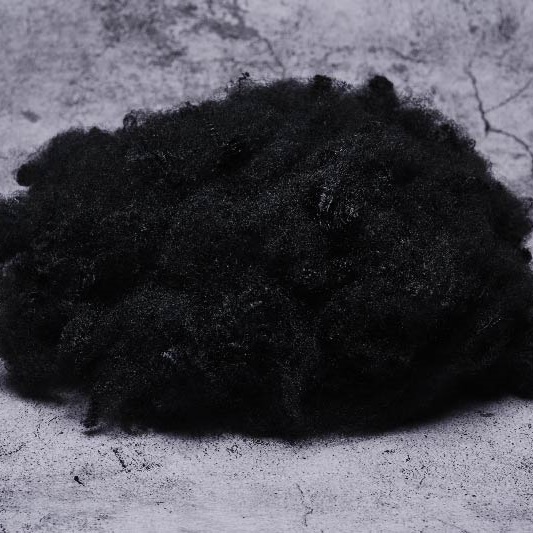
Solid black polyester fiber is a polyethylene terephthalate (PET) staple fiber with two defining characteristics: a solid (non-hollow) cross-section, and a permanently black coloration achieved through the incorporation of carbon black pigment directly into the polymer matrix during melt spinning.
The term “solid” distinguishes this fiber from hollow variants — such as hollow conjugated siliconized (HCS) fiber — which contain an air channel along their length. The solid cross-section gives black fiber its characteristic density, acoustic mass, abrasion resistance, and surface coverage properties that make it the preferred choice for surface textile, acoustic, and geotechnical applications where mechanical robustness and surface uniformity are priorities over loft.
The black coloration is achieved through solution dyeing — also called dope dyeing or mass coloration — in which carbon black masterbatch is metered into the molten PET stream before the spinneret. This means the pigment is homogeneously dispersed throughout the entire fiber cross-section, not applied to the surface. The result is a fiber that is fundamentally black rather than merely black on the outside — with colorfastness, UV resistance, and color permanence that conventional post-spinning dyeing cannot match.
Solid black polyester fiber is produced in both virgin PET and recycled PET (rPET) variants. The recycled version — produced from post-consumer PET bottles processed into clean flake and re-spun with carbon black masterbatch — is increasingly the commercial standard for sustainability-positioned supply chains, offering equivalent performance to virgin black fiber with a dramatically lower environmental footprint.
Why Black? The Commercial Importance of Black Fiber
Among all possible fiber colors, black holds a uniquely dominant commercial position in industrial and technical fiber applications. Understanding why explains both the scale of demand for solid black polyester fiber and the performance requirements it must meet.
Black in Automotive Interiors
Black and very dark grey are by far the most specified interior colors in global automotive production. Trunk liners, floor carpets, door panel backings, wheel arch covers, engine bay insulation, and underbody noise barriers are overwhelmingly produced in black — for aesthetic consistency with dark interior color schemes, for resistance to visible soiling, and because dark colors are preferred in hidden or semi-visible components where a finished, professional appearance is required without the cost of premium visible materials.
Black in Exhibition and Event Flooring
The global exhibition and event industry — trade fairs, conferences, retail pop-ups, entertainment venues, and stage productions — relies heavily on black needle punch carpet and exhibition felt as the standard floor covering for temporary events. Black provides a neutral, professional backdrop that allows exhibits, products, and displays to stand out visually. It also conceals wear, dirt, and imperfections in the floor surface beneath, and coordinates with standard event furniture, display systems, and lighting rigs.
Black in Geotextiles and Civil Engineering
Black is the standard color for geotextile nonwovens used in road construction, drainage filtration, erosion control, and land reclamation. The carbon black pigment that produces the color also functions as a UV stabilizer — absorbing ultraviolet radiation before it can attack the PET polymer chains. This dual function of colorant and UV protector makes carbon black pigmented fiber the technical standard for geotextiles that will be exposed to sunlight during installation before being covered by soil or aggregate.
Black in Acoustic Insulation and Nonwovens
Black nonwoven panels and acoustic insulation boards are widely used in building interiors, recording studios, industrial facilities, and vehicle interiors where the insulation material is partially or fully visible. A clean black finish gives these products a professional appearance consistent with the spaces they are installed in, while the fiber’s acoustic density delivers the noise reduction performance required.
How Solid Black Polyester Fiber Is Made
The production of solid black polyester fiber follows the same fundamental process as standard solid polyester staple fiber, with the critical addition of carbon black masterbatch at the melt stage. Each step of this process contributes to the fiber’s final properties.
Step 1: PET Feedstock Preparation
For virgin black fiber, the process begins with high-purity PET chips produced by the polymerization of purified terephthalic acid (PTA) and monoethylene glycol (MEG). For recycled black fiber — the increasingly dominant commercial variant — the feedstock is clean, sorted, and dried rPET flake produced from post-consumer PET bottles. The flake is sorted to remove non-PET contamination, washed, dried to a moisture content below 50 ppm (to prevent hydrolytic degradation during melt processing), and conveyed to the extruder.
Color uniformity in the finished fiber depends critically on feedstock consistency. For recycled black fiber, using clear or light-blue bottle flake (rather than mixed-color flake) as the base feedstock before carbon black addition produces a more uniform, deeper black than using mixed-color recycled flake — because the base polymer color is consistent and neutral before pigmentation.
Step 2: Carbon Black Masterbatch Preparation and Metering
Carbon black — the pigment that produces the deep, neutral black color — is not added to the PET melt as a raw powder. Raw carbon black particles are extremely fine (typically 10–100 nanometers in primary particle size), difficult to disperse uniformly, and potentially hazardous as an airborne dust. Instead, carbon black is pre-compounded into a carrier polymer (typically PET or a PET-compatible carrier) at high concentration — typically 20–40% carbon black by weight — to create a carbon black masterbatch in pellet form.
This masterbatch is metered into the main PET melt stream at a precisely controlled ratio using a gravimetric dosing system — typically at 1–5% masterbatch addition rate depending on the target depth of black and the carbon black concentration in the masterbatch. The metering accuracy of the dosing system determines the batch-to-batch color consistency of the finished fiber — modern gravimetric dosing achieves addition accuracy of better than ±0.1%, enabling extremely tight color consistency.
Carbon black selection is also technically important. Different carbon black grades vary in particle size, structure, and surface chemistry — affecting the depth of black (jetness), the blue or brown undertone of the color, dispersibility in the PET matrix, and UV absorption characteristics. High-structure carbon blacks with very small particle sizes produce the deepest, most neutral black with the best UV protection; coarser grades produce a less intense black at lower cost.
Step 3: Melt Homogenization and Filtration
The carbon black masterbatch and PET melt are combined in the extruder screw and subjected to intensive mechanical mixing to achieve a homogeneous dispersion of carbon black particles throughout the melt. Adequate dispersion is critical: inadequately dispersed carbon black produces fiber with visible color streaks, spinneret blockages from agglomerated particles, and poor UV resistance in areas of low pigment concentration.
The pigmented melt passes through fine filtration screens (typically 20–40 micron) to remove any carbon black agglomerates, undispersed carrier polymer, or other solid contaminants before reaching the spinneret. Filter pressure monitoring is an important process control — rising filter pressure indicates increasing contamination or agglomeration, signaling a need for process adjustment.
Step 4: Melt Spinning Through Solid Spinneret Orifices
The filtered, pigmented PET melt is pumped through spinneret plates containing thousands of circular orifice holes. The melt flows through these holes and emerges as continuous filaments, which are quenched in a cross-flow air stream and solidified. The circular hole geometry produces the solid round cross-section that defines solid fiber — no hollow channel, no bicomponent sheath-core structure, just a dense, uniformly black PET filament.
The diameter of the spinneret holes determines the fiber denier. For solid black fiber, common denier specifications range from 1.5 denier (fine, for soft nonwovens and light fill applications) through 6 denier (the most common for needle punch carpets and exhibition felt) up to 15 denier or heavier for geotextiles, thick acoustic panels, and heavy padding applications. The denier is one of the most important specification parameters — it directly determines the fiber’s surface coverage, fabric weight, hand feel, and acoustic mass.
Step 5: Drawing — Developing Tensile Strength
The as-spun filament tow is drawn — mechanically stretched between heated roller pairs — to develop the tensile strength and dimensional stability required by the end application. The draw ratio (the ratio of output speed to input speed) determines the degree of polymer chain orientation along the fiber axis, and therefore the fiber’s tenacity (breaking strength per unit linear density) and elongation at break.
For geotextile applications, higher tenacity grades are specified (typically 5.0–7.0 cN/dtex) to provide the tensile strength and long-term creep resistance required in civil engineering use. For exhibition carpet and automotive applications, standard tenacity grades (3.5–5.0 cN/dtex) provide adequate mechanical performance at lower cost. The drawing process does not affect the carbon black pigmentation — the color remains uniformly distributed throughout the fiber regardless of draw ratio.
Step 6: Crimping
After drawing, the filament tow passes through a stuffer box crimper, which imparts a regular zig-zag crimp pattern along the fiber length. Crimping is essential for processability on carding and needle punch equipment — uncrimped fibers would not form a cohesive web on a carding machine. The crimp frequency and amplitude are adjusted based on the target application: higher crimp (more crimps per unit length, higher amplitude) for carding-intensive applications requiring strong fiber cohesion; lower crimp for applications where a denser, flatter fiber structure is preferred.
Step 7: Finishing and Cutting
Finish oils are applied to the crimped tow to control static electricity and fiber-to-fiber and fiber-to-metal friction during carding and needle punching. The finish chemistry is selected for compatibility with the end application — finishes for automotive applications must meet low-VOC requirements; finishes for geotextile applications must be durable under outdoor conditions.
The finished tow is cut to the target staple length using precision rotary cutters. Standard lengths for solid black fiber are 51 mm (the most common for dry-lay carding) and 64 mm (for coarser carding and needle punch applications), with 32–38 mm available for fine carding and specialty applications.
Carbon Black Pigmentation vs. Conventional Dyeing: Why It Matters
The choice to produce solid black fiber through carbon black pigmentation rather than conventional post-spinning dyeing is not merely a manufacturing convenience — it produces a fundamentally superior product in every performance dimension that matters for industrial black fiber applications.
Performance Dimension | Conventionally Dyed Black Fiber | Carbon Black Pigmented (Solution Dyed) |
Color location | Surface and near-surface of fiber — dye penetration limited | Uniform throughout entire fiber cross-section |
UV / Light Fastness | Grade 4–6 (ISO 105-B02) — fades with prolonged UV exposure | Grade 7–8 (ISO 105-B02) — among the highest achievable |
Wash Fastness | Grade 3–5 (ISO 105-C06) — risk of color bleed in washing | Grade 4–5 — color locked in polymer, cannot bleed |
Abrasion Fastness | Moderate — surface dye lost through fiber wear | Excellent — fresh black fiber exposed as surface wears |
Color depth | Good — limited by dye exhaustion and fixation efficiency | Excellent — carbon black loadable to any depth specification |
Color consistency (batch-to-batch) | Variable — dye bath conditions affect result | Highly consistent — gravimetric pigment metering |
Water consumption | Very high — 10–100 L/kg fiber in dyeing process | Zero from the coloring process |
Chemical inputs | Dyes, carriers, levelling agents, fixatives, washing chemicals | Carbon black masterbatch only |
Wastewater generated | Significant dye-laden effluent requiring treatment | None from the coloring process |
UV stabilization function | None from the dye | Yes — carbon black absorbs UV and protects PET chains |
Cost structure | Lower fiber cost; additional dyeing cost + water/chemical cost | Higher fiber cost; zero dyeing cost — typically lower total |
The UV stabilization function of carbon black deserves special emphasis: carbon black is not merely a colorant — it is one of the most effective UV absorbers available. When dispersed throughout the PET fiber at sufficient concentration, carbon black absorbs incoming UV radiation before it can reach and degrade the PET polymer chains. This is why carbon black pigmented geotextiles outperform conventionally dyed equivalents in long-term UV exposure tests — the pigment is protecting the fiber as well as coloring it.
Applications of Solid Black Polyester Fiber
1. Automotive Trunk Liners and Trunk Nonwovens
The automotive trunk liner — the finished nonwoven material that lines the interior of a vehicle’s luggage compartment — is one of the most commercially significant applications for solid black polyester fiber. Every passenger car produced globally requires a trunk liner, and the overwhelming majority specify a black finish for aesthetic consistency with the vehicle interior.
Trunk liners must deliver a demanding combination of properties simultaneously:
- A clean, uniform black appearance that remains consistent across years of UV exposure through the rear window and physical contact from luggage
- Sufficient stiffness and dimensional stability to hold a consistent shape without wrinkling or sagging when installed
- Abrasion resistance to withstand repeated loading and unloading of luggage, tools, and equipment
- Light weight — every gram of interior component weight affects vehicle fuel economy and EV range
- Low VOC emission — automotive interior materials face strict limits on volatile organic compound off-gassing that affect cabin air quality
Solid black polyester fiber needle punch or thermally bonded nonwovens meet all of these requirements. The carbon black pigmentation ensures UV-stable, abrasion-resistant color without dyeing VOCs. The nonwoven structure provides the required stiffness and dimensional consistency. And the use of recycled black fiber — increasingly the standard in automotive supply chains committed to sustainability targets — delivers equivalent performance with verified recycled content documentation.
Trunk nonwovens are typically produced in two constructions: needle punch nonwovens for flat liner panels, and thermoformed composite panels (where black fiber nonwoven is combined with a thermally bondable substrate) for shaped trunk floors and side walls that conform to the geometry of the luggage space.
2. Exhibition Carpet and Event Flooring
The global exhibition and events industry consumes enormous volumes of black needle punch carpet and exhibition felt every year. Trade shows, conferences, retail activations, concert venues, film sets, and corporate events all rely on black exhibition carpet as the standard temporary floor covering — providing a professional, neutral surface that frames exhibits and performances without competing with the visual content on display.
Black exhibition carpet produced from solid black polyester fiber must deliver:
- Consistent, deep, uniform black across large areas — even color distribution is critical for a professional installation appearance
- Acceptable foot comfort and sound absorption for event attendees standing or walking for extended periods
- Sufficient abrasion resistance for the event duration — typically days to weeks of heavy foot traffic
- Cost-effectiveness for single-use or limited-use deployment — exhibition carpet is often used once and discarded
- Easy cutting, joining, and installation on-site
Carbon black pigmented solid polyester fiber delivers the deep, consistent black and abrasion resistance required for exhibition carpet at a cost point appropriate for the application. Needle punch construction produces the compact, flat surface profile preferred for exhibition flooring — providing even coverage without pile height that could create tripping hazards or uneven appearance.
The shift toward recycled solid black fiber in exhibition carpet is gaining momentum driven by event organizers and exhibition venues committing to sustainability targets. GRS-certified recycled black fiber delivers equivalent performance to virgin material with verifiable environmental credentials — an increasingly important factor for large-scale event sustainability reporting.
3. Geotextile Industry
Geotextile nonwovens produced from solid black polyester fiber are used across a wide range of civil engineering applications where the fiber must maintain its mechanical performance under sustained load, chemical exposure, and — critically — UV radiation during the installation period before the geotextile is buried under soil or aggregate.
Key geotextile applications for solid black fiber include:
- Road subbase separation: Black needle punch geotextile placed between the natural subgrade and the aggregate base course of road construction, preventing mixing of the two layers while allowing water drainage.
- Embankment and slope stabilization: High-tenacity black geotextile used to reinforce embankments, retain fill material, and prevent slope erosion in highway and railway construction.
- Drainage filtration: Black needle punch geotextile wrapped around perforated drainage pipes, allowing water to pass while retaining fine soil particles that would block the pipe.
- Erosion control blankets: Black geotextile used on slopes, channel banks, and coastal areas to stabilize exposed soil surfaces against wind and water erosion during vegetation establishment.
- Pond and reservoir lining protection: Black geotextile used as a protective layer beneath HDPE pond liners, preventing puncture damage from subgrade irregularities.
- Agricultural ground cover: Black geotextile used as a weed-suppressing ground cover in orchards, vineyards, and landscape applications — where the carbon black pigment’s UV resistance ensures multi-year service life under direct sunlight exposure.
The carbon black in solid black geotextile fiber serves a dual function that makes it technically superior to undyed or conventionally dyed white geotextile for UV-exposed applications: it provides deep, light-absorbing color that also functions as a UV stabilizer, protecting the PET polymer chains from UV degradation. High-tenacity grades of solid black fiber (5.0–7.0+ cN/dtex) are specified for geotextile applications requiring structural tensile performance.
4. Needle Punch Carpets and Floor Coverings
Beyond exhibition applications, solid black polyester fiber is used in permanent needle punch carpet installations for commercial, industrial, and residential floor coverings. Black needle punch carpet is widely used in:
- Office and commercial corridors where a neutral, professional appearance and high durability are required
- Retail environments as display flooring that frames merchandise without visual competition
- Automotive showrooms, galleries, and museum spaces where a clean, dark floor surface enhances displayed objects
- Industrial facilities where a functional, easy-to-maintain dark floor covering is required
- Stair coverings and entrance mats in commercial buildings
Needle punch carpets produced from solid black fiber offer excellent abrasion resistance (the solid cross-section resists fiber extraction from the needled structure), color consistency across large production runs, and the permanent color stability of solution-dyed carbon black pigmentation. Unlike conventionally dyed carpet, solid black needle punch carpet will not fade significantly even under prolonged UV exposure near windows and entrances.
5. Automotive Door Panels, Headliners, and Interior Components
Beyond trunk liners, solid black polyester fiber is used throughout automotive interiors in components where black nonwoven is required as a substrate, backing, or visible surface material:
- Door panel backings: Black needle punch nonwoven provides the structural backing for door panel facing fabrics, offering dimensional stability, sound absorption, and a finished reverse face.
- Headliner substrates: Black fiber nonwoven is used in headliner constructions where the nonwoven layer is visible at the edges of the headliner or in sunroof surrounds.
- Pillar trims: Needle punch black fiber fabric provides the surface covering for A, B, and C pillar trim components.
- Underbody acoustic panels: Dense black fiber nonwoven panels are used in underbody acoustic packages, where black color prevents visible soiling from road debris and provides UV stability for components partially exposed before body-in-white assembly.
- Wire harness wrapping: Narrow strips of black needle punch nonwoven are used to bundle and protect automotive wire harnesses — one of the highest-volume applications for black nonwoven in automotive manufacturing.
6. Acoustic Insulation Panels
In building, studio, and industrial acoustic insulation, black nonwoven panels and boards produced from solid black polyester fiber are used where the insulation material is visible and a finished appearance is required. Recording studios, home theaters, open-plan offices, industrial machinery enclosures, and public building interior walls all use acoustic panels that must be acoustically effective and aesthetically acceptable.
Solid black polyester fiber delivers the acoustic mass required for mid-to-high frequency sound absorption (the fiber’s density and entangled structure efficiently converts sound energy to heat through fiber friction), while the carbon black pigmentation provides the uniform, professional black appearance without the cost and process complexity of covering the fiber with a separately dyed facing fabric.
Thermally bonded black fiber panels — produced by blending solid black fiber with low melt bicomponent fiber and hot-air bonding the mixture into a stable panel — can be produced in precise thicknesses and densities, enabling acoustic performance to be engineered to specification. These panels can also be cut, shaped, and surface-finished (laminated with black scrim or fabric) for installation as wall tiles, ceiling rafts, or baffles.
7. Filtration Media
Dense needle punch or thermally bonded solid black polyester fiber nonwovens are used as filter media in industrial filtration applications where a dark-colored filter is preferred — either for aesthetic reasons (to minimize the visible appearance of collected dust or particulate on the filter face) or for UV stability in outdoor filtration installations. Bag filters for industrial dust collection, black filter socks for liquid filtration in food and beverage processing, and UV-stable filter fabric for outdoor air intake installations all use solid black fiber media.
8. Stuffed Products and Fill Applications
While hollow conjugated siliconized (HCS) fiber dominates premium pillow fill, solid black fiber has a role in stuffed products where a dark fill is specifically required — including decorative cushions with dark or transparent outer covers, certain toy applications where fill color is specified by design, and industrial fill applications where the fiber’s high density provides the weight and firmness characteristics required by the product design.
Recycled Solid Black Fiber: Sustainability at Scale
The production of solid black polyester fiber from recycled PET feedstock — typically post-consumer PET bottles — represents one of the most compelling and commercially mature sustainable fiber choices available to the industrial nonwoven and textile industry today.
The Environmental Case
- Carbon footprint reduction: Producing rPET fiber from post-consumer bottles requires approximately 50–70% less energy than producing virgin PET fiber from petrochemical feedstocks, translating into a 30–60% reduction in greenhouse gas emissions per kilogram of fiber produced.
- Plastic waste diversion: Approximately 25 standard 500 ml PET bottles are required to produce one kilogram of recycled polyester fiber. By creating a high-volume industrial demand for post-consumer PET, recycled black fiber production directly incentivizes bottle collection infrastructure and diverts plastic from landfill and ocean environments.
- Water savings from solution dyeing: The carbon black pigmentation of recycled solid black fiber eliminates the dyeing step entirely — saving the 10–100 liters of water per kilogram that conventional black dyeing would consume, and eliminating the chemical wastewater associated with dye baths.
- Combined lifecycle benefit: Recycled + solution dyed = the most water and carbon-efficient pathway to a black polyester fiber available in commercial production today.
GRS Certification: Making the Claims Verifiable
Global Recycled Standard (GRS) certification provides third-party verified traceability of recycled content from the post-consumer collection point through fiber production to the finished fiber bale. For buyers and brands with sustainability commitments — particularly those reporting under GRI standards, Science Based Targets, or EU Ecodesign requirements — GRS-certified recycled solid black fiber provides the auditable documentation needed to substantiate recycled content claims in annual reports, product specifications, and consumer communications.
VNPOLYFIBER produces GRS-certified recycled solid black polyester fiber, enabling our customers to incorporate verified recycled content into their supply chains with complete confidence in the traceability and integrity of the recycled content claim.
Recycled Black Fiber vs. Virgin Black Fiber: Performance Comparison
Parameter | Virgin Solid Black Fiber | Recycled Solid Black Fiber (rPET) |
Raw material source | Petrochemical PTA + MEG (fossil-derived) | Post-consumer PET bottles (circular) |
Carbon footprint | Higher — primary polymerization required | 30–60% lower |
Color (carbon black) | Identical — solution dyed in both cases | Identical — solution dyed in both cases |
Colorfastness | Excellent (Grade 7–8 light fastness) | Excellent (Grade 7–8 light fastness) |
Tensile properties | Precisely controlled across full range | Equivalent for standard and high-tenacity grades |
Denier range | Full range (1.5–15 D+) | Full range (1.5–15 D+) |
Certifications | Oeko-Tex Standard 100 | GRS + Oeko-Tex Standard 100 |
Applications | All standard black fiber applications | All standard black fiber applications — identical performance |
Sustainability positioning | Standard | Strong — verified recycled content + zero dyeing water |
How to Specify Solid Black Polyester Fiber
Selecting the correct solid black fiber grade for your application requires systematic evaluation of the following parameters. Providing these specifications clearly to your fiber supplier ensures you receive a product that performs correctly in your process and end application.
- Denier: The most important single specification. Fine denier (1.5–3 D) for soft nonwovens and light fill; 6 D for the most common exhibition carpet, automotive, and acoustic applications; 10–15 D+ for geotextiles and heavy-duty applications. Confirm with your needle punch or carding machine specification.
- Staple length: 51 mm for standard dry-lay carding; 64 mm for coarser needle punch systems; 32–38 mm for fine carding or specialty applications. Match to your opening and carding equipment specification.
- Tenacity: Standard grade (3.5–5.0 cN/dtex) for carpet, automotive, fill, and acoustic applications; high-tenacity grade (5.0–7.0+ cN/dtex) for geotextile and structural nonwoven applications.
- Crimp: Standard crimp (5–8 crimps/cm) for carding and needle punch. Specify crimp frequency and amplitude if your equipment has known sensitivity to these parameters.
- Recycled or virgin: Specify recycled (rPET) if GRS certification and sustainability documentation are required. Confirm that performance specifications are identical — recycled black fiber meets the same technical standards as virgin.
- Certification requirements: Specify GRS for recycled content verification; Oeko-Tex Standard 100 for chemical safety; automotive-specific certifications (e.g., IMDS registration, VDA 278 VOC testing) for automotive supply chain requirements.
- Finish oil: Standard finish for most applications; low-VOC or automotive-grade finish for vehicle interior applications; confirm compatibility with your needle punch line lubricants and any downstream lamination or bonding process.
Market Trends Driving Demand for Solid Black Fiber
Several powerful demand trends are shaping the market for solid black polyester fiber over the coming years:
- Automotive electrification: The transition to electric vehicles is increasing the acoustic challenge in vehicle interiors — without engine noise to mask road and tire noise, NVH performance requirements are intensifying, driving greater use of acoustic fiber nonwovens including black fiber trunk liners and underbody panels.
- Sustainability mandates in automotive: Major automotive manufacturers have committed to significant recycled material content in their vehicles by 2030, creating strong pull for GRS-certified recycled black fiber in trunk liners, door panels, and acoustic packages.
- Exhibition industry recovery and growth: The global events and exhibition industry is recovering strongly post-pandemic, with new venue construction and large-scale events driving sustained demand for black exhibition carpet and needle punch flooring.
- Infrastructure investment: Government infrastructure programs across Asia, Europe, and North America are driving geotextile demand — and black carbon-pigmented solid fiber remains the technical standard for UV-exposed geotextile applications.
- Acoustic building standards: Tightening building acoustic standards in residential, commercial, and institutional construction are expanding the market for acoustic insulation panels including black fiber products.
- Circular economy regulation: EU extended producer responsibility (EPR) regulations for textiles and automotive materials are accelerating the shift from virgin to recycled fiber across all nonwoven segments — positioning GRS-certified recycled black fiber as the future standard.
Conclusion: Solid Black Polyester Fiber Is a Cornerstone Industrial Material
Solid black polyester fiber — produced through carbon black solution dyeing for permanent, UV-stable coloration and solid cross-section spinning for mechanical density and abrasion resistance — is one of the most important and versatile materials in the global nonwoven and technical textile industry. Its applications span some of the most demanding environments in industrial manufacturing: the structural and acoustic requirements of automotive interiors, the UV exposure of outdoor geotextiles, the high foot-traffic abrasion of exhibition flooring, and the precision acoustic engineering of building insulation.
The shift to recycled solid black fiber — produced from post-consumer PET bottles with carbon black solution dyeing — represents the most compelling sustainable upgrade available for these applications: equivalent performance, verifiable recycled content, zero dyeing water consumption, and a carbon footprint 30–60% lower than virgin equivalent. For automotive manufacturers, exhibition companies, civil engineers, and building product specifiers with sustainability commitments, GRS-certified recycled solid black fiber delivers the performance and the documentation needed to meet those commitments without compromise.
To discuss your solid black fiber requirements — denier, staple length, tenacity, recycled content certification, or custom specification — please contact our technical team. We provide samples, technical data sheets, GRS certification documentation, and application development support for all black fiber grades.
Technical Parameter
Key Technical Properties of Solid Black Polyester Fiber
Property | Specification / Performance |
Denier range | 1.5 D – 15 D+ (application dependent; most common: 6 D for carpet/felt, 4–6 D for automotive, 10–15 D for geotextile) |
Fiber cross-section | Solid round (standard); trilobal available for enhanced surface coverage and light reflection |
Staple length | 32 mm, 38 mm, 51 mm, 64 mm (application dependent) |
Color | Deep, uniform black — carbon black pigmented throughout cross-section |
Light fastness (ISO 105-B02) | Grade 7–8 — excellent UV resistance |
Wash fastness (ISO 105-C06) | Grade 4–5 — color locked in polymer matrix |
Tenacity | Standard: 3.5–5.0 cN/dtex | High-tenacity: 5.0–7.0+ cN/dtex (geotextile grade) |
Elongation at break | 30–60% (varies by draw ratio and application) |
Crimp (standard) | 5–8 crimps/cm stuffer box crimp |
Moisture absorption | <0.4% (inherent polyester hydrophobicity) |
Melting point | ~255–260°C (standard PET) |
Chemical resistance | Excellent — resistant to dilute acids, alkalis, and most common chemicals |
Thermal stability | Continuous use to ~150°C; short-term to higher temperatures |
Certifications available | Oeko-Tex Standard 100 | GRS (Global Recycled Standard) for recycled variants |
Video
FAQ
1. What do you offer?
We supply a comprehensive range of fibers, including recycled hollow conjugated (both siliconized and non-siliconized) polyester staple fiber, hollow fiber, microfiber, virgin polyester staple fiber, and low-melt fiber.
2. What is it used for?
Our fibers are versatile and widely utilized across both the filling and non-woven industries, providing essential loft, durability, and texture for various consumer and industrial applications.
3. Are you a factory or a trading company?
We are primarily a manufacturer specializing in polyester staple fiber with years of industry expertise. To better serve our clients, we also operate a dedicated trading division that allows us to act as a one-stop solution provider.
In addition to our own fiber production, we source high-quality textile components (such as yarn and low-melt fibers) and finished goods (including foam, pillows, cushions, toys, and down/feather products) to ensure our customers have access to a comprehensive supply chain.
4. Where is your factory location?
To maintain a robust and flexible global supply chain, our manufacturing facilities are strategically located throughout Asia, specifically in Vietnam, China, Malaysia, Thailand, and Indonesia. If you would like to visit one of our sites, please contact your sales representative, and we will be happy to arrange transportation for you.
5. Can you accept free sample?
Yes, we provide free hand samples for quantities under 1 kilogram. Once a price is confirmed, we can prepare and dispatch your sample within 2–3 business days. Please note that while the sample is free, the freight costs are the responsibility of the client.
6. Can you provide ODM service?
Absolutely. We specialize in ODM (Original Design Manufacturing). This means we can customize the material composition, dimensions, quantity, packaging, and branding to meet your specific requirements. Your logo and unique specifications will be integrated into the final product.
7. How about your quality? What’s the minimum order Quantity (MOQ)?
We invite you to place a trial order to experience our quality firsthand. Our standard MOQ is 23,000 kilograms per order.
Regarding pricing, we maintain a no-bargain policy. We believe in transparency and efficiency, so we provide our most competitive offer upfront to save you time and ensure a straightforward procurement process.
8. Can I mix different items in one order?
Yes, for your convenience, we allow for a maximum of two different items to be mixed within a single container.
9. How can you guarantee the product quality?
Quality is the cornerstone of our business. We employ an experienced QC team that monitors every stage of production, from raw material inspection to the final manufacturing process. We utilize a range of advanced testing instruments to ensure our fibers meet strict industry standards.
Our business philosophy is simple: We aim to serve one customer 1,000 times, rather than 1,000 customers once. We prioritize long-term partnerships built on consistent excellence.
10. What’s the payment terms?
L/C at sight, 30% TT in advance are mostly accepted; other terms shall be negotiable by both sides
For more information, please feel free to contact :
Tony Tan
Mobile number: +84 90 466 5251 (Whatsapp/Wechat/Viber/Signal)