
PRODUCT DETAIL
Post-Consumer Recycled PSF — Transparent Bottle-to-Fiber Supply Chain
Post-Consumer Recycled PSF: The Supply Chain Explained
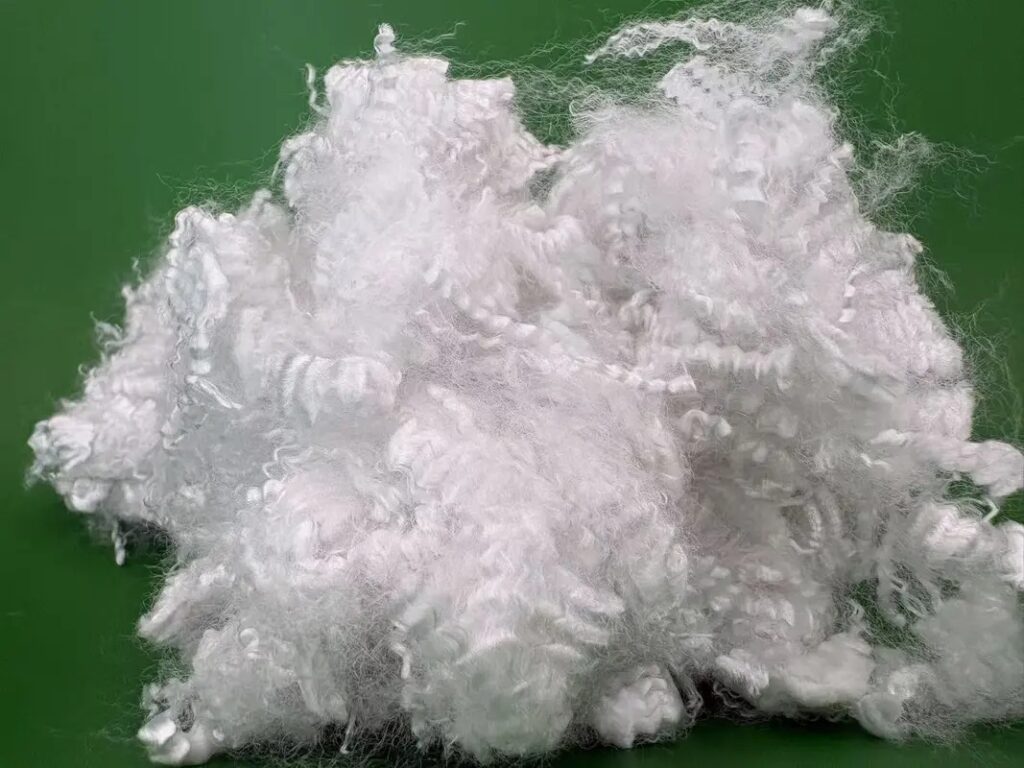
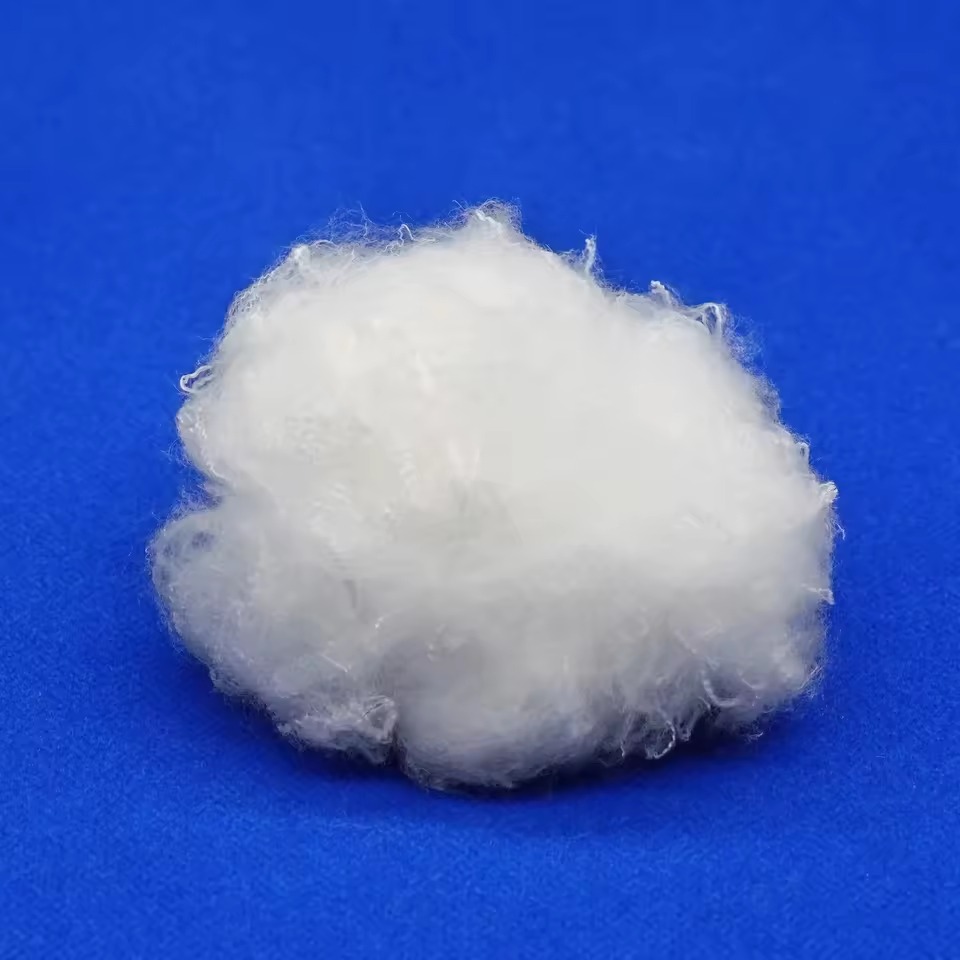
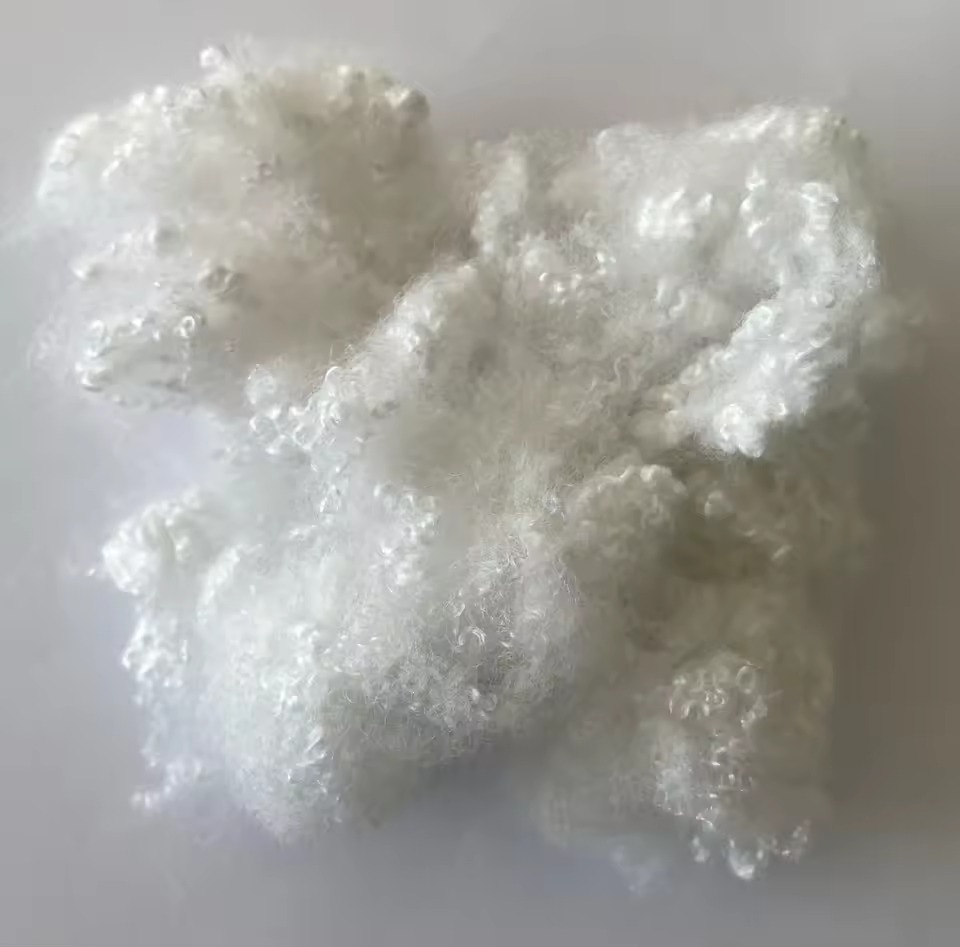
Post-consumer recycled PSF begins with PET plastic bottles — the everyday single-use packaging collected from household recycling programs, deposit return schemes, and informal collection networks across Asia and globally. These bottles enter a reclamation supply chain that converts them into fiber-grade recycled PET resin, and from there into polyester staple fiber that performs equivalently to virgin PSF in all commercial fill and nonwoven applications.
VNPOLYFIBER’s recycled PSF supply chain is bottle-origin: post-consumer PET bottles collected in Asia, sorted by color (clear bottle priority for highest whiteness and fiber quality), washed, shredded and processed to PET flake, pelletized or directly melt-spun, and extruded into fiber at GRS-certified spinning facilities. We can document the full chain from bottle collection region to finished fiber bale — the documentation backbone of any credible recycled content claim.
The supply chain steps where quality is determined — and where VNPOLYFIBER’s specification controls are applied — are the flake quality (IV, color, contamination), the spinning process (consistent denier and crimp), and the finishing (silicone level, cut length). The fiber that reaches our customers has passed incoming quality inspection and pre-shipment verification at each of these stages.
Post-Consumer vs Pre-Consumer: Why the Distinction Matters
GRS certification distinguishes between two types of recycled content feedstock, and this distinction matters commercially:
- Post-consumer recycled (PCR): Material that has been used by end consumers and discarded — PET bottles, collected clothing, used carpet. PCR represents genuine circular economy recovery: material rescued from the waste stream that would otherwise go to landfill or incineration. PCR is the stronger sustainability claim and is what VNPOLYFIBER’s recycled fiber uses.
- Pre-consumer recycled (also called post-industrial): Manufacturing offcuts, production rejects, and process waste that never reached a consumer. While technically ‘recycled,’ pre-consumer material is waste from manufacturing processes that would typically be recycled within the manufacturing system regardless. It is a weaker claim than PCR and some retailer sustainability programs specifically require PCR feedstock, not pre-consumer.
- How to verify: The GRS Transaction Certificate issued by VNPOLYFIBER specifies the feedstock type for each shipment. ‘Post-consumer recycled content’ on the TC is the documentation your retail buyer or certification body requires if they specifically mandate PCR feedstock.
How to Use GRS Documentation in Corporate Sustainability Reporting
GRS Transaction Certificates from VNPOLYFIBER are the primary source documentation for recycled content reporting in corporate sustainability disclosures. Here is how they integrate with the most common reporting frameworks:
- GHG Protocol Scope 3, Category 1 (Purchased Goods and Services): Replace the emission factor for virgin PSF (~5.5 kg CO₂e/kg) with the emission factor for GRS-certified recycled PSF (~2.0 kg CO₂e/kg). The GRS TC documents the quantity of recycled fiber purchased, allowing your sustainability team to calculate the Scope 3 Category 1 emission reduction versus the virgin fiber baseline. Approximately 60–70% GHG reduction per kg of fiber purchased.
- Science Based Targets initiative (SBTi): For brands with SBTi-aligned climate commitments, switching from virgin to recycled PSF reduces Scope 3 Category 1 emissions. GRS TCs provide the input material documentation your SBTi reporting requires.
- CDP (Carbon Disclosure Project) supply chain questionnaire: CDP asks suppliers to document recycled content and recycled material sourcing practices. GRS certification and TC documentation is the standard evidence format for positive CDP supply chain responses.
- Annual sustainability reports: GRS TCs provide the auditable source documentation behind recycled material percentage claims in published sustainability reports. Third-party assurance providers (EY, Deloitte, PwC sustainability practices) accept GRS TCs as evidence for recycled content disclosures.
Applications
- Brand Scope 3 Category 1 GHG reduction: Replace virgin PSF with rPSF. 60–70% GHG reduction per kg, documented by GRS TC.
- SBTi-aligned procurement: Recycled material sourcing for Science Based Targets emission reduction pathways.
- Retailer sustainability sourcing program compliance: H&M, Zara, M&S, IKEA, Target — all require documented recycled content with GRS certification for program participation.
- Consumer-facing ‘made from recycled bottles’ claim: Bottle count estimates per shipment weight provided by VNPOLYFIBER for consumer marketing.
- Annual sustainability report material documentation: GRS TCs as primary auditable source documentation for recycled content percentage claims.
The bottle count per shipment: VNPOLYFIBER provides estimated bottle count per kilogram of rPSF shipped — approximately 60–70 standard 500ml PET bottles per kg. For a 20-tonne container of rHCS fill fiber: approximately 1.2–1.4 million recycled bottles. This figure is an estimate based on average bottle weight and processing yield. It cannot be exactly documented per bottle in the supply chain — but the GRS chain-of-custody audit does verify that the total feedstock input is consistent with the certified output quantity, making the estimate credible for consumer communication.
Frequently Asked Questions
Q: How do I confirm that VNPOLYFIBER’s recycled fiber is genuinely from PET bottles, not from factory waste?
The GRS chain-of-custody audit by an accredited certification body (Control Union, Bureau Veritas, Intertek, etc.) reviews the purchasing records linking our recycled fiber production to the PET flake input, which in turn links to the reclamation facility’s documentation of the bottle feedstock. The auditor verifies mass balance — that the quantity of certified output is consistent with the documented certified input. This chain of verified documentation is what makes the GRS post-consumer claim credible to retailers, sustainability NGOs, and corporate procurement teams. The GRS Transaction Certificate we issue per shipment is the consumer-facing expression of this audit trail.
Q: Is recycled PSF more expensive than virgin PSF?
GRS-certified recycled PSF typically carries a 5–15% cost premium over equivalent virgin grade. This premium reflects the recycling supply chain processing costs (collection, sorting, washing, flaking) and the GRS certification cost (annual audit and certification fee). For brands where the sustainability claim adds product value — allowing higher retail pricing, meeting retail buyer program requirements, or supporting brand ESG commitments — the premium is typically recoverable. For cost-driven procurement without sustainability positioning requirements, virgin PSF remains the lower-cost option.
Q: Can I get a certificate of analysis (COA) per shipment alongside the GRS TC?
Yes. VNPOLYFIBER provides a certificate of analysis per shipment documenting key quality parameters — denier (measured, nominal, and tolerance), silicone level (extraction test result), whiteness (CIE L/b values), moisture content, staple length, and crimp count. The COA and GRS TC are provided together as part of the standard shipping documentation package for every container.
Technical Parameter
Product Specifications
| Grade | Specification | Application |
| rHCS fill — all grades | rHCS 3D, 4D, 7D×51–64mm, GRS PCR | Post-consumer bottle feedstock. GRS TC per shipment. Full fill fiber range. |
| Solid rPSF — nonwoven | Solid rPSF 6D–12D×51–76mm, GRS PCR | Needlepunch geotextile, carpet underlay, automotive nonwoven. |
| rLMF binder fiber | rLMF 4D×51mm 130°C sheath, GRS PCR | Recycled binder for sustainable through-air bonded wadding production. |
| Fine rPSF — microfiber | rPSF 1.5D×38mm, GRS PCR | Fine fill and spunlace fiber. Limited availability — confirm lead time. |
FAQ
1. What do you offer?
We supply a comprehensive range of fibers, including recycled hollow conjugated (both siliconized and non-siliconized) polyester staple fiber, hollow fiber, microfiber, virgin polyester staple fiber, and low-melt fiber.
2. What is it used for?
Our fibers are versatile and widely utilized across both the filling and non-woven industries, providing essential loft, durability, and texture for various consumer and industrial applications.
3. Are you a factory or a trading company?
We are primarily a manufacturer specializing in polyester staple fiber with years of industry expertise. To better serve our clients, we also operate a dedicated trading division that allows us to act as a one-stop solution provider.
In addition to our own fiber production, we source high-quality textile components (such as yarn and low-melt fibers) and finished goods (including foam, pillows, cushions, toys, and down/feather products) to ensure our customers have access to a comprehensive supply chain.
4. Where is your factory location?
To maintain a robust and flexible global supply chain, our manufacturing facilities are strategically located throughout Asia, specifically in Vietnam, China, Malaysia, Thailand, and Indonesia. If you would like to visit one of our sites, please contact your sales representative, and we will be happy to arrange transportation for you.
5. Can you accept free sample?
Yes, we provide free hand samples for quantities under 1 kilogram. Once a price is confirmed, we can prepare and dispatch your sample within 2–3 business days. Please note that while the sample is free, the freight costs are the responsibility of the client.
6. Can you provide ODM service?
Absolutely. We specialize in ODM (Original Design Manufacturing). This means we can customize the material composition, dimensions, quantity, packaging, and branding to meet your specific requirements. Your logo and unique specifications will be integrated into the final product.
7. How about your quality? What’s the minimum order Quantity (MOQ)?
We invite you to place a trial order to experience our quality firsthand. Our standard MOQ is 23,000 kilograms per order.
Regarding pricing, we maintain a no-bargain policy. We believe in transparency and efficiency, so we provide our most competitive offer upfront to save you time and ensure a straightforward procurement process.
8. Can I mix different items in one order?
Yes, for your convenience, we allow for a maximum of two different items to be mixed within a single container.
9. How can you guarantee the product quality?
Quality is the cornerstone of our business. We employ an experienced QC team that monitors every stage of production, from raw material inspection to the final manufacturing process. We utilize a range of advanced testing instruments to ensure our fibers meet strict industry standards.
Our business philosophy is simple: We aim to serve one customer 1,000 times, rather than 1,000 customers once. We prioritize long-term partnerships built on consistent excellence.
10. What’s the payment terms?
L/C at sight, 30% TT in advance are mostly accepted; other terms shall be negotiable by both sides
For more information, please feel free to contact :
Tony Tan
Mobile number: +84 90 466 5251 (Whatsapp/Wechat/Viber/Signal)