PET Bottle to Recycled Polyester Fiber: The Complete Supply Chain Guide
Every GRS-certified recycled polyester staple fiber (rPSF) bale begins the same way—as a discarded PET plastic bottle. The journey from that bottle to the fiber inside a pillow, a jacket, a mattress topper, or a nonwoven fabric involves at least six distinct industrial stages, each with its own quality specifications, equipment, economics, and certification requirements. For brands making ‘made from recycled bottles’ claims, for buyers sourcing GRS-certified fiber, and for manufacturers specifying rPSF performance, understanding this supply chain in full is the foundation for credible, accurate, and commercially sound sourcing decisions.
This guide traces the complete bottle-to-fiber journey with technical precision—covering collection and sorting, PET flake production, chip conversion, fiber spinning, and the GRS certification framework that tracks every stage. It closes with an honest performance comparison of rPSF versus virgin PSF, so buyers know exactly what changes and what stays the same when they switch to recycled fiber.
VNPOLYFIBER supplies GRS-certified rPSF—hollow conjugated siliconized (HCS), solid, microfiber, and dope-dyed grades—produced from post-consumer PET bottle feedstock at manufacturing partners across China, Vietnam, Malaysia, and Indonesia. Our rPSF carries both GRS chain-of-custody certification and OEKO-TEX Standard 100 (Class I for children’s applications, Class II for adults).
The Global rPET Supply Chain: Scale and Context
Global PET bottle production exceeds 600 billion bottles per year — roughly 80 bottles for every person on earth annually. Of this, approximately 58% is collected for recycling globally, though collection rates vary enormously by region: European countries achieve 50–90%+ collection (with deposit-return schemes delivering the highest rates); the US collects approximately 27–30%; much of Southeast Asia and South Asia collects less than 20% of PET bottles formally, though informal collection by waste pickers fills a significant portion of the gap in practice.
The textile fiber sector is the single largest consumer of recycled PET—absorbing approximately 60–65% of all mechanically recycled PET globally, primarily as recycled polyester staple fiber (rPSF) and recycled polyester filament yarn (rPOY/rFDY/rDTY). This makes the fiber industry the backbone of the global PET bottle circular economy: without fiber demand, bottle collection rates would collapse economically in most markets.
Region | Approximate PET Bottle Collection Rate and Notes |
Europe (deposit-return schemes) | 70–95% — Germany, Norway, Finland achieve highest rates through well-established deposit schemes |
Europe (kerbside only) | 45–65% — UK, France, Spain without deposit systems; improving with EPR regulations |
United States | 27–30%—voluntary kerbside; no national deposit mandate; significant state variation |
Japan | 85%+ — highly organized municipal collection; very high sorting discipline |
China | ~70–80% — driven by informal waste picker networks and growing formal infrastructure |
Southeast Asia | 20–50% — wide variation; informal collection significant; formal infrastructure growing |
India | ~30–40% — predominantly informal collection; large informal recycling sector |
Global average | ~58% — weighted average; significant growth needed to meet 2030 circular economy targets |
Stage 1: Collection and Baling
The recycling chain begins with collection—either through formal municipal recycling programs (kerbside bin collection, bring banks, or supermarket return points) or through informal waste picker networks that are the primary collection mechanism in many developing markets. Collected bottles are transported to materials recovery facilities (MRFs) or directly to PET reclamation facilities.
At the MRF, mixed recycling streams are sorted to separate PET from other materials. Bottles are then compressed into dense bales (typically 300–600 kg each) for efficient transport. Bale quality — the purity of PET content and the contamination level — directly determines the value and processability of the material downstream. A premium clear PET bale with less than 1% non-PET contamination commands a significantly higher price than a mixed-color bale with higher contamination.
- Bale grade 1 (clear/natural): 90%+ clear and natural PET bottles; less than 1% non-PET; highest value; produces brightest white rPSF
- Bale grade 2 (mixed color): Mix of clear, blue, green, and other colors; higher contamination tolerance; lower value; produces grey/mixed-color rPSF—typically used for solid dark fiber or dope-dyed applications
- Bale grade 3 (contaminated/mixed plastics): Significant non-PET content; requires intensive sorting before processing; lower value; some facilities reject this grade
Stage 2: Sorting and Color Separation
Baled bottles are unbaled and fed through automated sorting lines using Near-Infrared (NIR) spectroscopy sensors that identify each bottle’s polymer type and color in milliseconds, directing them to separate streams via high-speed air jets. Modern NIR sorting achieves polymer purity above 99% for PET separation from HDPE, PVC, PP, and other plastics.
Color sorting is the critical quality step for fiber production. Clear (natural) PET produces the brightest, most consistent white rPSF suitable for subsequent dyeing to any color. Blue PET produces a slightly tinted rPSF suitable for darker or black dope-dyed fiber. Green PET requires either color-specific processing or blending with clear to dilute the green tint. Caps and labels are removed — caps are typically HDPE or PP, which are separated by density in the float-sink washing step; labels are removed by the washing and friction process.
Stage 3: Washing, Flaking and Quality Control
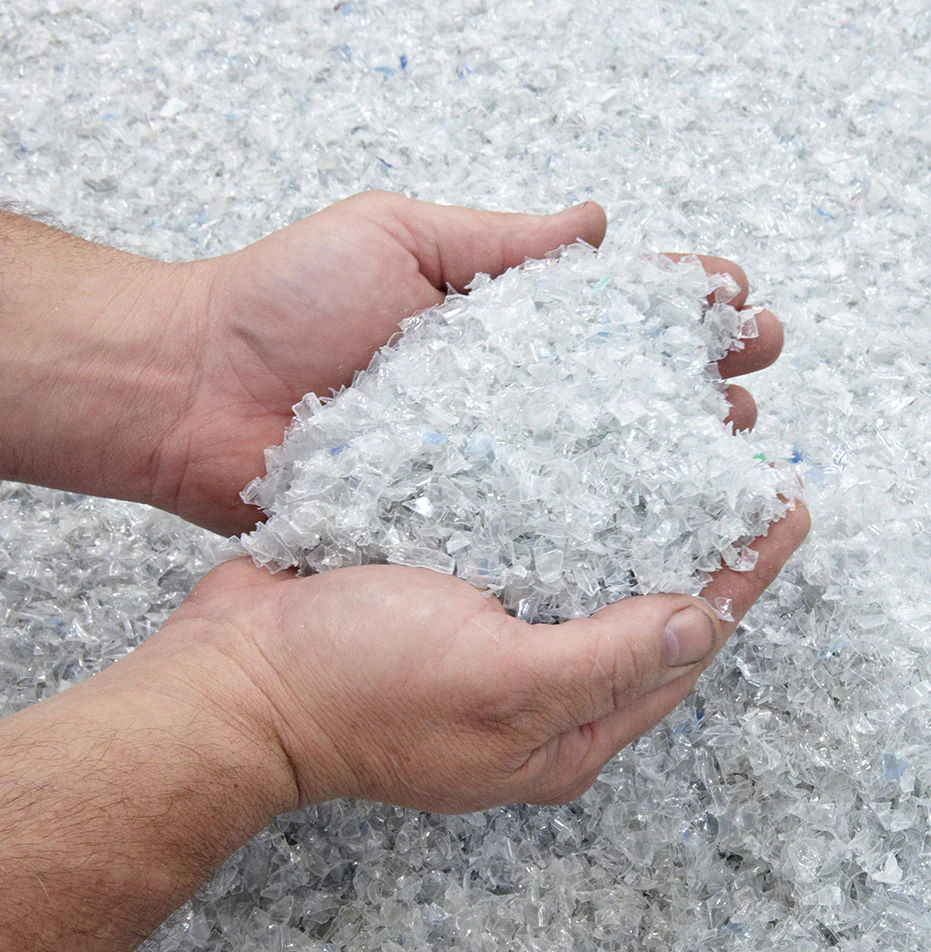
Sorted PET bottles are shredded into flakes—typically 8–12 mm pieces—then passed through a multi-stage hot wash system. The washing process removes food residue, adhesive from labels, dirt, and processing oils using hot water (80–85°C), caustic soda, and detergent in a sequence of wash tanks with friction agitation. Clean flakes are then separated by density in float-sink tanks: PET (density 1.38 g/cm³) sinks, and caps (HDPE density 0.95 and PP density 0.91) float and are skimmed off.
After density separation, flakes are centrifuge-dried and air-classified to remove labels and fine particles. The resulting clean, dry PET flakes are the intermediate product traded as a commodity in the rPET market. Flake quality is assessed by several parameters:
Quality Parameter | Specification and Significance for Fiber Production |
Intrinsic viscosity (IV) | Target: 0.70–0.82 dL/g for fiber-grade flakes. IV measures polymer chain length—lower IV means shorter chains and weaker resulting fiber. IV drops slightly during mechanical recycling due to hydrolytic degradation in washing; SSP (see Stage 4) can restore it. |
Moisture content | Less than 0.5% after drying. Excess moisture causes hydrolytic degradation during melt extrusion, further reducing IV and creating processing problems. |
Colour (L value) | L value greater than 75 for premium clear flakes. L measures lightness — higher = whiter. Critical for producing bright white rPSF that can be dyed to full color range. |
Colour (b value) | b value less than 3 for premium clear flake. b measures yellowness—lower = less yellow. Yellowing indicates thermal or UV degradation of the polymer. |
Contamination (non-PET content) | Less than 50 ppm for food-grade; less than 500 ppm for fiber-grade. PVC contamination is most critical—even trace PVC causes black specks in fiber. |
Fines content | Less than 1% of material is below 2 mm. Fines cause filter clogging in extrusion and uneven melt flow. |
Stage 4: Flake to Chip — SSP and IV Recovery
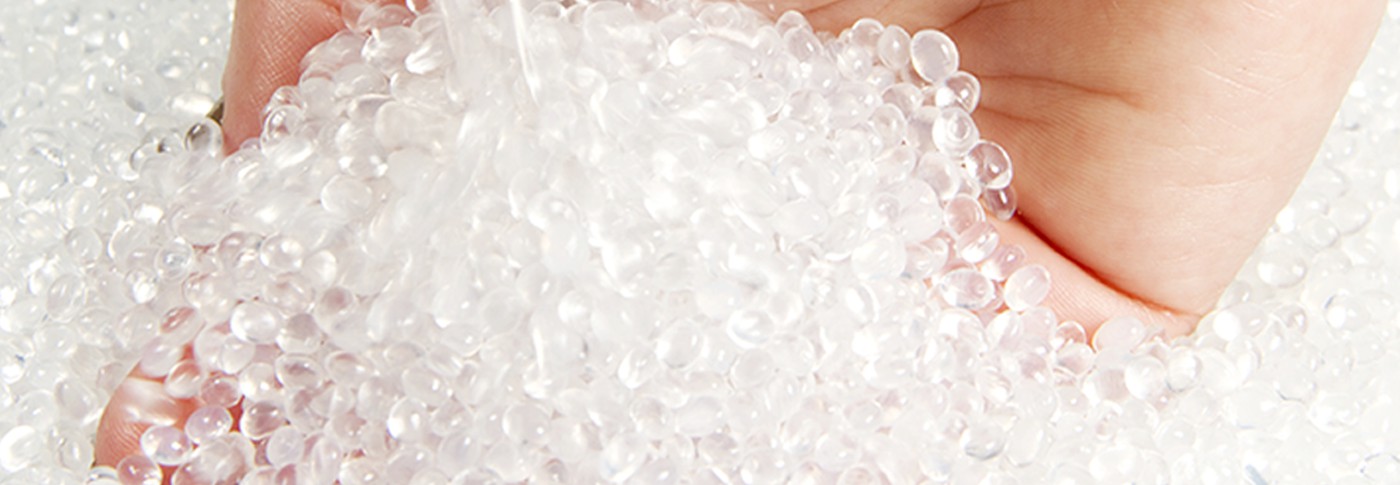
Clean PET flakes can be fed directly into fiber spinning (flake-to-fiber process) or first converted to rPET chips through an additional solid-state polymerization (SSP) step. SSP heats flakes in a nitrogen atmosphere at 200–220°C for several hours, allowing shorter polymer chains to reconnect and raising the IV back toward virgin-equivalent levels. SSP also serves as a decontamination step—removing volatile contaminants through the nitrogen purge.
The SSP step is mandatory for food-grade rPET (bottle-to-bottle recycling, where regulatory standards require near-virgin polymer quality) but optional for fiber-grade applications where moderate IV reduction is acceptable. Many rPSF producers use direct flake-to-fiber spinning without SSP, accepting the slightly lower IV (and therefore slightly lower fiber tenacity) as an acceptable trade-off for the cost saving. Premium rPSF producers who specify high-tenacity grades or want closer-to-virgin polymer performance use SSP.
Stage 5: Chip to Fiber — The Spinning Process
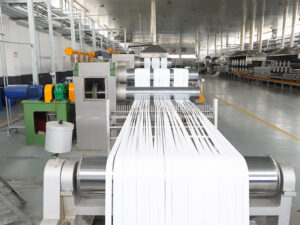
Whether from direct flake or from rPET chips, the fiber spinning process converts solid polymer into the fiber form that ultimately reaches textile manufacturers. The process mirrors virgin PSF production exactly — the polymer is melted, filtered, extruded through spinnerets, quenched, drawn, crimped, and cut — but uses rPET feedstock rather than virgin PTA+MEG polymer.
- Melt extrusion: rPET chips or flakes are dried to below 50 ppm moisture and melted in a screw extruder at 270–290°C. Multiple filter packs remove solid contaminants before the melt reaches the spinnerets.
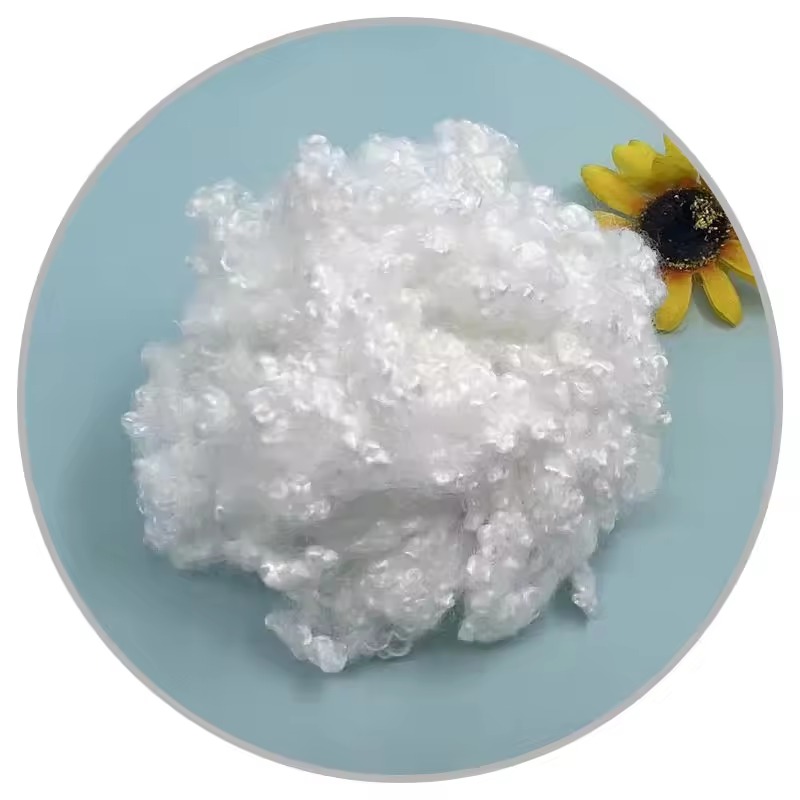
- Spinning: Molten polymer is extruded through spinnerets—plates with thousands of precisely drilled holes. For hollow conjugated siliconized (HCS) fiber, the spinneret holes have a C-shaped or 4-hole geometry that produces a hollow cross-section. The extruded filaments are cooled by quench air.
- Drawing: Cooled filaments pass through heated godets (rollers) that draw the filaments to 3–4× their extruded length, developing molecular orientation and tensile strength.
- Crimping: For conjugated crimp (the 3D helical crimp of HCS fiber), two polymer streams with slightly different crystallization rates are spun side-by-side through bicomponent spinnerets—differential shrinkage creates the permanent 3D helical crimp. Standard mechanical crimp uses a gear-type crimper for simple 2D crimps.
- Silicone application: For siliconized grades, silicone emulsion is applied to the fiber tow before cutting—lubrication reduces fiber-to-fiber friction, preventing clumping in fill applications and enabling free redistribution of fill within pillow and duvet shells.
- Cutting and baling: The tow is cut to the specified staple length (32–64 mm for spinning grades; 51–76 mm for fill and nonwoven) and baled at 220–230 kg per bale for shipment.
Stage 6: Fiber to Product—Where rPSF Enters Your Supply Chain
Depending on the grade and end application, rPSF leaves the fiber producer and enters one of three downstream pathways:
- Filling and wadding (direct use): HCS siliconized rPSF is directly stuffed into pillowcases, duvet shells, toy covers, and jacket baffles or thermally bonded with LMF (low-melt fiber) into wadding sheets for mattress toppers and quilts. This is the largest volume single end-use for rPSF globally.
- Spinning into yarn: Solid rPSF (appropriate staple length and denier) is processed on cotton-system ring spinners or open-end rotor spinners into spun polyester yarn—the same system as cotton spinning. The resulting recycled polyester spun yarn is used in woven and knit fabrics for apparel and home textiles.
- Nonwoven manufacture: rPSF is processed by carding into fiber webs, then thermally bonded, needle-punched, or hydroentangled into nonwoven fabrics for geotextiles, automotive components, filtration, and hygiene products.
rPSF vs Virgin PSF: What Changes and What Does Not
The most important commercial fact about rPSF: the PET polymer chemistry is identical to virgin PSF. The fiber that emerges from recycled PET bottle feedstock is the same polymer — polyethylene terephthalate — with the same ester linkage structure, the same hydrophobicity, the same melting point, and the same basic mechanical properties. What changes is the supply chain origin, the carbon footprint of production, and some consistency parameters.
Property | ||
Polymer chemistry | PET — identical to virgin | PET — same as recycled |
Tensile strength | 3.5–6.5 cN/dtex (slightly lower for direct flake grades; SSP grades approach virgin) | 4.0–7.0 cN/dtex — marginally higher in premium grades |
Melting point | 255–265°C — same as virgin PET | 255–265°C |
Moisture regain | ~0.4% — identical to virgin | ~0.4% |
Colour consistency | Slightly less consistent between batches—dependent on flake source consistency | Highly consistent — controlled virgin polymer input |
Whiteness (CIE whiteness) | Slightly lower for non-SSP grades; SSP grades approach virgin | Higher CIE whiteness — important for bright white end products |
GHG emissions (production) | ~1.5–2.5 kg CO₂e/kg — 60–70% lower than virgin | ~5.0–6.0 kg CO₂e/kg |
Fossil fuel feedstock | Post-consumer PET bottles — no new petroleum extraction | Virgin PTA + MEG from petroleum refining |
GRS certification | Available and required for chain-of-custody claims | Not applicable |
OEKO-TEX Standard 100 | Available—Class I for children, Class II for adults | Available — same certification scope |
Price vs virgin | Historically slight premium, gap has narrowed; market-dependent | Reference price |
Conclusion: Why the Bottle-to-Fiber Chain Matters for Your Business
The PET bottle-to-fiber supply chain is the most commercially mature and scalable pathway to verified sustainable synthetic fiber in the global textile industry. It diverts post-consumer plastic waste from landfill and ocean accumulation, delivers a 60–70% reduction in GHG emissions versus virgin fiber production, and produces a certified fiber that performs equivalently to virgin PSF in every application that matters for fill, nonwoven, and spun yarn production.
Understanding this chain in full—from collection rates and flake grades through IV management and fiber spinning to GRS certification documentation—is what enables brands to make accurate, legally defensible ‘made from recycled bottles’ claims, procurement teams to specify rPSF correctly, and manufacturers to produce products that meet both performance and sustainability requirements.
VNPOLYFIBER’s GRS-certified rPSF range covers the complete product spectrum: HCS siliconized fill fiber in 3D–15D, solid fiber for spinning and nonwovens, microfiber grades, and dope-dyed options for colorfast applications. Contact us with your fiber specification and certification requirements for technical and commercial quotations.