PET Flakes: Quality Grades, Specifications and What Fiber Producers Need — Complete Buyer’s Guide
PET flakes are the critical intermediate product in the bottle-to-fiber recycling chain — the commodity traded between PET bottle reclamation facilities and the fiber producers who convert them into rPSF. They are shredded, washed, and dried fragments of post-consumer PET bottles, typically 8–12 mm in size, packed in supersacks or bulk bags for transport. While they look like a simple commodity, PET flakes are a technically specified material with quality parameters that directly determine the quality of the fiber, yarn, or chip produced from them.
This guide covers everything fiber producers, chip manufacturers, and traders need to know about PET flakes: how they are produced, what quality parameters define their value, how color grades affect downstream fiber production, what the difference between food-grade and fiber-grade flake means, how to specify and verify flake quality, and how GRS certification applies to flake trading.
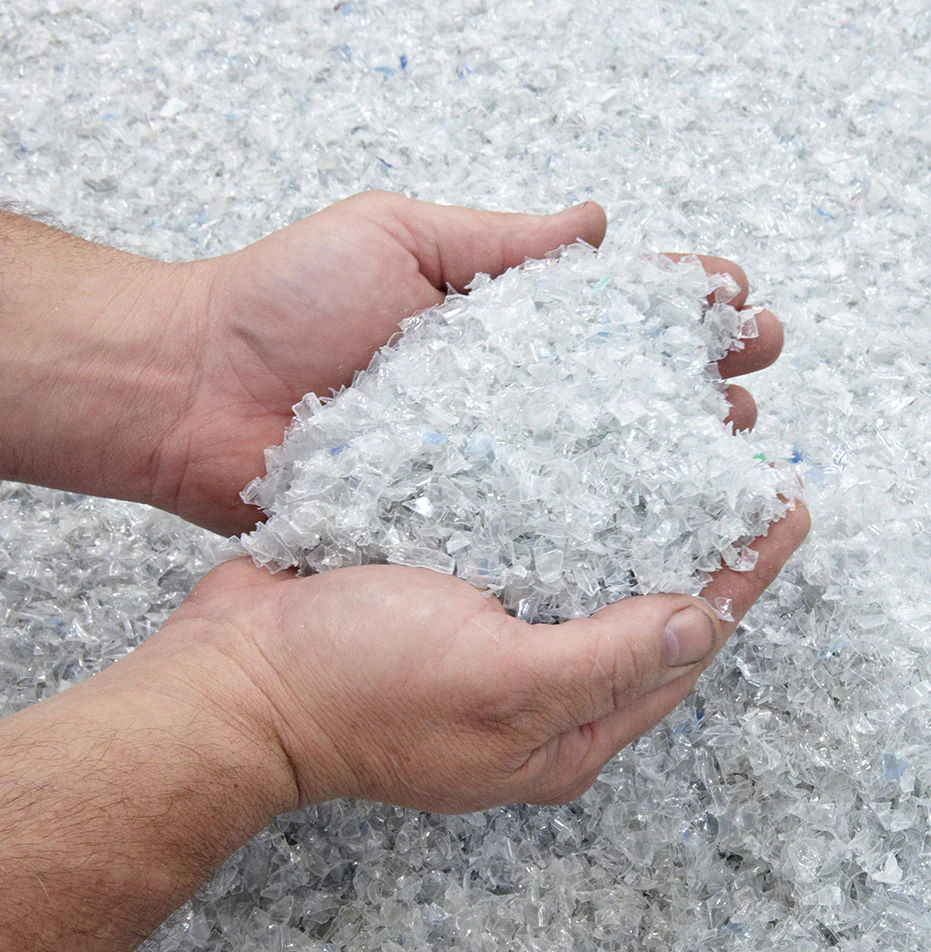
How PET Flakes Are Produced
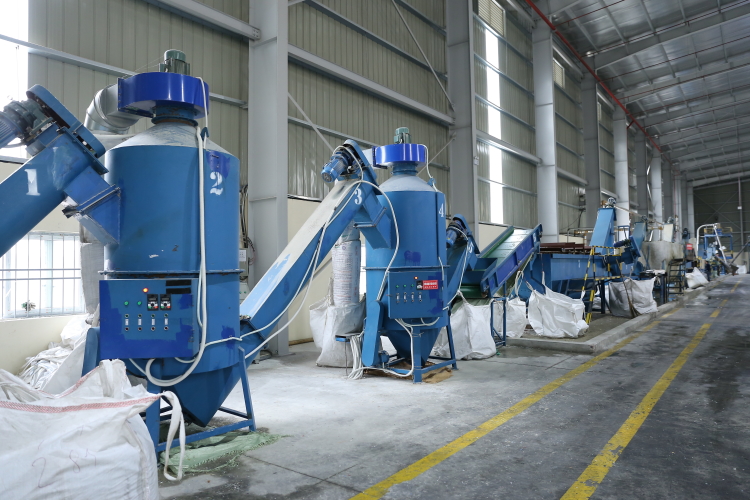
PET flake production begins at the bottle reclamation facility (also called a PET reclaimer or reclamation plant) after bottles have been collected, baled, and delivered. The production process:
- Bale breaking and pre-sorting: Bales of PET bottles are broken open and fed onto conveyor sorting lines. Manual pre-sorting removes obvious contaminants — bags, non-PET bottles, large foreign objects.
- Automated sorting (NIR and color): Near-Infrared (NIR) sensors identify polymer type, directing non-PET materials (HDPE caps, PVC, PP, PS) to reject streams. Color sensors separate clear, blue, green, and mixed-color bottles into separate streams for premium clear flake production.
- Label removal and pre-wash: Bottles pass through a pre-wash/label removal stage using friction and hot water to detach sleeve labels and reduce label contamination.
- Shredding: Sorted bottles are granulated or shredded into flakes of approximately 8–15 mm by rotary granulators. Smaller flakes wash more thoroughly but produce more fines that must be removed.
- Hot caustic wash: Flakes are washed in tanks with hot water (80–85°C) and caustic soda (NaOH) with friction agitation. This removes food residue, adhesive residue from labels, dirt, and oils. The wash sequence typically includes multiple tanks in series.
- Float-sink density separation: Washed flakes pass through float-sink tanks where PET (density 1.38 g/cm³) sinks and lighter contaminants — HDPE (0.95), PP (0.91) caps and their fragments — float and are skimmed off.
- Rinsing and centrifuge drying: Flakes are rinsed with clean water and centrifuge-dried to reduce surface moisture.
- Air classification and friction sorting: Remaining label fragments (low-density paper/film) are removed by air classifiers. Friction separators remove any remaining HDPE or PP fragments not separated by density.
- Final drying and quality control: Flakes are dried to target moisture content (typically below 0.5%) and sampled for quality testing before packaging in supersacks (typically 1,000 kg) or bulk bags.
PET Flake Quality Parameters: The Complete Specification
| Parameter | Typical Range | Significance for Fiber Production |
| Intrinsic Viscosity (IV) | 0.70–0.84 dL/g | The single most important quality parameter. Measures polymer chain length — directly determines fiber tenacity. IV below 0.72 produces weak fiber; premium fiber grades need 0.76+. IV drops slightly during wash processing; SSP can restore it. |
| Moisture content | Less than 0.5% (5,000 ppm) | Excess moisture causes hydrolytic degradation of PET during melt extrusion — rapidly reducing IV and causing processing problems. Critical for direct flake-to-fiber spinning. |
| CIE Whiteness (L value) | L greater than 75 for clear; L 55–74 for mixed | Whiteness of clear flake determines achievable fiber whiteness. L below 70 produces off-white or greyish fiber that limits dye colour range. |
| Yellowness (b value) | b less than 3.0 for premium | Yellowing indicates thermal or UV degradation during bottle use or storage. High b values cause yellow-tinted fiber that cannot be corrected without bleaching. |
| PVC contamination | Less than 10 ppm (strict) / less than 50 ppm (standard) | Even trace PVC causes severe black speck defects in fiber at the spinneret. PVC has a lower melting point than PET and degrades, generating HCl that further degrades the PET melt. Zero PVC tolerance in premium fiber grades. |
| Non-PET contamination (total) | Less than 300 ppm fiber grade; less than 100 ppm food grade | All non-PET content combined — HDPE, PP, aluminium, paper. Higher contamination causes filter clogging, spinneret blockage, and defects in fiber. |
| Fines content (below 2mm) | Less than 1% | Fine particles pass through filter packs inconsistently and cause pressure fluctuations in melt extrusion. Excessive fines reduce effective filtration. |
| Bulk density | 300–400 kg/m³ typical | Affects hopper design and feeding rate at the extruder. Dense flake is more consistent to feed; very low bulk density causes bridging. |
| Colour (for coloured grades) | Measured by spectrophotometer | Mixed colour flakes are sorted by dominant colour family — clear, light blue, green, mixed. Each produces different base fibre colour limiting achievable dyed shades. |
PET Flake Color Grades and Fiber Production Implications
The color of PET flakes — determined by the color mix of the input bottle stream — is the second most commercially important quality dimension after IV. Different color grades produce different base fiber colors, determining what end-use applications they can serve:
| Flake Grade | IV Range | Price vs Clear | Fiber Production Use and Limitations |
| Clear / natural (A grade) | 0.76–0.84 | Reference (highest) | Produces brightest white rPSF — suitable for dyeing to full colour range including pale pastels. Required for premium consumer fill products and light-colour apparel fabrics. Can achieve CIE whiteness comparable to virgin fiber with optical brightener. |
| Light blue (B grade) | 0.74–0.82 | 5–10% discount | Produces slightly blue-tinted white rPSF. Suitable for dyeing to mid-dark colours. Not suitable for very pale or white finished products without additional processing. Most water bottles are light blue — large available volume. |
| Mixed colour (C grade) | 0.70–0.80 | 15–25% discount | Produces grey or off-white base fibre. Only suitable for dark colour dope-dyed applications, solid black/charcoal fibre, or non-visible applications (nonwoven core, structural layers). Much lower value but large volume availability. |
| Green (D grade) | 0.70–0.78 | 20–30% discount | Green-tinted base fibre — severely limits achievable colour range. Generally only suitable for dark colours or dope-dyed applications where base colour is masked. Green PET volume is declining as beverage brands move to clear packaging. |
Food-Grade vs Fiber-Grade PET Flakes: The Regulatory Difference
One of the most commercially important distinctions in the PET flake market is between food-grade and fiber-grade quality — a distinction that has significant implications for IV specification, decontamination processing, regulatory compliance, and price:
- Food-grade PET flake (and food-grade rPET chip): Must meet regulatory requirements for food contact — specifically decontamination standards that ensure migrateable substances from the recycling process (including post-consumer contaminants) are reduced to safe levels. In the EU, this means compliance with EFSA (European Food Safety Authority) authorizations for specific rPET processes. In the US, FDA Letter of No Objection (LNO) is the equivalent. Food-grade rPET typically requires SSP processing (solid-state polymerization) to decontaminate and restore IV, adding significant cost. Strict IV minimum (typically 0.78+ dL/g) and very tight contamination limits.
- Fiber-grade PET flake: Subject to no food contact regulatory requirements. Lower contamination tolerance acceptable (below 300 ppm non-PET vs below 100 ppm for food grade). SSP optional — direct flake-to-fiber spinning at lower IV (0.70–0.76) is commercially common and produces adequate fiber for fill, nonwoven, and standard yarn applications. Significant cost saving vs food-grade. GRS certification applies regardless of food/fiber grade.
For rPSF production, fiber-grade PET flakes are standard — there is no regulatory requirement for food-contact quality in textile fiber applications. Brands marketing ‘food-grade rPET’ fiber are typically referring to the purity of the process and the absence of harmful chemical residues, but the formal food-contact regulatory framework does not apply to fiber. OEKO-TEX Standard 100 is the relevant fiber-specific safety certification.
Sourcing PET Flakes: Key Producing Regions and Trade Flows
PET flake is a globally traded commodity with major production in regions of high PET bottle consumption and collection infrastructure:
- China: World’s largest rPET flake producer and consumer — both from domestic bottle collection and significant imports of baled bottles. Chinese rPET flake flows primarily to domestic fiber and chip producers; some export to Southeast Asia.
- Southeast Asia (Vietnam, Indonesia, Malaysia, Thailand): Growing flake production from improving collection infrastructure; also significant importing of flake and bales from Europe and the US for fiber production. VNPOLYFIBER’s manufacturing network spans this region.
- Europe: High collection rates (particularly in Germany, Scandinavia, Netherlands) produce large volumes of premium clear flake. European flake commands quality premium; significant export flows to Asia for fiber production.
- United States: Large volume producer with relatively low collection rate (~28%); significant clear flake exports to Asia. US flake is valued for its consistent clear grade.
- India: Large and growing rPET sector; significant informal collection feeds formal reclamation sector; increasing domestic consumption for fiber and export of flake.
GRS Certification for PET Flakes
PET flakes can and should be GRS-certified at the reclaimer level for supply chains requiring verified recycled content. The GRS certification at flake level:
- Scope certificate: The reclamation facility holds a GRS scope certificate covering ‘PET flake production from post-consumer PET bottles‘ — confirming their process is audited and certified.
- Transaction certificate: For each shipment of GRS-certified flake, the reclaimer issues a GRS Transaction Certificate documenting the quantity, the recycled content percentage (100% post-consumer for virgin bottle-derived flake), and the buyer details.
- Chain continuity: The flake TC is the foundation of the downstream chain — fiber producers need GRS-certified flake TCs to issue GRS fiber TCs, and yarn or fabric producers need fiber TCs to issue their own TCs. Breaking the chain at any stage means downstream GRS claims cannot be substantiated.
Specification Checklist for PET Flake Buyers
- IV (intrinsic viscosity): Specify minimum — 0.74 dL/g minimum for standard fiber; 0.78+ for SSP-grade or food-grade
- Color grade: Clear A-grade, light blue B-grade, or mixed C-grade — matched to your fiber colour requirements
- Moisture: Maximum 0.5% at time of delivery — verify with moisture test on receipt
- PVC contamination: Maximum 10–50 ppm — specify your tolerance; premium fiber needs the tighter limit
- Total non-PET contamination: Maximum 200–500 ppm for fiber grade
- Whiteness (L value): Specify minimum L value for clear flake — L greater than 75 for premium white fiber
- Fines: Maximum 1% below 2mm
- GRS certification: Require GRS scope certificate from the reclaimer AND a GRS Transaction Certificate per shipment
- COA (Certificate of Analysis): Standard quality report with each shipment covering all specified parameters
Conclusion
PET flakes are the commercially traded commodity that connects the bottle collection system to the fiber production system — the bridge between plastic waste and sustainable textile raw material. Understanding flake quality grades, the IV specification critical for fiber performance, the color grade implications for achievable fiber whiteness, and the GRS certification requirements for each shipment is the practical knowledge that fiber buyers and producers need to source rPSF feedstock effectively and to maintain the verified recycled content chains their customers require.
VNPOLYFIBER works with GRS-certified PET flake suppliers across our manufacturing network in China, Vietnam, Malaysia, Thailand, and Indonesia. Our rPSF is produced from certified post-consumer clear bottle flake feedstock — the quality input that produces the brightest, most consistent recycled fiber for fill, nonwoven, and spinning applications.