Recycled Polyester vs Virgin Polyester: The Complete Comparison for Brands and Buyers
The question that every brand, retailer, and manufacturer faces when considering a switch to recycled polyester fiber is, “Does it actually perform as well as virgin?” And the honest answer—which is both commercially important and often understated in sustainability marketing—is, in almost every technical application, yes. Recycled polyester staple fiber (rPSF) from GRS-certified post-consumer PET bottle feedstock delivers equivalent performance to virgin PSF across the properties that matter for fill, nonwoven, and spinning applications, while delivering materially lower GHG emissions and a verifiable supply chain story.
But ‘almost’ is doing meaningful work in that sentence. There are real differences—in color consistency, in IV variability, in achievable whiteness, and in the documentation overhead of maintaining a GRS chain of custody—that buyers need to understand before committing to rPSF specifications. This guide provides the complete, honest comparison: what changes, what does not, what the sustainability numbers actually mean, and how to make verified recycled content claims that are legally defensible.
What Does Not Change: The Polymer Is the Same
The fundamental starting point for any rPSF vs. virgin PSF comparison is this: both are polyethylene terephthalate (PET) fiber. The polymer chemistry—the ester linkage backbone, the aromatic terephthalate ring, and the ethylene glycol segments—is identical. The recycling process that converts post-consumer PET bottles into rPSF does not alter the chemical structure of the polymer; it preserves and reforms it.
This means that the core physical and chemical properties of PET are largely preserved in rPSF:
- Hydrophobicity: rPSF has the same 0.4% moisture regain as virgin PSF—equally important for fill applications (where moisture retention is undesirable) and for nonwoven barrier performance
- Melting point: 255–265°C — identical to virgin; thermal processing conditions are the same
- Density: 38 g/cm³ — identical; bulk density calculations are unchanged
- Chemical resistance: Same resistance to acids, alkalis, and solvents as virgin PET
- UV stability: Comparable UV resistance to virgin fiber for most applications
- Dyeability: Accepts disperse dyes at the same temperature and pressure conditions as virgin PSF
- OEKO-TEX certification: GRS-certified rPSF with OEKO-TEX Standard 100 certification meets the same chemical safety standards as virgin-certified fiber
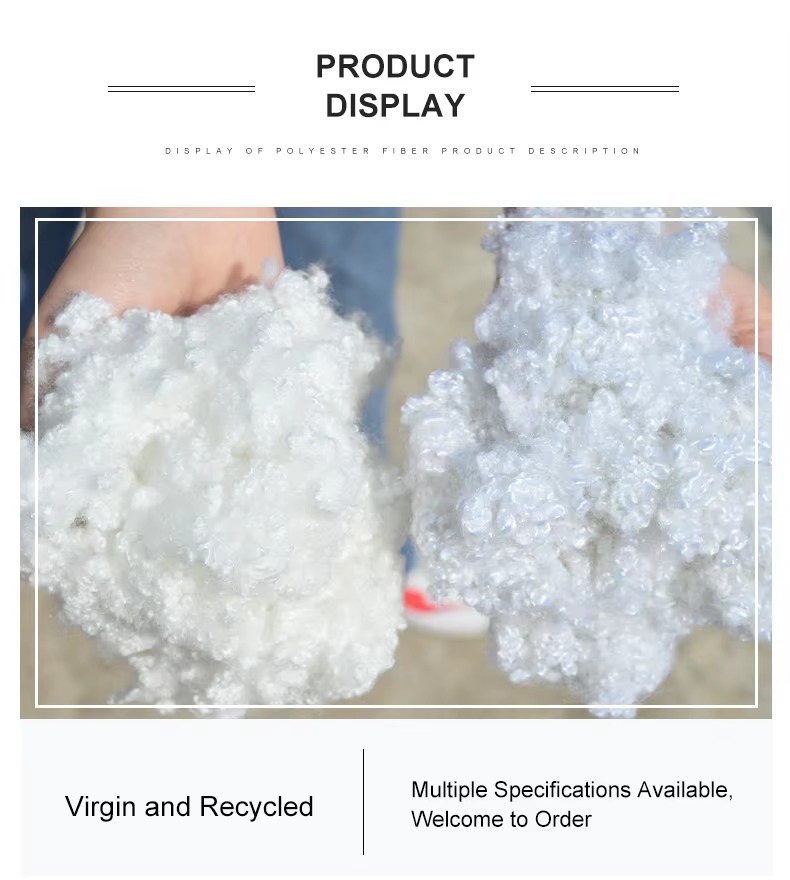
The Complete Performance Comparison
| Property | GRS Recycled PSF (rPSF) | Virgin PSF |
| Tensile strength (tenacity) | 3.5–6.5 cN/dtex—slightly lower for non-SSP direct flake grades; SSP-processed rPSF approaches virgin | 4.0–7.0 cN/dtex for standard grades; higher for specialty |
| Elongation at break | 25–45% — within virgin range for most grades | 20–50% — similar range |
| Crimp (HCS fiber) | Equivalent conjugate 3D crimp—loft retention comparable to virgin infill applications | Same 3D conjugate crimp for equivalent grade |
| Loft retention after washing | Equivalent—no measurable difference in pillow fill loft retention after laundering | Reference |
| Silicone finish | The same siliconized finish available—the same anti-clump and redistribution behavior | Reference |
| Colour consistency batch-to-batch | Slightly more variable—dependent on consistency of flake input stream | Very consistent controlled virgin polymer |
| Achievable whiteness (CIE) | Slightly lower for non-SSP grades; premium clear flake + OBA approaches virgin | Highest achievable whiteness |
| Dope-dyed availability | Black, dark grey, dark colors are available—lighter dope-dyed colors are limited by base flake color. | Full color range, including pale/pastel |
| GHG emissions (production) | ~1.5–2.5 kg CO₂e per kg—60–70% lower than virgin | ~5.0–6.0 kg CO₂e per kg |
| Water use (production) | Very low—comparable to virgin (both have very low agricultural water use) | Very low |
| GRS certification | Available and standard for verified sustainable claims | Not applicable |
| OEKO-TEX Standard 100 | Available Class I and Class II | Available Class I and Class II |
| Price | Competitive with virgin in most markets; slight premium in some periods/grades | Reference commodity price |
The Sustainability Numbers: What the GHG Savings Actually Mean
The 60–70% lower GHG emissions claim for recycled vs. virgin polyester is the most widely cited sustainability credential for rPSF—and it is well-substantiated by multiple independent Life Cycle Assessment (LCA) studies, including Textile Exchange’s Preferred Fiber & Materials Market Report and peer-reviewed academic analyses. But understanding what these numbers mean requires some precision:
- What the GHG comparison covers: The LCA comparison is typically ‘cradle-to-gate’—it covers the emissions from feedstock extraction through fiber production, but not the emissions associated with subsequent processing, use, or end of life. The 60–70% saving applies to the production phase of the fiber lifecycle.
- Virgin polyester GHG baseline: ~5.0–6.0 kg CO₂e per kg of fiber. This covers petroleum extraction → PTA and MEG monomer production → PET polymerization → fiber spinning.
- Recycled polyester GHG: ~1.5–2.5 kg CO₂e per kg of fiber. This covers collection and sorting → PET flake production → fiber spinning. The energy-intensive monomer synthesis step is replaced by mechanical processing of an existing polymer.
- Scope 3 implications for brands: For brands with approved Science-Based Targets (SBTi) covering Scope 3 Category 1 (purchased goods and services), switching from virgin to GRS-certified rPSF delivers a measurable, reportable emissions reduction that counts toward Scope 3 targets—with the GRS TCs providing the documentation trail.
Important caveat: neither virgin nor recycled polyester is biodegradable, and both shed microplastics during washing. The GHG savings of rPSF are real and significant — but they do not address polyester’s end-of-life persistence or microplastic contribution. Accurate sustainability communication acknowledges both the genuine GHG benefit and the persistent non-biodegradability limitation.
The Honest Limitations of rPSF
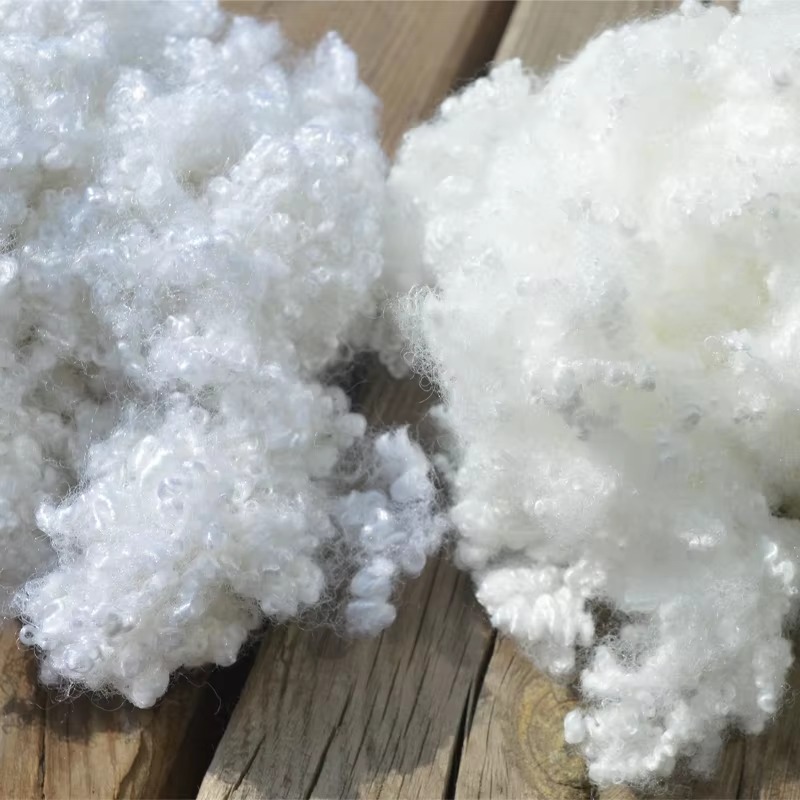
A credible guide to rPSF vs. virgin must be honest about where recycled fiber genuinely falls short of virgin performance—because suppliers who oversell rPSF create customer disappointment and undermine market confidence in recycled materials:
- Color consistency batch-to-batch: The most commonly experienced quality challenge with rPSF. Because the input stream (PET flakes from post-consumer bottles) varies in color and contamination between batches, the base whiteness of rPSF can vary slightly between production runs. For products where consistent bright white is critical—premium white pillow fill, white wadding visible through light covers—this can require more careful quality monitoring than virgin fiber. Premium rPSF from clear-bottle-only feedstock with consistent sourcing has much better consistency than mixed-feedstock grades.
- Achievable maximum whiteness: Non-SSP rPSF from mixed-color flake cannot achieve the maximum CIE whiteness of virgin fiber without optical brightening agents (OBAs). For products where the fiber is visible or for very light-colored dyed applications, this can be a limitation. Clear-only flake + SSP + OBA processing closes most of this gap.
- Limited light dope-dyed options: The slightly off-white base color of non-premium rPSF limits achievable pale dope-dyed colors (pastels, light pink, and light blue). Dark dope-dyed colors—black, navy, charcoal, and dark green—are fully achievable. Brands specifying rPSF in light-color dope-dyed applications should verify base color specifications with their supplier.
- Documentation overhead: Maintaining GRS chain of custody requires TC documentation for every shipment, scope certificate verification, and audit trails that virgin fiber supply chains do not require. This is not a technical product limitation but a sourcing process consideration—particularly for first-time rPSF buyers who need to establish GRS documentation workflows.
- Price volatility: rPSF pricing is linked to PET bottle collection rates, virgin PSF pricing, and demand from brand sustainability programs—all of which can move independently. In periods of strong sustainability-driven demand, rPSF can trade at meaningful premiums over virgin material. Price stability planning needs to account for this volatility.
Making Verified Recycled Content Claims: What Is Required
For brands using rPSF in products with ‘recycled polyester’ marketing claims, the following documentation chain is required for legally defensible claims in major markets (EU, UK, and US):
- GRS scope certificate from fiber supplier: Confirm your rPSF supplier holds a current GRS scope certificate covering fiber production. Verify at textiledirectory.textileexchange.org.
- GRS Transaction Certificate per shipment: Require a TC for every delivery of rPSF—documenting the specific quantity and certified recycled content percentage of that shipment.
- Your own GRS certification: If you are a pillow manufacturer, nonwoven producer, or brand putting GRS claims on finished products, you must also hold GRS certification covering your processing stage. The claim must be continuous through the supply chain.
- Accurate claim language: “Made with X% GRS-certified recycled polyester”—state the actual certified percentage, not a rounded or approximated figure. Avoid ‘made from recycled bottles‘ without GRS backing — this is unverifiable and regulatorily exposed.
- Keep records: Retain all TCs and scope certificates for a minimum of 3 years—this is the standard audit lookback period for certification body verification audits.
Application-by-Application: When to Switch to rPSF
| Application | Switch Recommendation | Notes |
| Pillow fill (HCS siliconized) | ✅ Switch now | Performance equivalent. GRS certified. OEKO-TEX Class I for children. Premium clear flake rPSF delivers acceptable whiteness. Strong brand story. |
| Duvet/comforter fill | ✅ Switch now | Same as pillow fill. Lighter weight per area means whiteness matters—specify premium clear flake rPSF. |
| Cluster fill (fiber ball) | ✅ Switch now | GRS-certified rPSF cluster fill is commercially available. Performance equivalent to virgin. |
| Mattress wadding and topper | ✅ Switch now | Fill color is less critical (not visible). Performance equivalent. Cost-effective way to add GRS credentials. |
| Stuffed toy fill | ✅ Switch now | OEKO-TEX Class I certified rPSF is available. GRS certification provides brand credibility for sustainability-conscious toy brands. |
| Nonwoven (needlepunch, thermal bond) | ✅ Switch now | Fiber color not visible in product. Full performance equivalence. GRS adds significant brand value for retail nonwoven products. |
| Spun yarn for apparel fabric | ✅ Switch now | Ring-spun rPSF yarn performance equivalent. GRS TC required. Batch consistency monitoring recommended. |
| White consumer products (visible white fill) | ⚠️ Specify carefully | Specify clear flake feedstock and minimum L whiteness value. Premium rPSF grades perform well; generic mixed-flake rPSF may show whiteness variation. |
| Pale dope-dyed colours | ⚠️ Verify with supplier | Light colors are limited by base flake color. Test production samples before committing to specifications. |
| Maximum tenacity yarn (industrial) | ⚠️ Consider SSP grade | Standard direct-flake rPSF has a slightly lower tenacity ceiling than virgin for demanding industrial applications. SSP-processed rPSF closes the gap. |
Conclusion: The Switch Is Ready for Most Applications — Get the Documentation Right
The evidence is clear: for the vast majority of fill, nonwoven, and spinning applications, GRS-certified rPSF is a technically equivalent, commercially competitive, and sustainability-superior alternative to virgin PSF. The 60–70% GHG savings are real, well-documented, and reportable against Scope 3 targets. The performance limitations are manageable with correct specifications—particularly by specifying premium clear-flake feedstock for applications where whiteness matters.
The switch from virgin to recycled polyester is not a compromise—it is a specification exercise that requires attention to flake grade, color consistency requirements, and GRS documentation workflows. Done correctly, it delivers equivalent product performance with a materially lower carbon footprint and a verified supply chain story that is increasingly required by retail buyers, brand sustainability commitments, and emerging regulatory frameworks in the EU and beyond.
VNPOLYFIBER’s GRS-certified rPSF range—HCS siliconized, hollow slick, solid, microfiber, and dope-dyed—is produced from premium clear post-consumer PET bottle feedstock and carries both GRS chain-of-custody certification and OEKO-TEX Standard 100 (Class I for children and Class II for adults). We provide GRS Transaction Certificates for every shipment and full certification documentation to support our customers’ brand-level GRS certification processes.