POY vs FDY vs DTY vs HTY vs PSF: The Complete Polyester Yarn Comparison Guide
Every woven fabric, knitted garment, home textile, and technical textile that uses polyester starts with one of five core polyester products: POY, FDY, DTY, HTY, or PSF. These abbreviations appear on every polyester yarn specification sheet, quotation, and purchase order—yet they are frequently misunderstood, confused with each other, or specified incorrectly by buyers who are not deeply familiar with the production chain.
The confusion is understandable. POY, FDY, and DTY are all polyester filament yarns made from the same PET polymer, going through overlapping production steps. The differences between them — in molecular orientation, mechanical properties, surface character, and appropriate downstream applications — are real and commercially significant, but they are not immediately obvious from the names alone.
This guide explains the complete polyester product family: what each yarn form is, how it is produced, precisely how it differs from the others, what it is correctly used for, and how to choose the right form for your specific application. It is written for fabric manufacturers, textile buyers, yarn traders, and anyone who needs to specify or source polyester yarn accurately.
The Polyester Production Chain: How Every Form Relates
Understanding the five polyester product forms requires first understanding where each sits in the production chain. All five begin with the same raw material — PET polymer (produced by condensation polymerization of PTA and MEG) — but diverge at different processing stages:
Stage | Product | What Happens at This Stage |
1 | PET Polymer / PET Chips | PTA and MEG polymerized into PET resin, solidified into chips for transport or used as melt directly |
2 | POY (Partially Oriented Yarn) | Polymer melt extruded through spinnerets at moderate speed (~3,000–4,000 m/min); filaments partially oriented—the intermediate form that feeds DTY and FDY production |
3a | FDY (Fully Drawn Yarn) | POY drawn and crystallized in a one-step spin-draw process at high speed; fully oriented, heat-set—ready for direct weaving or knitting |
3b | DTY (Draw Texturized Yarn) | POY simultaneously drawn and texturized through friction discs and false-twist spindle, gives filaments a permanent 3D crimp—the soft, bulky apparel yarn |
3c | HTY (High Tenacity Yarn) | Specialized high-IV polymer drawn to very high orientation under controlled conditions; tenacity >60 cN/tex—the industrial/technical yarn form |
Alternative | PSF (Polyester Staple Fiber) | Polymer melt extruded into tow, crimped, and cut into staple lengths (25–76 mm); the fiber form used in spinning, nonwovens, and fill—not a yarn itself |
The key relationship: POY is the feedstock that gets converted into FDY, DTY, or twisted yarns. It is rarely used directly in fabric production. PSF is in a separate branch—it is not a yarn but a fiber that gets spun into spun yarn or processed directly into nonwovens and fill products. The four filament yarn forms (POY, FDY, DTY, HTY) and PSF serve almost entirely different markets and fabric systems.
POY — Partially Oriented Yarn: The Intermediate
What POY Is
Partially Oriented Yarn (POY)—also called Pre-Oriented Yarn or Partially Drawn Yarn—is the primary form of polyester filament yarn produced directly from the polymer melt. It is extruded through spinnerets at winding speeds of approximately 3,000–4,000 meters per minute, fast enough to produce some molecular orientation in the filaments but not enough to fully crystallize the polymer chains. The result is a yarn with partial molecular orientation—hence the name—that is stable for storage and transport but still has significant residual draw potential.
POY is semi-stable: it will change properties if stored for too long or exposed to heat before drawing. It is typically packed on 10–15 kg cheese cones, palletized, and shipped promptly to texturizing mills or draw-warping operations for conversion.
POY Specifications and Available Variants
- Luster: Semi-dull (SD, with TiO₂ additive), bright (BR, trilobal cross-section for maximum shine), or full dull (FD)
- Denier range: Typically 50D to 1000D; most common apparel POY in 50D–300D range
- Filament count: 24F to 288F depending on denier—more filaments = finer, softer resulting yarn
- Colors: Raw white (RW) for downstream dyeing; dope-dyed black or color (DDB/DDC) where colorfast master-batch is added to the polymer melt before spinning
- Recycled grades: GRS-certified POY produced from rPET chips or flakes; same properties as virgin, with verified recycled content documentation
What POY Is Used For
- DTY production (primary use): The vast majority of POY is consumed by texturizing mills to produce DTY. The residual draw potential in POY is what allows the false-twist texturizing machine to simultaneously draw and texturize the yarn in a single operation.
- FDY production: POY can be further drawn and heat-set in a separate draw-twisting operation to produce FDY — though most FDY is now produced in integrated spin-draw processes that skip the intermediate POY stage.
- Draw-warping for weaving: Some POY is directly draw-warped — drawn and wound onto warp beams for immediate use in weaving without the texturizing step. Produces a smooth, flat filament fabric.
POY is almost never used directly in knitting or weaving without further processing — its partial orientation gives it poor dimensional stability and inconsistent properties that make direct fabric formation problematic.
FDY — Fully Drawn Yarn: The Smooth Filament
What FDY Is
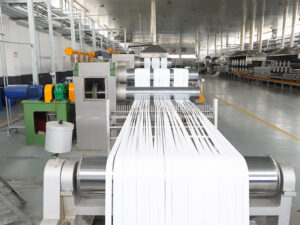
Fully Drawn Yarn (FDY) — also called Spin Draw Yarn (SDY) or Polyester Filament Yarn (PFY) — is polyester filament yarn that has been fully drawn and heat-set during production, resulting in complete molecular orientation and crystallization. Modern FDY production uses an integrated spin-draw process: the polymer is extruded from spinnerets, drawn through heated godets (rollers), and wound onto bobbins in a single continuous operation, without the intermediate POY stage.
The complete drawing and crystallization process gives FDY highly stable, consistent properties: it will not change dimensions, shrink unpredictably, or draw further in downstream processing. This stability is what makes FDY suitable for direct use in weaving and knitting without further processing.
FDY vs POY: The Key Differences
Property | POY | FDY |
Molecular orientation | Partial (~55–65%) | Full (~85–95%) |
Crystallinity | Low | High |
Tensile strength | Lower (2.5–3.5 cN/dtex) | Higher (3.8–5.5 cN/dtex) |
Elongation at break | High (120–180%) | Low (20–40%) |
Dimensional stability | Poor—will draw further | Excellent — fully stable |
Surface appearance | Slightly uneven | Smooth, consistent |
Direct use in fabric | Not recommended | Yes—woven and knitted directly |
Primary use | Feedstock for DTY, FDY, draw-warping | Direct weaving, knitting, twisting |
Packing | Cheese cones ~10–15 kg | Cheese cones ~10–25 kg |
FDY Applications
- Woven fabrics: Taffeta, chiffon, satin, georgette, organza—FDY’s smooth filament surface produces the clean, lustrous face characteristic of woven filament fabrics. FDY is used as both warp and weft.
- Knitted fabrics: Warp-knit tricot for linings and lingerie; circular knit for smooth-surface fabrics. FDY produces a smooth, slightly shiny knit surface distinct from the softer matte surface of DTY knits.
- Twisted and embroidery yarns: FDY is twisted to high TPI (twists per inch) to produce embroidery thread, sewing thread (when combined with spun yarn in core-spun constructions), and specialty twisted yarns for lace and jacquard fabrics.
- Technical applications: Filter fabrics, geotextile woven products, tent and awning fabrics, and industrial sacks—FDY’s consistent strength and stability make it reliable for structural woven applications.
DTY — Draw Texturized Yarn: The Soft, Bulky Workhorse
What DTY Is
Draw Texturized Yarn (DTY) — also called Drawn Textured Yarn or Textured Polyester Yarn — is produced by processing POY through a false-twist texturizing machine that simultaneously draws the yarn and inserts a permanent three-dimensional crimp into the filaments. The false-twist process runs the yarn through a series of heated zones and friction discs that twist the filaments, heat-set the twist into the polymer, and then untwist—leaving the filaments with a permanent helical crimp that gives the yarn bulk, softness, and stretch.
The resulting yarn looks and behaves quite differently from FDY: it is bulkier, softer, more opaque, and has natural stretch from its crimped structure. This crimp makes DTY fabrics comfortable against skin, gives them a cotton- or wool-like handfeel, and allows them to recover from deformation—properties that make DTY the dominant yarn for soft apparel and home textile applications.
DTY Technical Parameters and Variants
- 1-heater vs. 2-heater DTY: 1-heater DTY has more stretch and bulk (more textured, woolly character). 2-heater DTY has less stretch but higher dimensional stability and a cleaner appearance — better for structured fabrics where minimum elongation is needed.
- Intermingling (interlace) level: NIM (non-intermingled, 0–10 knots/m) for fine, open yarn; SIM (semi-intermingled, 40–50 knots/m) for standard fabrics; HIM (high-intermingled, 100–120 knots/m) for warp beams and applications replacing sizing.
- Twist direction: S-twist or Z-twist—often used in alternating patterns in fabric to reduce torque and produce a uniform appearance.
- Multi-ply DTY: 2-ply, 3-ply, 4-ply, and 5-ply constructions produced by combining multiple DTY ends—used for heavier, warmer fabrics including blankets and upholstery.
DTY vs FDY: The Critical Commercial Difference
Property | FDY | DTY |
Structure | Smooth, flat filaments — no crimp | Crimped, bulked filaments—3D helical structure |
Hand feel | Smooth, silky, sometimes slippery | Soft, warm, cotton- or wool-like |
Fabric appearance | Lustrous, smooth face | Matte to semi-matte, slightly fuzzy |
Stretch | Minimal—dimensionally stable | Moderate—crimp gives inherent stretch |
Bulk | Low, flat filaments pack tightly | High crimp creates air spaces and adds warmth |
Moisture wicking | Low | Better—crimped structure increases surface area |
Dyeability | Good—requires disperse dye at 130°C | Good—same disperse dye system |
Primary end uses | Woven taffeta, chiffon, linings, filter fabrics | Knit jersey, fleece, blankets, upholstery, sportswear |
Price vs POY | Higher — additional draw processing | Higher — additional texturizing processing |
DTY Applications
- Apparel: The dominant yarn for polyester knit apparel—jersey T-shirts, interlock polos, fleece, sweatshirts, tracksuits, and most sportswear fabrics. DTY’s bulk and softness give knit fabrics their comfortable, cotton-like character.
- Home textiles: Rachel blankets (cationic DTY for bi-color effects), curtain fabrics, sofa fabrics, mattress fabrics, upholstery, cushion covers, and sheets.
- Woven fabrics: Suiting, shirting (in combination with FDY), and fabrics where textured bulk and warmth are desired alongside the stability of a woven construction.
- Zipper tapes: DTY’s crimp and bulk make it ideal for the fabric tape of zippers—it provides cushion against the zipper mechanism and a soft feel when garments are worn.
HTY — High Tenacity Yarn: The Industrial Specialist
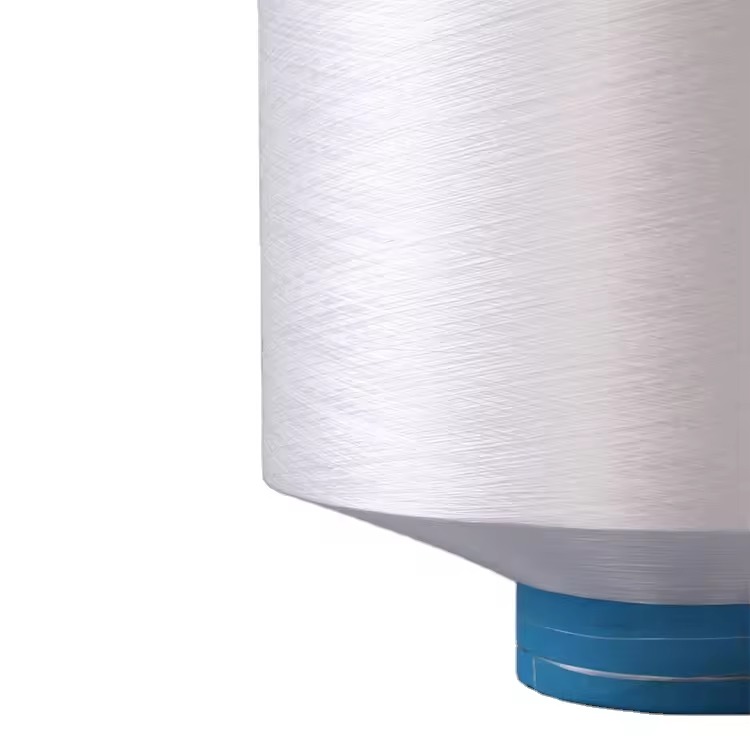
High Tenacity Yarn (HTY) is a specialized polyester filament yarn produced from a high intrinsic viscosity (IV) polymer—higher IV means longer polymer chains and higher potential strength. The yarn is drawn to very high orientation levels (draw ratio 4–6×, versus 3× for standard FDY) under precisely controlled temperature conditions, maximizing molecular chain alignment along the fiber axis and achieving tenacity values of 60–90 cN/tex—far above standard FDY’s 38–55 cN/tex range.
HTY is not an apparel or home textile yarn. It exists for demanding structural and safety applications where the strength-to-weight ratio of polyester is critical:
- Tire cord fabric: Polyester HTY (840D–1890D, high-twist cord construction) reinforces tire carcasses in passenger and light truck tires—providing dimensional stability, heat resistance, and fatigue resistance through millions of flexing cycles.
- Seat belts: Flat-woven polyester HTY webbing in automotive seat belts must withstand sudden peak loads in crash conditions—typically tested to 15,000+ N tensile strength.
- Conveyor belts: Industrial conveyor belt fabric reinforced with polyester HTY—particularly for mining applications where the belt’s dimensional stability prevents the constant re-tensioning that nylon belts require.
- Ropes, fishing nets, safety nets: Heavy-denier HTY (840D–1890D) in various constructions for marine and industrial rope applications.
- Fire hoses, geosynthetics, airbag fabric: Safety-critical applications requiring guaranteed minimum tensile performance.
- High-strength sewing thread (fine HTY): Fine-denier HTY (44D–300D) with low shrinkage for sewing thread applications — particularly for industrial sewing where thread strength and heat resistance are critical.
PSF — Polyester Staple Fiber: The Different Branch
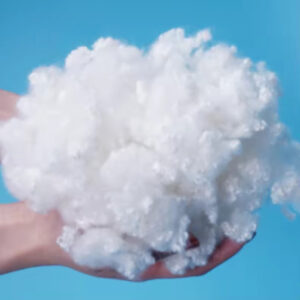
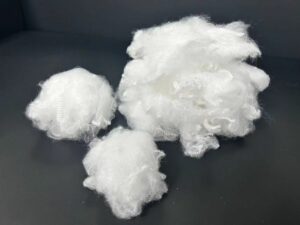
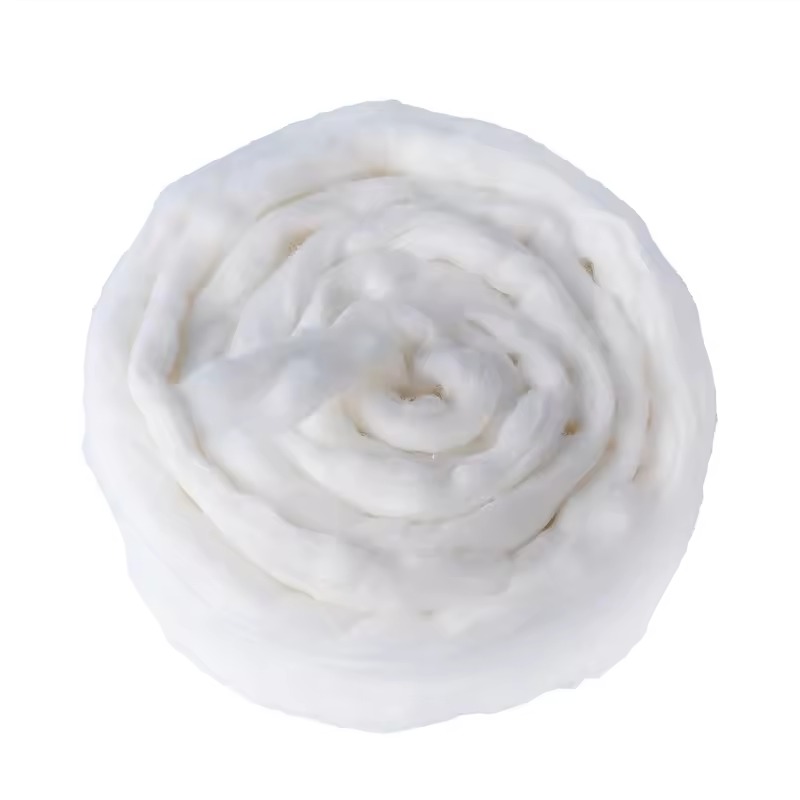
Polyester Staple Fiber (PSF) is often grouped with POY/FDY/DTY in discussions of polyester products, but it is fundamentally different in structure and application. PSF is not a yarn—it is a fiber that is cut from tow into staple lengths (typically 25–76 mm) and used as a raw material for spinning or nonwoven processing rather than as a direct textile input.
Dimension | Polyester Filament Yarn (POY/FDY/DTY/HTY) | Polyester Staple Fiber (PSF) |
Physical form | Continuous filament — one or many unbroken strands of indefinite length | Short-cut discrete fibers—25 mm to 76mm lengths |
Production output | Wound on cheese cones or bobbins—ready as yarn | Baled (200–250 kg bales)—raw material for further processing |
Downstream use | Direct weaving, knitting, texturizing, or twisting | Spinning into spun yarn, OR nonwoven manufacture, OR fill (pillow, duvet) |
Fabric character | Smooth, lustrous, precise filament structure | Soft, matte, spun-yarn fabric character similar to cotton |
Key markets | Apparel fabrics, home textile wovens, technical textiles | Spinning mills, nonwoven manufacturers, bedding fill producers |
Key fiber types | SD, bright, trilobal, dope-dyed, recycled | HCS (hollow conjugated siliconized), solid, bicomponent, microfiber, dope-dyed |
Denier range | 15D filament yarn (for fine fabric) to 1890D (HTY) | 0.9D (microfiber PSF) to 20D (coarse fill/nonwoven) |
Price relationship | Typically priced per kg of yarn, by denier and grade | Priced per kg of fiber, by denier and type |
VNPOLYFIBER’s core product is PSF—hollow conjugated siliconized (HCS) polyester staple fiber for fill and wadding, solid fiber for spinning and nonwovens, and specialty grades including dope-dyed, bicomponent (LMF), and microfiber. Our PSF is GRS-certified for recycled content and OEKO-TEX Standard 100 certified for safe use in all textile applications, including children’s products.
The Full Comparison: All Five Polyester Forms
Property | POY | FDY | DTY | HTY | PSF |
Form | Continuous filament yarn | Continuous filament yarn | Continuous filament yarn | Continuous filament yarn | Discrete staple fiber |
Orientation | Partial | Full | Full (crimped) | Ultra-high | Variable |
Strength (cN/dtex) | 2.5–3.5 | 3.8–5.5 | 3.0–4.5 | 6.0–9.0 | 3.5–7.0 |
Surface | Smooth | Smooth, lustrous | Soft, bulky, matte | Smooth | Discrete fiber ends |
Stretch | High (residual draw) | Low | Moderate (crimp) | Very low | N/A — not a yarn |
Typical denier | 50–1000D | 30–600D | 50–300D | 44–1890D | 0.9–20D per filament |
Key end use | DTY/FDY feedstock | Wovens, linings, knits | Apparel, blankets, upholstery | Tire cord, belts, ropes | Spinning, nonwovens, fill |
Direct fabric use | No—intermediate | Yes | Yes | Yes (industrial) | No—needs processing |
Dyeing | Disperse dye 130°C | Disperse dye 130°C | Disperse dye 130°C | Disperse dye (cord) | Disperse dye or dope-dye |
Recycled grade | GRS rPOY | GRS rFDY | GRS rDTY | Limited | GRS rPSF available |
Dope-Dyed Yarn: The Colorfast Solution Across All Types
Dope-dyed (also called solution-dyed or spun-dyed) polyester yarn is produced by mixing color masterbatch into the polymer melt before extrusion — so the color is integral to the fiber structure rather than applied to the surface afterward. This applies to POY, FDY, DTY, and HTY alike and to PSF.
- Advantages over conventional post-dyeing: Outstanding wash fastness (color does not fade with washing), exceptional light fastness (color does not fade with UV exposure—critical for outdoor fabrics), no wastewater from dyeing process, lower cost than conventional dyeing for large volumes
- Limitation: Colors must be specified at the manufacturing stage—cannot be changed after production. Minimum order quantities for specific colors are typically higher than for raw white yarn that is dyed later.
- Best applications: Outdoor furniture fabric, awning fabric, marine textiles, automotive interior fabric, military and workwear—any application where color retention under UV and laundering is critical
Recycled Polyester Yarn: GRS Certification Explained
All five polyester product forms are now available in recycled grades—produced from post-consumer PET bottle flakes or recycled PET chips rather than virgin PTA and MEG. The GRS (Global Recycled Standard), administered by Textile Exchange, provides third-party chain-of-custody certification verifying that the recycled content claim is accurate and traceable from recycling facility through to finished yarn.
- For brands: GRS certification enables ‘made with GRS-certified recycled polyester’ marketing claims that are legally defensible and auditable—distinguishing verified sustainable claims from unverifiable greenwashing.
- Environmental benefit: Recycled polyester delivers approximately 60–70% lower GHG emissions per kilogram versus virgin polyester production—the same polymer performance with a materially lower carbon footprint.
- Transaction certificates: Require a GRS Transaction Certificate (TC) for each shipment — not just a company-level scope certificate — to document the specific recycled content of each batch you receive.
Yarn Selection Guide: Choosing the Right Form
Your Application Requirement | Recommended Polyester Form |
Soft knit apparel, T-shirts, fleece, sportswear | DTY—the bulk and softness of crimped filaments give knit fabrics cotton-like comfort |
Woven taffeta, chiffon, lining, smooth woven | FDY—smooth flat filaments produce clean woven faces and good drape |
Embroidery or sewing thread | FDY (twisted) or HTY (fine range) — strength and consistency for thread applications |
Tire cord, seat belt, conveyor belt reinforcement | HTY—only high-tenacity yarn meets structural safety requirements |
Rope, fishing net, industrial webbing | HTY (coarse denier, 840D–1890D)—maximum strength per weight |
Rachel or warp-knit blanket | DTY (cationic for bicolour)—bulk, softness, warmth |
Pillow fill, duvet fill, mattress topper | PSF (HCS siliconized) — fill fiber, not yarn; engineered for loft and resilience |
Nonwoven fabric (geotextile, hygiene, wadding) | PSF (various grades depending on application) |
Cotton-system spun yarn for weaving or knitting | PSF (appropriate staple length and denier) → then spin at mill |
Outdoor or automotive fabric (colorfast) | Dope-dyed FDY or DTY — UV-stable color with no washing fade |
Sustainable product with verified recycled content | GRS-certified rPOY → rDTY or rFDY; or GRS-certified rPSF for fill/nonwoven |
Conclusion
POY, FDY, DTY, HTY, and PSF are not variations on the same product — they are genuinely different forms of polyester with different production processes, different properties, and almost entirely different end markets. The right specification requires understanding where in the production chain each form sits, what properties it offers, and what applications it is correctly matched to.
For most apparel applications: DTY for soft knit fabrics, FDY for smooth wovens. For industrial and safety applications: HTY. For fill and nonwoven production: PSF. For feedstock supply to texturizing mills: POY. Using the wrong form creates downstream processing problems, suboptimal fabric properties, or unnecessary cost—using the right form delivers exactly the fabric character, performance, and commercial value the application requires.