How Pillows Are Made: The Complete Guide to Pillow Construction, Fill Specifications and Manufacturing
Every night, billions of people rest their heads on a pillow — and the vast majority give no thought to what is inside it or how it was made. For pillow manufacturers, home textile brands, hotel procurement teams, and fiber suppliers, however, the decisions that go into pillow construction are entirely consequential. Fill fiber specification, fill weight, cover fabric selection, sewing construction, and packaging together determine whether a pillow delivers years of comfortable, supportive sleep or flattens and clumps within months.
This guide is written for the professionals who make, buy, and specify pillows at a commercial level—manufacturers seeking to understand fill fiber options and specifications, brands looking to differentiate product lines, hospitality buyers specifying institutional pillow requirements, and the broader home textile supply chain. It covers every stage of pillow manufacturing: fill fiber selection and specifications, fill weight determination, cover fabric choices, sewing construction methods, quality control metrics, and how different pillow specifications map to market segments from budget retail to ultra-premium hotel collections.
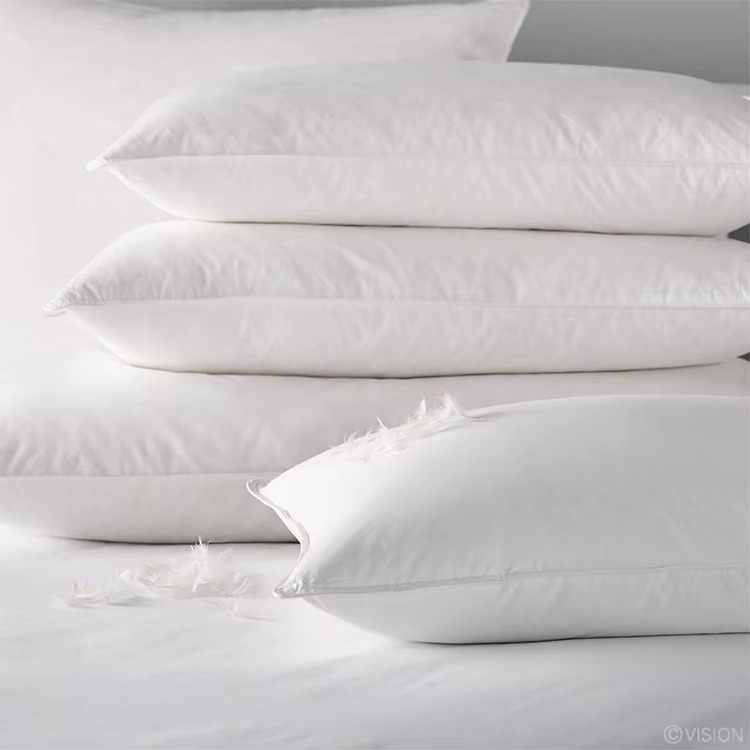
VNPOLYFIBER supplies hollow conjugated siliconized (HCS) polyester staple fiber—the global standard for pillow fill—in both virgin and GRS-certified recycled grades, across the full denier range (3D to 20D), with OEKO-TEX Standard 100 Class I certification for children’s applications. This guide reflects the technical knowledge from supplying pillow fill fiber to manufacturers across 30+ countries.
The Anatomy of a Pillow: Four Components
Every pillow—regardless of fill type, price point, or market segment—consists of four components whose quality and specifications interact to determine the finished product’s performance:
Component | Role and Key Specifications |
Fill material | The core functional element determines softness, support, loft, warmth, durability, washability, and allergen profile. The largest cost component in premium pillows is the most important specification decision. |
Inner casing (ticking) | The direct container of the fill must prevent fill escape while allowing the fill material’s properties to express through it. For loose fiber fill, tight weave counts (200+ thread count cotton or tight polyester-cotton) are essential. For cluster fiber and down, specially constructed downproof ticking is required. |
Outer shell (cover) | The consumer-facing surface determines hand feel, appearance, and laundering behavior. Usually polyester-cotton (65/35 for commercial; higher cotton ratios for premium), microfiber polyester, or pure cotton for premium applications. |
Sewing construction | Determines structural integrity and durability. Critical decisions: stitch type (straight stitch, safety stitch, or serger), thread type and weight, seam allowance, and the presence of gussets or border panels that maintain loft and prevent fill migration. |
Fill Fiber Selection: The Most Important Decision
The fill material drives the majority of a pillow’s cost, determines its performance profile, and defines its market positioning. For polyester fiberfill—the global dominant fill material—the specification decisions are more granular and more consequential than most buyers realize.
Hollow Conjugated Siliconized Fiber (HCS) — The Industry Standard
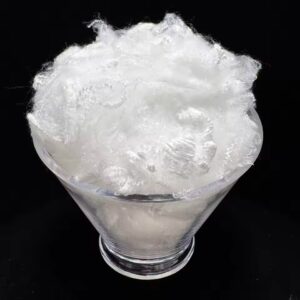
Hollow Conjugated Siliconized (HCS) polyester fiber is the global standard for premium polyester pillow fill, combining three engineered features that together produce superior fill performance: the hollow cross-section traps an air channel within each fiber for warmth and lightness; the conjugate crimp—a three-dimensional spiral produced by the differential shrinkage of two polymer streams in the bicomponent spinning process—provides permanent loft recovery that a mechanical 2D crimp cannot match over time; and the silicone surface finish lubricates fiber-to-fiber contact, preventing clumping and allowing the fill to redistribute freely within the pillow shell.

The result is a fill that maintains its loft, softness, and resilience through years of use and repeated washing — the defining performance requirement for any premium pillow. Standard HCS fill is specified at 7D (denier) × 64 mm (staple length), though the full range from 3D to 20D serves different end-use requirements as detailed below.
Denier Guide for Pillow Fill Fiber
Denier — the linear mass density of the fiber — is the primary specification parameter for polyester pillow fill. It determines the softness, weight, loft-per-gram, and feel of the finished pillow:
Denier | Character | Recommended Applications and Rationale |
0.9D–1.5D | Ultra-fine microfiber | Premium down-alternative pillows; the finest available synthetic fill. Fibers are finer than human hair; the resulting fill has exceptional softness and a silky, cloud-like quality closest to natural down. Higher cost; used in luxury positioning. |
3D | Fine soft fill | Premium soft pillows, plush toy fill, high-end cluster fiber feedstock. Noticeably softer than standard 6D fill; produces a very pliable, conforming pillow. Popular in premium consumer and hotel applications. |
6D–7D | Standard premium | The most widely used pillow fill specification globally. Optimal balance of softness, loft, weight, and cost. 7D × 64 mm HCS siliconized is the reference specification for mainstream premium pillow fill. Hotel and institutional standard. |
10D–12D | Medium-firm fill | Firmer, more supportive pillow feel. Used in pillows positioned as ‘medium support’ or ‘firm comfort.’ Popular for back and side sleeper positioning. Also used as a firmer core layer in multi-zone pillow constructions. |
15D | Firm support fill | Firm pillow feel; used where structured support is prioritized over plush softness. Common in orthopedic and therapeutic pillow ranges. Also used in sofa cushion fill and furniture padding where shape retention is the priority. |
20D | Extra-firm / structural | Heavy structural fill; used in firm cushions, bolsters, floor cushions, and some therapeutic pillow applications. Rarely used alone in sleep pillows but can be blended with finer fill for a firm-with-softness combination. |
Cluster Fiber Fill (Fiber Ball Fill) — The Premium Alternative
Cluster fiber fill — also called fiber ball fill — is produced by processing fine-denier HCS fiber (typically 1.5D–3D) through a fiber ball machine that rolls individual fibers into small spherical clusters, typically 8–20 mm in diameter. Each cluster mimics the structure of a natural down cluster — a spherical unit of air-trapping fiber that flows freely within the pillow shell, providing the most down-like feel of any synthetic fill material.
Cluster fill’s defining advantages are its anti-clumping behavior (individual balls cannot mat together the way loose fiber can), its loft recovery after compression, and its free-flowing redistribution within the shell—the fill automatically evens out as the sleeper moves, maintaining consistent support across the sleeping surface. Cluster fill is the premium fill specification for high-end hotel pillows, five-star hospitality applications, and consumer products positioned as luxury down alternatives.
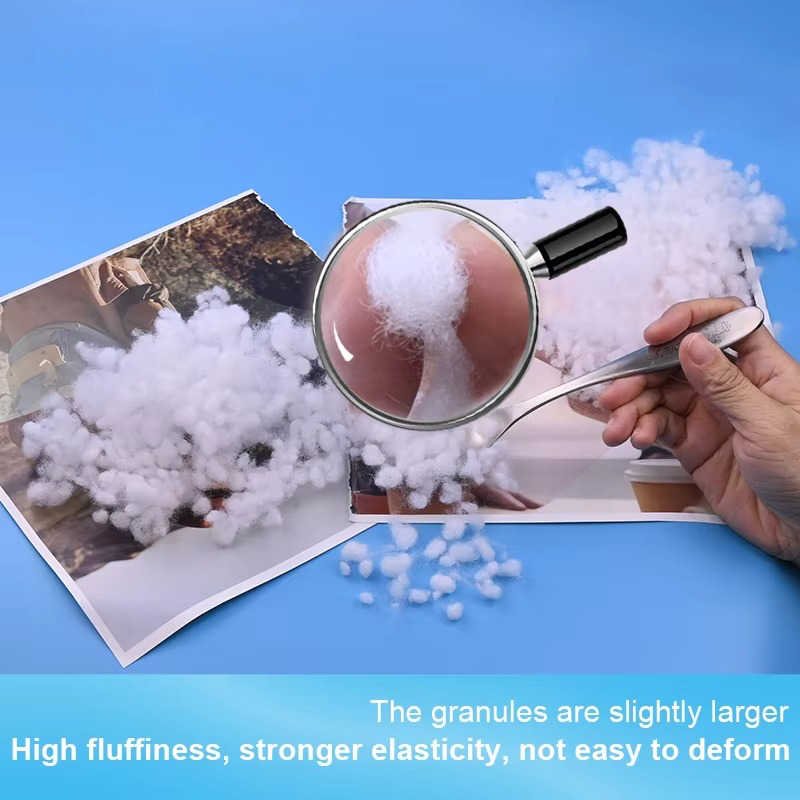
- Standard cluster fill: 15–20 mm ball diameter; 3D base fiber; used in standard premium hotel pillows
- Fine cluster fill: 8–12 mm ball diameter; 1.5D–2D base fiber; the softest, most premium cluster fill for ultra-luxury positioning
- GRS-certified recycled cluster fill: Available from certified suppliers; provides verified recycled content documentation for sustainable product lines
HCS vs. Cluster vs. Standard Polyester Fill: A Manufacturer’s Comparison
Property | Standard HCS Loose Fill | Cluster Fiber Fill | Solid Polyester Fill |
Softness | ★★★★☆ | ★★★★★ | ★★★☆☆ |
Loft recovery | ★★★★☆ | ★★★★★ | ★★★☆☆ |
Anti-clumping | ★★★☆☆ | ★★★★★ | ★★★☆☆ |
Down-like feel | ★★★☆☆ | ★★★★★ | ★★☆☆☆ |
Wash durability | ★★★★☆ | ★★★★★ | ★★★★☆ |
Cost (material) | Mid | Mid-premium | Low |
Processing complexity | Low | Medium (ball machine needed) | Low |
Market positioning | Standard to premium | Premium to ultra-premium | Budget |
Best for | Hotel, institutional, mid-premium consumer | Luxury hotel, premium consumer, down alternative | Budget retail, entry price point |
Fill Weight Specification: How Much Fill per Pillow?
Fill weight—the grams of fiber packed into each pillow—is one of the most commercially important and most frequently debated pillow specification decisions. It directly determines the pillow’s loft, softness, firmness, and cost; and there is no universally correct answer because the right fill weight depends on the denier of the fill, the intended firmness, and the target market.
The fundamental relationship: finer denier fiber (3D) requires less weight to achieve the same loft as coarser fiber (7D) because finer fibers trap more air per gram. This is why a high-quality 3D microfiber pillow at a 400g fill weight may feel loftier and softer than a cheaper 7D fill pillow at 600g—the fiber specification matters as much as the weight.
Fill Weight Range | Pillow Size | Firmness Profile | Typical Application and Notes |
300–400g | Standard (50×70 cm) | Soft / plush | Soft consumer pillow for stomach and comfort sleepers. Requires fine denier (3D–5D) for adequate loft at this weight. |
400–500g | Standard | Medium-soft | Entry hotel specification: mainstream consumer medium-soft pillow. 7D fill at this weight gives a good soft-medium feel. |
500–600g | Standard | Medium | Standard hotel pillow specification. Most commercial hotel pillows use 500–550g of 7D HCS siliconized fill. Good support for back and side sleepers. |
600–750g | Standard / King | Medium-firm | Premium hotel and institutional pillow. Higher fill weight gives better loft retention over time and a denser feel preferred by some consumers. |
750–1000g | King (50×90 cm) | Firm | Large or very firm pillows; bolsters and body pillow specifications. Higher fill weight requires correspondingly larger cover dimensions. |
1000g+ | Body pillow / bolster | Very firm / structural | Body pillows, bolsters, and floor cushions. Fill weight is specified per product dimensions rather than per standard pillow format. |
A practical fill weight test for manufacturers: Fill a pillow cover with your target weight, close it, lay it on a flat surface, and place your forearm across the middle. A properly filled medium hotel pillow should support your forearm approximately 10–12 cm above the surface. Too low: underfilled (add 50–75g). Too high: overfilled (remove 50g). This simple test is more reliable than specification numbers alone because it accounts for the interaction between fiber denier, fill weight, and cover size.
Cover Fabric Selection
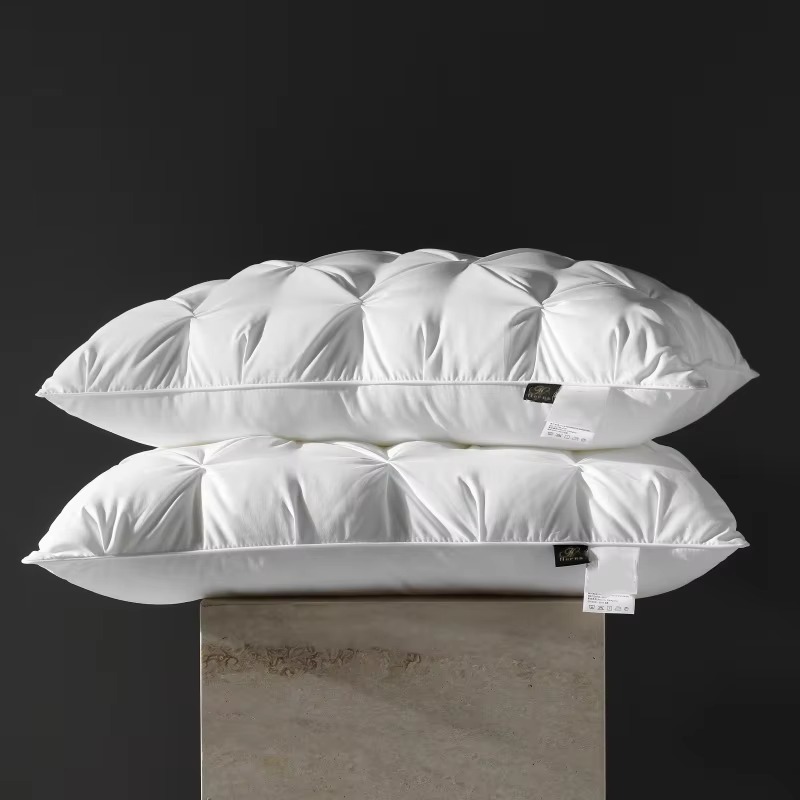
The pillow cover (shell) serves three functions simultaneously: it contains the fill, provides the consumer-facing surface experience, and must withstand repeated laundering without degrading in dimensional stability or allowing fill escape. Cover fabric selection is a meaningful cost and quality lever:
Polyester-Cotton Blends — The Commercial Standard
65/35 polyester-cotton in 180–200 thread count percale construction is the standard cover fabric for commercial, hotel, and institutional pillows. The polyester component provides excellent dimensional stability through repeated laundering, resistance to shrinkage, wrinkle resistance, and cost efficiency. The cotton component contributes enough breathability and softness to be acceptable for skin contact. This specification balances durability and commercial washability requirements for frequent industrial laundering at 60°C.
For mid-premium consumer pillows, a 50/50 or 60/40 cotton-rich blend at a 200–250 thread count improves the surface hand feel while maintaining acceptable washability. Higher cotton ratios (80/20 or 100% cotton) at 300+ thread count are used in premium consumer pillows where the natural cotton surface feel is a marketed product attribute.
Microfiber Polyester — The Budget Commercial Option
100% polyester microfiber shell fabric (typically 68–90 gsm) is used in budget retail pillows for its very low cost, easy care, and soft synthetic surface. The limitation is breathability—microfiber polyester traps more body heat than cotton-blend shells, making it less comfortable for sustained skin contact in warm conditions. However, for budget pricing tiers and applications where cost is the primary driver, microfiber polyester provides acceptable performance at significantly lower cost than cotton-blend alternatives.
Down-Proof Ticking — For Down and Cluster Fill
Pillows filled with down, feather, or cluster fiber require a shell fabric with tight enough weave structure to prevent individual fiber balls or down clusters from working through the shell fabric over time. Down-proof ticking is typically a 200–300 thread count plain-weave cotton or cotton-polyester fabric with a fabric weight of 80–120 gsm. The tighter the weave, the more effective the containment — but higher thread counts also reduce breathability and increase cost. A dual-layer shell construction — tight inner ticking over a softer outer shell — achieves good containment without compromising surface feel.
Sewing Construction and Quality
The sewing construction determines how long the pillow holds its shape and fill under the mechanical stress of use and laundering. The key construction decisions:
- Stitch type: For maximum durability, a safety stitch (combining an overlock stitch and a chain stitch simultaneously) is the highest-quality seam construction, resistant to both unraveling and seam separation. Standard straight stitch seams are adequate for budget applications but less durable. Hotel specifications typically require safety stitch construction.
- Thread specification: Polyester thread (rather than cotton) is specified for most pillow manufacturing because polyester thread maintains its strength when wet, does not shrink, and is more resistant to abrasion in commercial laundering cycles. Thread weight (ticket number) is specified according to seam construction: heavier thread for structural seams and finer thread for decorative topstitching.
- Seam allowance: A minimum 12 mm (1/2 inch) seam allowance is recommended for hotel and institutional pillows to prevent seam failure under the mechanical stress of commercial laundering. Budget retail pillows often use 8–10 mm seam allowances to reduce fabric waste.
- Gusset / border panel: A gusseted construction — where the pillow shell has a separate side border panel sewn between the front and back faces — maintains the pillow’s three-dimensional loft by preventing the fill from migrating fully to one side under compression. Standard gusset depth for premium hotel pillows is typically 5–8 cm. Non-gusseted (flat) construction is simpler and less expensive but produces pillows that compress more easily.
- Opening and closure: Commercial pillows are typically closed with a fabric overlap or concealed zip. The overlap (envelope closure, where the cover back overlaps by 10–15 cm without fastening) is preferred for commercial applications because it eliminates zip failure risk and simplifies laundering. Zipper closures are used where adjustable fill weight or fill material replacement is a product feature.
Quality Specifications and Testing
For commercial and hotel pillow manufacturing, the following quality control parameters are standard specification items:
Parameter | Specification and Test Method |
Fill weight | Stated weight ± 5%; weighed on calibrated scale at production. Critical for fill uniformity across a production batch. |
Fill fiber denier | Specified denier (e.g., 7D) verified by fineness measurement (vibroscope or air-flow method). Tolerance ± 0.5D. |
Fiber certification | GRS Transaction Certificate for recycled fiber; OEKO-TEX Standard 100 Certificate (Class I for children, Class II for adults) per shipment. |
Shell fabric GSM | Fabric weight per square meter ± 5%. Verified by standard ISO fabric weight test method. |
Thread count | Verified by standard thread count method for woven shell fabrics. ± 5 threads per inch tolerance is typical. |
Seam strength | ASTM D1683 seam strength test. A minimum 45 N (10 lbf) seam break force is typical for hotel specifications. |
Dimensional stability | Shell fabric wash shrinkage is ≤ 3% in warp and weft after 3 wash cycles at 60°C. Critical for shape retention. |
Loft retention | Before/after loft height measurement after 10 machine wash and tumble-dry cycles. Premium fill should retain ≥ 80% of initial loft. |
Fill escape | Post-wash inspection for fiber escape through shell fabric seams and weave. Zero visible fiber escape is the standard for quality classification. |
Market Segments and Specification Guide
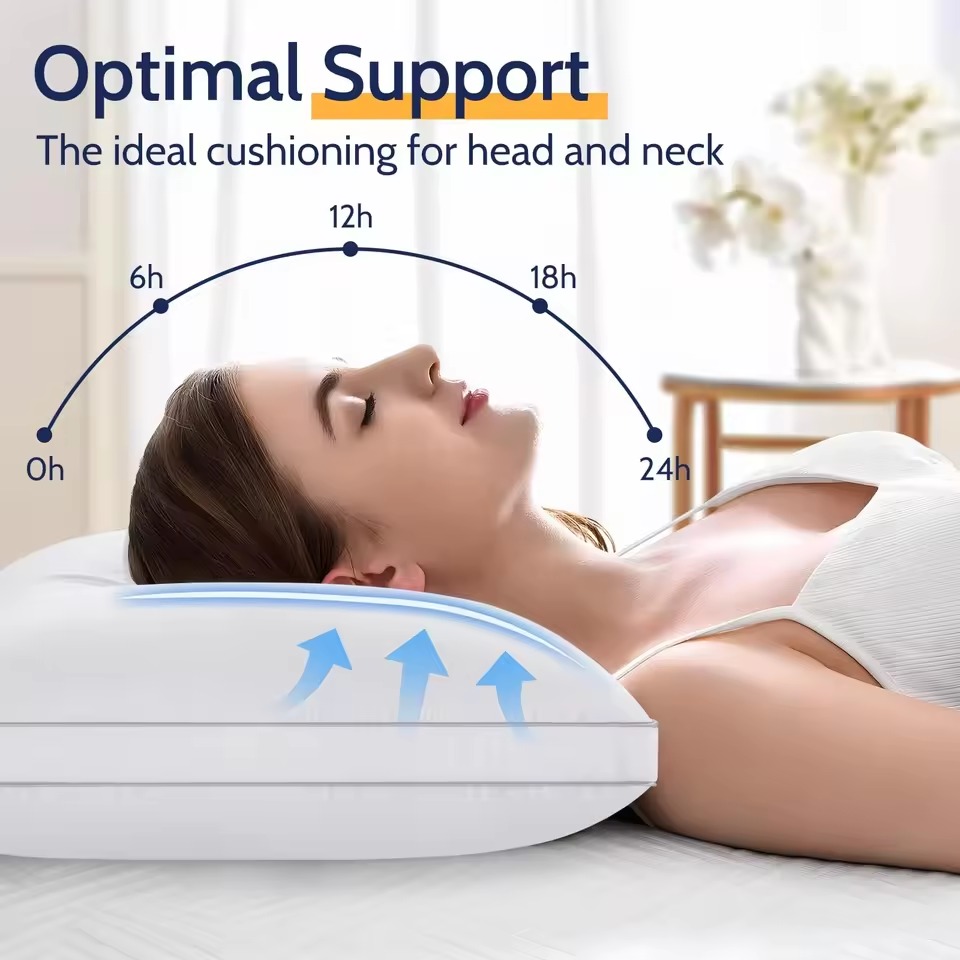
Pillow specifications differ materially across market segments. Here is the reference guide for key segments:
Segment | Fill Specification | Fill Weight | Cover Spec and Key Notes |
Budget retail | Solid or standard HCS 7D | 300–400g | 65/35 PC 180TC or microfiber polyester. Cost-optimized construction. |
Mid-market retail | HCS 7D siliconized | 450–550g | 50/50 or 65/35 PC 200–250TC. Branded fill grade (GRS option popular). |
Premium consumer | HCS 6D or 3D or cluster fill | 500–700g | Pure cotton 300TC+; GOTS organic cotton option. Zipper closure. Full certifications. |
Economy hotel | HCS 7D non-siliconized | 500g | 65/35 PC 200TC safety stitch. Durability for high-frequency laundering priority. |
Standard hotel | HCS 7D siliconized | 500–550g | 65/35 or 50/50 PC 200–250TC safety stitch. Standard specification for 3–4 stars. |
Premium hotel | Cluster fill (3D) | 600–700g | 100% cotton 300TC or 50/50 200TC. Gusset construction. Compress-packed. |
Ultra-premium hotel | Fine cluster fill (1.5D) or down/cluster mix | 700–900g | 100% cotton 300TC+ downproof ticking. Gusset. All certifications. White compress-packed. |
Children’s products | HCS 6D or 7D OEKO-TEX Class I | 350–500g | GOTS organic cotton or OEKO-TEX 100 certified PC. Envelope closure. GRS recycled option. |
Pillow Packaging: The Final Step
Pillow packaging serves both logistical and marketing functions — protecting the product, enabling efficient shipping and retail display, and communicating product attributes to buyers. The key packaging formats used in commercial pillow manufacturing:
- Vacuum compression: Premium and mid-market pillows are typically vacuum-compressed in polyethylene bags using horizontal or vertical compression machines. Compression reduces the packed volume by 60–80% compared to uncompressed pillows, dramatically reducing shipping costs and storage space. Compressed pillows are packed in retail-format bags (individual) or trade cartons (multiple units, typically 4, 6, 10, or 20 per case). Upon opening, HCS and cluster-fill pillows spring back to full loft within minutes.
- Trade/institutional carton packing: Hotel and institutional orders are typically packed 20 pillows per compressed bag in a standard shipping carton. The carton dimensions are optimized for pallet stacking efficiency. Each carton is labeled with fiber content, fill weight, denier specification, certification numbers, and country of manufacture per importing country requirements.
- Private label and retail packaging: Consumer-facing retail packs are supplied in printed polyethylene bags (typically 2 mil) or rigid box packaging for premium brands. Retailers often provide their own packaging artwork to be printed by the manufacturer. VNPOLYFIBER can print customer private-label logos and product information on standard packaging films for direct retail supply.
How VNPOLYFIBER Supports Pillow Manufacturers
VNPOLYFIBER specializes in supplying the fill fiber component of pillow manufacturing—the most important specification decision in the entire pillow construction process. Our complete pillow fill fiber range:
- HCS Siliconized Fill Fiber (3D, 6D, 7D, 10D, 15D, 20D): Standard specification in both virgin and GRS-certified recycled grades. OEKO-TEX Standard 100 Class I (children’s) and Class II (adults) certified. 32, 51, and 64 mm staple lengths. White compress-packed in 220–230 kg bales.
- HCS Slick Fill Fiber: Enhanced ultra-smooth silicone finish for the closest synthetic approximation to down. Used in luxury positioning and fine cluster fiber production.
- Cluster Fiber Fill (Fiber Ball): Fine-denier 1.5D–3D base fiber processed into 8–20 mm ball clusters. Premium down-alternative positioning. GRS-certified recycled is available.
- Microfiber Fill (0.9D–1.5D): Ultra-fine hollow siliconized for luxury premium pillows and down-jacket-equivalent fill positioning. The softest available synthetic fill fiber.
We supply fill fiber to pillow manufacturers across Asia, Europe, North America, and South America—providing technical support on fiber selection, fill weight specification, and certification documentation for all major market regulatory requirements. Contact us with your pillow specification requirements, and we will provide a comprehensive technical and commercial quotation.
Conclusion
Pillow manufacturing is more technically complex than it appears from the consumer side. The choice of fill fiber denier and type, fill weight calibration, cover fabric specification, sewing construction standard, and packaging format together determine where a pillow sits in the quality hierarchy—from a budget retail item that flattens within months to a premium hotel pillow that maintains its loft and certification credentials through thousands of laundering cycles.
For manufacturers and buyers who want to understand and control this complexity, the technical foundation is in the fill fiber specification. HCS fiber denier, conjugate crimp quality, silicone finish level, and certification status — these are the parameters that separate a well-specified pillow from one that underperforms. Understanding them is the starting point for building pillow products that deliver consistent quality, attract the right market segment, and meet the certification requirements of an increasingly sustainability-conscious global retail and hospitality market.