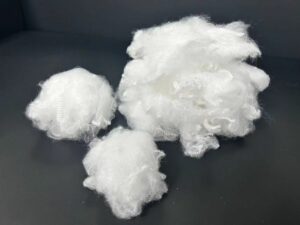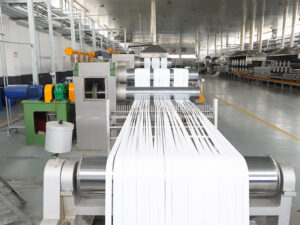
Is man-made fiber eco-friendly and sustainable?
Economic activities and developments invariably mean interfering with nature.
Therefore, a special responsibility to protect the environment arises from any kind of industrial activity.
A competitive industry is a prerequisite for effective protection of the climate and the environment because only competitive companies can develop novel technologies for efficient resource handling—e.g., to cut greenhouse gas emissions.
These descriptions of connections and backgrounds highlight how man-made fibers and their manufacture contribute to ecological sustainability and help solve environmental problems.
History
After man lost his natural fur in the course of evolution, clothing became as vitally important as food and housing. Some 135,000 years ago in the Middle Stone Age, people wore the first clothes, which consisted of simple pelts. Soon this type of clothing was no longer sufficient, and the man started using fibers from natural plants for clothing purposes.
With the rising quality of life and the growing world population, consumption and demand for textiles went up continuously. Simultaneously, the need to feed the population led to a conflict of interests regarding the use of available agricultural land. Finally, priority was given to food-producing agriculture to ensure direct survival—to the detriment of sheep farming and flax cultivation.
Consequently, only continually decreasing areas were available in Europe for the cultivation of renewable resources for the textile industry, so the demand in Europe could no longer be fully covered with textile raw materials from this continent. Thus, raw sheep wool imported from Australia became ever more important. Linen—which had been obtained from flax cultivation—was gradually replaced by cotton, which, however, grows only in subtropical to tropical climates.
Most probably, the wish to be independent from transcontinental renewable resources was getting stronger due to military conflicts, which frequently interrupted transatlantic transport routes. Furthermore, requirements for textiles became more sophisticated. As late as the 19th century, the conflict over whether agricultural land should be used for food production or for growing plants for clothing purposes remained unresolved. This is understandable when considering that statistically one person would need ca. 1 hectare of fertile land if this person were to resort exclusively to natural products. Given the growing population, it is easy to see why other solutions had to be found to meet the demand for textiles, as agricultural areas are limited.
As early as 1665 the Englishman Robert Hooke had the idea to produce artificial fibers from the viscous mass. However, it was a long way with many failures before this idea became a reality. For over two centuries, people merely viewed Hooke’s defined aim as a fantastic utopia.
In 1845 Christian Friedrich Schönbein dissolved trinitrocellulose (‘gun cotton’) in alcohol ether, producing collodium. The Swiss, Audemars, produced artificial fibers from this solution for the first time in 1855.
Based on these experiments, which Count Hilaire de Chardonnet achieved between 1878 and 1884, the breakthrough in the manufacture of the first natural man-made fiber (‘artificial silk,’ or ‘rayon’) from dissolved dinitrocellulose, which was produced industrially from 1890, was followed by the manufacture of ‘copper rayon’ from a solution of cellulose in copper oxide ammonia, for which, however, relatively costly cotton linters (3.5 mm hairs on cotton seed capsules) were needed as raw materials.
Important to this day is the manufacture of viscose fibers from cellulose xanthogenate, soluble in sodium hydroxide, which became possible in 1885, and the acetylation of cellulose (cellulose triacetate), which was first performed successfully in 1865. From 1919, this material was spun into acetate silk on an industrial scale by way of partial saponification.
Total independence from the natural raw material cellulose was achieved with synthetic fibers such as polyamide 66 (‘Nylon,’ 1935), polyamide 6 (‘Perlon,’ 1938), polyacrylonitrile (1942), polyester (1941), and elastane (1958).
After World War II, the triumph of man-made fibers was unstoppable. With the start of mass production of successful fibers—such as polyacrylic, polyamide, polyester, elastane, and viscose—people’s quality and feeling of life improved perceptibly.
That ended the competition between agriculture and clothing industries for limited farmland. Rising fiber production was no longer to the detriment of the population’s food situation.
Raw materials
Today’s awareness of the finiteness of fossil raw materials faces, especially the energy industry, great challenges. It is urgently imperative for the energy industry to seek alternatives to fossil energy sources because currently some 90% of petroleum produced goes directly—without preceding uses in other material life cycles—into incineration processes (heating and mobility). Here, it is important to significantly enhance the possibilities for using the only external energy source of the ‘system Earth’—namely, the sun—without the ‘detour’ via petroleum or natural gas.
In context with the search for alternative raw materials, the call for renewable resources is getting louder. Voices in the textile sector also advocate for a greater cultivation of natural fibers for this reason. This demand shows that, unlike 100 years ago, a stronger use of natural fibers is no longer connected to famines. However, the first signs that prove the lasting validity of this connection are rising global food prices—because agricultural areas are increasingly put to different uses to produce raw materials for industry.
Now as in the past, man-made fibers ease the strain on agricultural areas and thus make contributions to sustainability without aggravating the food situation. The global production of synthetic, man-made fibers requires only 0.8% of the currently produced volumes of petroleum.
Cellulosic man-made fibers do not compete with food production, either. Only 0.2% of the amount of wood felled globally is used for the manufacture of cellulosic man-made fibers. Furthermore, the wood used for this purpose comes from sustainably managed plantations or marginal productivity areas that are unsuitable for food crops due to soil conditions, anyway.
Area
In a comparison of areas needed to produce 1 tonne of fibres, 67 ha are required for wool production against only 0.8 ha for viscose fibers—while no agricultural area at
All are needed for the production of synthetic fibers.
The total area used globally for fiber production highlights the sustainability of chemistry compared to natural fibers. 867 000 km²
Currently, 69% of the total fiber production area of grasslands is used for wool production, while 27% (344,000 km²) is used for cotton growing. In contrast, viscose fiber production requires 44,000 km² (3.5%), while synthetic fibers only need 400 km² (0.03%).
Here, sizes of areas are inversely proportionate to yields: With a share of only 3.5 %
In the total area, man-made fibers cover 60% of the global fiber production. By contrast, 27 % (cotton) of the total area accounts for only 38 % of the share of cotton fibers, and 55 % (wool) of the total area contributes a share of merely 2 % of wool fiber in fiber production worldwide.
The worldwide fiber demand amounts to 68 million tonnes. Abandoning man-made fibers and switching solely to wool production would require 46 million km² of grasslands. This corresponds to one-third of the entire land surface of the Earth, with globally available grasslands amounting to only 3.4 million km². To enable a comparison: The total area of the Federal Republic of Germany is ca. 0.36 million km²; the total area of the Republic of Austria is 0.08 million km². In theoretically necessary sheep farming, there would be four times as many sheep as humans. Those sheep would emit 160 million tonnes of the climate gas methane, corresponding to 3,700 million tonnes of CO₂ equivalent. Global transport burdens the environment with 3.3 million tons of CO₂ equivalent.
Producing exclusively cotton would not be ecologically viable, either. Currently 25 %
Cotton growing utilizes fertile cultivation areas of good value and suitable for food production. To meet the global fiber demand solely with cotton, we would need to boost yields by 300%. Cotton would occupy 75% of cultivation areas, leaving only 25% for food production, leading to global famines. In practice, such a dramatic increase in cotton areas would not even be possible, because cotton can be cultivated only in certain climatic conditions. Therefore, improved yields can be achieved only with artificial irrigation and high inputs of fertilizers and pesticides. Currently, conventional cotton cultivation sprays approximately 10% of globally used insecticides and one-fifth of all pesticides.
Water consumption
Crop cultivation requires not only agricultural areas but also water. It is a well-known fact that water resources worldwide are limited and precious. For example, in cotton growing, some 25,000 m³ of water is needed to produce 1 tonne of cotton fibers—which is doubtful in ecological terms. This is over 70 times the water quantity needed for viscose fiber production and over 6,000 times more than what is required in polyester fiber production. Thus, man-made fibers make important contributions to preserving vital water resources.
Without man-made fibers, there would be neither enough agricultural areas for food production nor sufficient water resources for humankind.
CO₂ balance
Compared with natural fibers, man-made fibers offer the extra advantage that they can be manufactured wherever there are markets with a demand for them. Grasslands and arable areas cannot be created just anywhere—unlike production plants for man-made fibers.
Transporting textiles across the globe makes little sense ecologically, even less so if they are made of man-made fibers. But also T-shirts made of biologically grown cotton may have flown half across the globe. For example, an item of clothing made in China is transported over a distance of ca. 19,000 km to the final consumer in Europe. If transported by ship, some 0.4 kg of CO₂ is emitted per kg of textile.
In air transport, the eco-balance deteriorates by ca. 10 kg of CO₂. Assuming that textile production exclusively in Europe would involve transport distances of ca. 2,000 km, European rail transport ca. 0.04 kg, and air transport ca. 1 kg of CO₂ would be calculated in an eco-balance for the transport of textiles. Considering that ca. 90 % of textiles offered in Germany are imported, the ecological benefits of manufacturing man-made fibres and textiles close to their consumers are obvious

Recycling
Man-made fibers are ecologically valuable also after their use as products. While cellulosic man-made fibers are biodegradable, synthetic fibers can be reused in the recycling process via their monomers. Furthermore, many man-made fibers consist of recycled raw materials in the first place. For example, annually some 40% of old PET bottles in Europe are processed into fibers. This reduces rubbish piles by 10 million PET bottles per day, saving 200 000 tonnes of primary raw materials.
Unlike natural fibers, the energy fraction in man-made fibers can be recovered and used for heating purposes in the form of long-distance heating, saving valuable primary energy.
“Eco” or not
The growing trend toward and the rising demand for environmentally friendly textiles manufactured in socially acceptable conditions lead to a proliferation of eco-labels and eco-collections. However, so far designations such as “natural,” “bio,” or “eco” are not protected in respect of clothing. The sweeping judgment “nature is better than chemistry” is unjustified, because the overall eco-balance of man-made fibers is more favorable than that of cotton. In addition to energy and resource consumption, it is also important to consider factors such as machine deployment, fertilizers, and finishing and transport costs.
Man-made fibers are used in several technical applications and also help solve environmental problems.
Light by Man-made fibres
Man-made fibers are indispensable raw materials for lightweight constructions. Synthetic fibers are precursors for carbon fibers that are processed into modern composite materials for use as metal substitutes. With the use of composite materials in aircraft and automotive industries, a high reduction in weight and significant decrease of fuel consumption can be achieved
Insulating materials save energy
Up to 80 million tonnes of CO2 emissions can be avoided annually with insulating materials. Man-made fibers are processed into nonwovens—for use in buildings as insulating and sealing materials in facades, floors, and windows or as roofing sheets. Energy savings achieved with innovative products based on man-made fibers are higher than the energy input needed in the production of these products and fibers.
Strong presence in environmental protection
At the workplace, in production, in exhaust gas and air purification. Almost always in the background, unseen and unnoticed, man-made fibers make active contributions to clean water and air. As nonwovens, man-made fibers filter liquids, collect solids and e.g., purify waste air from power plants by removing pollutant particles. Only man-made fibers can resist such a wide range of thermal and chemical strains.
Man-made fibres are the solution
Humans and the environment must adapt to changing conditions that come with climate change. Man-made fibers are the solution. As nonwovens, wovens and nets, they make foundation materials for roads on less stable ground and also help reinforce ways, dams and heaps
Source from: Industrievereinigung Chemiefaser e.V.