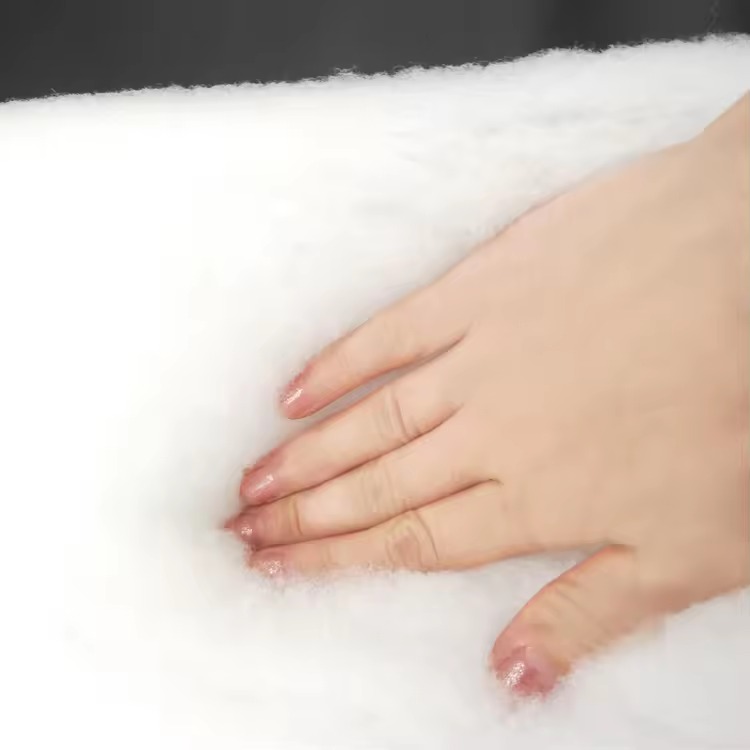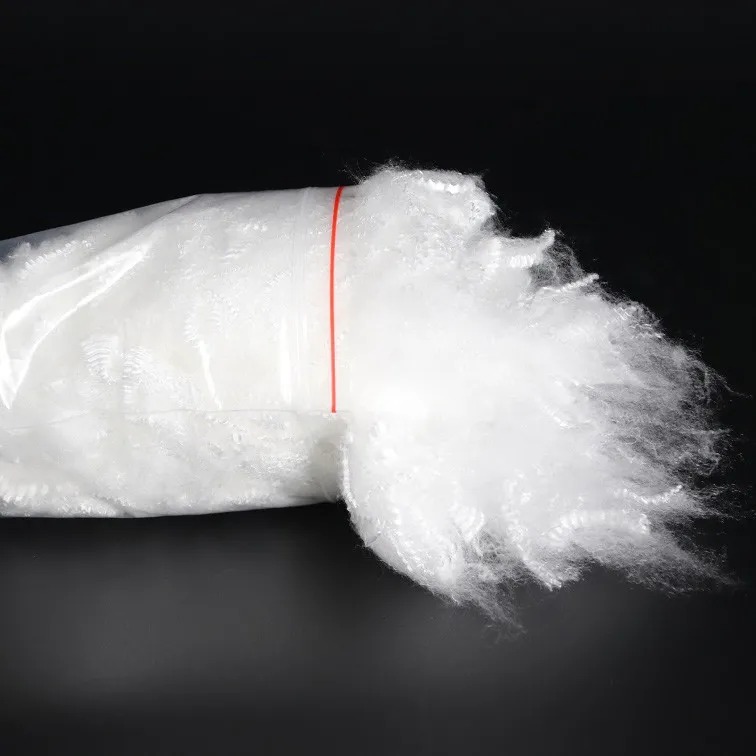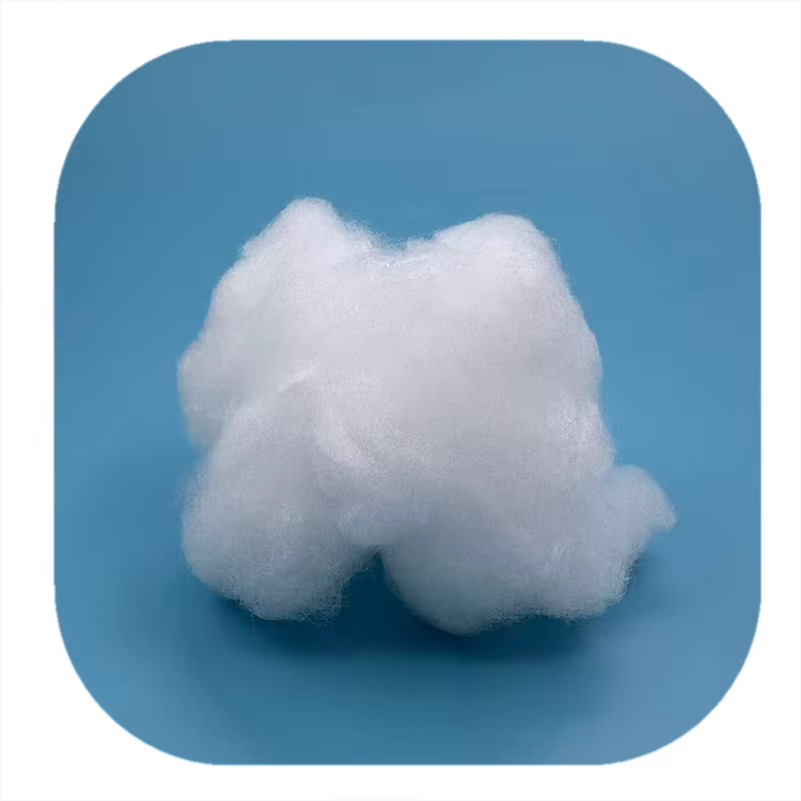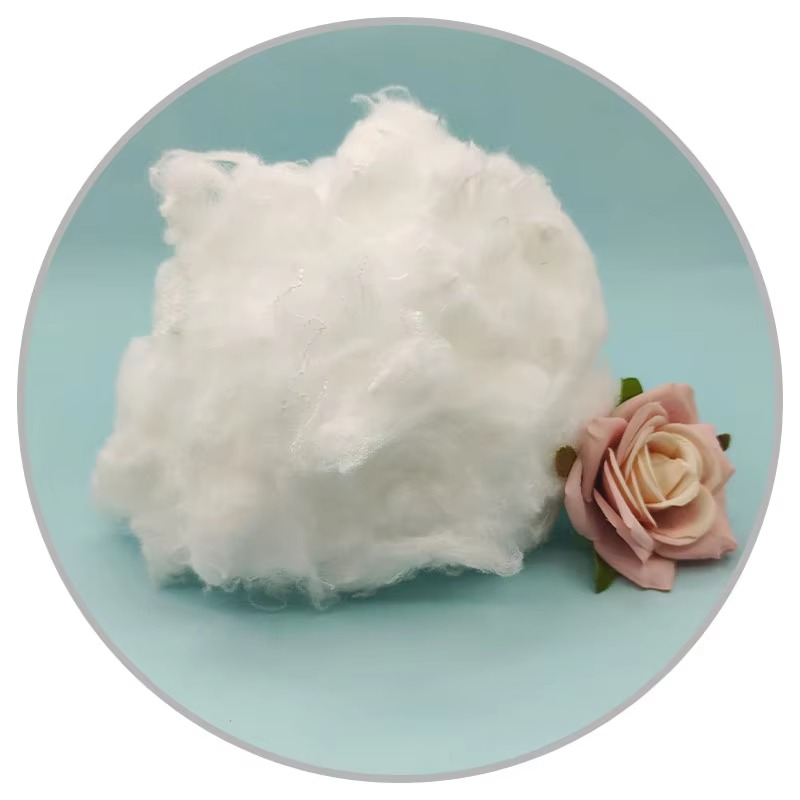
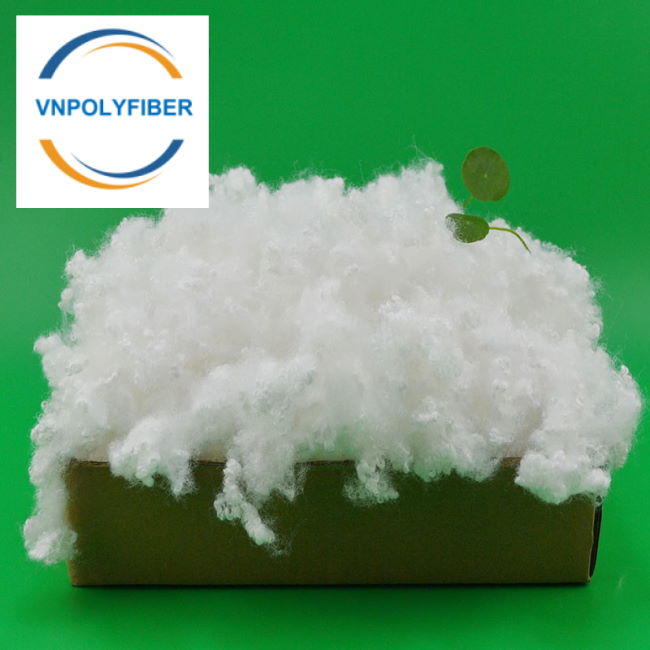
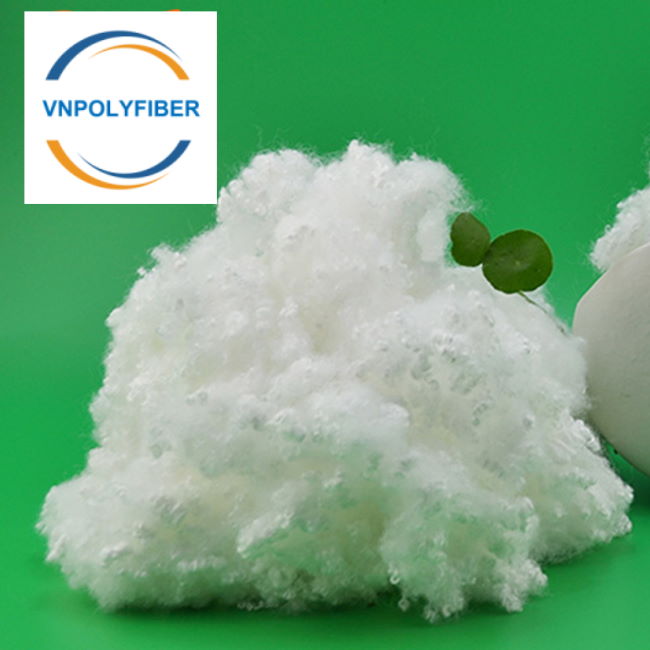
7D 64MM HCS Fiber with GRS Certified Polyester
Eco-Certified: GRS-certified 7D and 15D HCS fibers ensure environmental responsibility.
Child Safe: Premium recycled quality that is safe, durable, and reliable for toys.
Future-Ready: The sustainable choice for high-quality, eco-conscious plush products.
PRODUCT DETAIL
Sustainable Toy Stuffing: Why GRS-Certified Polyester is the Future
In the global toy manufacturing industry, the shift toward sustainability is no longer a niche trend—it is a market requirement. As major retailers and consumers demand transparency in the supply chain, sustainable toy stuffing has moved to the forefront of product development. Among the various options available, GRS Certified Polyester has emerged as the definitive material for the future of the industry.
By utilizing high-performance Hollow Conjugate Siliconized (HCS) fiber made from recycled post-consumer PET bottles, manufacturers can deliver the “cuddle factor” children love while meeting the rigorous environmental standards required by the modern world.
1. What is GRS-certified polyester?
The Global Recycled Standard (GRS) is a holistic international standard that sets requirements for third-party certification of recycled content. But it goes beyond just the material. A GRS certification also tracks social and environmental practices, as well as chemical restrictions during the manufacturing of the fiber.
When you source GRS Certified Polyester for toy stuffing, you are ensuring:
Verified Recycled Content: Proof that the fiber is made from 100% recycled PET flakes.
Environmental Responsibility: Strict wastewater treatment and energy usage protocols in the production hubs of Southeast Asia and China.
Chemical Safety: Assurance that no harmful substances or glues are used in the creation of the fiber, which is critical for products intended for children.
2. The Technical Edge: Why HCS Fiber is Ideal for Toys
Sustainability is vital, but for a toy manufacturer, performance is non-negotiable. This is where Hollow Conjugate Siliconized (HCS) fiber—specifically in grades like 7D or 15D—excels.
Hollow Construction for Maximum “Fluff”
Hollow fibers are engineered with a microscopic void in the center. This traps air, making the toy stuffing 20% lighter than solid fiber. For a stuffed animal, this means a “lighter-than-air” feel that remains easy for children to carry.
3D Conjugate Crimp for Resilience
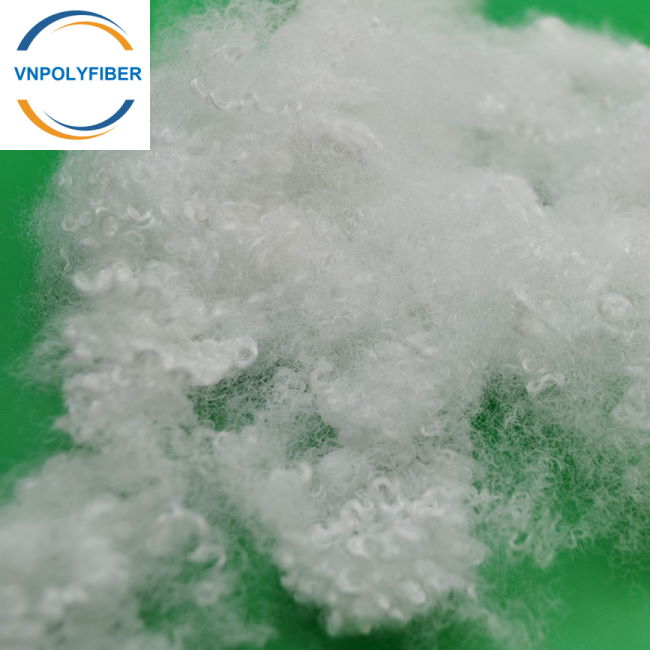
The “conjugate” part of the fiber refers to its spiral, spring-like shape. Unlike straight fibers that can flatten or “mat” over time, conjugate fibers act like tiny springs. When a child squeezes a plush toy, these fibers compress and then instantly “bounce back” to their original shape, ensuring the toy looks “new” for years.
Siliconized Finish for the “Feather Touch”
To achieve a “slick” and soft hand feel, the fiber is impregnated with a silicone emulsion. This treatment ensures the fibers slide past one another easily, preventing the clumping and bunching that often plagues lower-quality synthetic fills.
3. Virgin vs. Recycled: Debunking the Quality Myth
Historically, there was a misconception that recycled polyester was “yellow” or “weak” compared to virgin polyester made from petroleum oil. Modern recycling technology in Southeast Asia and China has completely eliminated this gap.
AAA Grade Recycled PSF now matches virgin fiber in every key metric:
Natural Whiteness: Optical brighteners and high-purity PET flakes result in a clean, white fiber.
High Tenacity: With a tensile strength of 3.5 to 4.5 g/denier, recycled fiber is strong enough for high-speed industrial stuffing machines.
Hypoallergenic Safety: It is inherently resistant to dust mites, mold, and bacteria—making it safer for children than many organic alternatives like wool or cotton.
4. Five Advantages of Polyester Staple Fiber (PSF) in Toy Production
Whether you are a small craft business or a large-scale toy factory, PSF offers structural benefits that enhance the final product:
Anti-Warping Memory: It neither stretches nor shrinks. This resilience ensures that the stuffed toy maintains its proportions even after heavy play.
Moisture Management: Polyester is hydrophobic (repels water). This allows the toy to “breathe” and dry quickly if it gets wet, preventing the growth of fungus or bad odors.
Lightweight Durability: Despite its soft feel, the material is solid and durable, resistant to the wear and tear of daily use.
Material Synergy: It can be combined with other materials (rayon, cotton, etc.) for specialized toy linings or weighted sections.
Brilliant Ink Compatibility: When used in the outer fabric (ticking), polyester allows for bright, durable colors that do not fade easily.
5. The Manufacturing Journey: From Bottle to Bear
The process of creating GRS-certified stuffing is a marvel of modern engineering. It begins with post-consumer PET bottles, which are cleaned, shredded into flakes, and melted.
The molten polymer is extruded through a spinneret to create long filaments. These filaments are cooled, lubricated, and stretched to align the molecular structure. They are then given their 3D spiral crimp, dried, and cut into “staple” lengths—typically 32mm to 64mm for toys. Finally, the fiber is baled and shipped to manufacturers globally.
6. Applications Beyond Plush Toys
While plush toys are the primary use, GRS-certified HCS fiber is found in a variety of related sectors:
Pet Products: Durable and washable filling for cat and dog beds.
Baby Bedding: Safe, hypoallergenic filling for cot bumpers and nursing pillows.
Home Decor: High-loft filling for decorative “cloud” effects in nurseries and children’s rooms.
Specialized Padding: Soft interlining for children’s winter jackets and slippers.
7. Procurement Standards: What to Look For
When sourcing sustainable toy stuffing from South East Asia or China, procurement teams should verify these technical benchmarks:
Certification: Ensure the supplier provides a valid GRS Transaction Certificate (TC).
Oil Pickup (OPU): A minimum of 0.20% to 0.35% for that “slick” feel.
Crimps per CM: 3 to 5 crimps per cm is ideal for maximum spring-back resilience.
Denier Choice: Use 3D or 7D for small, soft toys; use 15D for larger, firmer stuffed animals.
Conclusion: The Sustainable Standard
Sustainable Toy Stuffing is more than a marketing label; it is a commitment to quality and the environment. By choosing GRS Certified 15D or 7D HCS, manufacturers are providing a product that is safe for children, incredibly durable, and responsible toward the planet. As the industry continues to evolve, recycled polyester will remain the essential foundation for comfort and creativity in the toys of tomorrow.
Technical Parameter
Polyester Staple Fiber used in Non-woven Industry
| Luster | Denier | Cross Section | End-Use |
| SD | 1.5, 1.7, 2, 3, 4, 6 & 15 | Solid | Nonwoven Interlining, Sanitary Material, Microfiber and Thermal Bonding |
| FBR (Black) | 1.5, 1.7 & 3 | Solid | Needlepunch, Resin Bonding & Fiberfill |
| SD | 1.5 & 4.5 | Solid | Dyeable Fabric & High-Pile |
| SD | 6, 8 & 15 | Hollow and Hollow-Siliconized | Resin Bonding, Needlepunch, Fiberfill, Flame Retardant Fabric, Anti Bacteria & Platinum Photon Fiber |
| SD, BR,OBBR | 0.7, 1.1, 1.2, 1.4, 2.0, 6, 8, 12, 15 & 20 | Solid | Low Pilling, Knitting, Fiberfill, Thermal Bonding, Needlepunch, Infrared Fiber & Resin Bonding |
| SD | 2, 3, 4.5, 7, 12 & 15 | Hollow Conjugate | Resin Bonding, Needlepunch & Fiberfill |
| SD | 7 | Hollow Conjugate | Anti-Bacteria |
Polyester Staple Fiber as per Direct End Use
| Type | Denier | Section | End Use |
| Anti Pilling | 1.4, 1.5, 2, 2.5 & 3 | Solid & Hollow | Sportswear, Underwear, Casual wear |
| Bamboo Charcoal | 1.5, 1.7 & 6 | Hollow | Bedding, Shoe pad, Cushion, Thermal Sock |
| Spinning Use | 1.3, 1.4, 1.5 & 1.7 1.5 | Solid Hollow | Sportwear, Casual Wear, Underwear |
| Dopedyed Black | 1.5, 2 & 3 | Solid | Nonwoven, Casual wear, Sport wear, Underwear |
| Flame Retardant | 1.4 | Solid | Home, Comfort & Clothing textiles |
| Micro Fiber | 0.8 – 1.0 | Solid | Cloth & Fleece |
| High Tenacity | 1.2 | Solid | Yarn, Cloth & Water transport |
| High Void Conjugate | 3, 7, 12 & 15 | Hollow | Toy Padding, Badding, Furniture Cushion, etc |
| Regular Fiber | 2, 2.5, 3, 6 & 15 | Solid | Nonwoven, Filter medics, Padding, etc. |
FAQ
1. What do you offer?
We supply a comprehensive range of fibers, including recycled hollow conjugated (both siliconized and non-siliconized) polyester staple fiber, hollow fiber, microfiber, virgin polyester staple fiber, and low-melt fiber.
2. What is it used for?
Our fibers are versatile and widely utilized across both the filling and non-woven industries, providing essential loft, durability, and texture for various consumer and industrial applications.
3. Are you a factory or a trading company?
We are primarily a manufacturer specializing in polyester staple fiber with years of industry expertise. To better serve our clients, we also operate a dedicated trading division that allows us to act as a one-stop solution provider.
In addition to our own fiber production, we source high-quality textile components (such as yarn and low-melt fibers) and finished goods (including foam, pillows, cushions, toys, and down/feather products) to ensure our customers have access to a comprehensive supply chain.
4. Where is your factory location?
To maintain a robust and flexible global supply chain, our manufacturing facilities are strategically located throughout Asia, specifically in Vietnam, China, Malaysia, Thailand, and Indonesia. If you would like to visit one of our sites, please contact your sales representative, and we will be happy to arrange transportation for you.
5. Can you accept free sample?
Yes, we provide free hand samples for quantities under 1 kilogram. Once a price is confirmed, we can prepare and dispatch your sample within 2–3 business days. Please note that while the sample is free, the freight costs are the responsibility of the client.
6. Can you provide ODM service?
Absolutely. We specialize in ODM (Original Design Manufacturing). This means we can customize the material composition, dimensions, quantity, packaging, and branding to meet your specific requirements. Your logo and unique specifications will be integrated into the final product.
7. How about your quality? What’s the minimum order Quantity (MOQ)?
We invite you to place a trial order to experience our quality firsthand. Our standard MOQ is 23,000 kilograms per order.
Regarding pricing, we maintain a no-bargain policy. We believe in transparency and efficiency, so we provide our most competitive offer upfront to save you time and ensure a straightforward procurement process.
8. Can I mix different items in one order?
Yes, for your convenience, we allow for a maximum of two different items to be mixed within a single container.
9. How can you guarantee the product quality?
Quality is the cornerstone of our business. We employ an experienced QC team that monitors every stage of production, from raw material inspection to the final manufacturing process. We utilize a range of advanced testing instruments to ensure our fibers meet strict industry standards.
Our business philosophy is simple: We aim to serve one customer 1,000 times, rather than 1,000 customers once. We prioritize long-term partnerships built on consistent excellence.
10. What’s the payment terms?
L/C at sight, 30% TT in advance are mostly accepted; other terms shall be negotiable by both sides
For more information, please feel free to contact :
Tony Tan
Mobile number: +84 90 466 5251 (Whatsapp/Wechat/Viber/Signal)