The Invisible Ingredient That Makes Waterproofing Work
There is one material inside every roll of modified bitumen waterproofing membrane that most installers never think about — yet without it, the membrane would tear, shrink, delaminate, and fail within years. That material is the polyester mat: a nonwoven reinforcement carrier that gives the membrane its structural backbone.
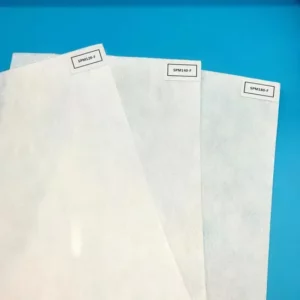
A polyester spunbond nonwoven is a fabric composed of endless polyester fibers oriented in a random pattern and bonded together by thermal, mechanical, and/or chemical means, resulting in highly differentiated product characteristics. Being highly versatile, polyester spunbond nonwoven has conquered many applications, including synthetic and bitumen waterproofing membranes.
Whether you are a bitumen membrane manufacturer setting up a new production line, a construction materials distributor evaluating supplier quality, or an engineer specifying waterproofing systems for a major infrastructure project—understanding polyester mat is essential to making the right decisions.
What Is a Polyester Mat?
A polyester mat—also called a polyester nonwoven mat, polyester felt, or PET base fabric—is a flat nonwoven fabric produced from polyester fibers and used as the structural reinforcement carrier inside modified bitumen waterproofing membranes. During membrane production, the mat passes through a coating line where it is saturated and coated with modified bitumen (either SBS or APP polymer-modified) on both sides, producing a finished roll ready for roofing or waterproofing installation.
When a polyester nonwoven is used as a carrier in roofing underlayments or commercial built-up roofing systems, it gets saturated with asphalt. The high tear strength of the spunbond contributes to the dimensional stability of the bitumen roof. At the same time, it provides excellent elasticity, which makes the roof robust.
The mat does not provide the waterproofing — that is the job of the bitumen compound. What the mat provides is everything else: dimensional stability, tensile strength, tear resistance, puncture resistance, and elongation. Without the mat, the bitumen compound would crack, shrink, and fail under the mechanical and thermal stresses that real-world roofs and waterproofing systems endure every day.
Two Types of Polyester Mat: Spunbond vs. Needle-Punched Staple Fiber
There are two fundamentally different manufacturing routes for polyester mat, each producing a material with distinct properties:
Spunbond (Long Fiber / Continuous Filament) Polyester Mat
Spunbond mat is produced by extruding continuous polyester filaments from PET polymer chips, laying them into a random web, and bonding the web through a combination of mechanical needle punching, thermal calendering, and chemical impregnation. Spunbond (long filament) provides superior mechanical strength and puncture resistance because the fibers are continuous. Choose spunbond for high-end, high-specification infrastructure projects and premium waterproofing brands.
Terbond — Freudenberg Performance Materials’ flagship polyester mat — is a polyester fiber nonwoven manufactured using spunbond technology and available in numerous weights. The technology is the result of specific knowledge in the fields of spinning, stretching with air at subsonic speed, and web-laying, supported over the years by continuous technological improvements in mechanical, chemical and thermal bonding.
Needle-Punched Staple Fiber Polyester Mat
A staple fiber mat uses pre-cut polyester staple fiber as raw material. The fibers are carded into a web and mechanically bonded through needle punching, then chemically impregnated to prepare for bitumen coating. Staple fiber (short fiber) is more flexible and offers better bulk or loft. Choose staple fiber for general construction, standard-grade waterproofing, or projects where cost-efficiency is the priority.
This is the direct link between polyester staple fiber supply and the waterproofing industry. The quality of the PSF used — its denier, cut length, tenacity, and crimp — directly determines the performance of the finished nonwoven mat.
| Property | Spunbond (Long Fiber) Mat | Staple Fiber (Needle-Punched) Mat |
|---|---|---|
| Raw material | PET polymer chips | Polyester staple fiber |
| Filament type | Continuous | Pre-cut (32mm–76mm typical) |
| Tensile strength | Higher | Good |
| Flexibility / loft | Good | Better |
| Bitumen bonding | Excellent | Excellent |
| Cost | Higher | More cost-effective |
| Best use | Premium membranes, infrastructure | Standard membranes, general construction |
Key Performance Properties of Polyester Mat
Tensile Strength: The ability to resist being pulled apart in both the machine direction (MD) and cross direction (CD). For spunbond polyester mat used in bitumen membranes, typical tensile strength ranges from 340 N/5 cm at 110 g/m² to 940 N/5 cm at 250 g/m². Higher weights mean higher strength — critical for membranes that will face installation stress and long-term structural loads.
Elongation at break is polyester mat’s defining advantage over fiberglass tissue. At 25–40% elongation, polyester mat allows the finished membrane to stretch with building movement, thermal cycling, and seismic activity without cracking. This is why polyester is the preferred carrier for dynamic structures: parking garages, bridges, and buildings in seismic zones.
Tear Strength: Resistance to tear propagation once a puncture or cut has been initiated. Polyester’s fiber structure resists tears effectively—vital for roofing applications where hail, foot traffic, or dropped tools may penetrate the surface.
Dimensional Stability / Shrinkage at 200°C During torch-on APP membrane application, the mat is exposed to direct flame. High-quality spunbond polyester mat achieves less than 1.5% shrinkage at 200°C—low enough for most applications. However, this is where fiberglass-reinforced composite mats have a significant edge, achieving near-zero shrinkage.
Bitumen Impregnation / Binding The mat must absorb and bond completely with the bitumen compound during membrane production. Poor impregnation leads to delamination, the number one cause of membrane failure. Quality polyester mat achieves full impregnation because its fiber structure and chemical treatment create an excellent affinity with both SBS and APP bitumen compounds.
How Polyester Mat Is Manufactured: Step by Step
Understanding the production process helps buyers evaluate quality claims from suppliers.
Step 1 — Raw Material Preparation For spunbond mats: PET polymer chips are dried and melted. For staple fiber mat: polyester staple fiber bales are opened and blended.
Step 2 — Web Formation For spunbond: molten polymer is extruded through spinnerets, stretched by air jets at subsonic speed, and laid onto a moving belt in a random pattern. For staple fiber, fibers are carded and cross-lapped into a web of the desired weight and width.
Step 3 — Mechanical Bonding (Needle Punching) The web is passed through a needle loom where thousands of barbed needles penetrate the web repeatedly, mechanically entangling the fibers and creating a cohesive fabric structure. Terbond TH is first mechanically bonded using the needle-punching process, then thermally bonded—enabled by the presence of a low-melt polymer.
Step 4 — Chemical Bonding / Impregnation The needled web is saturated with a chemical binder (typically an acrylic or starch-based system) that stiffens the mat and prepares it for bitumen coating. This step determines the mat’s handling stiffness and its ability to run on high-speed membrane production lines without tearing.
Step 5 — Drying and Calendering The impregnated mat passes through a dryer to remove moisture (target: < 0.5% moisture content), then through calendar rolls to achieve the required thickness and surface smoothness.
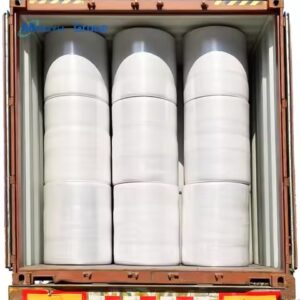
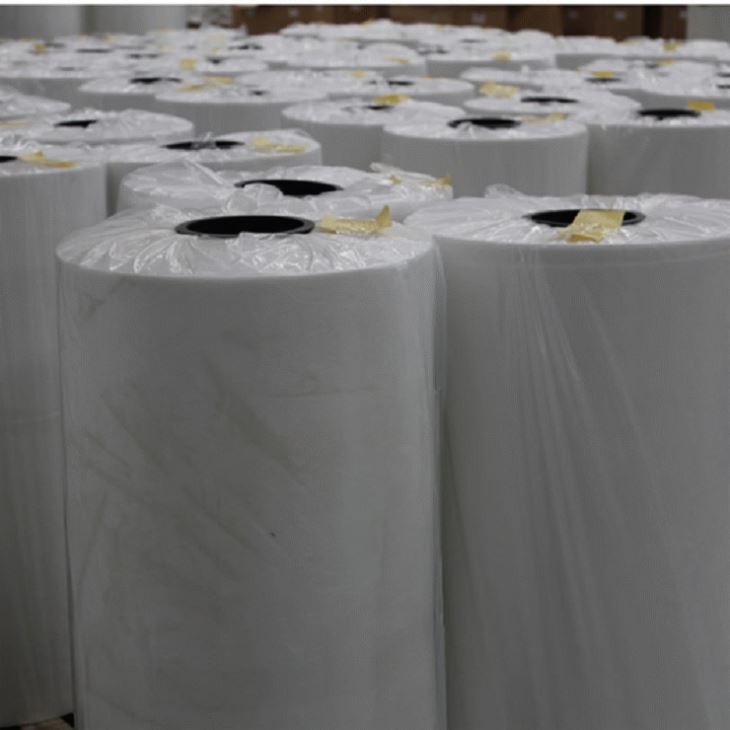
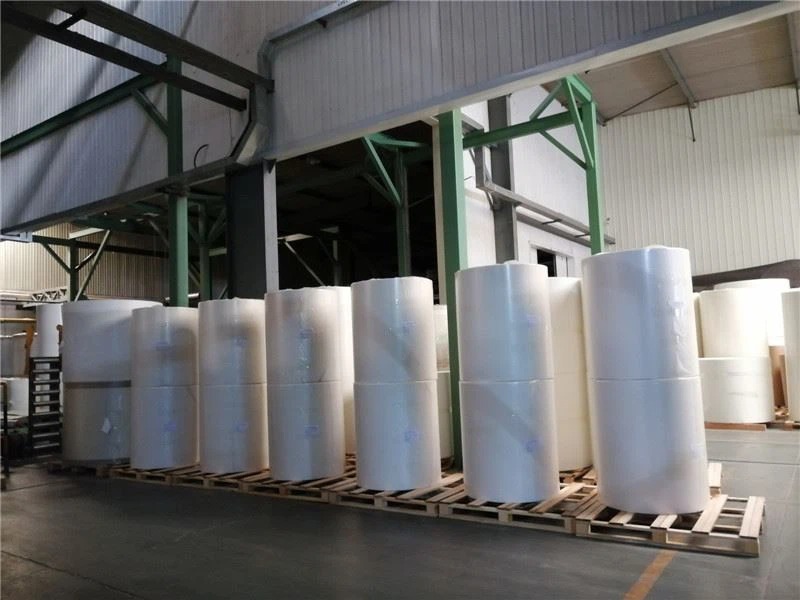
Step 6 — Winding and Quality Control The finished mat is wound into rolls, inspected for weight, tensile strength, elongation, and moisture content, and then packed for shipment. Standard roll widths are typically 1,020mm to match membrane production line requirements.
Standard Specifications at a Glance
| Weight (g/m²) | Longitudinal Tensile (N/5cm) | Transverse Tensile (N/5cm) | Elongation MD | Shrinkage at 200°C | Moisture Content |
|---|---|---|---|---|---|
| 110 | ≥ 340 | ≥ 230 | 25% | < 1.5% | < 0.5% |
| 120 | ≥ 450 | ≥ 260 | 25% | < 1.5% | < 0.5% |
| 140 | ≥ 560 | ≥ 340 | 27% | < 1.5% | < 0.5% |
| 160 | ≥ 620 | ≥ 400 | 30% | < 1.5% | < 0.5% |
| 180 | ≥ 680 | ≥ 480 | 30% | < 1.5% | < 0.5% |
| 200 | ≥ 750 | ≥ 600 | 30% | < 1.5% | < 0.5% |
| 250 | ≥ 940 | ≥ 780 | 35% | < 1.5% | < 0.5% |
Applications Beyond Bitumen Membrane
Polyester mat is not limited to roofing. The same material serves critical roles in underground waterproofing for tunnels and foundations, bridge deck waterproofing systems, water storage tank lining and protection, sports floor reinforcement layers, and as a protection layer over insulation in roof build-ups.
Source Your Polyester Mat Through VNPolyfiber
VNPolyfiber supplies both polyester staple fiber for nonwoven mat producers and finished polyester mat for bitumen membrane manufacturers. Our network of factory partners across China and Southeast Asia covers the full range—from standard needle-punched staple mat to premium spunbond and fiberglass-reinforced composite mats—all with ISO 9001 quality management and GRS recycled content options.