Polyester Mat for Bitumen Membrane: Complete Guide — Reinforcement Types, Spunbond vs Needlepunched, vs Fiberglass, Specifications and Selection
In the waterproofing industry, the bitumen itself is only half the product. The component that determines whether a membrane lasts 10 years or 30 — that survives building movement, holds dimensional stability at 130°C in the bitumen impregnation line, and bridges the fine cracks that develop in substrates over decades of thermal cycling — is the nonwoven reinforcement carrier. And the dominant reinforcement material for modified bitumen waterproofing membranes globally is polyester mat: a nonwoven polyester fabric engineered specifically for impregnation and saturation with SBS or APP-modified bitumen.
This complete guide covers everything waterproofing membrane manufacturers and construction material buyers need to know about nonwoven reinforcement for bitumen membranes: what polyester mat is and how it is produced, the critical performance properties that determine membrane quality, the spunbond vs needlepunched manufacturing comparison that drives the biggest specification decision, the polyester mat vs fiberglass tissue choice, standard specifications and key test parameters, and VNPOLYFIBER’s nonwoven supply position in this market.
VNPOLYFIBER supplies polyester spunbond nonwoven fabric and needlepunched polyester nonwoven fabric from our manufacturing network in Asia, covering the full range of basis weights and specifications used in bitumen membrane production. We also supply solid polyester staple fiber (PSF) — the raw material for staple-fiber (needlepunched) polyester mat production. Contact us for specifications, samples, and quotations.
Why Nonwoven Reinforcement Defines Membrane Performance
Modified bitumen waterproofing membranes consist of two equally critical components: the bituminous compound (SBS or APP-modified bitumen providing the waterproofing barrier) and the reinforcement carrier (providing dimensional stability, tensile strength, elongation, and puncture resistance). The bitumen compound determines the waterproofing chemistry; the reinforcement carrier determines the membrane’s structural mechanical properties.
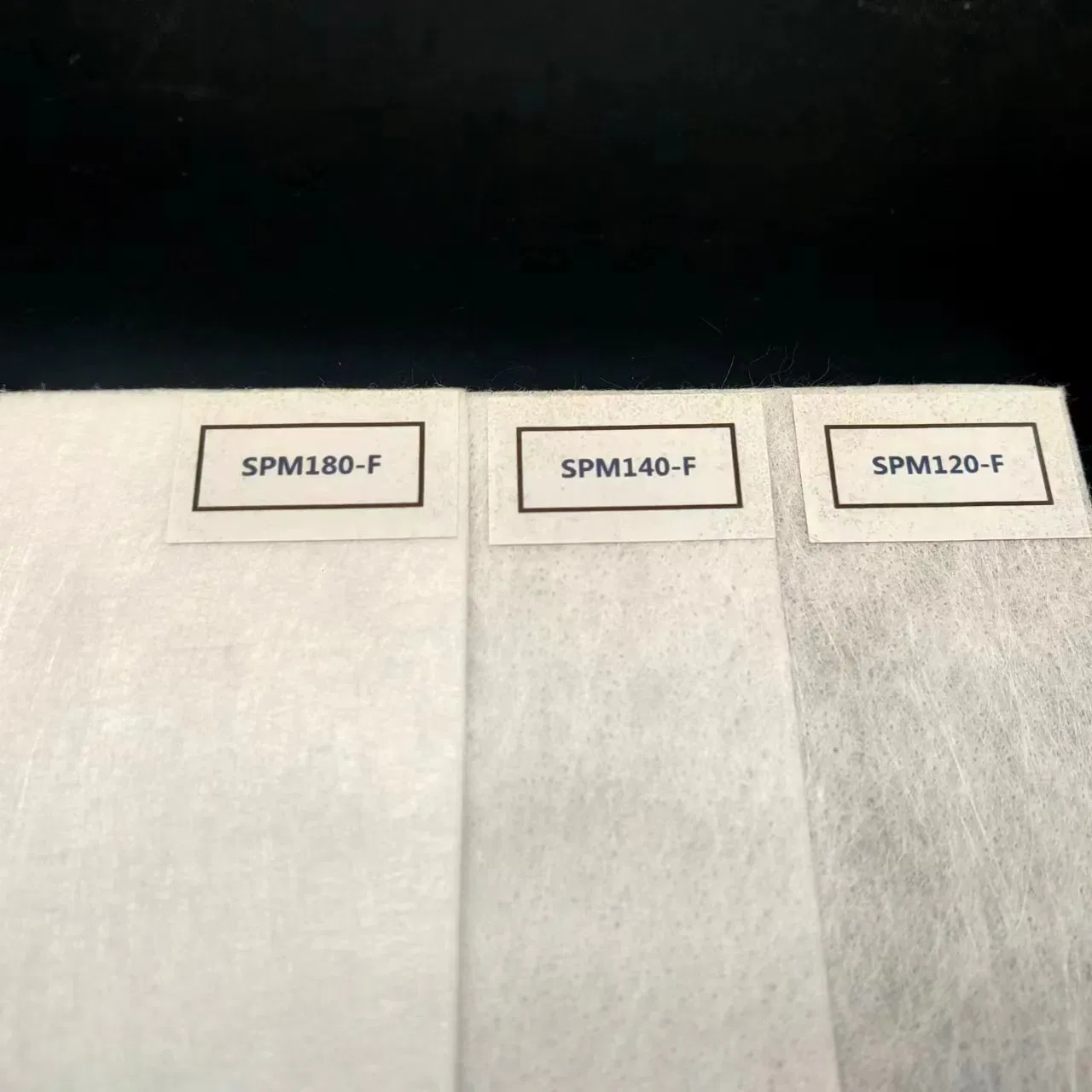
The reinforcement carrier must perform under some of the most demanding conditions any textile material encounters in construction:
- Temperature extremes during production: The carrier fabric is pulled through a bitumen impregnation line at 160–185°C (APP) or 150–170°C (SBS). It must maintain dimensional stability — no shrinkage, no distortion — under these temperatures while being saturated with molten bitumen. Low-temperature-tolerance carriers lose dimensional stability in the impregnation line, producing membranes with width variation and uneven bitumen distribution.
- Temperature extremes in service: Installed roofing membranes face summer surface temperatures of 70–90°C on sun-exposed rooftops in warm climates, and winter temperatures of -30°C or below in cold climates. The carrier must maintain its contribution to the membrane’s structural integrity across this entire temperature range.
- Dimensional stability: Membranes must not shrink during or after installation. Reinforcement carrier shrinkage causes membrane edges to curl, laps to open, and adhesion to the substrate to fail. Low-shrinkage carrier fabric is one of the most critical specifications in membrane production.
- Elongation and crack bridging: Buildings move — thermal expansion and contraction, foundation settlement, structural vibration. The membrane must accommodate substrate movement without cracking or delaminating. High-elongation polyester carriers allow the membrane to stretch and recover with substrate movement, bridging cracks up to the carrier’s elongation limit.
- Bitumen saturation and adhesion: The carrier must allow thorough bitumen penetration through its structure (saturation) and then maintain strong adhesion to the bitumen compound throughout the membrane’s 20–30 year design life. Poor saturation causes delamination; poor adhesion causes the reinforcement to pull away from the bitumen layer under stress.
The Four Carrier Types: An Overview
| Carrier Type | Construction, Key Properties and Primary Application |
| Spunbond polyester mat (long-fiber) | Continuous polyester filaments extruded and bonded by needlepunching, thermal calendering, and/or chemical impregnation into a unified fabric. High tensile strength, high elongation, excellent dimensional stability. The dominant carrier for SBS modified bitumen membranes. Also used for APP membranes where high elongation is required. |
| Staple fiber (needlepunched) polyester mat | Short-cut polyester staple fiber (PSF) carded into a web and mechanically entangled by needlepunching. Slightly lower tensile strength than spunbond but similar elongation. Typically softer and more conformable. Used where cost is a primary driver or where conformability to complex substrate geometry is important. |
| Fiberglass tissue (glass fiber mat) | Very fine glass filaments bonded with resin into a thin, rigid mat. Extremely low elongation (<3%), very high dimensional stability, heat resistance to 200°C+. Used for APP membranes where dimensional stability is more important than crack bridging, and in composite membranes (spunbond + fiberglass). |
| Composite carriers (polyester + fiberglass) | Laminated combination of polyester mat and fiberglass tissue — provides both the elongation of polyester and the rigidity and temperature resistance of fiberglass. Used in premium membrane products combining APP’s heat resistance with polyester’s crack bridging capability. |
Spunbond vs Needlepunched (Staple Fiber) Polyester Mat: The Most Important Decision
The choice between spunbond and staple-fiber (needlepunched) polyester mat is the most consequential carrier specification decision a membrane manufacturer makes — it affects membrane production parameters, finished product properties, bitumen consumption, and the market segments the membrane can serve. Yet it is often made by habit or supplier availability rather than by technical analysis.
How Spunbond Polyester Mat Is Made
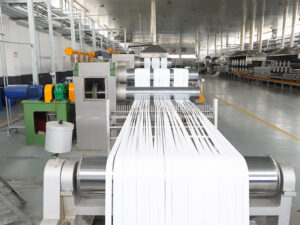
Spunbond polyester mat is produced by a direct-extrusion process: PET polymer chips are melted and extruded through spinnerets into continuous filaments, which are drawn by high-velocity air jets and deposited in a random orientation on a moving belt to form a uniform web. The raw web is then consolidated and bonded through a combination of mechanical needlepunching (barbed needles entangle the filaments), thermal calendering (heat and pressure bond filaments at contact points), and/or chemical impregnation with acrylic binder.
The continuous filament structure is the defining characteristic of spunbond mat — there are no fiber ends within the fabric structure, which gives spunbond higher tensile strength per unit weight than staple fiber constructions and produces a more uniform, consistent surface for bitumen saturation.
How Staple Fiber (Needlepunched) Polyester Mat Is Made
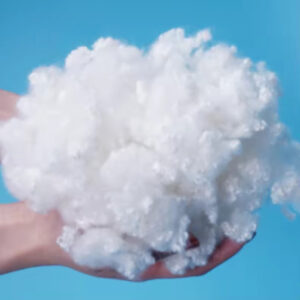
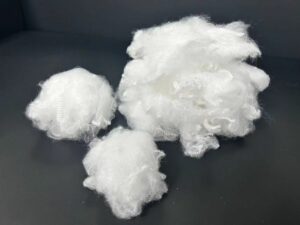
Staple fiber polyester mat uses polyester staple fiber (PSF) — short-cut fiber lengths of 51–76 mm — rather than continuous filaments as its raw material. PSF bales are opened, blended, and carded into a uniform fiber web, then cross-lapped to build the target basis weight, and passed through multiple needle looms that mechanically entangle the fibers into a coherent fabric by the barbed needle felting process. Chemical bonding with acrylic or latex binder is typically applied after needlepunching to stabilize the structure and improve bitumen adhesion.
Staple fiber mat is the construction type that most directly uses polyester staple fiber (PSF) as its raw material — making it the construction most directly linked to VNPOLYFIBER’s core PSF supply business. The PSF specification for staple fiber mat production requires solid polyester fiber at 6D–17D denier, 51–76 mm staple length, with a surface finish compatible with subsequent binder application.
Spunbond vs Staple Fiber: The Technical Comparison
| Property | Spunbond Polyester Mat | Staple Fiber (Needlepunched) Mat |
| Filament structure | Continuous — no fiber ends in fabric | Staple (short-cut) — fiber ends throughout structure |
| Tensile strength (MD/CD) | Higher — continuous filaments provide direct load path | Slightly lower — fiber ends reduce load transfer efficiency |
| Elongation at break | High — typically 40–60% MD, 50–70% CD | Similar — typically 40–60% MD, 50–70% CD |
| Dimensional stability (shrinkage) | Excellent — continuous filaments resist shrinkage well | Very good — comparable with correct needling and heat setting |
| Surface uniformity | Excellent — very uniform filament distribution | Good — fiber-end texture creates slightly more variation |
| Bitumen saturation | Very good — open structure allows penetration | Very good — fiber-end texture aids initial bitumen wetting |
| Bitumen adhesion | Excellent — binder provides adhesion anchor points | Excellent — fiber ends mechanically interlock with bitumen |
| Weight range | 30–200 g/m² | 80–300 g/m² |
| Thickness at same gsm | Lower — more dense structure | Higher — less dense, more voluminous |
| Production speed | Higher — direct extrusion from polymer | Lower — multi-step fiber processing |
| Cost at equivalent gsm | Lower — fewer processing steps | Slightly higher — separate PSF production and carding steps |
| Conformability to substrate | Moderate | Better — fiber construction conforms to irregular surfaces |
| Primary membrane application | SBS (high elongation), APP premium | SBS and APP, particularly where cost optimization matters |
| PSF raw material connection | Does not use PSF (uses PET chips directly) | Directly uses solid PSF as primary raw material |
Polyester Mat vs Fiberglass Tissue: Choosing Between Them
The choice between polyester mat and fiberglass tissue as the carrier for modified bitumen membranes is the second major specification decision — and it is driven primarily by the membrane’s bitumen chemistry (SBS vs APP), the required elongation performance, and the installation conditions:
| Property | Polyester Mat | Fiberglass Tissue |
| Material | Polyester (PET) — synthetic polymer fiber | E-glass filaments bonded with resin binder |
| Elongation at break | High — 40–60%+ — the defining advantage of polyester | Very low — typically 1–3% — glass fiber is essentially inextensible |
| Tensile strength | Good — adequate for standard roofing applications | Higher at equivalent weight — glass is inherently stronger per filament |
| Dimensional stability | Excellent — low shrinkage with heat setting | Outstanding — glass has essentially zero thermal expansion in this range |
| Temperature tolerance | Good to 130–150°C continuous; suitable for SBS and APP | Excellent to 200°C+ — ideal for high-temperature APP application |
| Crack bridging | Excellent — high elongation accommodates substrate movement and crack opening | Very poor — low elongation means glass tears when substrate cracks |
| Flexibility (cold bending) | Good — flexible at low temperatures | Brittle — cracking risk in cold installation conditions |
| Weight (gsm) | 40–200+ gsm typical for membrane carrier | 30–100 gsm typical for membrane carrier |
| Bitumen saturation | Good — open structure; binder treatment aids wetting | Good — open tissue structure allows penetration |
| Membrane rollability | Flexible — easy to roll and unroll | Can crack if rolled too tightly, especially in cold conditions |
| Primary membrane type | SBS modified bitumen (high elongation required); also APP | APP modified bitumen (high-temperature application; stiffness acceptable) |
| Best application scenario | Roofing with significant substrate movement; cold climates; surfaces requiring conformability | High-temperature APP application; rigid substrate; when max dimensional stability required |
| European standard | EN 14695 (polyester reinforcement for bitumen membranes) | EN 1172 / EN 14932 (glass tissue for bitumen membranes) |
The practical selection rule: If the membrane is SBS modified bitumen, polyester mat is the correct carrier — SBS’s elastomeric properties are designed to work with high-elongation polyester reinforcement. If the membrane is APP modified bitumen, fiberglass tissue or composite carrier is typically preferred — APP’s plastomeric chemistry is more compatible with the low-elongation, high-rigidity properties of glass reinforcement. However, polyester mat APP membranes exist and perform well in moderate-climate applications where temperature extremes are less severe.
SBS vs APP Modified Bitumen: What the Carrier Needs to Deliver
Understanding the two modified bitumen chemistries is essential for understanding why carrier selection differs between them:
SBS (Styrene-Butadiene-Styrene) Modified Bitumen
SBS is a thermoplastic elastomer that modifies bitumen’s properties by introducing a polymer network that provides elasticity — the membrane stretches under stress and returns to its original dimensions when stress is released. SBS membranes are flexible at low temperatures (typically to -25°C or lower) and have good elongation. The SBS compound is typically applied to the reinforcement carrier at temperatures of 150–170°C in the impregnation line.
Carrier requirements for SBS membranes: The carrier must have high elongation to match and support the SBS compound’s elastic behavior. Low elongation carrier with high-elongation SBS compound creates a mismatch — the bitumen wants to stretch but the carrier prevents it, causing delamination at the carrier-bitumen interface. Polyester mat (both spunbond and staple fiber) is the standard carrier for SBS membranes because its 40–60%+ elongation is compatible with SBS compound’s typical elongation range.
APP (Atactic Polypropylene) Modified Bitumen
APP is a plastomeric modifier that increases bitumen’s resistance to flow at high temperatures — APP membranes have better heat resistance than SBS (flow resistance to 120°C+ vs SBS’s 90–100°C) but are less flexible at low temperatures and have much lower elongation than SBS. APP membranes are typically applied to the substrate by torch (open flame fusion) at surface temperatures reaching 180–200°C.
Carrier requirements for APP membranes: The higher application temperatures require a carrier with better heat resistance than is needed for SBS. Fiberglass tissue’s temperature resistance to 200°C+ makes it the natural match for torch-applied APP membranes. However, polyester mat does survive APP impregnation temperatures (180–185°C in the production line is within polyester’s tolerance when dwell time is controlled) — polyester mat APP membranes are produced and perform adequately in moderate climates. In very hot climates where rooftop temperatures regularly exceed 70°C, fiberglass-reinforced APP is preferred for superior heat resistance.
Key Specifications for Polyester Mat in Bitumen Membrane Production
When specifying or sourcing polyester mat for bitumen membrane production, the following parameters define the carrier’s performance profile and must be precisely matched to the membrane’s application requirements:
| Specification Parameter | Typical Range | Significance for Membrane Production |
| Basis weight (gsm) | 80–250 g/m² | The primary weight specification. Higher gsm = thicker carrier = heavier membrane = better reinforcement but higher material cost. Standard roofing membranes use 130–180 gsm carrier. |
| Tensile strength MD (EN 29073-3) | ≥600 N/50mm (light); ≥900 N/50mm (standard); ≥1,200 N/50mm (heavy) | Machine direction tensile strength — resistance to tearing during production (where MD tension is applied) and under wind uplift in service. |
| Tensile strength CD (EN 29073-3) | ≥400 N/50mm (light); ≥600 N/50mm (standard); ≥800 N/50mm (heavy) | Cross-direction strength. EN 14695 requires MD/CD tensile strength ratio ≤2 for balanced reinforcement. |
| Elongation at break MD/CD (EN 29073-3) | MD: 40–70%; CD: 50–80% | Critical for crack bridging. Higher elongation = more substrate movement accommodation. SBS membranes typically require >40% MD elongation carrier. |
| Dimensional stability at 120°C (EN 14695) | MD shrinkage ≤1.5%; CD shrinkage ≤1.5% | Shrinkage in the impregnation line directly causes membrane width variation and edge curl. This is a pass/fail specification for production compatibility. |
| Thickness (EN ISO 9073-2) | 0.5–2.5 mm depending on gsm | Thickness affects total membrane thickness and bitumen consumption. Excessively thick carrier increases bitumen needed for full saturation. |
| Apparent opening size / pore size | Per application | Open structure required for adequate bitumen penetration. Too dense = poor saturation; too open = poor surface quality. |
| Binder content | 5–15% by weight (acrylic typical) | Binder stabilizes the fiber structure and provides anchor points for bitumen adhesion. Binder type and level affect production line speed and bitumen compatibility. |
| Width | 100–320 cm (to membrane production line specification) | Must match the impregnation line width precisely. Available in multiple slit widths or roll goods. |
| EN 14695 compliance | Full certification test report | European standard for polyester reinforcement in bitumen sheets — tensile, elongation, dimensional stability, water absorption, mass per unit area. |
The PSF Connection: How Polyester Staple Fiber Feeds Carrier Production
Polyester staple fiber (PSF) is the raw material feedstock for staple-fiber (needlepunched) polyester mat production — establishing a direct commercial link between VNPOLYFIBER’s core PSF business and the waterproofing membrane market. Understanding the PSF specification requirements for mat production clarifies this supply chain connection:
PSF Specification for Needlepunched Polyester Mat
| PSF Parameter | Specification for Mat | Reason |
| Fiber type | Solid (round or multi-lobal cross-section) | Hollow fiber is not suitable for needle-punched mat — the hollow cross-section weakens under the mechanical stress of needling and provides no benefit in a dense mat structure where loft is not the objective. |
| Denier | 6D–17D | Coarser denier than textile/fill fiber. Coarser fiber provides better needle entanglement, higher mat strength per needle punch, and more bitumen impregnation volume. Fine fiber would produce a dense mat with poor saturation. |
| Staple length | 51–76 mm | Longer staple for better fiber entanglement during needlepunching. Short staple fiber (<51mm) does not interlock as effectively, producing weaker mat. |
| Tenacity | Minimum 4.5 cN/dtex | High tenacity is important for mat strength — the fiber’s tensile properties directly contribute to the mat’s tensile properties. |
| Finish | Non-siliconized — compatible with acrylic binder | Silicone finish (used for fill fiber) prevents adhesion of acrylic binder to the fiber surface — incompatible with mat production. Solid non-siliconized PSF with standard spin finish is the correct specification. |
| UV stabilization | UV-stabilized grades preferred | Mat stored outdoors before membrane production benefits from UV stability. UV-stabilized fiber also contributes to membrane durability in UV-exposed applications. |
| Crimp | Standard mechanical 2D crimp | The 3D conjugate crimp of HCS fiber is not required — the needlepunching process provides the mechanical entanglement; crimp primarily aids initial web formation in carding. |
Selection Guide: Matching Carrier to Membrane Application
| Application / Requirement | Recommended Carrier Selection |
| SBS modified bitumen — standard roofing | Spunbond polyester mat, 130–180 gsm, EN 14695 certified. High elongation essential for SBS compound compatibility. Spunbond preferred for uniform surface quality. |
| SBS modified bitumen — budget / cost-optimized | Staple fiber (needlepunched) polyester mat, 130–180 gsm. Slightly lower cost than equivalent spunbond. Adequate performance for standard SBS membrane. EN 14695 compliance still required. |
| APP modified bitumen — torch applied, standard | Fiberglass tissue 60–100 gsm, or composite polyester/glass carrier. Higher temperature resistance required for torch application. Fiberglass dimensional stability matches APP’s low-elongation character. |
| APP modified bitumen — moderate climate, conformability required | Polyester mat 130–180 gsm. Polyester mat tolerates APP impregnation temperatures when dwell time controlled. Better conformability than glass for irregular substrates. |
| High-performance premium membrane (both SBS and APP properties) | Composite carrier — spunbond polyester + fiberglass tissue laminate. Combines polyester’s elongation and crack bridging with glass’s temperature resistance and rigidity. |
| Underground waterproofing / basement tanking | Polyester mat (spunbond or staple fiber), higher elongation specification. Underground applications require crack bridging as substrate is more prone to settlement-induced cracking. |
| Bridge deck waterproofing | Polyester mat, heavy grade (180–250 gsm), high tensile specification. Traffic-induced dynamic loading and temperature cycling require robust reinforcement. |
| Green roof / inverted roof systems | Polyester mat with enhanced chemical resistance (filter layer). Standard polyester mat compatible with most green roof growing media. |
| Membrane for mechanically fastened system | Spunbond polyester mat — continuous filament provides better resistance to fastener pull-through than staple fiber construction. |
Production Line Considerations for Membrane Manufacturers
For membrane manufacturers evaluating carrier options, several production-line-level factors affect the carrier selection beyond the finished product performance specifications:
Impregnation Line Speed and Temperature
Carrier dimensional stability at line temperature directly determines production line speed. A carrier that shrinks by 3% at 170°C on the impregnation line causes the membrane width to vary by 3% — requiring constant width monitoring and edge trimming. A carrier specified to EN 14695 dimensional stability (≤1.5% shrinkage at 120°C) runs stably at production speed, minimizing waste and monitoring overhead.
Spunbond polyester mat’s continuous filament structure generally provides better dimensional stability consistency roll-to-roll than staple fiber mat, because filament orientation is more uniform. However, quality staple fiber mat produced with proper needling and heat-setting meets the same EN 14695 specifications.
Bitumen Saturation and Consumption
The carrier’s open structure and thickness determine how much bitumen is required to achieve full saturation (complete penetration of the carrier by bitumen). Thicker, lower-density mats absorb more bitumen per square metre — increasing bitumen consumption cost per roll of finished membrane. At equivalent gsm, spunbond mat is typically thinner and denser than staple fiber mat, requiring slightly less bitumen for saturation. However, at equivalent thickness, both achieve comparable saturation with appropriate bitumen viscosity control.
Roll Quality and Consistency
For membrane production at scale, carrier roll consistency — uniform width, consistent gsm across the roll width, constant tensile properties, absence of splices or defects — is critical. Roll splices within the carrier fabric create weak points in the finished membrane that may lead to early failure. Specifying minimum roll length and requiring defect-rate documentation from suppliers is standard practice for quality membrane manufacturers.
Standards Reference: EN 14695 and Key Test Methods
EN 14695:2012 (Flexible sheets for waterproofing — Reinforcement for bitumen sheets — Definition and characteristics of glass-fibre and polyester nonwoven reinforcements) is the primary European standard for polyester mat used in bitumen membrane production. Membrane manufacturers in Europe and many export markets specify EN 14695 compliance as a baseline carrier requirement.
Key test methods specified or referenced in EN 14695:
- Tensile strength — EN ISO 29073-3: Strip test measuring tensile force at break in N/50mm for both machine direction (MD) and cross direction (CD). The ratio of MD to CD strength indicates directional balance of the reinforcement.
- Elongation at break — EN ISO 29073-3: Percentage extension at break in MD and CD. Critical specification for SBS membrane compatibility.
- Mass per unit area (gsm) — EN 29073-1: Basis weight verification — actual gsm must conform to declared value within specified tolerance.
- Dimensional stability — EN ISO 11092 or EN 14695: Shrinkage measurement after exposure to elevated temperature (120°C for EN 14695). MD and CD shrinkage must be ≤1.5% to pass.
- Thickness — EN ISO 9073-2: Carrier thickness measurement — important for calculation of finished membrane thickness and bitumen consumption estimation.
- Water absorption — EN 29073-6: Percentage water uptake — low water absorption indicates the carrier will not introduce moisture into the membrane that could cause blistering during torch application.
VNPOLYFIBER’s Position in the Polyester Mat Supply Chain
VNPOLYFIBER connects to the bitumen membrane reinforcement supply chain at two points — as a nonwoven fabric supplier and as a PSF raw material supplier:
- Polyester nonwoven fabric (spunbond and needlepunched): VNPOLYFIBER supplies polyester spunbond nonwoven fabric and needlepunched polyester nonwoven from our manufacturing network in Vietnam, China, Malaysia, Thailand, and Indonesia. Our polyester spunbond is produced across basis weights from 30 gsm to 200+ gsm, with width to 320 cm, and is available in grades compatible with bitumen membrane production specifications including dimensional stability requirements. EN 14695 compliance documentation available.
- Solid polyester staple fiber (PSF) for needlepunched mat production: VNPOLYFIBER supplies solid polyester staple fiber in the 6D–17D, 51–76 mm specification range required for staple-fiber polyester mat production. Non-siliconized grades compatible with acrylic binder application. Virgin and GRS-certified recycled grades available — GRS-certified recycled PSF for green-certified sustainable membrane products.
For bitumen membrane manufacturers sourcing carrier fabric directly, or for needlepunched mat producers sourcing PSF raw material, contact VNPOLYFIBER with your specific gsm, tensile, elongation, and dimensional stability requirements for technical specifications, samples, and commercial quotations.
Conclusion: Carrier Selection Is Membrane Performance
The nonwoven reinforcement carrier is not a commodity component in bitumen membrane production — it is the structural backbone that determines whether a membrane delivers on its 20-30 year performance promise. The choice between spunbond and staple-fiber polyester mat is a technical specification decision driven by production parameters, cost structure, and end-product performance requirements. The choice between polyester mat and fiberglass tissue is driven by the membrane’s bitumen chemistry (SBS vs APP) and the application’s elongation and temperature requirements.
Getting the carrier specification right from the start — matched to the membrane chemistry, the production line parameters, and the application’s performance requirements — prevents the warranty failures, delamination problems, and installation complaints that result from treating reinforcement as a commodity. EN 14695 certification provides the baseline framework for specifying and verifying carrier quality; the specific gsm, tensile, and elongation values within that framework must be matched to each manufacturer’s product and market requirements.