What are nonwovens?
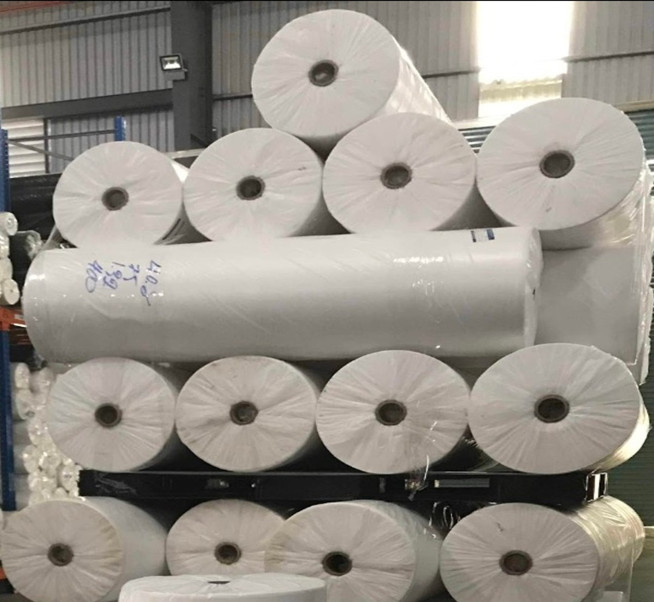
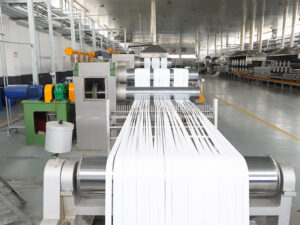
Nonwovens are a category of textile materials that are produced through various processes without the need for weaving or knitting. Instead of interlacing yarns, nonwovens are made by bonding or interlocking fibers through mechanical, thermal, or chemical means. Here’s a detailed overview of nonwovens:
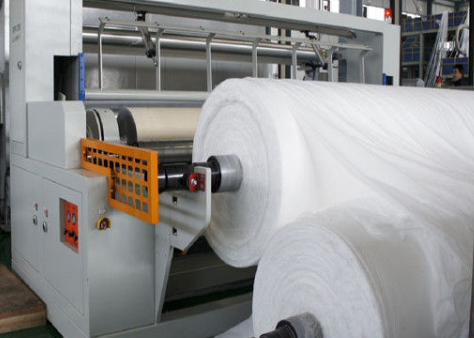
“Nonwoven” is a wide term for sheet or web structures that are held together by threads or filaments that are tangled up in some way, such as by heat, chemicals, or machines. You don’t need to turn the fibers into yarn or weave or knit them.
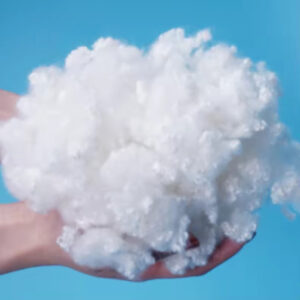
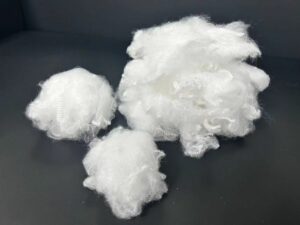
Nonwoven is made from a wide range of fibers, including natural fibers like cotton, hemp, and wool; chemical fibers; recycled fibers; and pulp for paper.
It is challenging for us to name the different ways that nonwovens are utilized in everyday life because they are hidden as parts of the basic material of the product.
For instance, it is commonly used for shoulder padding, interlinings, and clothing tapes. Other important uses are for medical or hygienic products like diapers, masks, and gauze. Nonwoven fabrics are also used in industrial goods, including soil stabilizers, polishing agents, electric insulation, battery separators, car interiors, and air conditioning filters. You could notice that nonwovens are employed in many parts of your life.
Nonwoven is a crucial material that you might not even notice. Our lives are supported and enhanced by this fundamental substance.
Our products are applied to liquid filters, surgical masks, and separators of non-rechargeable Li batteries.
In addition, composite products with other materials are applied to various fields, from commodity use to industrial specialties, such as disposable goods of medical use, industrial air filters, and specialty products in the nuclear power industry.
Liquid Filter
As VNPOLYFIBER products are made of very fine fibers, we can control a wide range of properties, such as fiber diameter, base weight, thickness, filtering resistance, and pore size distribution.
Thus, it is the most adequate filtering material for the various filters, eliminating particles of more than 0.3 micrometers.
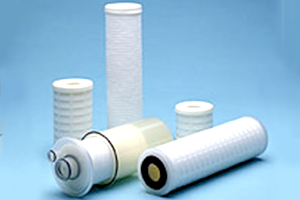
Major application
- As it does not contain any adhesive and it stands against autoclave sterilization, it can be used for the final filter of food services.
- Nonwoven web is mainly used for the depth filter.
- Calender-processed nonwoven is mainly used for the surface filter after pleating.
Application examples
- Final filter for liquors such as beer, wine, soft drinks, and other food services.
- Prefilter of ultra-pure water for the semiconductor device industry
- Filter separator in electronics industry, etc.
Battery Separator
VNPOLYFIBER products made of polypropylene show good chemical resistivity, and they have a superior holding capacity for electrolyte in the battery as they consist of very fine fibers.
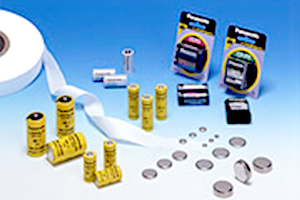
Major application
- It fits best for the separator of non-rechargeable Li batteries where long life and high reliability are required.
- VNPOLYFIBER products made of heat-resistant resins are used for the heat-resistant battery.
Application example
- Separator of non-rechargeable Li battery, etc.
Mask
VNPOLYFIBER products show more than 99% of bacterial filtration efficiency (BFE). It conforms with the ASTM standard of surgical masks due to its unique characteristic of effortless respiration.
Further, it is employed for the main material of dust masks, which suit the N95 classification of that category.
N95 is one of the US standards set by NIOSH (the US National Institute of Occupational Safety and Health). It authorizes the dust mask to be classified as “N95” such that it filters at least 95% of airborne particles while not requiring the respirator to be resistant to oil in the air.
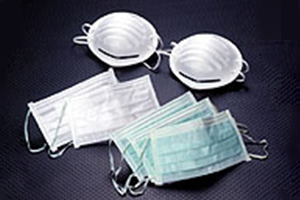
Major application
- It is used as a main filtering material of various kind of masks
Application example
- Surgical masks or masks of medical use, such as those for dentist
- Masks used for clean room, pollen protection, the food industry, etc.
Air Filter
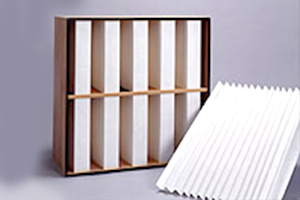
VNPOLYFIBER products are characterized as excellent filtering media because of their superior dust collection efficiency, low pressure drop, and sufficient dust holding capacity.
We can supply the most appropriate filtering material with both excellent filtration efficiency and a low pressure drop, as required.
Major application
- Mainly used for filter media in air conditioning as nonwoven or composite products with other types of nonwovens.
Application example
- Air filters for air conditioning in buildings or industry include medium performance, high performance, HEPA, and ULPA filters.
- Air purifier at home
- Cabin filter of automotive
Wet Wiper
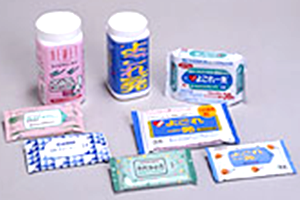
The fiber in VNPOLYFIBER products is very fine; it reaches a small dent. Hence, it can successfully remove the dirt trapped in a small scratch, which conventional wet wipers have been unable to work out. Moreover, it is intrinsically safe without any adhesive where no elution of hazardous material occurs.
Major application
- It is appropriate to clean up the delicate surface of an OA device, or it can be applied to stain removal for clothes or carpet.
Coffee Filter
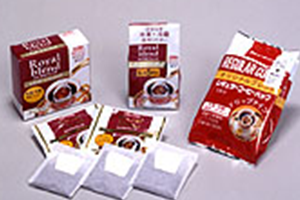
Coffee filters made of fine fiber of VNP POLYFIBER products can lead to the most adequate extraction time. It thus ensures tastily extracted coffee while eliminating coffee powder leaks.
Information of VNPOLYFIBER products
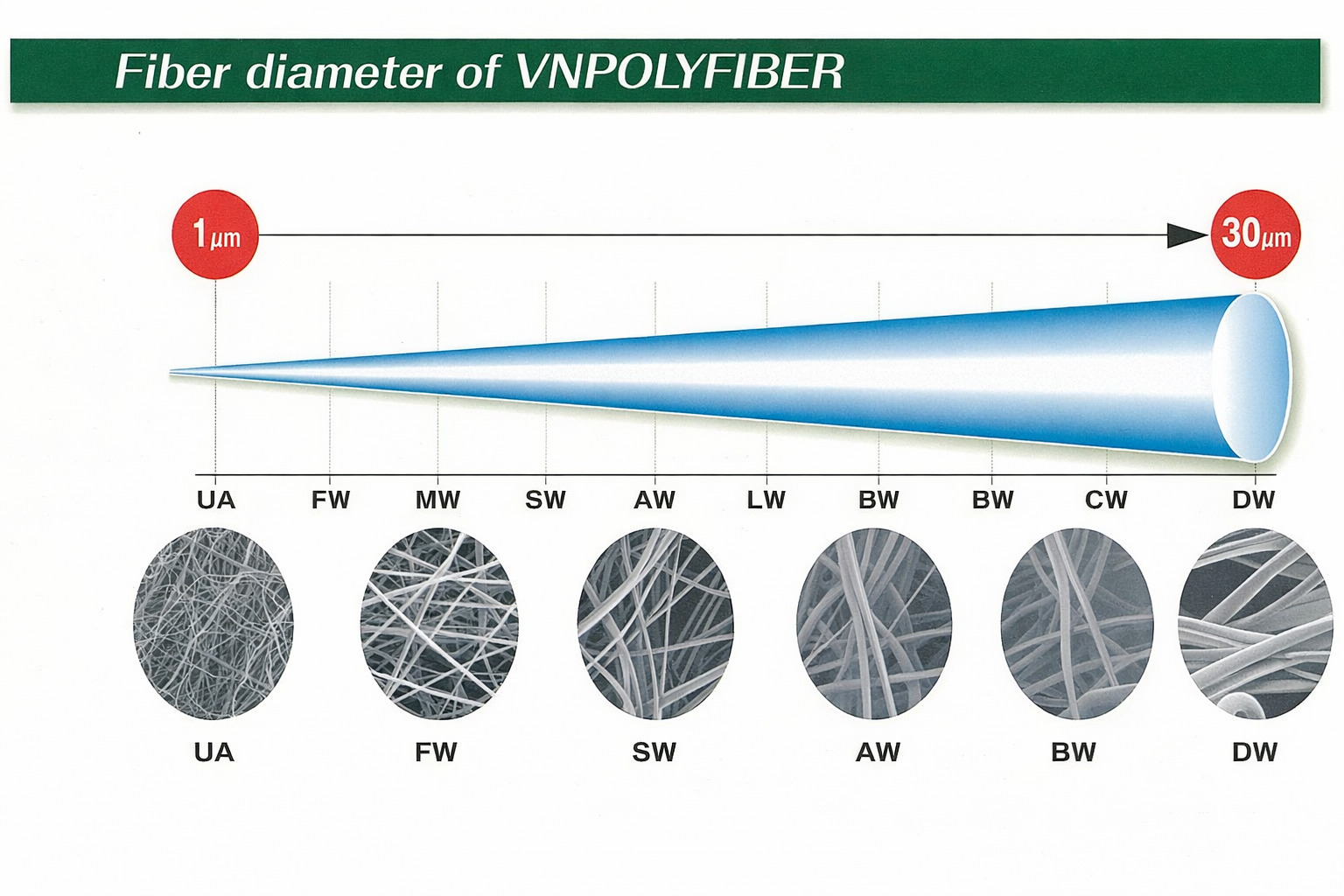
- Fiber diameter
- controllable as wide as from less than μm to a few dozen μm
- Basis weight
- controllable as wide as from approx. 7 g/m²~400 g/m²
- Pore size
- Porosity ranges from a few to 100 μm in size, providing superior filter performance due to its porous nature.
・No-binding nonwoven
・Made of fine fiber uniformly and isotropically dispersed
・Excellent texture, softness and drapability.
Variety of raw material resin
Any thermoplastic resin can be used to make meltblown nonwovens.
The following are the raw material resins that we have used for VNPOLYFIBER products.
- Polypropylene
- Good in chemical resistivity, water repellency, and electrical insulation.
- As it stands against autoclave sterilization, it can be used for the food services, drinks, and industrial goods of medical use.
- It is relatively inexpensive and most widely used as raw material for VNP Polyfiber products.
- Polyester
- It has excellent heat resistivity (m.p. ~220~240℃) and excellent resistance to oxidative degradation.
- This is appropriate for secondary processing, such as impregnation in an aqueous solution.
- Polyamide
- High water absorption capacity is associated with an amide group.
- Excellent heat resistivity (m.p. ((approx. 225°C) and good chemical resistivity.
- Poly(methyl pentene)
- Excellent heat resistivity (m.p. It has a temperature of approximately 230°C and exhibits good chemical resistivity and electrical insulation, as it is a type of polyolefin.
- Poly Phenylene Sulfide
- Excellent heat resistivity (m.p. (approx. 285°C) and excellent flame retardancy.
- Excellent chemical resistivity against any solution except for hot concentrated nitric acid.
- Polylactic Acid
- Bioplastic is not derived from fossil resources.
- Biodegradable and environmentally friendly resin is to be decomposed to carbon dioxide and water by microorganisms in the end.
We have lots of manufacturing experience for many other thermoplastics. 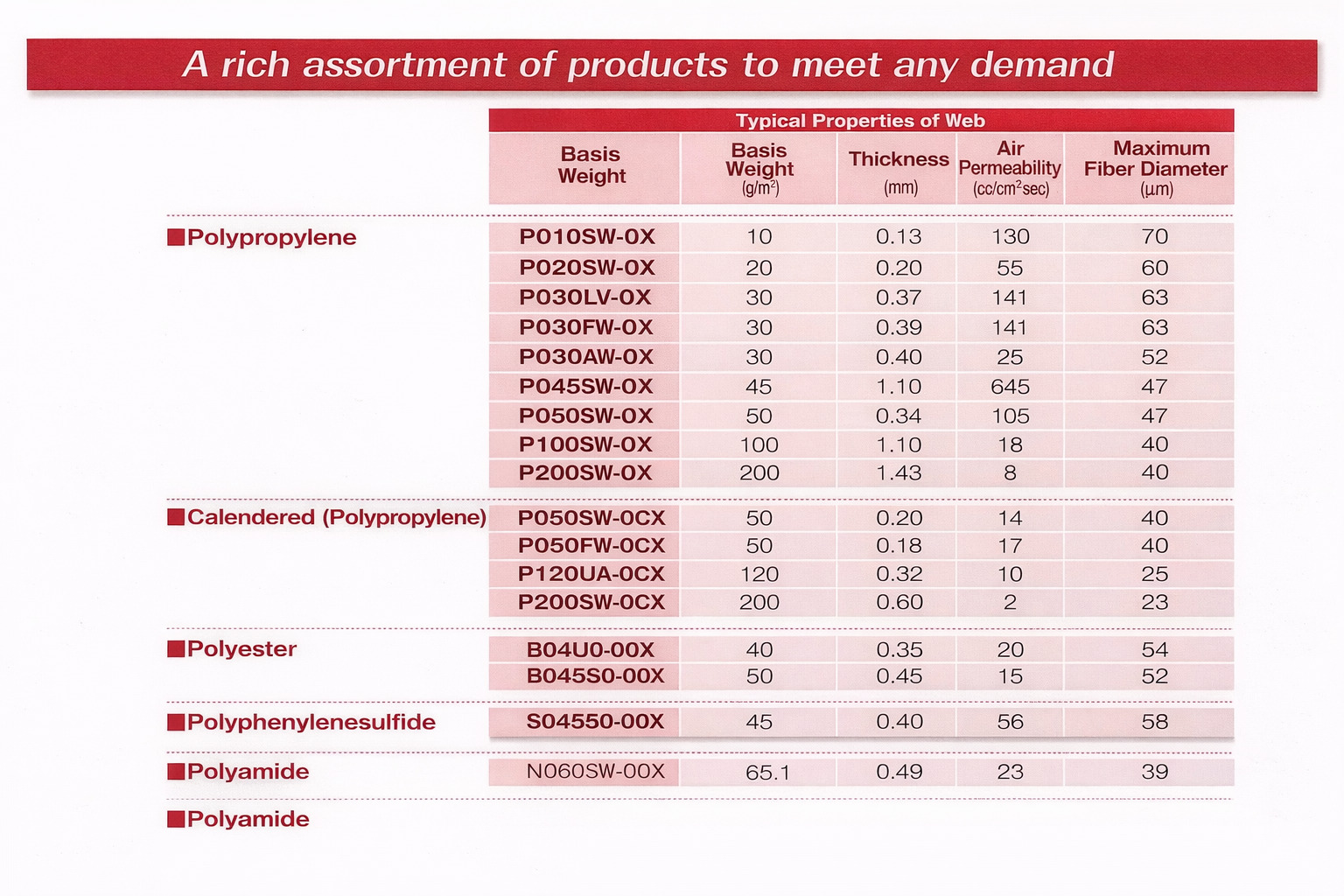
Characteristics of Nonwovens
- Structure: Nonwovens are typically formed from fibers or filaments laid together in a web or sheet structure. They do not have a regular, repeating structure like woven or knitted fabrics.
- Production Efficiency: Nonwoven fabrics can be manufactured quickly and cost-effectively, making them suitable for high-volume, disposable products.
- Versatility: The properties of nonwovens can be tailored to specific needs by varying the type of fibers, bonding methods, and finishing processes.
Types of Nonwoven Fabrics
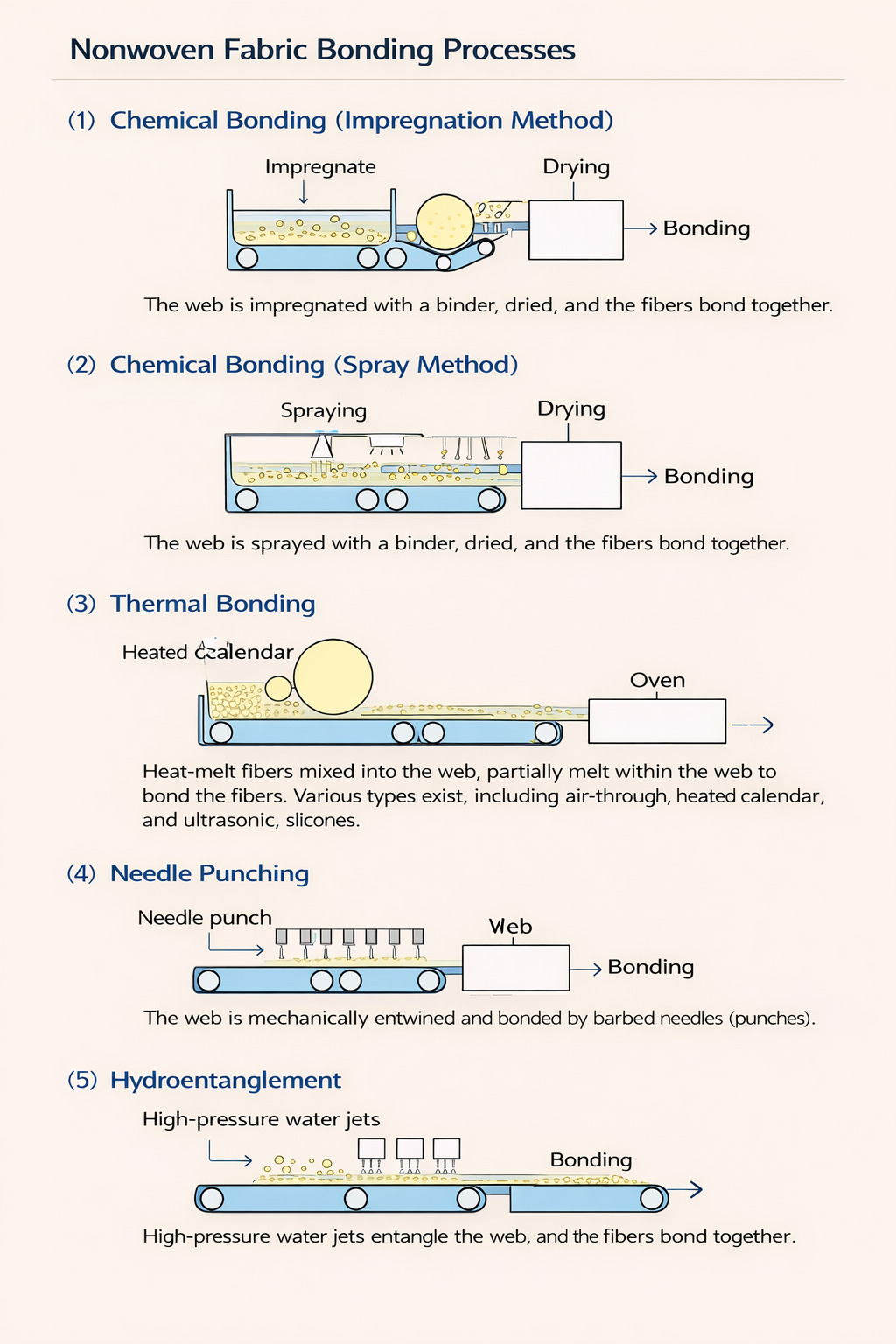
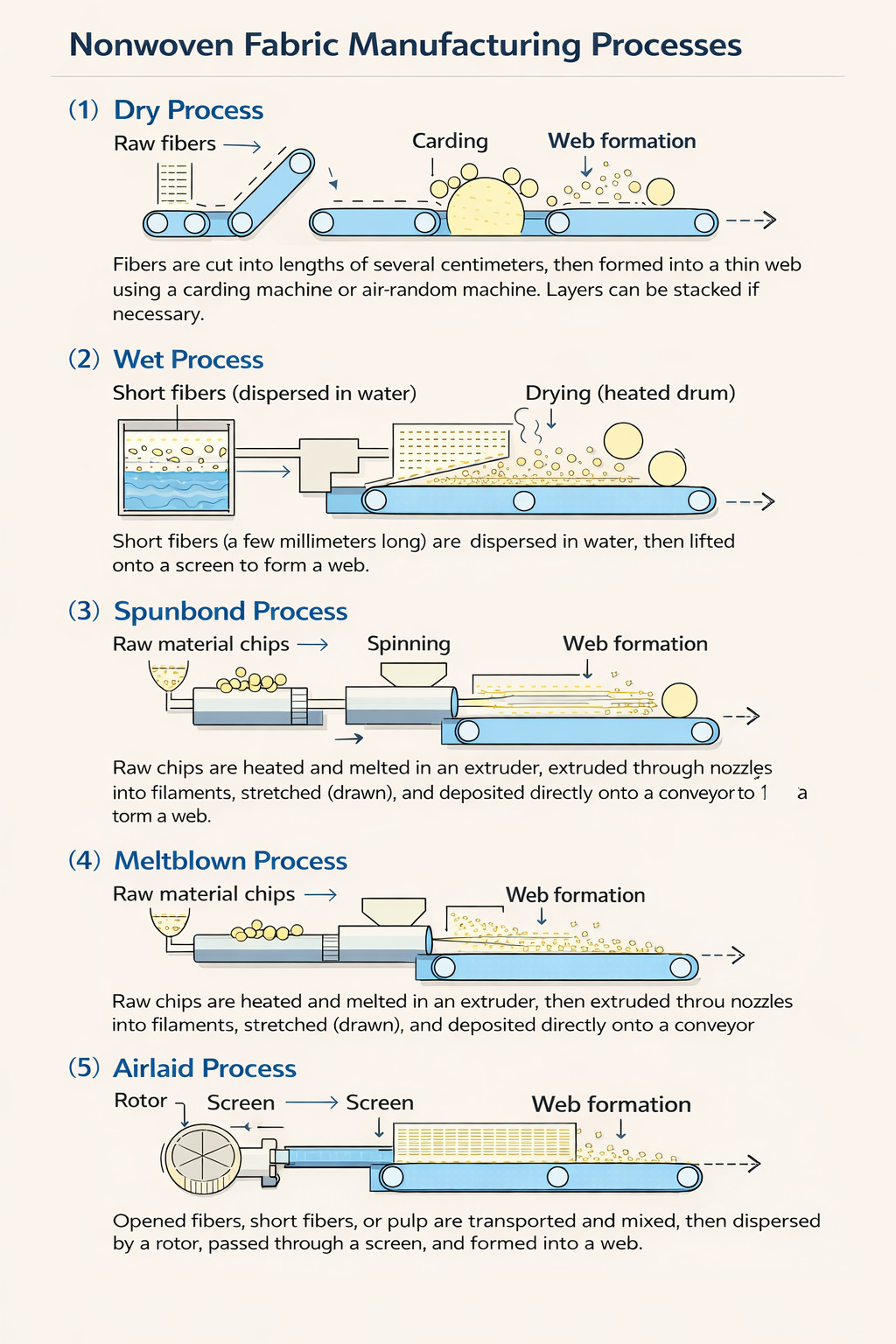
- Spunbond: This process involves extruding molten polymer through spinnerets to form continuous filaments, which are then laid down into a web and bonded thermally. Read more: https://vnpolyfiber.com/spunbond-nonwoven-meltblown-nonwoven-spunlace-nonwoven/
- Meltblown: Similar to spunbond, but the fibers are much finer and the web is formed by blowing molten polymer through nozzles with high-velocity air. Read more: https://vnpolyfiber.com/spunbond-nonwoven-meltblown-nonwoven-spunlace-nonwoven/
- Airlaid: Fibers are suspended in air and then deposited onto a moving belt, where they are bonded by heat or adhesives. Read more: https://vnpolyfiber.com/airlaid-nonwoven-vs-air-through-bond-nonwoven/
- Needle Punching: A mechanical process where barbed needles are repeatedly punched through the fiber web, entangling the fibers to create a cohesive fabric. Read more
- Hydroentangling (Spunlace): High-pressure water jets are used to entangle fibers, creating a strong and flexible fabric. Read more: https://vnpolyfiber.com/spunbond-nonwoven-meltblown-nonwoven-spunlace-nonwoven/
- Chemical Bonding: Adhesives or binders are applied to the fiber web, which is then cured to form a stable fabric. Read more: https://vnpolyfiber.com/chemical-bonding-nonwoven-and-thermal-bonding-nonwoven/
- Thermal Bonding: Heat is applied to melt thermoplastic fibers in the web, which solidify upon cooling to bond the web together. Read more: https://vnpolyfiber.com/chemical-bonding-nonwoven-and-thermal-bonding-nonwoven/
Applications of Nonwovens
- Hygiene Products: Diapers, sanitary napkins, and incontinence products benefit from the absorbency and softness of nonwovens.
- Medical Textiles: Used in surgical gowns, masks, drapes, and wound dressings for their sterility, barrier properties, and disposability.
- Filtration: Nonwovens are widely used in air and liquid filtration due to their customizable pore sizes and permeability.
- Geotextiles: Employed in construction and landscaping for soil stabilization, drainage, and erosion control.
- Automotive: Used in interior fabrics, insulation, and filters.
- Agriculture: Nonwoven fabrics serve as crop covers, weed barriers, and seed germination fabrics.
- Consumer Products: Includes items like wipes, cleaning cloths, and interlinings for garments.
Advantages of Nonwovens
- Customizability: The properties of nonwovens can be tailored to meet specific requirements by varying fiber types, bonding methods, and treatments.
- Efficiency: Production processes for nonwovens are generally faster and less expensive compared to woven or knitted fabrics.
- Versatility: Nonwovens can be designed to exhibit a wide range of properties, from high strength and durability to softness and absorbency.
- Disposability: Many nonwoven products are designed for single-use applications, especially in the medical and hygiene sectors, reducing the risk of contamination.
Disadvantages of Nonwovens
- Strength and Durability: Generally, nonwovens are less durable than woven or knitted fabrics, which limits their use in applications requiring long-term wear.
- Environmental Concerns: Many nonwovens are made from synthetic polymers that are not biodegradable, raising concerns about environmental impact. However, there is a growing trend towards using biodegradable fibers and sustainable production methods.
Key Considerations
- Fiber Selection: The choice of fibers (synthetic, natural, or a blend) greatly influences the properties of the nonwoven fabric.
- Bonding Method: The method used to bond fibers (mechanical, thermal, or chemical) affects the fabric’s characteristics such as strength, flexibility, and softness.
- End Use: The specific requirements of the intended application will determine the type of nonwoven fabric and the manufacturing process.
Nonwovens are a critical component in a wide range of industries due to their versatility, efficiency, and adaptability to various applications.