Why the Choice of Nonwoven Reinforcement Matters More Than Most Buyers Realize
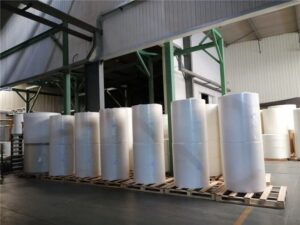
Walk into any bitumen membrane factory and you will find rolls of polyester mat stacked in the warehouse. Ask the production manager which type they use, and most will answer without hesitation. But ask why they chose spunbond over staple fiber, or vice versa—and the answers are often less certain.
The choice of nonwoven reinforcement type is one of the most consequential decisions a membrane manufacturer makes. It affects membrane production speed, bitumen consumption, finished product weight, elongation performance, cost structure, and the markets your product can serve. Yet it is often made based on habit, supplier availability, or price—rather than a clear understanding of the technical trade-offs.
This post provides that clarity.
The Two Production Routes: A Technical Overview
Route 1: Spunbond Polyester Mat (Continuous Filament)
The spunbond production route uses polyester chips as the raw material and is characterized by high-strength output and continuous manufacturing.
The polymer is melted and extruded into continuous filaments, laid into a random web, then mechanically, thermally, and/or chemically bonded.
The result is a fabric where every fiber runs continuously through the full length of the roll—no fiber ends, no weak points, just an uninterrupted network of interlocked filaments. This gives spunbond mat its superior tensile strength and puncture resistance compared to staple fiber mat of equivalent weight.
The material can be tailored to fit the properties the end applications require — such as air-permeability, dimensional stability, puncture resistance, pleatability, and stiffness — by adjusting the polyester type, the fiber diameter, the binder system, and the mat density.
Route 2: Needle-Punched Staple Fiber Mat (Short Fiber)
The staple fiber system utilizes pre-cut polyester staple fibers and relies on mechanical carding to form the web.
The fibers are opened from bales, blended for consistency, carded into a web, cross-lapped to build the required weight, and then needle-punched to mechanically bond the structure before chemical impregnation.
Because the fibers are cut to a defined length (typically 51 mm–76 mm for membrane mat applications), the resulting fabric has a slightly different internal structure from spunbond—more loft, slightly better flexibility, and excellent bitumen absorption due to the open fiber network.
Head-to-Head Comparison
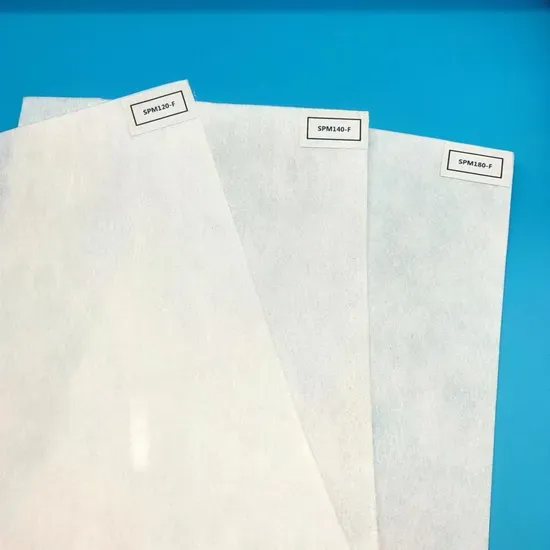
| Performance Factor | Spunbond Mat | Needle-Punched Staple Mat |
|---|---|---|
| Raw material | PET polymer chips | Polyester staple fiber |
| Filament continuity | Continuous (no fiber ends) | Discontinuous (cut fibers) |
| Tensile strength | Higher for same weight | Good — slightly lower |
| Puncture resistance | Excellent | Very good |
| Elongation at break | 25–35% | 25–40% |
| Loft / bulk | Lower | Higher |
| Bitumen impregnation | Excellent | Excellent |
| Dimensional stability | Very good | Good |
| Production line speed | Higher (better runnability) | Standard |
| Cost | Higher | More competitive |
| Best membrane type | Premium SBS/APP, infrastructure | Standard SBS/APP, general construction |
What the World’s Leading Producers Choose
The technology split among global leaders is telling. Freudenberg Performance Materials’ cutting-edge production facilities work with both staple and spunbond technology. The range of products comprises polyester nonwovens — with or without fiberglass reinforcements — for the roofing industry, bitumen modifiers, liquid waterproofing carriers, and geotextiles.
Johns Manville Engineered Products manufactures Evalith® nonwoven materials using multiple technologies, including wet-laid, air-laid, needle punch, polyester spunbond and PP/PBT meltblown production processes.
The fact that both global market leaders maintain both staple and spunbond capabilities tells you everything: neither technology is universally superior. Both have specific roles where they excel, and sophisticated manufacturers serve both markets.
Chinese producers like Hubei Bushi focus primarily on the spunbond route using PET chips, while many other Chinese factories — particularly those supplying standard-grade membrane producers — use the needle-punched staple fiber route, which has lower capital equipment costs and uses polyester staple fiber as raw material.
Choosing Based on Your Application
Choose spunbond polyester mat when
- Producing premium SBS or APP membranes for demanding markets (Europe, North America, high-specification infrastructure)
- Running high-speed membrane production lines where better runnability reduces waste
- Targeting applications requiring maximum tensile strength at low weight
- Supplying roofing membrane for Class A fire-rated assemblies where fiber integrity is critical
- Producing membranes for bridge deck, tunnel, or underground foundation waterproofing
Choose needle-punched staple fiber mat when
- Producing standard-grade SBS membranes for cost-competitive markets
- Your raw material supply chain is built around polyester staple fiber rather than PET chips
- Targeting general construction waterproofing for residential and commercial roofing
- Flexibility and loft are priorities over maximum tensile strength
- Cost per square meter is a primary competitive advantage in your target market
The Hybrid Answer: Fiberglass-Reinforced Composite Mat
For applications where neither pure polyester (whether spunbond or staple) fully meets requirements, the fiberglass-reinforced composite mat offers a third option. Texbond® R is a staple polyester nonwoven reinforced with glass filaments arranged lengthwise. It is available in numerous versions with different weights and is made of 100% recycled fiber, making a positive impact on the environment.
The carrier reinforced with fiberglass filaments gives the bituminous membrane outstanding dimensional stability and resistance over time. Using the fiberglass reinforcement also eliminates the phenomenon of thermal memory: once applied to roofs, the membrane is shrink-free even when temperatures fluctuate.
This composite approach—polyester for flexibility and elongation, fiberglass for dimensional stability—has become the premium specification for demanding projects, including green roofs, bridge decks, and high-rise commercial roofing where 20–30 year performance guarantees are required.
VNPolyfiber: Both Routes, One Supplier
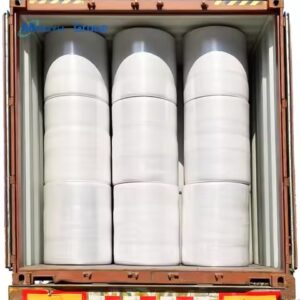
VNPolyfiber supplies polyester staple fiber for needle-punched mat production and finished mats of both types through our factory network. Whether you need a standard staple fiber mat or premium spunbond, we can source and supply to your specification.