Nonwoven Fabric: The Complete Guide to All Types, Bonding Methods and Applications
Nonwoven fabric is the fastest-growing segment of the global textile industry — and the least understood. Most people encounter nonwovens daily without recognizing them: the soft inner layer of a disposable diaper, the filtering layer of a face mask, the geotextile membrane beneath a road, the spunbond cover of a mattress, the needle-punched carpet underlay, the wet wipe used to clean a baby’s skin. These are all nonwoven fabrics, and they are made by processes that have almost nothing in common with each other.
This complete guide covers the full nonwoven fabric landscape — what nonwoven fabric is, how it differs from woven and knit fabric, all seven major bonding and production methods with their specific properties and applications, the comparison framework that helps buyers choose the right nonwoven for their requirements, and the connection between polyester staple fiber (PSF) feedstock and the nonwoven processes that convert it into fabric.
VNPOLYFIBER supplies both polyester staple fiber — the primary raw material for thermally bonded, needlepunched, and airlaid nonwovens — and nonwoven fabric products sourced from our manufacturing network across Asia. This guide reflects our supply chain knowledge from both ends of the nonwoven production chain.
What Is Nonwoven Fabric? The Definition
A nonwoven fabric is a sheet or web structure bonded together by entangling fibers, filaments, or perforated films — by mechanical, thermal, or chemical means. The defining characteristic that distinguishes nonwovens from woven and knit fabrics is that nonwovens are not made by interlacing yarn: they do not require the spinning of fiber into yarn, the weaving of yarn on a loom, or the knitting of yarn into loops.
Instead, nonwoven fabrics are formed by arranging fibers (or directly extruding polymer into filaments) into a web structure, then bonding that web into a coherent fabric through one of several methods. This fundamentally different manufacturing pathway gives nonwovens their characteristic properties: high production speeds, lower manufacturing cost per unit area, precise engineering of properties through fiber and process selection, and the ability to produce fabrics with structural characteristics that yarn-based textiles cannot achieve.
| Characteristic | Woven Fabric | Knit Fabric | Nonwoven Fabric |
| Fiber to fabric pathway | Fiber → Yarn → Weaving | Fiber → Yarn → Knitting | Fiber (or filament) → Web → Bonding — no yarn needed |
| Production speed | Low — 0.5–6 m/min | Medium — 2–16 m/min | Very high — 10–400+ m/min |
| Strength direction | Highest in warp and weft | Moderate, isotropic | Variable — can be engineered |
| Stretch | Minimal (without elastane) | High — loop structure extends | Low — most nonwovens have minimal stretch |
| Tear resistance | Good | Good | Variable — needlepunch and spunbond good; meltblown low |
| Durability / laundering | Excellent — most survive many cycles | Good — pre-shrunk grades stable | Low to none — most designed as single-use or limited wash |
| Cost per m² | Highest | Medium | Lowest — fewest processing steps |
| Pore size control | Limited by weave density | Limited | Precise — especially meltblown and spunbond |
| Typical end uses | Apparel, bedding, technical | Sportswear, knitwear, hosiery | Hygiene, medical, filtration, geotextile, insulation |
The Seven Major Nonwoven Production and Bonding Methods
Nonwoven fabrics are produced by a wide range of processes that differ fundamentally in how the fiber web is formed and how it is bonded into a coherent fabric. The seven major commercial processes each produce fabrics with distinct structural characteristics and performance profiles:
| Process | Feedstock | Key Properties and Applications |
| Spunbond | Polymer chips (PP or PET) — direct extrusion | Continuous filaments extruded and thermally bonded. Uniform, strong, dimensionally stable. Medical disposables, crop covers, hygiene components, geomembrane backing. |
| Meltblown | Polymer chips — ultra-fine extrusion | Extremely fine fibers (<10 micron) blown into web. Highest filtration efficiency of any nonwoven. N95 mask filter layer, HVAC media, liquid filtration. |
| Needlepunch | PSF or PP staple fiber bales | Fiber web mechanically entangled by barbed needles. Durable, isotropic, no binder needed. Geotextiles, carpet underlay, automotive, synthetic leather substrate. |
| Thermal bonding | PSF + LMF bico fiber | Web of thermoplastic fibers heated until LMF sheath melts and bonds at fiber crosspoints. Soft, clean, lofty. Pillow and duvet fill wadding, hygiene top sheets, mattress quilting. |
| Chemical bonding | Any fiber type + latex or acrylic binder | Binder applied to web and cured. Versatile fiber choice but chemical binder adds cost and environmental considerations. Interlining, specialty filter media, wipes. |
| Spunlace / Hydroentangle | PSF, viscose, cotton, or blends | High-pressure water jets entangle fibers without binder. Soft, strong wet, fabric-like surface. Wet wipes, medical dressings, cosmetic pads, industrial wipers. |
| Airlaid | Short fibers (fluff pulp, cotton, PSF) + bico | Fibers dispersed in air stream onto moving belt, then bonded. Bulky, highly absorbent. Diaper absorbent core, sanitary napkin, tabletop products. |
Method 1: Spunbond Nonwoven
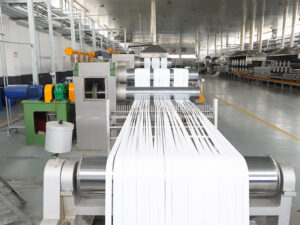
Spunbond is one of the two primary direct-extrusion nonwoven processes — polymer chips are melted, extruded through spinnerets into continuous filaments, cooled, drawn to develop orientation and strength, and deposited randomly onto a moving belt to form a web. The web is then thermally bonded by calendar rollers (heated to melt the filament surfaces at contact points) to form a coherent fabric. Because this process goes directly from polymer chip to bonded fabric without any intermediate staple fiber or yarn stage, spunbond is one of the most cost-efficient nonwoven production methods.
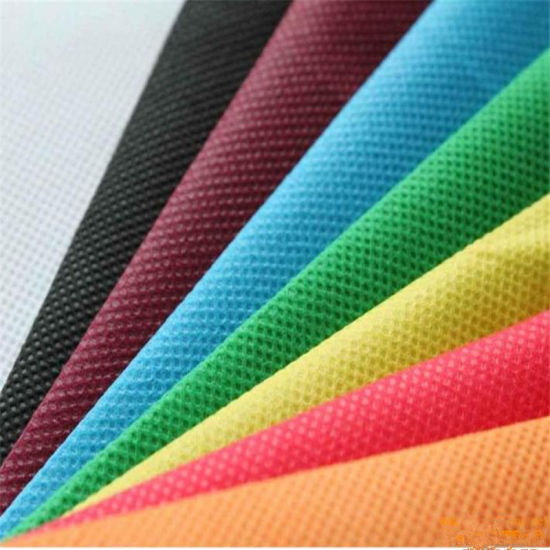
Spunbond fabrics are characterized by their dimensional stability, uniform pore structure, and good tensile strength relative to weight. Polypropylene (PP) spunbond dominates in hygiene, medical, and agricultural applications; polyester (PET) spunbond is preferred for geotextile and technical applications where higher UV resistance and heat tolerance are needed. The SMS (spunbond-meltblown-spunbond) laminate construction combines spunbond’s strength with meltblown’s filtration capability for medical protective fabrics and filtration applications.
- Key applications: Diaper top sheets and back sheets; surgical gown outer layer; crop cover and row cover; geomembrane protective layer; disposable medical cap, mask outer shell; furniture dust cover; mattress base cover
- PSF connection: Spunbond does not use PSF — it uses polymer chips fed directly to the spinneret. However, SMS laminates use meltblown as the central layer which also uses polymer chips rather than PSF.
Method 2: Meltblown Nonwoven
Meltblown is the highest-precision nonwoven process — polymer melt is extruded through an array of very small nozzles while high-velocity heated air streams impinge on the extrudate, shearing it into extremely fine fibers (typically 1–10 microns diameter, far finer than any staple fiber or spunbond filament). The ultrafine fibers are deposited on a collector to form a web with very high specific surface area and extremely small inter-fiber pore size.
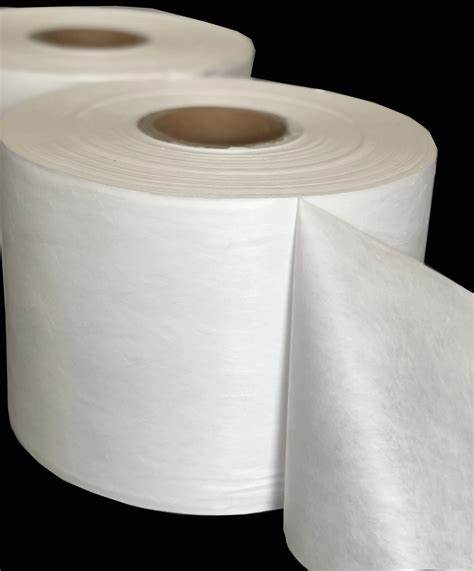
The combination of mechanical filtration (pore size far smaller than most particle sizes of interest) and electrostatic effects (meltblown fibers can hold electrostatic charge after corona treatment) gives meltblown the highest particle filtration efficiency of any nonwoven construction — the critical functional layer in N95, FFP2, and FFP3 respirators. The same properties make meltblown the standard for HVAC filter media achieving MERV 13–16 ratings.
- Key applications: N95 and FFP2/3 respirator filter layer; HVAC filter media; surgical mask middle filtration layer; liquid filtration cartridges; oil sorbent pads (PP meltblown absorbs oil while repelling water); clean room garment outer shell
Method 3: Needlepunched Nonwoven
Needlepunching is the oldest and highest-volume (by weight) nonwoven process globally. Polyester or polypropylene staple fiber is carded into a fiber web (batt), then passed through a machine equipped with thousands of barbed needles arranged in a board that punches repeatedly through the web. The barbs mechanically interlock the fibers as they penetrate and retract, creating a three-dimensionally entangled structure without any thermal or chemical bonding agent.
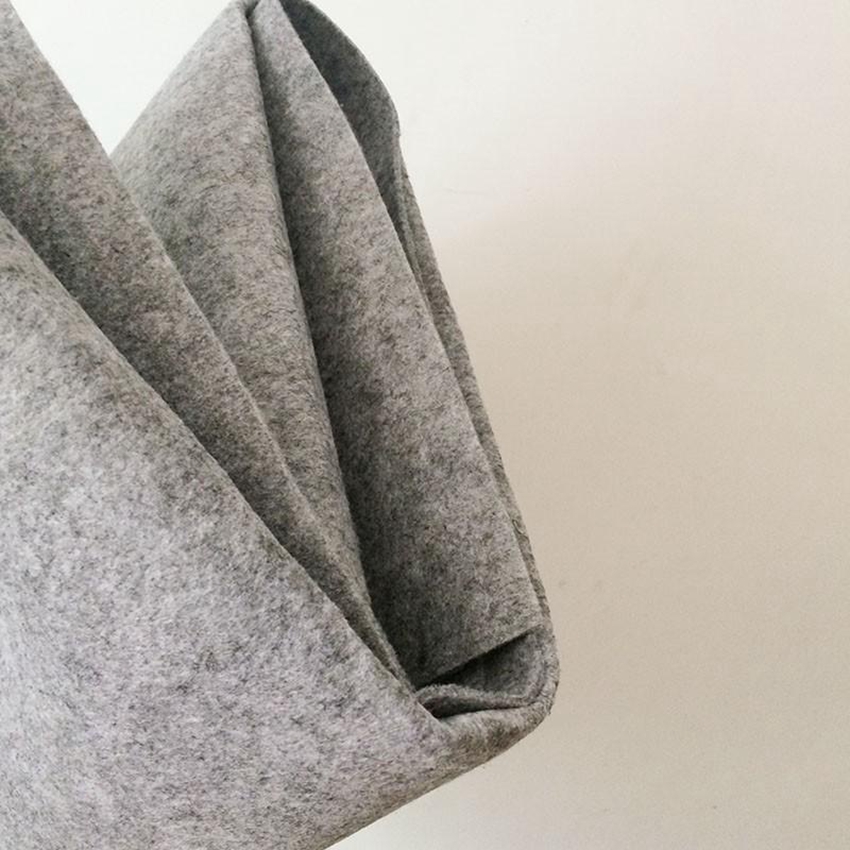
The result is a mechanically robust fabric with good tensile strength in all directions, reasonable elongation, and durability without binders — properties that make needlepunched nonwoven the standard for high-stress applications including geotextiles, carpet underlay, automotive trunk liners, and the substrate layer of synthetic leather. Basis weights range from approximately 100 g/m² (lightweight geotextile separation) to over 2,000 g/m² (heavy-duty geotextile reinforcement).
- PSF specification for needlepunch: Solid polyester staple fiber, typically 4D–17D, 51–76 mm staple length for standard needlepunch. UV-stabilized PP or polyester fiber for outdoor geotextile applications. Higher denier (10D–17D) for heavier structural geotextile grades; finer denier (4D–6D) for finer face fabric and filtration applications.
- Key applications: Geotextiles (road sub-base stabilization, slope erosion control, drainage filtration, retaining wall reinforcement); carpet underlay; automotive trunk liner, hood insulator, door panel fabric; filter bags for dust collection; synthetic leather substrate (needlepunched PET impregnated with PU)
Method 4: Thermally Bonded Nonwoven
Thermal bonding uses heat to melt thermoplastic fiber components at fiber crosspoints, creating bonds when the melt solidifies on cooling — without any chemical binder. The most important commercial variant uses bicomponent (bico) low-melt fiber (LMF): staple fiber with a high-melting-point core (PET or PP) and a lower-melting-point sheath (co-PET or PE). When the fiber web is heated, the LMF sheath melts and bonds the structural core fibers at their crosspoints.
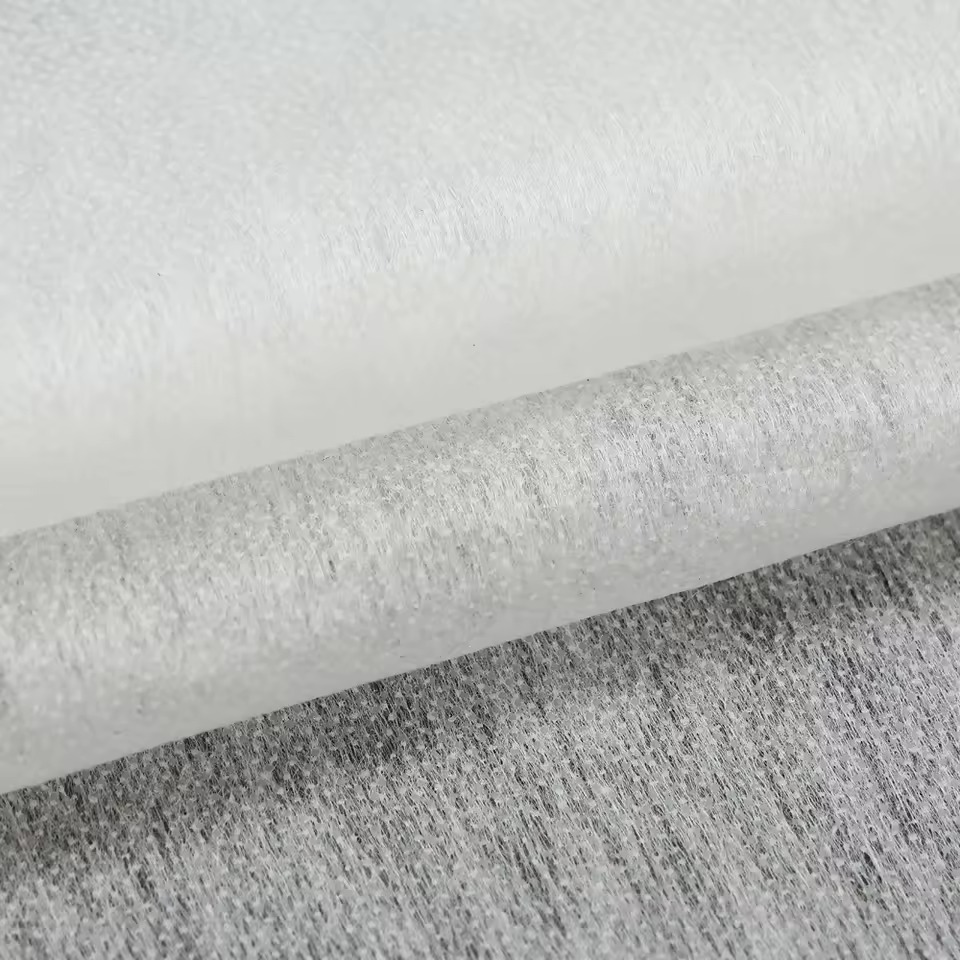
Thermally bonded nonwovens are the product category most directly fed by VNPOLYFIBER’s PSF range. The standard formulation blends 75–85% HCS (hollow conjugated siliconized) polyester fiber with 15–25% LMF bico fiber. The HCS provides bulk, loft, and resilience; the LMF provides bonding at heat-set crosspoints. The resulting wadding is used as insulation batting in quilted jackets, as mattress topper fill, as the quilting layer in duvets, and as the insulating layer in automotive door panels and headliners.
- PSF specification for thermal bonding: HCS siliconized PSF: typically 3D–7D × 51–64 mm for standard wadding; 1.5D–3D for fine, soft premium grades. LMF bico: typically 4D × 51 mm at 15–30% blend ratio; melting point of sheath at 110–130°C (below HCS melt point of 255°C+).
- Key applications: Quilted jacket and coat insulation; sleeping bag fill wadding; mattress quilting layer and topper; duvet inner batting; automotive door panel insulator and headliner; toy and plush fill wadding; diaper acquisition/distribution layer
Method 5: Chemical Bonding Nonwoven
Chemical bonding applies a liquid binder (typically latex, acrylic, SBR, or polyvinyl alcohol) to a fiber web — by spraying, padding, or foam application — and then cures the binder in an oven to create bonds at fiber crosspoints. Unlike thermal bonding, chemical bonding is not restricted to thermoplastic fibers: it can bond natural fibers (cotton, wood pulp), regenerated fibers (viscose), and synthetic fibers alike, giving it broader fiber compatibility than thermal bonding.
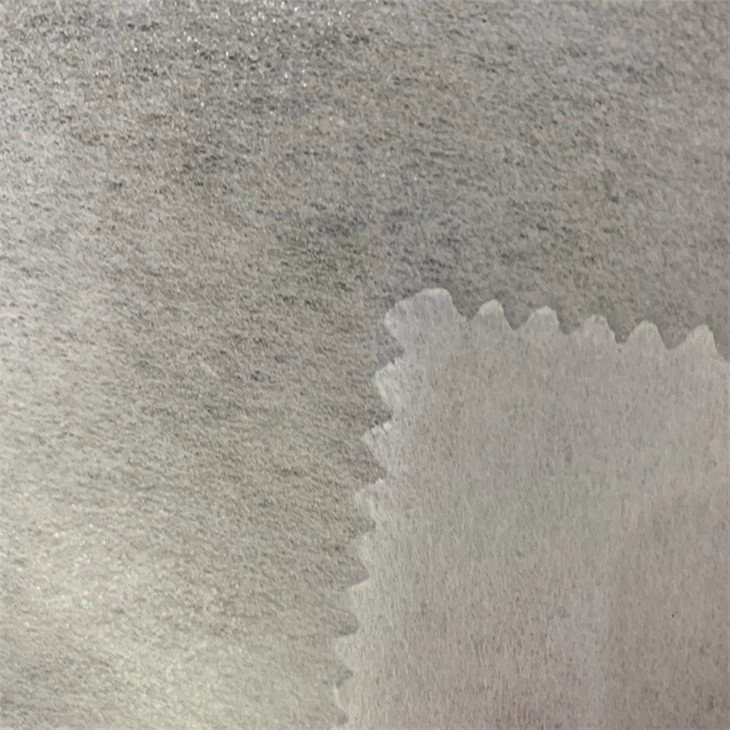
The binder adds stiffness and affects the fabric’s hand feel, breathability, and environmental profile — the presence of chemical binders can complicate recycling and adds cost compared to thermal bonding. For these reasons, thermal bonding has largely displaced chemical bonding in hygiene applications where clean, binder-free fabrics are preferred. Chemical bonding retains its position in specialty applications where specific binder chemistry provides properties (flame retardancy, water repellency, specific adhesion) that thermal bonding cannot achieve.
- Key applications: Garment interlinings; specialty filtration media requiring specific binder chemistry; wipes (where binder provides wet strength); roofing underlays; some geosynthetic composites
Method 6: Spunlace / Hydroentangled Nonwoven
Spunlace (also called hydroentanglement or water jet entanglement) bonds fibers by directing high-pressure water jets (30–100 bar) through a fiber web supported on a permeable belt or drum. The water jet energy drives fibers from the jet impact point through the web, mechanically interlocking with fibers below — creating a three-dimensional entanglement without any binder or heat. After entanglement, the fabric is dried.
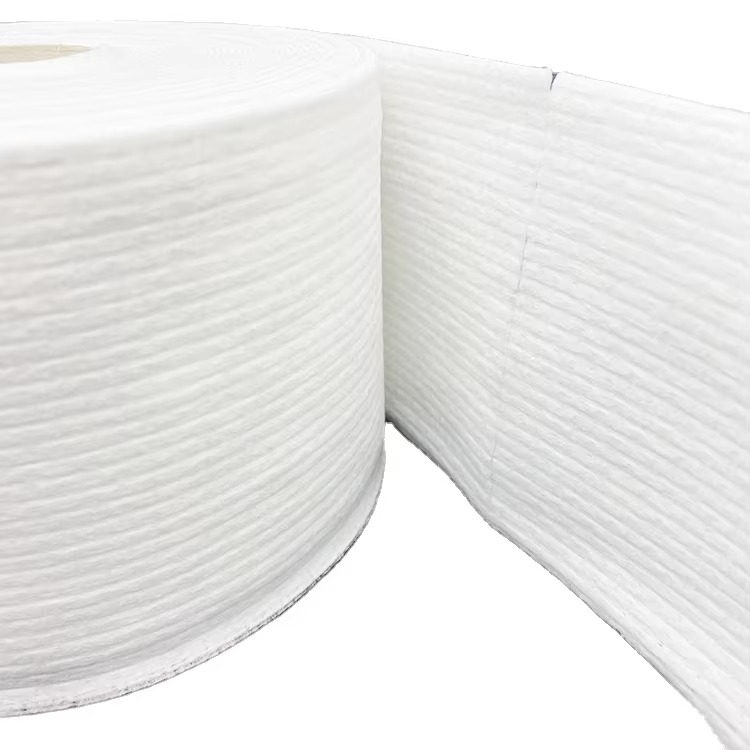
Spunlace produces the most fabric-like surface of any nonwoven — it is flexible, drapes well, and has a soft textile character significantly different from the stiffer, more ‘industrial’ feel of needlepunch or chemical bonding. It is strong in both dry and wet conditions (no binder to wash out). Viscose/polyester blends (typically 70/30 or 50/50) are standard for wet wipes; 100% PET spunlace is used for medical and industrial applications requiring chemical resistance; cotton spunlace is used for cosmetic and medical applications where natural fiber contact is required.
- PSF specification for spunlace: Solid polyester fiber, typically 1.5D–3D × 38–51 mm; must have good water dispersibility during jet entanglement. Blended with viscose (1.5D × 38 mm) for wipe applications.
- Key applications: Wet wipes (baby wipes, facial wipes, household cleaning wipes — the largest volume spunlace application); medical wound dressings and bandages; cosmetic and facial cleansing pads; industrial wipers (automotive, aerospace); premium synthetic leather substrate
Method 7: Airlaid Nonwoven
Airlaid forms fabric by dispersing short fibers (typically 3–12 mm — much shorter than carding-compatible staple fiber) into an air stream and depositing them on a moving perforated belt under vacuum suction. The resulting web has very high fiber density and exceptional absorption capacity — particularly when wood pulp (fluff pulp) is the primary fiber. After web formation, the web is bonded using bico fiber (thermal bonding), latex (chemical bonding), or hydrogen bonding (for pure cellulose webs).
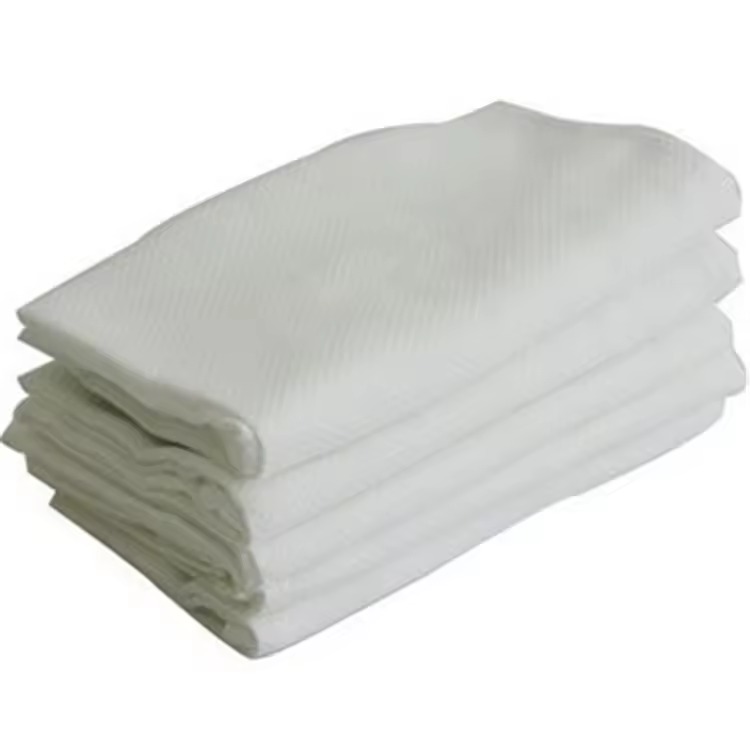
Airlaid’s primary advantage is the ability to use extremely short fibers — including wood pulp, which cannot be processed on carding machines — at very high basis weights (up to 400 g/m²) with excellent uniformity and absorbency. This makes airlaid the standard for the absorbent core of premium diapers and sanitary napkins, where the fluff pulp structure provides the liquid storage capacity and distribution that superabsorbent polymer (SAP) particles require.
- Key applications: Diaper and sanitary napkin absorbent core (fluff pulp + SAP composite); premium tabletop products (napkins, tablecloths with the feel of real cloth); food packaging (meat absorbent pads); industrial wipes; feminine hygiene
Nonwoven Fabric Specification Parameters
When sourcing or specifying nonwoven fabric, the key parameters that define a nonwoven’s performance profile are:
| Parameter | What It Means and Typical Ranges |
| Basis weight (gsm) | Grams per square metre — the primary weight and thickness indicator. Range: 8 gsm (fine hygiene spunbond) to 2,000 gsm+ (heavy geotextile needlepunch). |
| Width | Roll width — typically 160–320 cm for spunbond; 160–250 cm for needlepunch. Jumbo rolls or slit rolls to customer specification. |
| Fiber composition | Fiber type (PP, PET, viscose, cotton, bico), denier, and blend ratio. Determines chemical resistance, heat tolerance, moisture management, and recyclability. |
| Tensile strength (MD and CD) | Machine direction (MD) and cross direction (CD) tensile strength in N/5cm or kN/m for geotextiles. Critical for structural applications. |
| Elongation at break | Important for geotextile and filtration applications — higher elongation provides better conformability to uneven surfaces. |
| Pore size (AOS/O98) | Apparent Opening Size — the largest particle that the fabric will retain. Critical specification for geotextile and filtration applications. |
| Permeability (water / air) | Water flow rate (l/m²/s) or air permeability — critical for drainage geotextiles and breathable medical fabrics. |
| Surface treatment | Hydrophilic (wicking), hydrophobic (water repellent), anti-static, FR (flame retardant), UV-stabilized, anti-microbial. |
| Certification | OEKO-TEX Standard 100 for skin contact; GRS for recycled content; ISO 9001; EN 13249/13250 for geotextile applications. |
PSF Fiber to Nonwoven: VNPOLYFIBER’s Position in the Chain
VNPOLYFIBER occupies a unique position in the nonwoven supply chain — supplying both the PSF raw material that feeds several key nonwoven processes and the nonwoven fabric products that are produced from it. This dual position provides our customers with a single-source supplier across both the fiber and fabric stages of their nonwoven supply chain:
- Thermally bonded wadding: HCS siliconized PSF (3D–15D) + LMF bico fiber → thermally bonded insulation batting for quilted garments, mattress toppers, duvets, and automotive insulation
- Needlepunched nonwoven: Solid PSF (4D–17D, 51–76 mm) → needlepunched fabric for geotextile, automotive, carpet underlay, and filtration applications
- Spunlace nonwoven: Fine solid PSF (1.5D–3D, 38–51 mm) blended with viscose → spunlace fabric for wipes, medical, and cosmetic applications
- Airlaid nonwoven: Bico PE/PET or PE/PP fiber + fluff pulp → airlaid fabric for hygiene, food service, and medical applications
- Spunbond nonwoven: PP and PET spunbond fabric supplied directly from our manufacturing network — SMS, SMMS, and plain spunbond available
Conclusion
Nonwoven fabric is not a single material — it is a production philosophy: forming fabric from fiber without the intermediate yarn stage, through any of seven fundamentally different processes that produce fabrics as different as a meltblown respirator filter (fibers thinner than a bacterium, extreme filtration precision) and a needlepunched geotextile (heavy, durable, engineered for permanent infrastructure). Understanding the process-property-application logic of each nonwoven type is the foundation for specifying the right fabric for any application and for understanding where PSF raw material fits in each production pathway.
VNPOLYFIBER provides technical consultation on fiber specification for all PSF-fed nonwoven processes and supplies nonwoven fabric across the spunbond, airlaid, and spunlace categories from our manufacturing network. Contact us for fiber specifications, fabric specifications, certifications, and quotations.