Down Alternative Fill: The Complete Material Comparison Guide — Polyester, Wool, Bamboo, Kapok and Down
If you are a bedding brand, pillow manufacturer, or textile buyer deciding which fill material to specify for your next product line, you face a landscape that is more complex than it has ever been. Natural down remains the luxury benchmark. Synthetic polyester fill has become technically sophisticated. Wool, bamboo, kapok, and Tencel fills are growing in the sustainable positioning segment. And every material comes with marketing claims that are sometimes accurate, sometimes exaggerated, and sometimes simply wrong.
This guide cuts through the marketing to give you a clear, honest, technically grounded comparison of every major fill material category — what each is, what it genuinely offers, where it falls short, and which applications it suits best. The goal is not to tell you polyester fill is always the right choice. The goal is to give you the information to make the right choice for your specific product, market, and brand positioning.
This guide covers the full fill material landscape. For a detailed technical comparison specifically between microfiber fill and cluster fiber fill — the two premium synthetic fill constructions — see the companion article: ‘Down Alternative Fill: Microfiber Fill vs. Cluster Fiber Fill — Complete Comparison Guide’ at vnpolyfiber.com. That article covers the technical depth of synthetic fill types; this guide places all fill materials — natural and synthetic — in context with each other.
The Fill Material Landscape: Six Categories
Every fill material used in commercial pillow, duvet, and outerwear insulation production falls into one of six categories. Understanding the category first prevents the most common sourcing confusion — treating very different materials as if they are interchangeable substitutes:
| Category | Materials and Key Distinguishing Fact |
| Natural down | Goose or duck down clusters — the three-dimensional biological structure that remains the warmth-to-weight benchmark. Measured in fill power (cubic inches per ounce). Not a fiber — a cluster. |
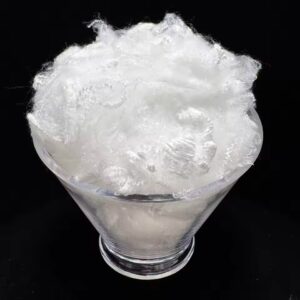
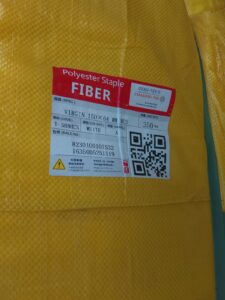
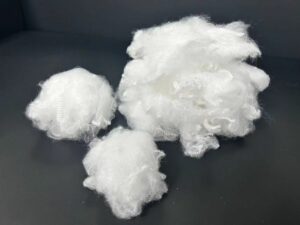
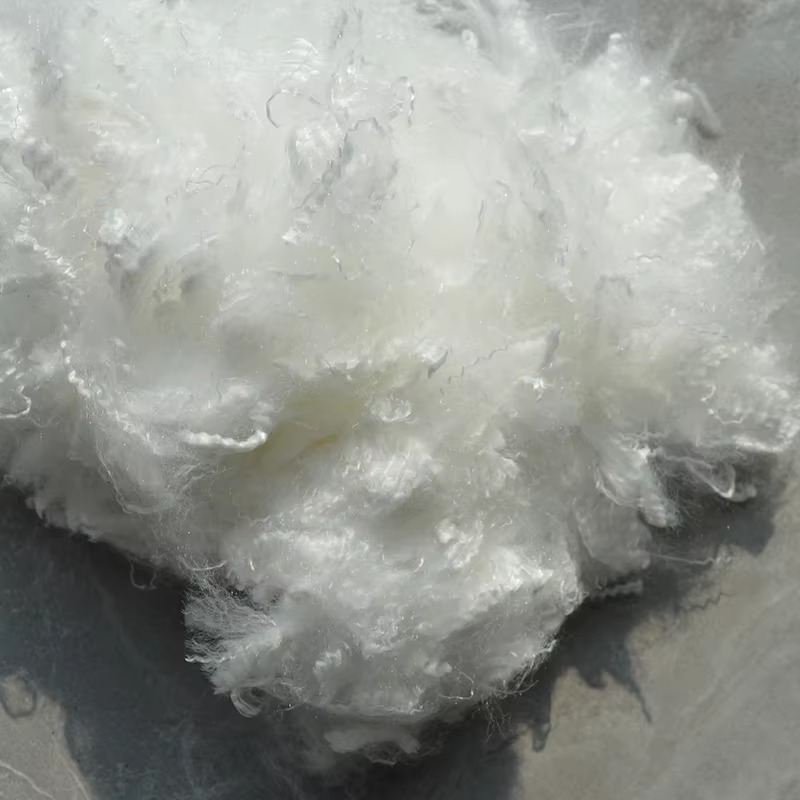
| Synthetic PSF fill | Polyester staple fiber engineered to replicate down’s properties: HCS siliconized fiber (standard), microfiber fill (fine denier, closest to down feel), cluster/ball fiber (spherical construction mimicking down clusters). Made from petroleum-derived PET; GRS-certified recycled versions available. |
| Wool fill | Cleaned and processed wool fiber from sheep. Natural protein fiber with natural crimp. Temperature-regulating, breathable, naturally flame-resistant. Heavier than down or polyester. Expensive. |
| Bamboo fill | A marketing category more than a technical one. ‘Bamboo fill’ almost always means bamboo viscose fiber — produced from bamboo cellulose by the same chemical process as standard wood-pulp viscose. The fiber properties are essentially identical to standard viscose. The ‘bamboo’ positioning is a brand story, not a technical distinction. |
| Kapok | Natural plant fiber from the seed pods of the Kapok tree (Ceiba pentandra). Hollow, very lightweight, silky texture. Naturally hypoallergenic. Limited supply; not suitable for machine filling; requires specialist handling. |
| Lyocell/Tencel fill | Regenerated cellulosic fiber (same as Tencel fabric) processed into fill form. Biodegradable, smooth, moisture-managing. Emerging premium sustainable fill category. Higher cost than PSF; limited availability as fill. |
Natural Down: The Benchmark — Genuine Strengths and Real Limitations
To evaluate any fill material honestly, you must start with an accurate picture of natural down — not the idealized luxury marketing version, and not the animal-welfare-focused critique. The technical reality.
What Down Does Better Than Anything Else
- Warmth-to-weight ratio: Premium goose down (800–900 fill power) produces more warmth per gram than any commercially available synthetic fill. A 900 fill power down duvet at 300g fill weight provides warmth that would require 450–500g of premium microfiber fill to match. This weight advantage matters most in outerwear insulation where garment weight is a performance specification.
- Compressibility: Down compresses to a fraction of its expanded volume and expands back immediately. The packability of a premium down sleeping bag or jacket — the ability to compress it into a pocket-sized sack — has no synthetic equivalent. Premium microfiber comes closest but still falls short of this extreme compressibility.
- Breathability: Down’s open cluster structure allows moisture vapor and body heat to move freely through the fill, preventing the heat build-up that disturbs sleep. This is the property that high-quality natural down does better than any synthetic fill currently available.
- Longevity: Properly maintained down products can last 10–25 years — far exceeding the 3–7 year useful life of most polyester fill products before loft degrades below acceptable levels.
Where Down Genuinely Falls Short
- Price and supply volatility: Premium goose down (700+ fill power) is expensive and its price is volatile — driven by poultry industry supply, weather, and geopolitical factors in major production regions (China, Hungary, Poland). A single adverse supply event can increase down costs 30–50% in months, which polyester fill is immune to.
- Animal welfare: The growing consumer and brand concern about live-plucking (removing down from live birds) is commercially significant. RDS (Responsible Down Standard) and Downpass certification address this — but certification adds cost and supply chain complexity, and some buyers and brands prefer to avoid the issue entirely by using synthetic fill.
- Allergens: Down allergies affect a meaningful portion of consumers — both genuine down protein allergies and dust mite sensitivity (mites colonize down products more easily than synthetic). Washable down at 60°C reduces dust mite risk but many consumers prefer guaranteed allergen-free synthetic fill.
- Care requirements: Down requires careful laundering — typically machine wash on gentle cycle with down-specific detergent, tumble dry low with dryer balls for 2–3 hours to prevent clumping. Incorrect drying causes mold and permanent loft loss. Many consumers find this maintenance burden unacceptable.
- Wet performance: Down loses virtually all insulating performance when wet — wet down clusters collapse and do not recover until thoroughly dried. This is a critical limitation for outdoor applications. Hydrophobic down treatment (DWR coating) mitigates but does not eliminate this weakness.
Polyester PSF Fill: The Commercial and Technical Reality
Polyester staple fiber fill is the world’s dominant fill material by volume — used in the vast majority of commercial pillows, duvets, stuffed toys, and wadding products globally. This dominance reflects genuine technical and commercial advantages, not just price.
→ Related article: For the detailed technical comparison of microfiber fill vs cluster fiber fill (the two premium PSF fill constructions), see: ‘Down Alternative Fill: Microfiber Fill vs. Cluster Fiber Fill — Complete Comparison Guide‘
Genuine Advantages of Polyester PSF Fill
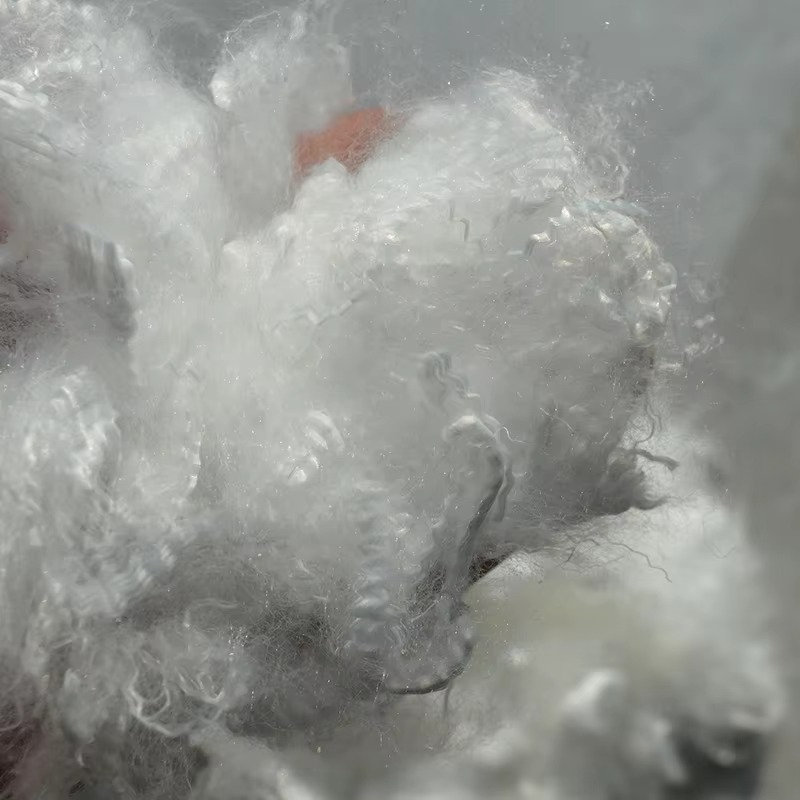
- Consistency: Every batch of VNPOLYFIBER HCS fill fiber is produced to the same specification — same denier, same silicone level, same crimp type, same whiteness. Down quality varies significantly between batches, between seasons, and between species and regions of origin. Polyester fill is the same every container.
- Washability: Machine washable and tumble-dryer safe at standard household settings. Polyester fill maintains its loft and character through far more wash cycles than natural fills — critical for hotel and institutional bedding that launders at 60°C weekly.
- Allergen-free: No animal proteins, no dust mite habitat risk. OEKO-TEX Standard 100 Class I certification confirms chemical safety for the most sensitive users — babies and children. This is the specification that stuffed toy manufacturers legally require.
- GRS-certified recycled options: GRS-certified recycled polyester fill (rPSF), produced from post-consumer PET bottles, allows brands to make verified sustainability claims — ‘made from recycled plastic bottles’ — with full chain-of-custody documentation. No natural fill can offer an equivalent verified recycled content claim.
- Price stability and supply security: Polyester fill is produced from PET — a commodity chemical with deep, global supply chains. Price is more stable than natural fill materials, and supply disruption risk is low. You will not face a sudden 40% price increase due to a weather event in Hungary.
- OEKO-TEX Class I for children’s: The legal requirement for stuffed toys and children’s bedding. Polyester fill with OEKO-TEX Class I certification meets this requirement. Most natural fills (down, wool, kapok) can achieve OEKO-TEX certification but the process for natural materials is more complex.
Where Polyester PSF Fill Is Genuinely Different from Down
An honest comparison requires acknowledging where polyester fill does not match down, rather than pretending it does:
- Warmth-to-weight: Premium microfiber PSF fill comes close to down but does not match 800+ fill power goose down’s warmth-to-weight ratio. For extreme cold weather applications (expedition sleeping bags, high-performance alpine insulation), down still has a performance advantage that polyester cannot fully close.
- Compressibility: Polyester fill does not pack down to the same volume as down. A PSF-filled sleeping bag or jacket is bulkier when compressed than an equivalent down product. This matters for packable outerwear and travel bedding.
- Breathability: Standard polyester fill is somewhat less breathable than natural down in hot sleep conditions — though fine microfiber fill significantly closes this gap. Hot sleepers may notice a difference, particularly in heavier-weight duvets.
- Longevity: High-quality HCS fill with conjugate crimp maintains good loft for 3–7 years of regular use under normal consumer conditions. Premium down can last 15–25 years with proper care. For products where longevity is the premium claim, down has a genuine advantage.
Wool Fill: The Natural Thermoregulator
Wool fill — processed wool fiber used as a fill material rather than woven into fabric — occupies a specific market niche: buyers who want a natural, sustainably positioned fill with temperature-regulating properties and are willing to pay a significant premium for it.
What Wool Fill Does Well
- Natural temperature regulation: Wool fiber’s crimped structure and its ability to absorb and release moisture (up to 33% of its weight in moisture vapor without feeling wet) create a natural temperature-buffering effect — wool fill products adapt to body temperature changes during the night more smoothly than synthetic fills. This is the primary genuine technical advantage of wool fill for bedding.
- Natural flame resistance: Wool has a high ignition temperature (~600°C) and does not melt or drip when burned — it chars and self-extinguishes. This gives wool fill an inherent fire safety advantage that neither polyester nor down shares. For bedding in markets with strict flammability requirements (UK BS 5852, California TB 603), wool fill can achieve compliance without chemical FR treatment.
- Moisture management: Wool’s moisture absorption capacity means it can absorb night sweat without feeling wet against the skin — beneficial for hot or perspiring sleepers. Synthetic fills are non-absorbent and may feel damper in high-sweat conditions.
- Natural and biodegradable: Wool is a renewable animal fiber that biodegrades fully at end of product life — an advantage over polyester fill (which does not biodegrade) for brands making circular economy commitments.
Wool Fill Limitations
- Weight: Wool fill is significantly heavier than polyester fill for equivalent warmth — a wool duvet requires more fill weight than a polyester equivalent to achieve the same thermal rating. This makes wool bedding feel luxuriously heavy but also burdensome for some users.
- Cost: Quality wool fill is substantially more expensive than polyester HCS fill — typically 3–5× the price per kg. This restricts wool fill to premium and luxury market positioning.
- Care requirements: Wool fill bedding typically requires dry cleaning or specialized wool washing — machine washing at standard temperatures causes felting and permanent damage. This maintenance burden is unacceptable for institutional and hotel bedding.
- Allergen risk: Wool protein allergy affects a small but commercially significant percentage of consumers — a genuine sourcing concern for brands that cannot accommodate returns from allergic customers.
- OEKO-TEX certification complexity: Wool fills must be tested for a range of restricted substances including pesticide residues from sheep dipping — the certification process is more complex than for synthetic fills.
Wool fill is the right choice for: premium natural bedding brands specifically targeting temperature-regulation claims; markets with stringent flammability requirements where wool’s inherent FR properties avoid chemical treatment; luxury product lines where the ‘natural’ and ‘heavy luxury’ positioning commands the necessary price premium.
Bamboo Fill: Marketing Reality Check
‘Bamboo fill’ is one of the most misleading terms in the bedding industry — and understanding what it actually is will save you from making a sourcing decision based on marketing rather than material properties.
What ‘Bamboo Fill’ Actually Is
In the overwhelming majority of commercial products, ‘bamboo fill’ means bamboo viscose fiber — a regenerated cellulosic fiber produced from bamboo cellulose by the viscose process (the same chemical process that produces standard wood-pulp viscose/rayon). The bamboo plant is the feedstock, but the production process dissolves the bamboo cellulose in carbon disulfide solvent, then re-spins it as fiber — a process that results in a fiber that is chemically identical to standard viscose regardless of whether the cellulose came from bamboo or wood pulp.
The commercial truth about bamboo viscose: the US Federal Trade Commission (FTC) has repeatedly taken enforcement action against manufacturers labeling bamboo viscose products as ‘bamboo’ without qualification — because the manufacturing process completely removes any botanical connection between the original bamboo plant and the finished fiber. The FTC requires correct labeling as ‘bamboo viscose’ or ‘bamboo rayon,’ not simply ‘bamboo.’ Brands making ‘bamboo fill’ claims should verify their labeling compliance.
What Bamboo Viscose Fill Actually Delivers
- Softness: Bamboo viscose has a silky, smooth surface texture that produces a noticeably soft fill — comparable to other fine viscose grades. This is real and genuinely pleasant.
- Moisture absorption: Viscose (including bamboo viscose) absorbs moisture readily — about 11% regain. This gives bamboo fill slightly better moisture management than polyester fill, similar to standard viscose.
- Biodegradability: Viscose fiber is biodegradable — it returns to CO₂, water, and biomass in soil. Unlike polyester fill, bamboo viscose fill does not persist as microplastics.
- What it does NOT offer: Bamboo viscose fill has no inherent antibacterial properties (the bamboo processing destroys any natural bamboo antimicrobial compounds — claims of antibacterial bamboo fabric/fill without specific additive treatment are not substantiated). It is not more sustainable than other responsibly sourced viscose — the bamboo plant grows rapidly and without pesticides, but the viscose manufacturing process uses toxic carbon disulfide solvent and generates the same environmental concerns as standard viscose production.
The honest positioning for bamboo viscose fill: it is a soft, moisture-absorbing, biodegradable fill with a marketable natural-origin story. If your brand and retail buyers value that story — and many do — it is a legitimate choice. If you are buying it because you believe it has specific technical properties that standard viscose does not have, you have been misled.
Kapok: The Plant-Based Specialty Fill
Kapok is the natural fiber harvested from the seed pods of the Kapok tree (Ceiba pentandra, also known as the Java cotton tree), native to tropical regions of Asia and the Americas. Each seed is surrounded by silky, hollow fibers that the tree uses for seed dispersal by wind — the same principle as dandelion seeds, but at textile scale.
Kapok’s Genuine Properties
- Ultra-lightweight: Kapok fiber has a very low density (approximately 0.3 g/cm³) — significantly lighter than cotton, wool, or polyester. Kapok fill products are noticeably lighter than polyester-fill equivalents at the same warmth level.
- Naturally hollow: The hollow fiber structure traps air effectively, giving kapok a good warmth-to-weight ratio for a natural fill — though it does not match down or premium microfiber fill at equivalent weights.
- Silky texture: Kapok fiber has a smooth, silky surface texture — soft and comfortable in skin-contact applications.
- Hypoallergenic: No animal proteins. Kapok is a plant fiber and generally well-tolerated by people with down or wool allergies.
- Biodegradable and sustainably grown: Kapok trees grow without irrigation or pesticides and produce fiber that biodegrades fully. Strong sustainability positioning credentials.
Kapok’s Commercial Limitations
- Not machine-fillable: Kapok fiber is extremely fine, light, and static-prone — it cannot be processed through standard pillow stuffing machines. Kapok fill products must be filled manually or semi-manually, significantly limiting production volume and increasing labor cost.
- Poor durability: Kapok fiber lacks the resilience of polyester or down. It does not recover well after compression — kapok pillows flatten significantly within months of use and do not plump back up reliably.
- Limited washability: Kapok fill is damaged by machine washing — the wet fiber clumps and does not redistribute. Kapok bedding is typically spot-clean or hand-wash only.
- Supply limitation: Global kapok production is small and concentrated in a few tropical regions. Large-volume procurement is difficult and price can be volatile.
Kapok fill is appropriate for: small-batch artisan and natural bedding brands with hand-filling production capabilities; products where extreme lightness is the primary selling proposition; markets where the natural, sustainable, vegan positioning commands a strong premium and buyers accept the care limitations.
Lyocell/Tencel Fill: The Emerging Sustainable Premium
Lyocell fill — produced from the same Tencel/lyocell fiber used in sustainable apparel, but processed into fill form rather than spun into yarn — is the newest category in the fill material landscape. It is available in limited commercial volumes and at a significant price premium over polyester fill, but it addresses a specific combination of properties that no other fill material provides simultaneously.
- Biodegradable with good wet strength: Lyocell is fully biodegradable, but unlike standard viscose it retains most of its strength when wet — making lyocell fill more washable than viscose or bamboo fill. This combination of biodegradability and washability is unique in the fill category.
- Smooth, cool surface: Lyocell’s smooth fiber surface gives it a cool-to-touch sensation and soft hand feel — appealing for brands marketing to hot sleepers.
- Closed-loop production: Lenzing’s Tencel is produced in a closed-loop NMMO solvent system with >99% solvent recovery — the most environmentally responsible MMCF production process available. For brands making specific environmental claims about production process, Tencel-source lyocell fill is the most defensible sustainable fill option.
- Limitations: Commercial availability as fill fiber is limited. Price is significantly higher than polyester fill. Loft recovery is less impressive than HCS PSF with conjugate crimp — lyocell is not a high-loft fill material.
Lyocell fill is appropriate for: premium sustainable bedding brands with specific environmental storytelling requirements; thin comforter and summer duvet applications where high loft is not required; brands with Tencel licensing partnerships with Lenzing.
Master Fill Material Comparison Table
| Property | Natural Down | PSF Fill (HCS) | Wool Fill | Bamboo Viscose | Kapok | Lyocell Fill |
| Warmth-to-weight | ★★★★★ | ★★★★☆ | ★★★☆☆ | ★★☆☆☆ | ★★★☆☆ | ★★☆☆☆ |
| Softness / hand feel | ★★★★★ | ★★★★☆ (microfiber ★★★★★) | ★★★☆☆ | ★★★★☆ | ★★★★☆ | ★★★★☆ |
| Loft recovery | ★★★★★ | ★★★★☆ (HCS conjugate) | ★★★☆☆ | ★★☆☆☆ | ★★☆☆☆ | ★★★☆☆ |
| Breathability | ★★★★★ | ★★★☆☆ | ★★★★☆ | ★★★☆☆ | ★★★☆☆ | ★★★☆☆ |
| Machine washable | ★★☆☆☆ (careful wash) | ★★★★★ | ★☆☆☆☆ (specialist only) | ★★★☆☆ | ★☆☆☆☆ | ★★★★☆ |
| Allergen-free | ★★☆☆☆ (allergy risk) | ★★★★★ | ★★★☆☆ (wool allergy risk) | ★★★★☆ | ★★★★★ | ★★★★★ |
| Biodegradable | ★☆☆☆☆ | ★☆☆☆☆ (rPSF: recycled) | ★★★★★ | ★★★★☆ | ★★★★★ | ★★★★★ |
| Price competitiveness | ★★☆☆☆ (expensive) | ★★★★★ | ★★☆☆☆ | ★★★☆☆ | ★★☆☆☆ | ★★★☆☆ |
| Supply reliability | ★★☆☆☆ (volatile) | ★★★★★ | ★★★☆☆ | ★★★☆☆ | ★★☆☆☆ | ★★☆☆☆ |
| Machine fillable | ★★★★☆ | ★★★★★ | ★★★★☆ | ★★★★☆ | ★☆☆☆☆ (hand fill only) | ★★★☆☆ |
| Sustainability claim | RDS/Downpass cert | GRS recycled (rPSF) | Organic/mulesing-free | FSC bamboo viscose | Wild-harvested | EU Ecolabel/Tencel |
| OEKO-TEX Class I | Available | Available (standard) | Available (complex) | Available | Available | Available |
| Longevity | ★★★★★ (15–25 yr) | ★★★☆☆ (3–7 yr) | ★★★★☆ (10–15 yr) | ★★★☆☆ | ★★☆☆☆ | ★★★☆☆ |
Application-by-Application Selection Guide
| Product / Application | Recommended Fill and Reasoning |
| Consumer pillow (premium retail) | HCS siliconized PSF 3D–4D (best value premium) or microfiber fill 0.9D–1.5D (closest to down feel). Down for luxury positioning if allergen-free guarantee is not required. Avoid kapok (flat quickly) and bamboo viscose (lower loft recovery). |
| Children’s pillow and stuffed toys | HCS siliconized PSF with OEKO-TEX Class I certification. Mandatory certification level — do not compromise. GRS recycled rPSF available with OEKO-TEX Class I simultaneously. Down and wool are achievable but certification is more complex. |
| Hotel and institutional pillow | HCS siliconized PSF 6D–7D — commercial laundering durability at 60°C is the primary requirement. Polyester only. Wool, kapok, and natural fills cannot survive institutional laundering. |
| Premium all-season duvet | HCS siliconized PSF 3D–4D (sustainable and washable) or down (for luxury market positioning and longevity). Wool for natural/temperature-regulation premium positioning. Avoid bamboo viscose (lower loft recovery) and kapok (not washable). |
| Sustainable brand duvet (recycled claim) | GRS-certified recycled rPSF — the only fill material that offers a verified recycled content claim with chain-of-custody documentation. Natural fills cannot make a ‘recycled content’ claim. |
| Sustainable brand (biodegradable claim) | Wool, kapok, lyocell, or bamboo viscose. Polyester fill does not biodegrade. If biodegradability at end of life is the primary claim, natural or cellulosic fills are required. |
| High-performance outerwear insulation | Microfiber PSF fill (0.7D–1.5D hollow conjugate) for brands requiring synthetic certification; natural down for brands positioning on maximum warmth-to-weight and packability. Standard HCS (4D–7D) for value outerwear. |
| Sleeping bag (expedition, below -20°C) | Natural down (800–900 fill power) for maximum warmth-to-weight performance at extreme cold. Premium microfiber fill approaches down performance but cannot match it at expedition ratings. |
| Sleeping bag (3-season, 0°C to +10°C) | Premium microfiber PSF fill or HCS 3D–4D — excellent performance, vegan, washable, competitive cost. Down for packability requirement. |
| Mattress topper | HCS siliconized PSF 4D–7D thermally bonded wadding — the standard and dominant specification globally. Wool topper for natural temperature-regulation premium positioning. Down toppers exist but are very expensive and difficult to maintain. |
| Natural/artisan fill (premium niche) | Kapok (ultra-light, natural, handmade positioning), wool (temperature-regulation, FR), lyocell (closed-loop sustainable). All require acceptance of higher cost, lower volume, and specialist care requirements from end consumers. |
The Sustainability Comparison: An Honest Assessment
Sustainability claims for fill materials are among the most misleading in the textile industry. Here is what the evidence actually supports:
- ‘Recycled’ claim — PSF wins clearly: GRS-certified recycled polyester fill (rPSF) from post-consumer PET bottles is the only fill material that can make a verified, chain-of-custody documented recycled content claim. No natural fill material can make an equivalent recycled content claim.
- ‘Biodegradable’ claim — natural and cellulosic fills win: Wool, kapok, lyocell, and bamboo viscose are all biodegradable. Polyester fill is not — it persists in landfill for decades and sheds microplastics during laundering. For brands committed to end-of-life biodegradability, natural fills are the only current option.
- ‘Lower carbon footprint’ claim — it depends: GRS-certified rPSF has approximately 60–70% lower GHG emissions than virgin PSF (roughly 1.5–2.5 kg CO₂e/kg). Wool has significant GHG emissions from sheep methane production — typically 10–25 kg CO₂e/kg. Down is difficult to separately account for as a byproduct of the poultry industry. Lyocell is approximately 2 kg CO₂e/kg. On carbon footprint alone, rPSF and lyocell are the most defensible sustainable choices.
- ‘Natural’ claim — all natural fills qualify, but ‘bamboo’ needs qualification: Down, wool, and kapok are unambiguously natural. Bamboo viscose requires correct labeling as a manufactured fiber despite its natural feedstock — see the FTC compliance note above.
- ‘Animal welfare’ claim — vegan fills: Any non-animal fill (PSF, bamboo viscose, kapok, lyocell) is vegan by definition. Down requires RDS certification to address live-plucking concerns. Wool requires non-mulesing certification for some markets.
Conclusion: Match Fill Material to Product Requirements, Not Marketing Trends
The fill material landscape has never been more complex — or more clearly differentiated, if you know what each material actually offers. The honest summary:
- Polyester HCS fill: The best commercial choice for the majority of consumer bedding applications — consistent, washable, allergen-free, certifiable, competitively priced, and available in GRS-certified recycled grades for sustainability positioning. Not the best choice for applications requiring extreme warmth-to-weight or biodegradability.
- Natural down: Still the performance leader for warmth-to-weight, compressibility, breathability, and longevity. Right for luxury positioning where the price, care requirements, and supply complexity are acceptable. Requires RDS certification for credible animal welfare positioning.
- Wool: The natural thermoregulator with inherent FR properties. Right for premium natural positioning where weight, cost, and care complexity are acceptable to the buyer segment.
- Bamboo viscose: A soft, biodegradable fill with a marketable natural story — but technically equivalent to standard viscose. Verify FTC labeling compliance. Do not buy it expecting properties that viscose does not have.
- Kapok: A genuine natural specialty for brands with hand-filling production capability and buyers who accept the care limitations.
- Lyocell fill: The emerging premium sustainable fill with the most defensible environmental production story. Limited availability and higher cost restrict it to premium positioning currently.
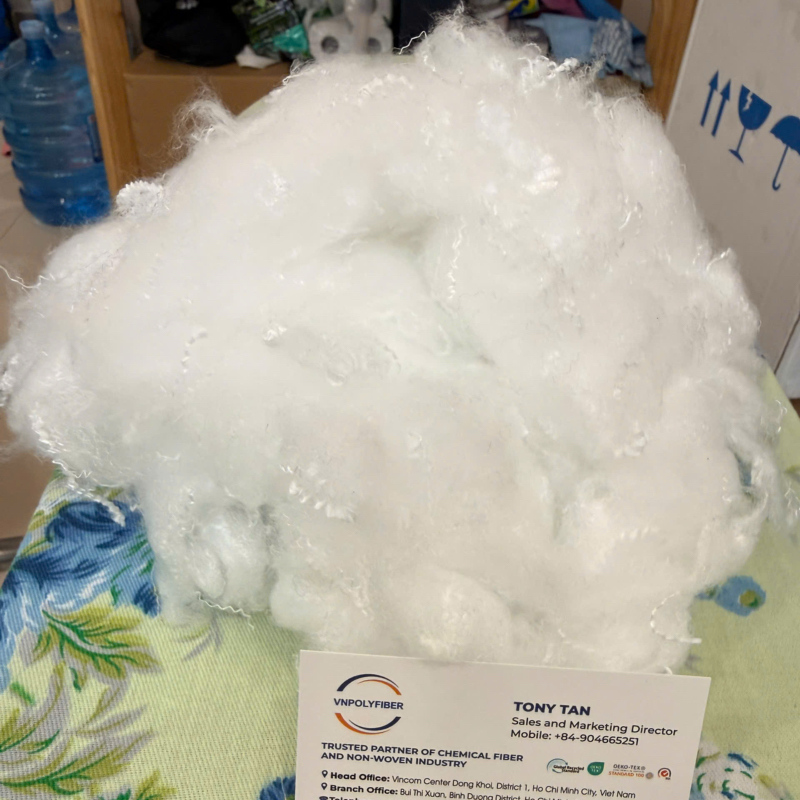
VNPOLYFIBER supplies HCS siliconized polyester fill fiber across the complete denier range — from 0.9D microfiber through 15D firm fill — in virgin and GRS-certified recycled grades, with OEKO-TEX Standard 100 Class I and II certification. For brands evaluating the transition from down to polyester fill, or comparing fill material options for a new product line, our technical team provides fill specification consultation as part of our commercial supply service. Contact us at vnpolyfiber.com/request-to-quote/.
down alternative fill comparison, fill material comparison pillow duvet, polyester fill vs wool, polyester fill vs bamboo, polyester fill vs down, fill material buyer guide, natural fill vs synthetic fill, kapok fill comparison, wool fill vs polyester, bamboo fill pillow, Tencel fill duvet, sustainable fill materials, best fill material pillow, fill material selection guide bedding, down alternative materials, GRS recycled fill fiber, bamboo viscose fill FTC, kapok fill properties, lyocell fill duvet, HCS fill vs down