Geotextile: The Unsung Hero of Modern Infrastructure
Every major highway, railway embankment, retaining wall, dam, and coastal defense structure built in the last 30 years contains one thing most people never see: geotextile. This engineered fabric, placed beneath, between, or alongside soil and aggregate layers, performs critical functions that determine whether infrastructure holds up for decades or begins to fail within years.
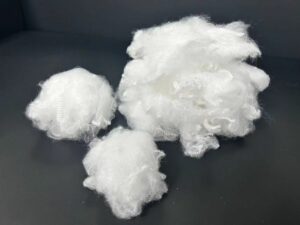
The majority of geotextiles produced globally are made from polyester—either as continuous filament (spunbond) or as cut-length staple fiber (needle-punched). And understanding the difference between these two types and how to specify them correctly is essential for anyone working in civil engineering procurement, waterproofing, or drainage design.
Four Core Functions of Polyester Geotextile
1. Separation Placed between layers of different soil types or between subgrade and aggregate, preventing them from mixing under load. Without separation, fine-grained subgrade soil migrates into the aggregate layer, reducing drainage and load-bearing capacity over time. A correctly specified geotextile maintains the structural integrity of the layered system throughout its design life.
2. Filtration Geotextiles act as a filter medium—allowing water to pass freely while retaining fine soil particles that would otherwise migrate and cause erosion or clogging. The effective opening size (O90 or O95) of the geotextile must be carefully matched to the particle size distribution of the soil it retains.
3. Drainage In-plane drainage geotextiles carry water along the plane of the fabric itself, directing it to drainage outlets. This is particularly important in retaining wall drainage layers and under paved surfaces where subsurface water must be managed without saturating the structure.
4. Reinforcement High-strength geotextiles add tensile strength to soft or unstable soil systems, enabling construction of embankments, retaining walls, and road subgrades on ground that would otherwise be too weak to support the structure.
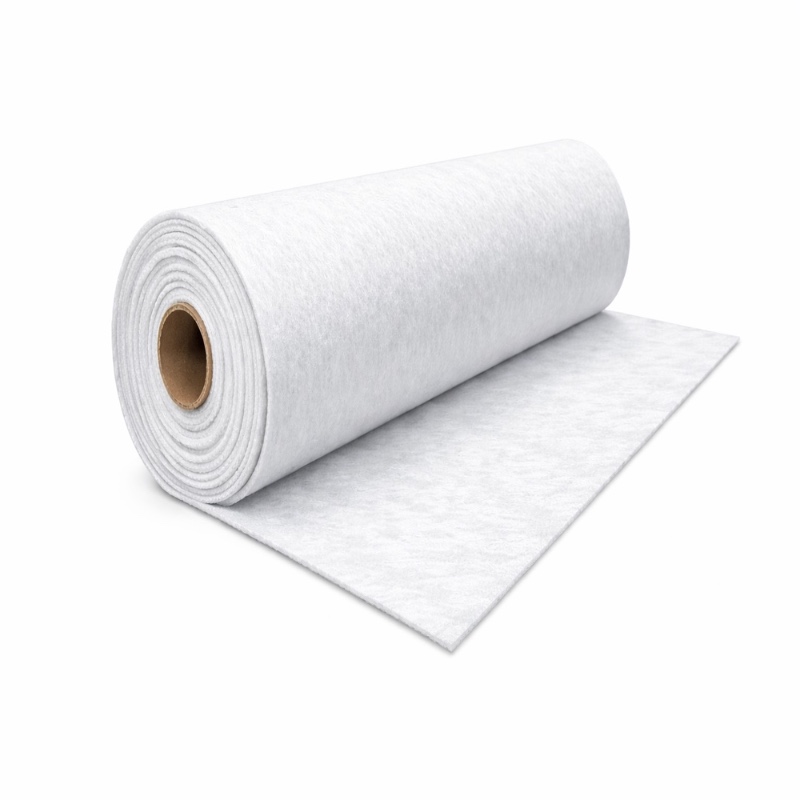
Filament (Spunbond) vs. Staple Fiber (Needle-Punched) Geotextile
Filament Polyester Geotextile
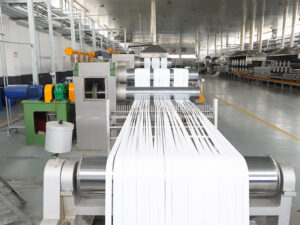
Made from long strands of polyester that are shaped from PET chips and pressed together to form a three-dimensional fiber structure. Hubei Bushi Nonwovens, one of China’s leading producers, operates production lines for filament polyester mat with an annual capacity of 65 million square meters per line.
Filament geotextiles offer higher tensile strength for their weight than staple-fiber equivalents—making them the choice for reinforcement and separation in high-load applications such as road and railway construction, port facilities, and embankments.
Staple Fiber (Needle-Punched) Geotextile
Produced from cut-length polyester staple fiber that is carded, cross-lapped, and needle-punched. The resulting fabric has higher in-plane permeability and better filtration characteristics than filament geotextiles of equivalent weight—making it preferred for filtration, drainage, and protection applications where water flow through the fabric is the primary performance criterion.
Property | Filament Geotextile | Staple Fiber Geotextile |
Raw material | PET polymer chips | Polyester staple fiber |
Tensile strength (per weight) | Higher | Good |
Elongation | 25–60% | 25–60% |
In-plane drainage | Lower | Higher |
Filtration | Good | Better |
Best function | Reinforcement, separation | Filtration, drainage, protection |
Applications | Road base, embankments, retaining walls | Dam face filtration, slope protection, drainage |
Key Technical Specifications and What They Mean
Mass per Unit Area (g/m²) is available from 60 g/m² (light—filtration and protection) to 500 g/m² and beyond (heavy—reinforcement). Standard grades for most civil engineering applications are 100–300 g/m².
Wide Strip Tensile Strength (kN) The force required to pull a 200 mm wide strip of geotextile apart. Filament geotextile at 200 g/m² typically achieves 13.4 kN MD / 12.0 kN CD. This is the primary specification parameter for reinforcement applications.
CBR Burst Strength (N): Resistance to puncture from a CBR plunger—reflecting the geotextile’s ability to resist damage from sharp stones during installation. Critical for protection are geotextiles placed over waterproof membranes or drainage layers.
Effective Opening Size O90/O95 (µm) The pore size that 90% or 95% of soil particles cannot pass through. Must be carefully matched to the retained soil’s particle size distribution. Typical values range from 80 to 180 µm depending on geotextile weight.
Vertical Permeability Coefficient (cm/s) How freely water passes through the geotextile perpendicular to the plane. Filtration geotextiles require high permeability; protection geotextiles can have lower values.
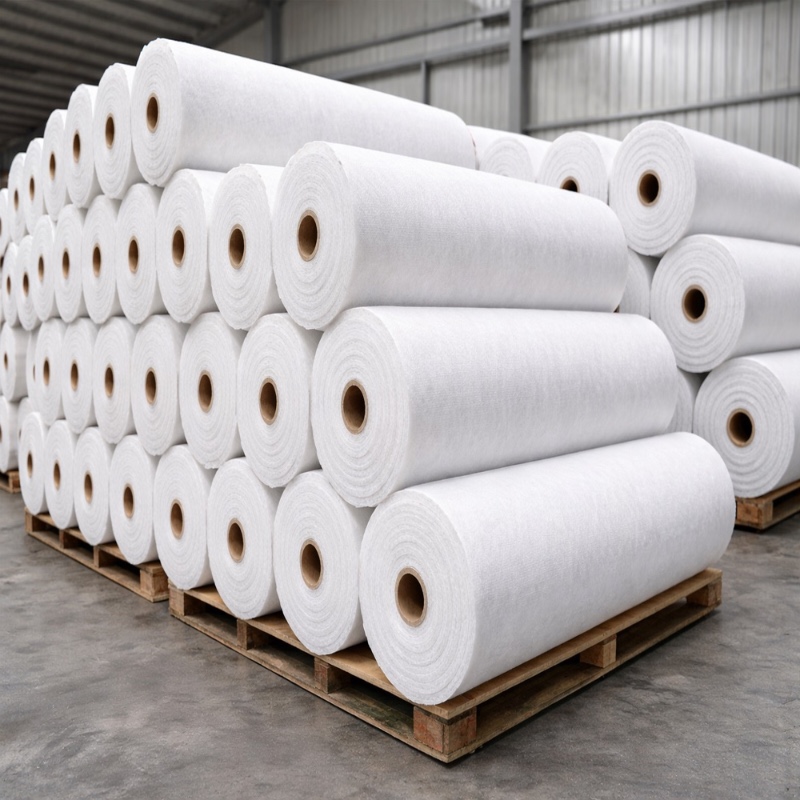
Applications in Waterproofing Systems
Polyester geotextile plays a specific and critical role in composite waterproofing systems beyond its civil engineering functions:
Protection Layer Placed over waterproof membranes in buried applications (basements, tunnels, and reservoirs) to protect the membrane from puncture by backfill aggregate. Without a protection geotextile, even high-quality waterproof membranes can be damaged by angular stone during compaction.
Drainage Layer In tandem drainage systems, geotextile wraps drainage aggregate or geocomposite drainage cores, filtering soil out of the drainage layer and maintaining permeability throughout the structure’s life.
Separation in Road Waterproofing At the interface between road subgrade and drainage aggregate, geotextile separation prevents subgrade clay from migrating upward under traffic loading — the primary cause of premature road failure in fine-grained soil conditions.
VNPolyfiber Polyester Geotextile Range
VNPolyfiber supplies both filament and staple fiber polyester geotextile through our factory network, as well as the polyester staple fiber used in needle-punched geotextile production.
Available specifications: 60 g/m² to 500 g/m², custom widths, ISO 9001 quality management, GRS recycled content options.