What is cotton fiber?
Cotton fiber is of natural and plant origin. It is produced by a plant called the cotton plant, which, after flowering, produces a capsule, known as a boll, containing seeds and fibers. These fibers are collected and then used by the textile industry.
The properties of cotton fiber are numerous: Softness – Hypoallergenic – Resistance – Lightness – Absorption capacity – UV resistance.
Cotton is used in :
- clothing for babies, owing to its softness and hypoallergenic properties.
- jeans, owing to its resistance.
Can cotton be recycled? Yes, cotton-based products can be recycled mechanically (tearing, shredding, garnetting, and fiber removal) or chemically (enzymatic dissolution).
Cotton is pricier, but polycotton is way more durable and long-lasting. Cotton tends to be softer, but polycotton brings a crisp and clean feel to your bedding.
Cotton feels softer on your skin, but polycotton feels crisp and fresh on your bed. Cotton is less strong and more likely to tear, whereas polycotton is a much stronger material, less likely to tear.
Cotton is also notoriously awkward to keep clean. It requires lower temperatures, meaning a less thorough wash, and is considerably more difficult to iron. Polycotton, however, can be washed at temperatures up to 60°, meaning a much cleaner wash. It can be tumble-dried without any problems and is much easier to iron. Combining cotton and polyester makes the garment less prone to pilling and static. One of the main advantages of the cotton-polyester blend is that it is more wrinkle-free.
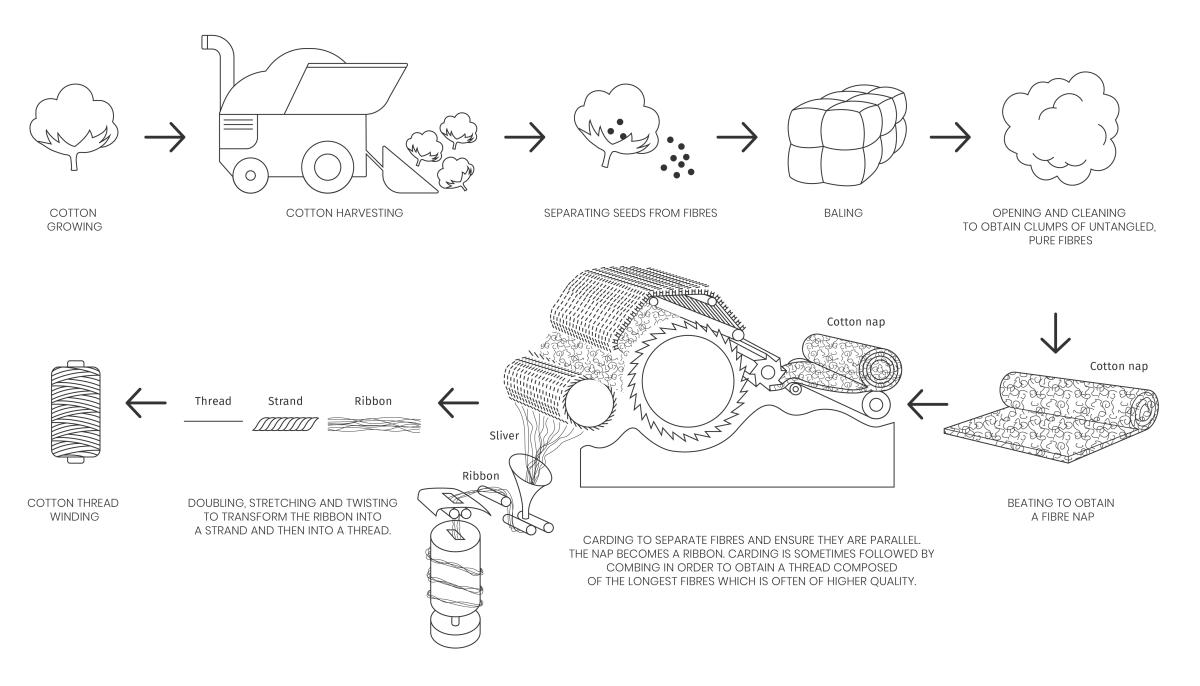
Production process of cotton fiber
- The cotton plant is first grown and its flower is harvested.
- Once the fibers are separated from the seeds, they are baled.
- Fibers are cleaned and untangled. A cotton nap is produced.
- This nap then follows the stages of spinning to obtain a thread: carding, combing, doubling, drafting, and twisting.
- The cotton thread is wound around a spool and is ready to be used to produce fabric or knitwear for example
COTTON PRODUCTION DIAGRAM
ORGANIC COTTON
Organic cotton is produced and certified according to organic agricultural standards. Production supports the well-being of soils, ecosystems, and humans by using natural processes as opposed to artificial inputs. Cultivating organic cotton does not permit the use of toxic chemical products and Genetically Modified Organisms (GMOs).
Organic cotton production combines tradition, science and innovation to benefit from a shared environment and promote a good quality of life for all of the persons involved. Certain labels affixed to products, namely, certify that the products are composed, at least partly, of organic cotton. These labels, namely, include the European Ecolabel, Global Organic Textile Standard, or BioRe. To find out more, consult the cheat sheet on product communication and labels.
BCI COTTON
The Better Cotton Initiative is a nonprofit-making organization that promotes sustainable and responsible production standards for cotton growing in 21 countries and among 2 million farmers. The initiative currently represents approximately 19% of global cotton production.
Among the production principles and criteria, BCI, namely, encourages the minimization of the harmful impacts of crop protection practices, the implementation of a good management system, the monitoring of soil well-being, the improvement of biodiversity thanks to responsible land management, the preservation of fiber quality, and the encouragement of decent employment to put in place an effective management system.
RECYCLED COTTON
Recycled cotton is a material resulting from used clothing recycling (known as post-consumer) or from production off-cuts (known as pre-consumer).
Cotton can be recycled both mechanically and chemically. In addition to being used to recreate thread, there are numerous outlets for recycled cotton: paper-making, professional or household cleaning cloths, and transformation into nonwoven fabric or fuel.
- Mechanical cotton recycling: to create a cotton thread via a mechanical recycling process, materials must first undergo fiber removal (stretched to recover the fibers). Given that mechanical fiber removal can shorten fibers and make them fragile, they are often blended with virgin cotton or polyester to provide them more resistance. Following this step, fibers are ready to undergo a classic spinning process.
- Chemical cotton recycling: to create a cotton thread via a chemical recycling process, materials undergo enzymatic dissolution. This step is an enzymatic treatment that decomposes polymers. Following treatment, the cellulose monomers are regenerated to re-form a filament. The filament can then undergo a classic spinning process.
Hotel Stripe Polyester Cotton Bed Linen
Satin Stripe (or ‘Hotel Stripe’) Pillowcases & Duvet Covers in Double or King Sizes. Made from durable, 200 thread count polycotton (50% cotton, 50% polyester), these stylish Satin Stripe (sometimes called ‘Hotel Stripe’) duvet covers and matching pillowcases bring a touch of hotel luxury to your home, guest house or B&B
Buy Cotton Bedding
Cotton has been the staple of bedding for many generations, offering warmth, softness, and a cozy feel. All good! The problem is, it’s a bit pricey and takes some effort keeping it clean and fresh.
100% cotton bedding is one of life’s luxuries!
On average, we spend about a third of our lives in bed. It’s so important to make sure our sleeping time is as restful as possible. The range of 100% cotton bedding can give you a cozy night’s sleep at a very affordable price! Whether you’re looking for just a cotton pillowcase or a matching cotton bedding set, you can be sure you’ll find just the right bedding, exactly here!
100% cotton bedding is perfect for your home, as well as for your guest house, B&B, or hotel. We like simple white cotton bedding. Crisp, clean and fresh, few things feel quite as 100% cotton as bedding. Treat yourself (or your guests) to a better night’s sleep!
POLYCOTTON
Polycotton is the abbreviation for a polyester/cotton blend. It’s the blend that is the most frequently encountered. This blend can be blended intimately, by thread assembly, or within the fabric structure. Combining cotton and polyester yields a material with numerous properties:
Resistance – Crease resistance – Dimensional stability – Absorption capacity – Ease of care – Comfort
It is obviously possible to blend recycled polyester with recycled cotton to reduce the material’s environmental impact.
Polycotton is Strong & Durable
Polycotton is a highly durable material, as polyester contains strong plastic-like substances, making it far less likely to rip or tear. The durable nature of polycotton makes it a very popular choice in commercial situations such as hotels, where bed sheets are changed frequently.
Polycotton is a blend of natural cotton and synthetic polyester. Both cotton and polycotton bed sheets are easy to care for; both types of fabric can be washed on normal cycles in your washing machine and can be dried in the dryer. It is advised to wash cotton at lower temperatures (around 30° or 40°); however, polycotton can be washed at higher temperatures—up to 60°—for ultimate cleanliness. Washing natural fabrics like cotton at 60 degrees may (most likely, will) cause them to shrink; however, polycotton will not. That said, there are several types of cotton and polycotton, so always follow the manufacturer’s guidelines when washing and drying your sheets and bed linen.