Viscose, Modal and Lyocell: Complete Guide to Regenerated Cellulosic Fibers — and How They Compare to Polyester
Viscose, modal, lyocell, and Tencel are four names that appear constantly in sustainable textile sourcing conversations — and are frequently confused with each other, conflated with cotton, or incorrectly classified as either natural or synthetic fibers. None of these descriptions is accurate. Viscose, modal, lyocell, and Tencel are all regenerated cellulosic fibers: they begin with natural cellulose from wood pulp, undergo significant industrial chemical processing to dissolve and re-form that cellulose into fiber, and emerge as manufactured fibers that are genuinely different from both natural plant fibers and fully synthetic petroleum-derived fibers like polyester.
Understanding these fibers with precision matters for a growing range of commercial decisions: sustainable sourcing choices, care label and regulatory compliance, spunlace nonwoven specification (where viscose/polyester blends are the global standard for wet wipes), sustainability reporting, and the increasingly complex landscape of textile environmental claims. This guide covers all four fiber types from their chemistry and production through their properties, sustainability profiles, and applications — and closes with the direct comparison to polyester that fiber buyers most frequently need.
VNPOLYFIBER’s core products are polyester staple fiber and nonwoven fabric. We do not produce or sell viscose, modal, or lyocell fiber. This guide exists because our spunlace nonwoven fabric (used in wet wipes and hygiene products) uses viscose/PET blends — and our customers need to understand both fiber components. It also provides the honest comparison framework between cellulosic and synthetic fiber that procurement teams navigating sustainable sourcing increasingly require.
What Is Regenerated Cellulosic Fiber?
Regenerated cellulosic fiber occupies a unique position in the fiber classification system — it is neither natural nor synthetic in the conventional sense. The raw material is natural cellulose (the structural polymer that gives plant cell walls their strength, the same cellulose found in cotton and wood). The fiber itself is manufactured through an industrial process that dissolves and re-spins this cellulose into a new fiber form. This dual nature — natural polymer origin, industrial production process — is what the term ‘regenerated’ describes.
The broader category of man-made cellulosic fibers (MMCF) encompasses viscose, modal, lyocell, cupro, and acetate. All share the same cellulose feedstock origin; what distinguishes them is the chemical solvent system used to dissolve the cellulose and the processing conditions used to re-form it into fiber. Different solvent systems produce different fiber properties, different environmental footprints, and different performance profiles in the finished fabric.
| Fiber | Formal Name and Classification |
| Viscose / Rayon | The original man-made cellulosic fiber (first commercial production 1905). Carbon disulfide (CS₂) solvent process. ISO fiber name: CV (viscose) or CMD (modal) or CLY (lyocell). ‘Rayon’ is the US/North American commercial name; ‘viscose’ is the European and Asian standard. Approximately 80% of all MMCF production globally. |
| Modal | A refined viscose process producing higher-tenacity, higher-wet-strength fiber from beechwood pulp. ISO fiber name: CMD. Tenacity specification is higher than standard viscose — modal must meet minimum wet strength criteria to carry the modal designation per ISO 2076. |
| Lyocell | Uses N-methylmorpholine N-oxide (NMMO) as solvent in a closed-loop process — solvent recovery >99%. Fundamentally different production chemistry from viscose. ISO fiber name: CLY. Tencel is Lenzing AG’s branded lyocell. The most environmentally advanced commercial MMCF. |
| Cupro | Cuprammonium process — cellulose dissolved in copper-ammonia solution, extruded into water to coagulate. Produces very fine, silk-like fiber. ISO fiber name: CUP. Bemberg is the dominant brand (Asahi Kasei, Japan). Closed-loop production with recovered copper and ammonia. |
| Acetate / Triacetate | Cellulose chemically modified with acetic acid to produce cellulose acetate ester — partially synthetic by modification. ISO fiber name: CA (acetate) / CTA (triacetate). Biodegrades more slowly than pure cellulosics due to acetate modification. |
The Three-Generation Framework: How Production Technology Evolved
The most useful way to understand the relationship between viscose, modal, and lyocell is as three successive generations of cellulosic fiber technology — each generation addressing the environmental and performance limitations of the previous one:
First Generation: Viscose / Rayon
Viscose is the original commercial regenerated cellulosic fiber, developed in the late 19th century and commercialized from 1905. The production process — the viscose process — dissolves wood pulp cellulose using two highly toxic chemicals: sodium hydroxide (NaOH, caustic soda) and carbon disulfide (CS₂). The dissolved cellulose xanthate solution (named ‘viscose’ for its high viscosity) is extruded through spinnerets into an acid coagulation bath, where the cellulose re-forms as solid fiber. The resulting fiber is washed, dried, and processed into staple or filament form.
Carbon disulfide is the production process’s most serious environmental liability. CS₂ is highly toxic to the nervous system, flammable, and releases sulfur compounds (H₂S) during the coagulation step. Workers in viscose plants historically faced significant occupational health risks from CS₂ exposure before modern engineering controls were implemented. Environmental discharges of CS₂, H₂S, and zinc-containing wastewater (zinc sulfate is used in some coagulation baths) from poorly managed viscose facilities have caused documented environmental harm in major producing countries.
Modern viscose production in responsible facilities operates with closed-loop CS₂ recovery systems that capture and recycle most of the solvent — but ‘most’ is not ‘all,’ and the baseline chemistry remains more environmentally challenging than the lyocell process. Better-practice viscose brands (Lenzing’s EcoVero, with FSC-certified pulp and 50% lower carbon and water footprint versus generic viscose) represent significant improvement within the viscose framework.
- Key properties: Soft, silky hand feel; excellent moisture absorption (11% regain — higher than cotton); good dyeability; drapes beautifully; fully biodegradable; lower wet strength than dry strength (cotton is the opposite)
- Key limitations: Weakens significantly when wet; wrinkles readily; shrinks if not carefully laundered; production process has significant environmental management requirements
- Primary applications: Apparel (blouses, dresses, linings); home textiles; spunlace nonwoven for wet wipes (dominant use in 70/30 viscose/PET spunlace globally)
Second Generation: Modal
Modal is a refined viscose process — using the same CS₂ chemistry as standard viscose, but with two important improvements: the use of beechwood pulp (rather than mixed softwood pulp) as the cellulose feedstock, and additional processing steps (stretching during regeneration and post-treatment) that produce a fiber with significantly higher tenacity and wet strength than standard viscose. To carry the ‘modal’ fiber designation under ISO 2076, a fiber must meet minimum tenacity and wet strength criteria — it is not simply a marketing term.
The beechwood pulp used for modal production (particularly Lenzing’s branded Modal, which dominates the premium modal market) is sourced from sustainably managed European beechwood forests — trees that grow on land not suitable for food production and that require no artificial irrigation. This gives modal a more favorable land use and water footprint than cotton, though the CS₂ production chemistry remains the same as standard viscose.
- Key improvements over viscose: Approximately 50% higher wet tensile strength than standard viscose — fabrics maintain their structure when wet and resist mechanical damage in washing. Softer, smoother hand feel. Better color retention after repeated washing. Generally softer than cotton.
- Primary applications: Underwear and intimate apparel (the largest application — modal’s exceptional softness against skin is its defining commercial advantage); T-shirts and base layers; bed linen; towelling blended with cotton
- Leading producer: Lenzing AG (Austria) — whose branded Modal (from European beechwood with responsible forest certification) is the market reference. Generic modal produced by other manufacturers may use different pulp sources and less closed production systems.
Third Generation: Lyocell / Tencel
Lyocell represents the most significant technological breakthrough in regenerated cellulosic fiber production — replacing the toxic CS₂ solvent of the viscose process with NMMO (N-methylmorpholine N-oxide), a solvent that is non-toxic, water-miscible, and recoverable from the process at greater than 99% efficiency. The NMMO solvent is continuously recycled within a closed loop: recovered after fiber formation, purified, and reused — producing essentially zero toxic solvent emission and a dramatically lower environmental footprint than viscose production.
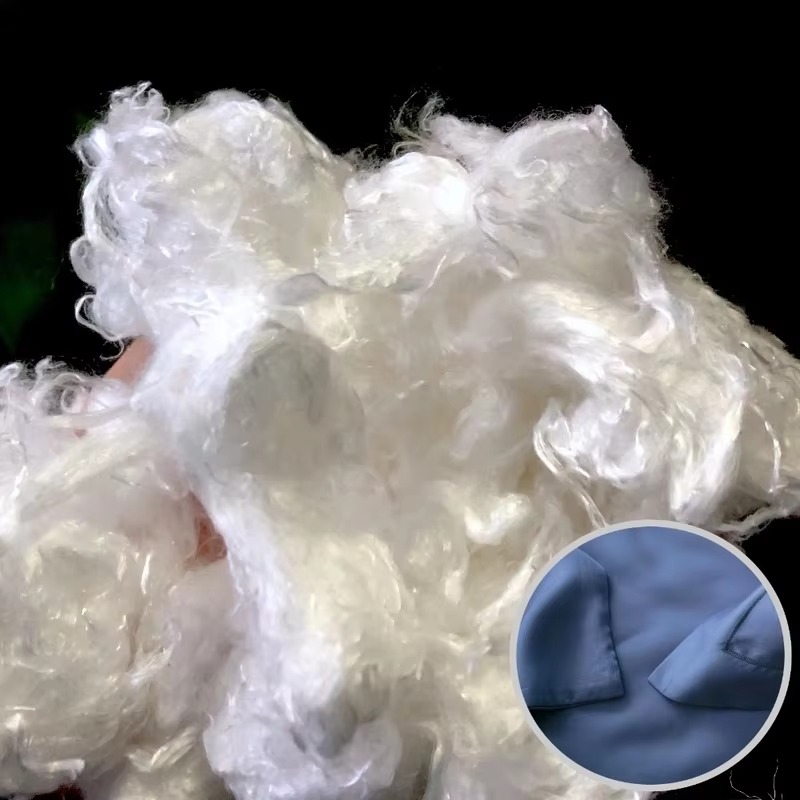
Tencel is the registered trademark of Lenzing AG for their lyocell fiber produced under their proprietary process conditions. Tencel is the most commercially recognized lyocell brand globally and has set the quality and sustainability reference for the lyocell category. Other lyocell producers exist (including Chinese and Korean producers), but Lenzing’s Tencel carries the strongest certification credentials (FSC-certified wood pulp, EU Ecolabel, OEKO-TEX).
- NMMO closed-loop process advantages: No toxic chemical discharge; >99% solvent recovery; 10× lower water consumption than conventional viscose; significantly lower GHG emissions; FSC-certified wood pulp feedstock from sustainably managed forests
- Key fiber properties: Very high dry and wet strength (stronger than modal when wet); excellent moisture management; smooth surface; naturally resistant to bacterial growth; biodegradable; fibrillation tendency in wet abrasion (a characteristic surface microfiber effect)
- Primary applications: Premium apparel (shirts, dresses, activewear); denim blends; home textiles; hygiene nonwoven (premium wipes); medical nonwoven (wound dressings)
Viscose Production Process: The Chemistry in Detail
Understanding the viscose production process helps buyers evaluate supplier environmental claims and understand why different viscose grades have different sustainability profiles:
- Pulp preparation: Wood chips (typically softwood or bamboo) are digested with chemicals to extract cellulose pulp, removing lignin and hemicellulose. The pulp is bleached to achieve target whiteness. Pulp quality and sourcing (FSC-certified vs uncertified; plantation vs natural forest) significantly affects the environmental profile.
- Steeping (alkalization): Cellulose pulp sheets are immersed in concentrated sodium hydroxide (NaOH, ~18% concentration) solution to swell and activate the cellulose, converting it to alkali cellulose. Excess NaOH is pressed out.
- Aging (shredding and oxidation): The alkali cellulose is shredded and aged in air for a controlled time — during which oxidative degradation reduces the average cellulose chain length (degree of polymerization) to the target range for viscose spinning. This determines the final fiber’s molecular weight and mechanical properties.
- Xanthation: The aged alkali cellulose reacts with carbon disulfide (CS₂) gas in a sealed reactor to form cellulose xanthate — a soluble derivative of cellulose. This is the step that uses the toxic CS₂ and the step where most of the process’s environmental impact is generated.
- Dissolution: Cellulose xanthate is dissolved in dilute NaOH to produce the viscose spinning solution — a thick, amber-colored, highly viscous liquid (the name ‘viscose’ derives from this high viscosity).
- Ripening and filtration: The viscose solution is allowed to ripen (age) for 18–36 hours to achieve optimal spinning viscosity, then filtered to remove undissolved particles.
- Spinning (wet spinning): Viscose solution is extruded through spinnerets into an acid coagulation bath (containing sulfuric acid, sodium sulfate, and often zinc sulfate). The acid regenerates cellulose from xanthate — the soluble xanthate decomposes, releasing CS₂, and solid cellulose fiber forms. The fiber is washed, stretched, and dried.
- Cutting and baling: Fiber is crimped (for staple applications) and cut to target staple length (typically 38–51 mm for textile, 3–6 mm for some airlaid nonwoven applications), then baled.
The key environmental issue in viscose production is Step 4 (xanthation) and Step 7 (spinning). CS₂ and H₂S released during these steps must be captured and either recovered or treated before discharge. Responsible producers capture >90% CS₂; some premium producers achieve >95%. Zinc in the coagulation bath must be recovered and treated — zinc discharge to waterways is the other major wastewater concern in viscose production. When sourcing viscose for sensitive applications, requesting supplier environmental performance data on CS₂ emission rates and zinc wastewater treatment is a legitimate due-diligence question.
Lyocell Production: The Closed-Loop NMMO Process
The lyocell process replaces viscose’s multi-step chemical derivatization approach with direct dissolution — NMMO dissolves cellulose directly without chemical modification, and the dissolved cellulose is extruded directly into a water/NMMO coagulation bath where cellulose precipitates back to solid fiber as NMMO dilutes. The simplicity of the chemistry — dissolve, spin, recover — makes the closed loop both effective and economically viable:
- Wood pulp preparation: FSC-certified wood pulp (beechwood, eucalyptus, or mixed hardwood — selected for high alpha-cellulose content) is mixed with NMMO/water solution.
- Dissolution: The pulp/NMMO/water mixture is heated under vacuum — water evaporates until the NMMO concentration reaches the range where cellulose dissolves (typically 78–82% NMMO). The resulting solution is clear and transparent — a fundamental visual difference from the amber viscose solution.
- Filtration and spinning: The clear cellulose/NMMO solution is filtered and extruded through spinnerets into a water/NMMO bath. Cellulose precipitates as NMMO dilutes — fiber forms cleanly without chemical reaction by-products.
- NMMO recovery: The dilute NMMO coagulation bath is continuously processed through evaporation to recover and concentrate the NMMO back to spinning concentration. Recovery efficiency exceeds 99% — making the process economics viable and the environmental discharge near-zero.
- Washing and drying: Fiber is washed with water to remove residual NMMO, dried, crimped, and cut. No acid bath, no CS₂, no zinc compounds — the process effluent is water with trace NMMO, which is readily biodegradable.
Comprehensive Comparison: Viscose vs Modal vs Lyocell vs Polyester
| Property | Viscose | Modal | Lyocell | Polyester (PET) |
| Raw material | Wood pulp cellulose (softwood, bamboo) | Beechwood pulp cellulose | Wood pulp cellulose (beechwood, eucalyptus) | Petroleum (PTA + MEG) |
| Production solvent | CS₂ (toxic) + NaOH | CS₂ (toxic) + NaOH (same as viscose) | NMMO (non-toxic, >99% recovered) | No solvent — melt spinning |
| GHG (kg CO₂e/kg fiber) | ~2–4 kg (varies by producer quality) | ~3–4 kg | ~2 kg (closed-loop process efficiency) | ~5–6 kg (virgin); ~1.5–2.5 kg (rPET) |
| Water use (L/kg fiber) | ~200–700 L (varies significantly) | ~150–400 L | ~100–200 L (lowest MMCF) | ~4–17 L (very low) |
| Land use | Managed forest / plantation land | European beechwood — no irrigation | Managed forest / plantation land | None — industrial production |
| Biodegradability | Fully biodegradable in soil | Fully biodegradable in soil | Fully biodegradable in soil | Not biodegradable — persists decades |
| Microplastic shedding | None — biodegradable fibers | None | None | Yes — sheds persistent microplastics |
| Moisture absorption | ~11% regain — very high | ~12% regain — excellent | ~11% regain — excellent | ~0.4% — hydrophobic |
| Tensile strength (dry) | ~22–27 cN/tex — moderate | ~34–36 cN/tex — good | ~38–42 cN/tex — excellent | ~35–90 cN/tex — excellent |
| Wet strength | Very low (~40% of dry) — key limitation | Good (~65% of dry) — modal’s main improvement | Excellent (~85% of dry) — best MMCF wet strength | 100% of dry — no wet weakening |
| Softness | Excellent — silky, smooth | Excellent — softest MMCF | Very good — smooth surface | Good to excellent (grade dependent) |
| Wrinkle resistance | Poor — creases readily | Moderate — better than standard viscose | Moderate — better than viscose | Excellent — key polyester advantage |
| Dyeability | Excellent — reactive dyes at atmospheric pressure | Excellent | Excellent | Disperse dyes at 130°C under pressure |
| Key sustainability certification | FSC pulp; EcoVero (Lenzing grade) | OEKO-TEX; FSC pulp (Lenzing Modal) | EU Ecolabel; OEKO-TEX; FSC; Tencel brand | GRS (recycled content); OEKO-TEX |
| Price vs polyester | Mid — higher than virgin PSF | Mid to premium | Premium | Reference (lowest for virgin PSF) |
Sustainability: The Honest Assessment
Regenerated cellulosic fibers — viscose, modal, and lyocell — are frequently marketed as sustainable alternatives to synthetic fibers. The honest assessment is more nuanced than the marketing suggests:
Where Cellulosic Fibers Have Genuine Advantages
- Biodegradability: Viscose, modal, and lyocell are fully biodegradable in soil — they return to CO₂, water, and biomass through microbial decomposition. This is a genuine, significant advantage over polyester, which persists in the environment for decades and sheds microplastics during washing. For single-use products (wipes, hygiene nonwoven, disposable medical fabrics) where end-of-life biodegradation is achievable, cellulosic fibers are clearly preferable to synthetic fiber.
- Renewable feedstock: Wood cellulose is a renewable resource — managed forests regenerate the feedstock on a defined cycle. Polyester depends on petroleum, a finite fossil resource, though recycled polyester (rPET) partially decouples from virgin petroleum extraction.
- No microplastic shedding: Cellulosic fiber shed during use and laundering is biodegradable — it does not contribute to persistent microplastic accumulation in waterways, marine environments, and human tissue. This is one of the most important environmental distinctions between cellulosic and synthetic fiber.
Where the Cellulosic Narrative Is More Complex
- Forest sourcing and deforestation risk: Not all wood pulp for MMCF production comes from responsibly managed forests. Canopy and Rainforest Alliance have documented cases of viscose producers using pulp from ancient and endangered forests in Indonesia, Canada, and Brazil. FSC certification of the pulp source is the only reliable verification. Without FSC, ‘natural origin’ claims for viscose do not guarantee responsible forest sourcing.
- CS₂ toxicity in viscose production: The carbon disulfide and hydrogen sulfide emissions from poorly managed viscose facilities are a genuine occupational health and environmental concern. Viscose from facilities without modern closed-loop CS₂ recovery should not be considered environmentally responsible regardless of the natural origin of the cellulose feedstock. EcoVero certification (Lenzing) and similar producer-level certifications are the most reliable indicators of responsible viscose production.
- Water use is lower than cotton but not negligible: Viscose uses significantly less water than conventional cotton (which can reach 25,000 L/kg), but it still uses meaningfully more water than polyester. Lyocell’s ~100–200 L/kg is the most water-efficient MMCF option. Comparisons that present any MMCF as ‘zero water’ are inaccurate.
- Carbon footprint versus recycled polyester: Lyocell’s ~2 kg CO₂e/kg fiber is competitive with GRS-certified rPET (~1.5–2.5 kg CO₂e/kg). Standard viscose at ~3–4 kg CO₂e/kg is higher than rPET. For brands making carbon-focused sustainability claims, lyocell is the most defensible cellulosic option, while rPET is competitive or better on this metric.
The Spunlace Connection: Why Viscose and Polyester Work Together
The most commercially important intersection between cellulosic fibers and VNPOLYFIBER’s products is in spunlace (hydroentangled) nonwoven fabric for wet wipes and hygiene applications. The global standard for wet wipe substrate fabric is a viscose/polyester blend — typically 70% viscose and 30% polyester, hydroentangled into a soft, strong, absorbent nonwoven.
The two fiber types contribute complementary properties that neither can provide alone:
- Viscose contributes: High absorbency (11% moisture regain — critical for wipes that must absorb and hold liquid); very soft hand feel against skin; biodegradability (increasingly required for wipes sold as ‘flushable’ or ‘compostable’); natural fiber origin for consumer positioning
- Polyester (PET) contributes: Tensile strength (viscose loses 60% of its strength when wet — pure viscose spunlace would tear during dispensing and use); dimensional stability; durability through processing on wipe converting lines; consistent fiber geometry for uniform hydroentanglement
Neither 100% viscose nor 100% polyester produces an optimal wet wipe substrate. The 70/30 viscose/PET blend delivers the performance balance the market requires — the reason this blend ratio has become the global standard for baby wipes, facial wipes, and household cleaning wipes.
The sustainability evolution in wipes: Regulatory pressure (UK plastic wipes ban effective 2026; EU developing similar legislation) is driving a shift toward 100% viscose or 100% lyocell spunlace for ‘biodegradable’ and ‘plastic-free’ wipe claims. However, 100% viscose spunlace has lower tensile strength than the viscose/PET blend and requires careful processing to produce acceptable strength. Lyocell’s higher wet strength makes it better suited to 100% cellulosic spunlace than standard viscose. VNPOLYFIBER’s spunlace nonwoven guide covers this transition in full detail.
Applications by Fiber Type
Viscose — Where Its Properties Shine
- Apparel: Blouses, dresses, skirts, and linings where drape and a silk-like surface are the priority. Viscose’s excellent drape and silky hand make it the preferred MMCF for flowing fashion garments. Common as a lining material in structured garments.
- Spunlace nonwoven for wipes: The largest single volume application of viscose staple fiber globally — 70/30 viscose/PET blends hydroentangled into wet wipe substrate for baby wipes, facial wipes, and household cleaning wipes.
- Airlaid nonwoven: Short-cut viscose (3–6 mm) in airlaid constructions for premium hygiene absorbent products and tabletop products — contributing softness and liquid management to the airlaid structure.
Modal — Where Its Properties Shine
- Underwear and intimate apparel: Modal’s defining commercial application — its exceptional softness, moisture absorption, and good wet strength make it the premium fiber for underwear, bras, and intimate apparel. Lenzing Modal dominates the premium underwear fiber market.
- T-shirts and base layers: Modal’s combination of softness, moisture management, and good durability makes it increasingly common in premium casual and activewear T-shirt fabric, often blended with cotton or spandex.
- Bed linen: Modal bed linen has growing market adoption in the premium segment — the fiber’s softness and its tendency to get softer with washing (rather than stiffer like cotton) makes it valued for bedding that improves with age.
Lyocell/Tencel — Where Its Properties Shine
- Denim: Lyocell/Tencel denim has become commercially significant — it provides the body and drape of traditional denim with better sustainability credentials and a softer hand. Lyocell also enables greater stretch in denim fabric without adding elastane.
- Activewear and performance apparel: Lyocell’s high wet strength (unlike viscose, it does not weaken dramatically when wet), excellent moisture management, and natural bacterial resistance make it increasingly used in premium sustainable activewear.
- Medical nonwoven: Lyocell’s high wet strength and natural bacterial resistance make it preferred over standard viscose for medical wound dressings and surgical drapes where wet mechanical performance is critical.
- Home textiles: Premium bed linen, towels, and soft furnishing fabrics use Tencel for its combination of softness, temperature regulation (cooler than cotton in warm conditions), and sustainability certification for eco-conscious consumer markets.
How to Read Care Labels: Cellulosic Fiber Codes
ISO 2076 and EN ISO 2076 define the international fiber identification codes used on care labels. For regenerated cellulosics:
| Code | Fiber | Care Implications |
| CV | Viscose (Rayon) | Hand wash or very gentle machine cycle cold (30°C). Do not wring. Reshape and dry flat. Loses significant strength when wet — mechanical stress during wet handling causes damage. |
| CMD | Modal | Machine washable at 40°C in gentle cycle. More durable when wet than standard viscose but still handle with care. Tumble dry low heat or dry flat. |
| CLY | Lyocell | Machine washable at 30–40°C gentle cycle. Best wet strength of MMCF — more forgiving in washing than viscose or modal. Air dry or tumble dry low heat. May fibrillate (develop fuzzy surface) with wet abrasion — inside-out washing reduces this. |
| CUP | Cupro (Bemberg) | Dry clean recommended for tailored garments; gentle hand wash acceptable for simple constructions. Very delicate when wet. |
| CA | Acetate | Dry clean recommended. Acetate weakens significantly when wet and dissolves in acetone (nail polish remover). Keep away from solvents. |
| PES | Polyester | Machine washable 30–60°C (standard). Wrinkle resistant. Quick drying. Iron on low setting if needed. |
Sourcing Cellulosic Fiber: Key Certifications to Require
- FSC (Forest Stewardship Council): Certifies that the wood pulp feedstock comes from responsibly managed forests that protect biodiversity and community rights. The most important upstream certification for viscose, modal, and lyocell — it addresses the deforestation risk that is the most serious environmental concern in MMCF production.
- OEKO-TEX Standard 100: Chemical safety testing for the finished fiber — ensures no restricted substances are present at harmful levels. Class I for babies and sensitive skin contact; Class II for adults. Covers processing chemicals including residual CS₂ in finished viscose fiber.
- EU Ecolabel: Requires meeting environmental performance criteria across the full production process — covers both the chemical management requirements and the forest sourcing. Lenzing Tencel holds EU Ecolabel.
- EcoVero (Lenzing brand): Lenzing’s certified sustainable viscose brand — produced with verified FSC or PEFC pulp and demonstrated 50% lower carbon footprint and water impact than generic viscose. A producer-level sustainability certification for viscose specifically.
- GOTS (Global Organic Textile Standard): Covers organic fiber production and responsible processing throughout the supply chain. Applies to organic cotton primarily but also to lyocell and other fibers used in organic product claims.
Conclusion: Three Generations, One Cellulose
Viscose, modal, and lyocell share a common origin — natural cellulose from wood — but represent three successive generations of production technology, each addressing the environmental and performance limitations of its predecessor. Standard viscose provides versatile textile properties at competitive cost, with significant environmental management requirements at the production stage. Modal improves wet strength and softness through process refinement. Lyocell closes the production loop with non-toxic solvents, achieving the most favorable environmental profile of any commercially available MMCF.
Against polyester: cellulosic fibers offer biodegradability and freedom from microplastic shedding — genuine advantages for single-use and skin-contact applications. Polyester (particularly GRS-certified rPET) offers better durability, lower water use, dimensional stability, and an established recycled content certification infrastructure. The most commercially sophisticated position is not to choose one over the other but to understand both well enough to specify each where its properties provide genuine, irreplaceable value.
For spunlace nonwoven buyers, understanding both fiber components in a viscose/PET blend — what viscose contributes (absorbency, softness, biodegradability potential) and what polyester contributes (strength, stability, processability) — is the foundation for making informed decisions about blend ratio, fiber grade, and the evolving regulatory landscape around biodegradable wipes. VNPOLYFIBER’s spunlace nonwoven fabric uses viscose/PET blends in the specifications our customers require — contact us for fabric samples, certifications, and quotations.