Basalt fiber
To make basalt fibers, a 1400 °C mass of molten basalt is spun. The filaments that come out of this process are usually between 10 and 20 µm in diameter. Basalt fibers are mostly utilized in fiber-plastic composites, but they are also used in other fields such as concrete reinforcement, horticulture, and filtration. Basalt fibers are commonly coated with a silane sizing to help them stick better to the plastic matrix in fiber-reinforced products.
Pros of Basalt fiber
- High tensile strength (more than glass fibers)
- Very good at withstanding high temperatures
- Not flammable
- Stable in UV light
- Product from nature
- Very resistant to corrosion
- Doesn’t take in a lot of moisture
Cons of Basalt fiber
- High density (specific weight)
- Not able to conduct electricity
How to make basalt fiber
After being crushed and cleaned, the raw basalt is melted at 1450°C. After being pressed, it is pulled through nozzle holes to make filaments that are 10–20 µm in diameter. To help the filaments stick to the matrix better, they also have a silane sizing. The filaments are then spun into yarn, put together into a roving, or chopped into short fibers.
Carbon fiber
Carbon fiber is a high-performance fiber with excellent mechanical properties, which is about 5 to 10 μm in diameter and mainly composed of carbon atoms.
Typical Categories
- PAN-Based Carbon Fiber
PAN-based carbon fibers are produced from PAN-based precursor fibers. Acrylic fibers with acrylonitrile content above 85% have been found to be ideal precursors. The figure below shows the chemical structure of a PAN homopolymer first introduced as a precursor for carbon fiber. PAN has two desirable properties: first, the high carbon content (67.9%) that leads to a high carbon yield (50-55%); and second, its tendency to establish a ladder structure when heat-treated in air.
- Pitch-Based Carbon Fiber
Pitch-based carbon fibers are derived from pitch-based precursors. Pitch was selected as one of the early candidates for carbon fiber precursors due to its high carbon yield (85%). The main advantage of using pitch as a precursor is the production of ultra-high modulus carbon fibers because the graphite crystallite size is significantly larger. However, the graphitic nature of the pitch-based precursors reduced the compressive and transverse properties of the resulting carbon fibers. - Activated Carbon Fiber
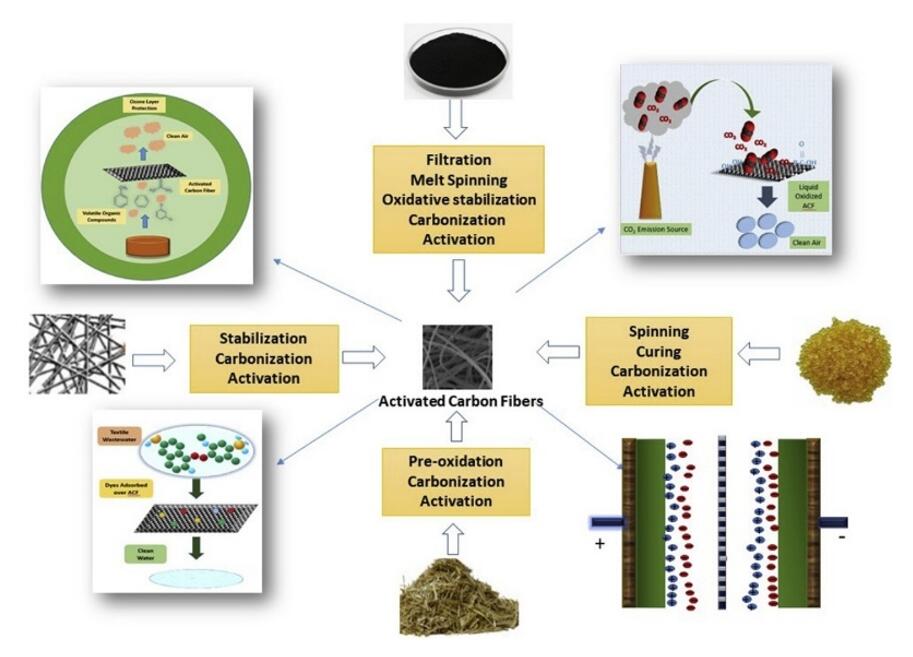
Activated carbon fiber (ACF) is a relatively novel fibrous carbon material, which offers the advantages of high porosity, high volume capacity, excellent bulk density, rapid adsorption kinetics, and adequate porous storage capacity. - Others
Other precursors for carbon fiber production also include cellulose precursors, phenolic precursors, and so on.
Features
- High tensile strength (2∼7 GPa)
- Notable compressive strength
- High Young’s modulus (200∼900 GPa)
- Low density (1.75∼2.20 g/cm³)
- Low thermal expansion
- Excellent electrical and thermal conductivity (~800 Wm⁻¹K⁻¹)
- Ultimate chemical stability
- High temperature resistance
- Good fatigue resistance
- Excellent wear resistance
Applications
- Battery Application
The application of carbon fibers as electrode materials in batteries has been widely studied, such as lithium-ion batteries, lithium-sulfur batteries, sodium-ion batteries, and vanadium redox flow batteries. Shengnan Yang et al. summarized the effects of carbon fibers and their composites on battery performance.

- Composite Materials
Based on the above-mentioned advantages of carbon fiber, such as high specific tensile strength, high modulus, and excellent wear resistance, it occupies an important position in reinforcing advanced composite materials. The obtained composite materials are widely used in aviation, deep-sea development, wind power generation, automobiles, construction engineering, sports and leisure, and other industrial and civil fields. - Environment and Energy
The general properties of ACF enable it to be used in a variety of environmental and energy applications, including applications in CO₂ capture, volatile organic compound removal, wastewater treatment, and energy. For example, some efforts have been made to utilize ACF materials to eliminate volatile organic compounds (VOCs) such as benzene, toluene, xylene (BTX), organic compounds, etc., especially from enclosed environments.
Ceramic Fiber
Ceramic fiber, also known as aluminum silicate fiber, is a new type of lightweight refractory material. Ceramic fibers come in two forms, continuous (long) and discontinuous (short). Ceramic fibers can be divided into oxide and non-oxide ceramic fibers, which are used as reinforcements for composites.
Features
Ceramic fibers have the following features:
- Light weight
- High temperature resistance
- Low thermal conductivity
- Good thermal stability
- Corrosion resistance
- Creep resistance
- Good microstructural stability
- Small specific heat
- Mechanical vibration resistance
Therefore, it has been widely used in machinery, metallurgy, the chemical industry, petroleum, ceramics, glass, electronics, and other industries.
Classification
- Ceramic Oxide Fiber
Typical compositions of these oxide fibers are Al₂O₃, Al₂O₃/SiO₂, or Al₂O₃/SiO₂/B₂O₃/B₂O₃ mixes. - Ceramic Nonoxide Fiber
Non-oxide fibers are often described by their constituent elements, as they contain distinct phases and do not have a uniform stoichiometry. Well-known filament fiber compositions are SiC, Si-C-O, Si-C-N, Si-C-N-O, and Si-B-C-N. Although these fibers can contain a certain amount of oxygen, they do not form typical oxides in the structure and are therefore “non-oxides.” Typical ceramic non-oxide fibers include silicon carbide (SiC) fibers and boron-based fibers.
Production Techniques
There are several production techniques for ceramic fibers:
- CVD technique
- Melt-spinning technique
- Slurry spinning
- Chemical conversion
- Polymer-derived precursor method
- Sol-gel process
- Single-crystal fiber growth technique
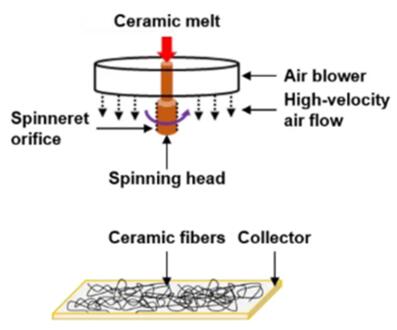
Fabrication of ceramic fiber with centrifugal spinning
It is worth noting that, considering the production efficiency and cost, there are also some advanced ceramic fiber technologies commonly used in scientific research.
- Centrifugal Spinning
- Electrospinning
- Solution Blow Spinning
- Self-assembly
- Atomic Layer Deposition
Applications
Ceramic fibers are mainly used in two fields of application: first, as thermal insulation material, and second, for the reinforcement of metals or ceramics. Non-oxide fibers could in future applications substitute carbon fibers, which are also used for ceramic reinforcement, for instance, in C/SiC materials. Some studies have also explored the effect of ceramic fibers on the mechanical properties of other materials. For example, Duoqi Shi et al. studied the effect of ceramic fibers on the high-temperature compression properties of SiO₂ aerogels. The results indicate that the modified material exhibits anisotropic mechanical properties.

Microstructure of ceramic-fiber-reinforced SiO₂ aerogel. (a) in-plane direction microstructure, (b) out-of-plane direction microstructure
Glass Fiber
When glass is melted and pulled out into long, thin threads, glass fibers are made. These fibers are particularly useful in technical applications. Today, they are employed as optical fibers, in textile textiles, as fillers in building chemicals, and in glass fiber-reinforced plastics. Glass fiber-reinforced plastics are one of the most essential building materials nowadays since they are forceful and last a long time.
Pros of glass fiber
- High tensile and elastic modulus
- Good at dampening
- Not able to catch fire
- Resistant to chemicals well
- Weatherproof and age-resistant
- Good price
- There are grades that are resistant to alkali.
Drawbacks of glass fiber
- High density (weight per unit volume)
Glass fiber Production process
For some uses, glass fibers are pulled from a preform or a glass tank using heated nozzles. Silicon dioxide is the most important part of glass. To get the right properties, other metal oxides such as aluminum oxide, magnesium oxide, beryllium oxide, or calcium oxide are added. These combinations make it feasible to build glass fibers that meet varied needs, such as very high mechanical needs, very high temperatures, or very high chemical resistance. Most standard fibers used in electrical applications and plastic reinforcing are created from E-glass (E stands for electric).
Classification of glass fiber
According to the monofilament diameter, glass fibers can be divided into coarse fibers (30 μm), primary fibers (greater than 20 μm), intermediate fibers (10-20 μm), high-grade fibers (3-10 μm), and ultrafine fibers (less than 4 μm). Generally speaking, fibers of 5-10 μm are used as textile products; fibers of 10-14 μm are generally used for roving, non-woven fabrics, chopped fiber mats, etc.
Depending on the raw glass material, types of glass fibers include E-glass, C-glass, S-glass, A-glass, D-glass, R-glass, EGR-glass, etc. The corresponding physical properties of different types of glass fibers are shown in the figure below. In general, glass fiber has the features of high temperature resistance, non-flammability, corrosion resistance, good heat and sound insulation, high tensile strength, good electrical insulation, low coefficient of linear expansion and dielectric permeability, etc.

Chemical Composition
- E-glass fibers, also known as alkali-free glass fibers, have an alkali metal oxide content < 0.05%.
- C-glass fiber is also known as medium alkali glass fiber, and its alkali metal oxide content is 11.5-12.5%.
- Glass fiber is also known as high-alkali glass fiber with an alkali metal oxide content > 15%.
- D-glass fiber contains a large amount of boron trioxide, which provides low dielectric constant properties. This makes glass fibers ideal for fiber optic cable applications.
- S-glass fiber, also known as “special glass fiber,” is a high-strength glass fiber composed of pure magnesium-aluminum-silicon ternary. S-glass fibers mainly include magnesium-aluminum-silicon-based high-strength and high-elastic glass fibers; silicon-aluminum-calcium-magnesium-based chemical corrosion-resistant glass fibers; lead fibers; high-silica fibers; and quartz fibers.
- The chemical composition of different glass fibers in wt% is summarized in the table below for reference.
| Type | (SiO₂) | (Al₂O₃) | TiO₂ | B2O3 | (CaO) | (MgO) | Na₂O | K2O | Fe₂O₃ |
|---|---|---|---|---|---|---|---|---|---|
| E-glass | 55.0 | 14.0 | 0.2 | 7.0 | 22.0 | 1.0 | 0.5 | 0.3 | – |
| C-glass | 64.6 | 4.1 | – | 5.0 | 13.4 | 3.3 | 9.6 | 0.5 | – |
| S-glass | 65.0 | 25.0 | – | – | – | 10.0 | – | – | – |
| A-glass | 67.5 | 3.5 | – | 1.5 | 6.5 | 4.5 | 13.5 | 3.0 | – |
| D-glass | 74.0 | – | – | 22.5 | – | – | 1.5 | 2.0 | – |
| R-glass | 60.0 | 24.0 | – | – | 9.0 | 6.0 | 0.5 | 0.1 | – |
| EGR-glass | 61.0 | 13.0 | – | – | 22.0 | 3.0 | – | 0.5 | – |
| Basalt | 52.0 | 17.2 | 1.0 | – | 8.6 | 5.2 | 5.0 | 1.0 | 5.0 |
Chemical Structure
The glass structure at the atomic level has been the subject of much theoretical speculation and experimental work. Zachariasen’s model shows that quartz glass is composed of a random network of SiO₄ tetrahedra. Schematic diagrams of glass crystals and multicomponent glasses have been proposed. The short-range order but lack of long-range order in figure (b) is due to the fact that SiO₄ tetrahedra are the basic building blocks of amorphous silica, but the orientation of the tetrahedra to each other has some random characteristics. The O atoms at the corners of the tetrahedra are shared between the two tetrahedra. Therefore, the overall chemical composition of glass is SiO₂… Although pure silica glasses appear to mostly have random arrangements of atoms beyond the nearest neighbors, when network modifiers (e.g., Na, Ca) and alternative network formers (e.g., B and Al) are introduced, some of the randomness of the structure is compromised.
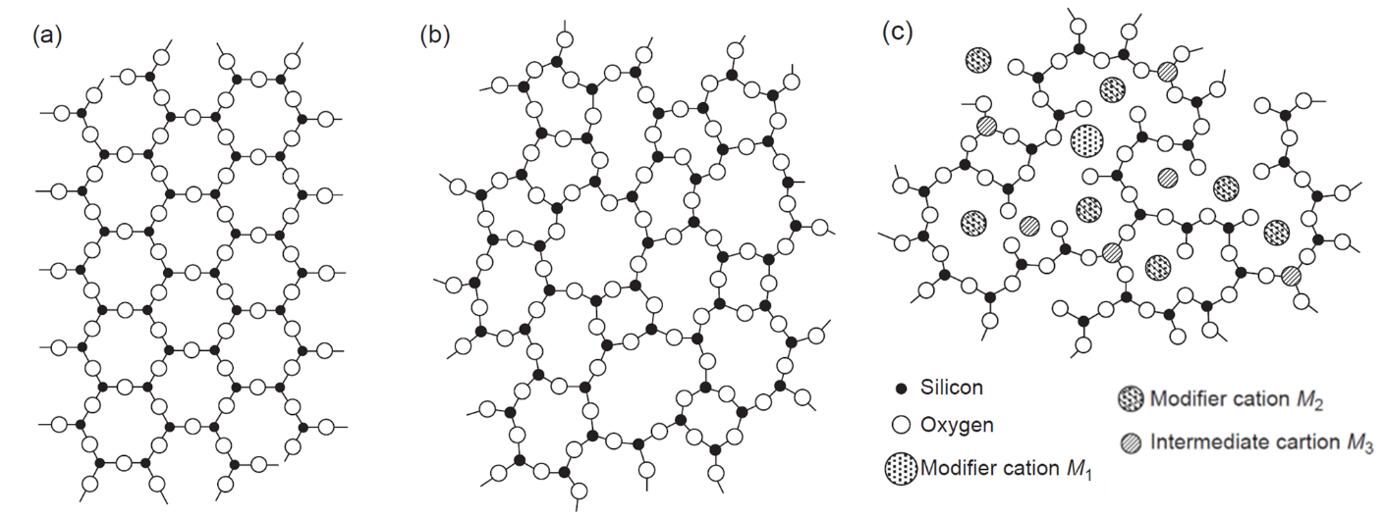
2D schematic diagram of (a) crystal structure; (b) simple glass; (c) multicomponent glass.
Composite Fiber
Classification
By combining the right polymers, manufacturing conditions, and added additives, one can obtain multicomponent fibers with desirable properties. The advantages of composite fibers include increased dyeability, decreased flammability, increased water absorption, increased photothermal stability, increased strength and elastic recovery.
According to the number of phase components, it can be divided into bicomponent and multicomponent composite fibers. Most of the currently developed conjugate fibers are bicomponent fibers. According to the shape of the cross-section, bicomponent fibers include side-by-side, sheath-core, island-in-the-sea types, etc. The figure below lists some common types of fiber cross-sections.
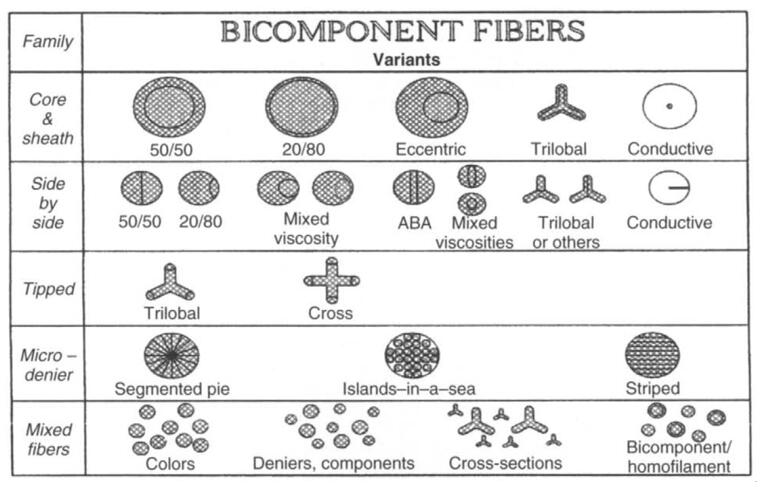
- Side-by-side type: Side-by-side composite fibers are fibers composed of polymers with different properties or structures arranged side by side and composited along the fiber axis. The ratio of each component can be symmetrical or asymmetrical. The most important feature of this fiber is that it can take advantage of the difference in shrinkage properties of each component to create an ideal wool-like three-dimensional crimp. Therefore, side-by-side composite fibers are mainly used to produce large-volume self-crimping fibers.
- Sheath-core type: This structure is a fiber in which two polymers are continuously formed along the longitudinal direction of the fiber to form a skin layer and a core layer, respectively. Using the sheath-core structure, special-purpose fibers can be manufactured. For example, the flame-retardant polymer is used as the core, and the ordinary polyester is used as the skin to make flame-retardant fibers.
- Island-in-the-sea type: This structure is a composite fiber in which the dispersed phase polymer is uniformly embedded in the continuous phase polymer. The island component of sea-island fiber is generally polyester (PET) or polyamide (PA), and the sea component compounded with it can be polyethylene (PE), polyamide (PA6 or PA66), polypropylene (PP), polyethylene alcohol (PVA), polystyrene (PS), etc.
Typical Product
Polyethylene and polypropylene composite fibers
One of the most commonly used multicomponent fibers includes polyethylene (PE) and polypropylene (PP), which are polymers with different melting points. The resulting material is lightweight, strong, soft, and comfortable; it dries quickly, and it has high abrasion and stain resistance.
Research and Application
As a kind of fiber variety with special style and performance, composite fiber has been widely used in people’s lives, industry, medical treatment, optoelectronic communication and other fields and has become an indispensable fiber material.
In advanced research, composite fibers can be used as luminous fibers. In 2004, Shim investigated the luminescence and mechanical properties of photoluminescent core bicomponent fibers produced in a sheath-core morphology. In 2018, Haolong Xue et al. developed a novel skin-core structure with a luminous fiber that emits red light in the dark.

Structure of xanthene derivative (a) and luminous fiber (b).
Fiber-reinforced plastics
Filling with fibers can effectively improve the strength and stiffness of plastics. Fiber-reinforced plastics are rigid structural materials.
Fiber-reinforced plastics have two main components. The matrix is thermosetting plastic or thermoplastic, which is filled with fibrous materials. Usually the strength of the matrix is low, while the fiber filler has high rigidity but brittleness. In the composite reinforced plastics, the fibers bear a significant load stress, and the matrix resin supports the fibers to transfer the external load through the shear stress at the interface with the fibers.
Thermosetting plastic fiber-reinforced plastics are abbreviated as FRP (fiber-reinforced plastics), and thermoplastic fiber-reinforced plastics are abbreviated as FRTP (fiber-reinforced thermoplastics). If the material is fiberglass-reinforced, use the prefix “G,” as in “GFRP” and “GFRTP”; for carbon fiber-reinforced, use the prefix “C”; for boron fiber-reinforced, use the prefix “B”; and for aramid polyamide fiber-reinforced, use the prefix “K.” Reinforcement plastics are primarily composed of glass fibers. There are many kinds of reinforced plastics. E-glass is a common fiber. The content of alkali metal oxides is very low. Hamilton has excellent chemical stability and electrical insulation.
High-strength glass fibers (S-glass) contain magnesium aluminosilicate and other components, which have 10% to 50% higher strength than E-glass fibers. Due to the different chemical compositions and production processes, there are also various kinds of glass fibers, such as high modulus, medium alkali, and high alkali. Carbon fibers have high rigidity and excellent corrosion resistance and are often used to reinforce thermosetting plastics.
Boron fiber is a composite material of tungsten wire and boron. It has high elastic modulus, but the fiber is thicker and the manufacturing cost is higher. Epoxy resin is commonly used as a matrix. Low-density aramid fibers have been practiced and used in China. They are used for cables and bearing components under tension stress.
Surface treatment is the coating of surface treatment agents on the surface of fibers. Surface treatment agents include sizing agents, a series of coupling agents, and additives. A coupling agent can form a favorable bonding interface between the fiber and matrix resin, which can effectively improve the bonding strength of both and also improve the waterproof, insulation and wear resistance of reinforced plastics.
Metallic Fiber
Features
- Metallic fibers have excellent mechanical properties. They not only have high breaking strength and tensile modulus but also have excellent bending resistance and outstanding toughness.
- Metallic fibers have excellent electrical conductivity and can prevent static electricity. For example, tungsten fibers are used as filaments for incandescent light bulbs. In addition, they are also important materials for protection against electromagnetic radiation and electrical conduction and electrical signal transmission.
- Metallic fibers have high temperature resistance.
- Some metallic fibers have good chemical corrosion resistance and are not easy to be oxidized in the air, such as stainless steel fibers, gold fibers, nickel fibers, etc.
Preparation
There are a variety of preparation methods for metallic fibers, including drawing, spinning, cutting, grinding, and plating and metal sintering.
- The drawing method is used to obtain extremely fine fibers with a smooth surface and precise dimensions.
- The spinning method can produce metallic fibers directly from liquid metal.
- The cutting method uses solid metal as raw material and uses a tool to cut it into fibrous chips, which are mainly used to produce short metallic fibers.
- The grinding method uses high-hardness materials as abrasives and obtains metallic fibers of the required diameter by grinding the metal.
- The plated metallic sintering method can be used to prepare hollow metallic fibers.
Applications
- Textile Industry
Metallized fabrics mixed with metallic fibers in ordinary textile fibers not only have the wearability of ordinary fabrics but also have protective properties such as antibacterial, antistatic and anti-electromagnetic radiation. For example, stainless steel fiber textiles can be heated by applying an electric current and can also be used in cut-resistant clothing. - Sound Energy Absorbing Material
Due to the porous structure, fibrous materials have been widely used for noise reduction. Among them, metallic fiber materials have received significant attention in noise reduction applications due to their large specific surface area, high mechanical strength, and excellent permeability, especially in noise control in harsh environments.
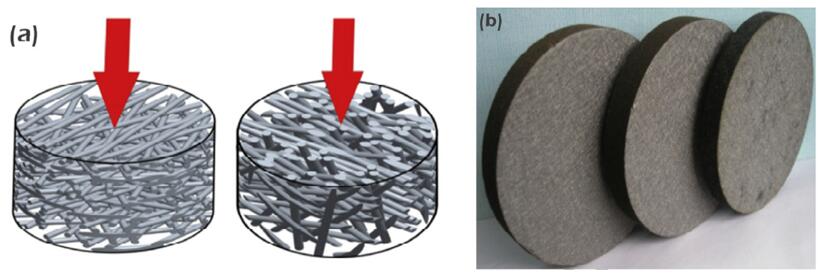
(a) Schematic illustration of sintered fibrous metal with sound incidence; (b) Test samples of sintered fibrous metal.
- Reinforcing Material
Metallic fibers can be used to reinforce polymers or plastics. This combination ensures high strength, light weight and excellent fatigue resistance. Continuous metallic fibers can be easily handled. Some metallic fiber-reinforced plastic composites exhibit superior flexural properties, along with increased strength and weight compared to fiberglass. - Chemical Industry
Metallic fibers can be used as filters for chemicals, materials, waste liquids, and wastewater; for high-temperature dust filters; and in strong, wear-resistant, and conductive conveyor belts.
Custom Profiled Fiber
Optional Service Items
By imitating the structural characteristics of natural fibers, the cross-sections of profiled fibers are made into special shapes instead of being circular or nearly circular like general chemical fibers, resulting in some performance improvements. Combining rich experience in R&D and production with advanced technical expertise,
- Optional Cross-Sectional Shape
The cross-sectional shape is the most important parameter in the profiled fiber customization service. We can provide you with various optional cross-sectional shapes, including but not limited to triangular, pentagonal, polygonal, trilobal, multilobal, cross, dumbbell, “L,” “H,” “Y,” hollow shapes, etc. Different cross-sectional shapes will bring different performance changes to the fibers. For example, triangular fibers have shiny properties, hollow fibers have better bulkiness, and dumbbell-shaped fibers have excellent elasticity and moisture conductivity.
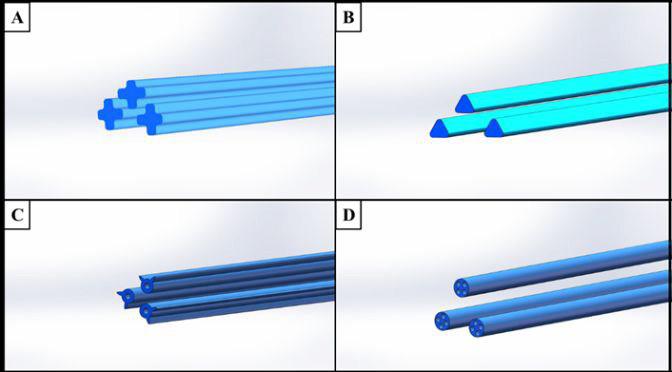
Several typical profiled fibers
- Optional Fiber Type
Our customized profiled fibers can be spun into monofilament, multifilament, staple fiber, fiber bundles, etc. according to customer requirements. - Profiled Fiber Analysis Service
Characterizing the cross-sectional shape of shaped fibers is an important part of quality control and performance design. Along with regular microscopy methods, our technical team can analyze the shape and measure the details of fiber cross-sections using image analysis techniques.
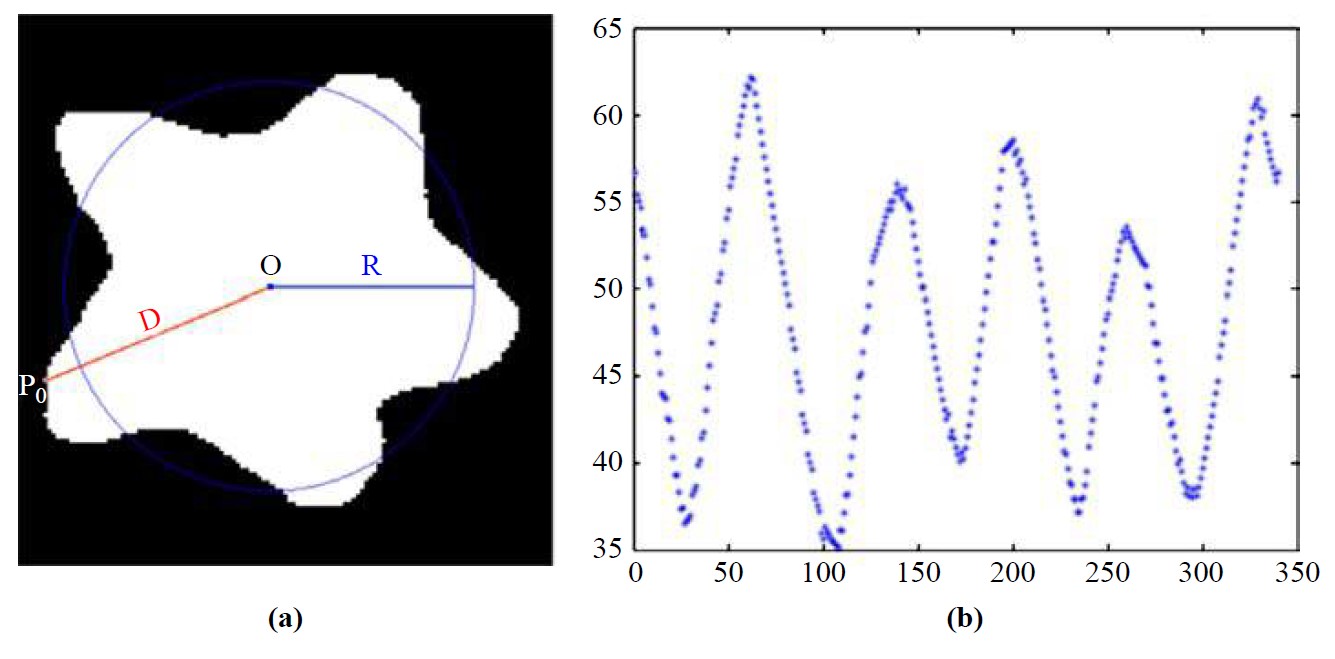
Boundary fluctuation curves of profiled fiber cross sections.
Characteristics
Compared with ordinary round fibers, profiled fibers often show advantages in the following aspects:
- Gloss
- Bulkiness
- Breathability
- Anti-pilling
- Abrasion resistance
- Water absorption
- Dyeability
- Porosity
- Specific surface area
Applications
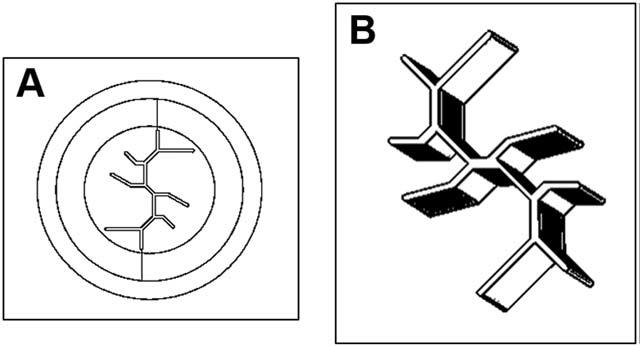
Based on the improved properties mentioned above, in addition to their application in clothing, the special-shaped fibers also show potential in water treatment, concentration separation, air purification, and tissue engineering. For example, studies have indicated that the fiber cross-sectional shape affects the material’s specific surface area, wicking effect, protein adsorption, and other properties, thereby regulating cell behavior and affecting tissue regeneration. Tissue engineering scaffolds can be constructed using grooved cross-section wicking fibers that help enhance cell proliferation.
Read more: Synthetic Fibers vs Man-made Fibers: Definitions and Classifications