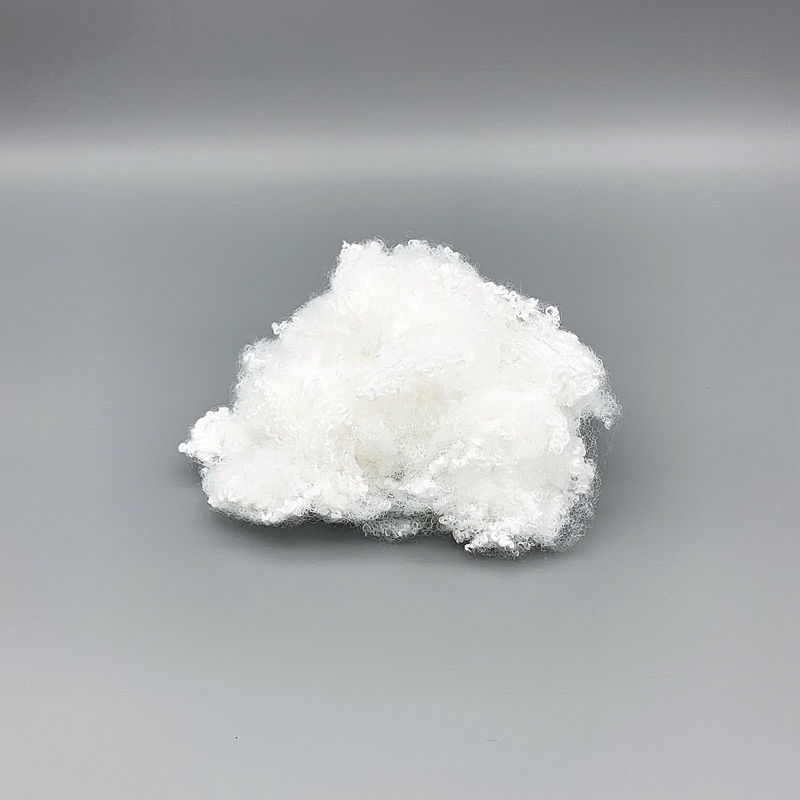
Microfiber: The Down-Like Fiber and Best Down Alternative Fiber for Modern Bedding and Apparel
Superior Softness: The fine structure results in a soft, luxurious feel often compared to silk or high-grade cotton.
Exceptional Strength: Despite its fineness, microfiber exhibits exceptional tensile strength.
Breathability & Moisture-wicking: These fibers excel at drawing moisture away from the body and allowing air to circulate, which is particularly beneficial in sportswear and activewear.
Durability: Microfiber products tend to be long-lasting and retain their shape well, even after repeated washing and wear.
Low Maintenance: It is easy to clean, dries quickly, and is completely machine washable.
PRODUCT DETAIL
Why the World Is Talking About Down Alternative Fiber
Walk into any bedding aisle—online or in store—and you’ll see the words “down alternative” everywhere. It’s on hotel pillow labels, premium duvet inserts, outdoor puffer jackets, and baby sleeping bags. But most consumers, and even some buyers, don’t know exactly what that material is.
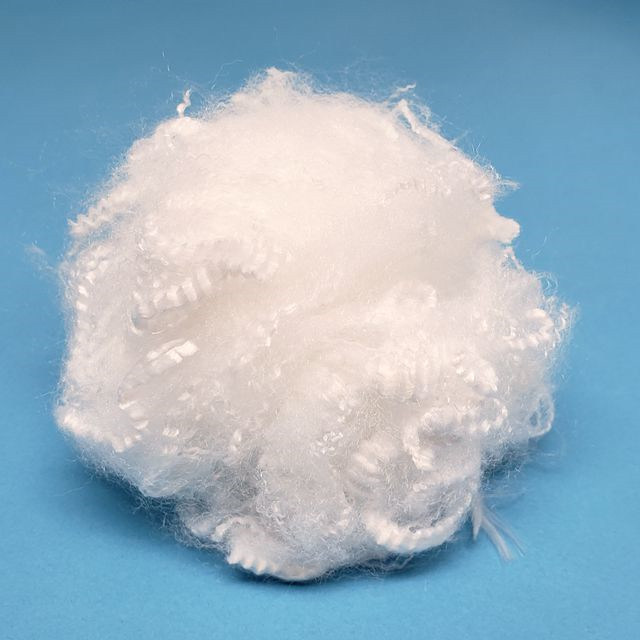
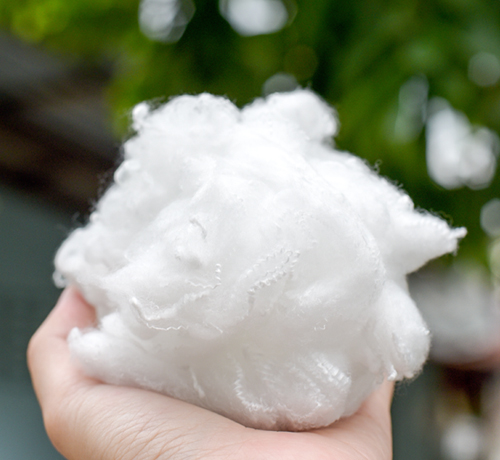
The answer, in nearly every case, is microfiber—an ultra-fine polyester staple fiber engineered to replicate the loft, warmth, and hand feel of natural goose or duck down. In the trade, it goes by several names: down fiber, down-like fiber, microdenier fiber, or simply down alternative fiber. They all point to the same material: a polyester staple fiber finer than 1.5 denier per filament, typically in the 0.7D–1.2D range, finished with a silicone coating to give it the smooth, slick feel that makes it behave like real down during filling and in use.
This post is a practical guide for bedding manufacturers, apparel brands, procurement teams, and product developers who want to understand microfiber deeply — not just as a buzzword, but as a material with specific engineering properties, real trade-offs, and clear advantages over natural down in the right applications.
What Exactly Is “Down-Like Fiber”?
In the industry, down-like fiber and down alternative fiber are commercial terms used to describe microfiber polyester staple fiber when it is used as a fill material in place of natural down. The name acknowledges what the fiber does — it mimics the three key properties of real down that consumers value most:
Loft — the ability to trap large volumes of still air relative to its mass, creating that cloud-like fullness in a pillow or comforter.
Softness — a gentle, feathery hand feel against the skin that does not scratch, poke, or feel synthetic.
Warmth — effective thermal insulation from trapped air, providing comfort without excessive weight.
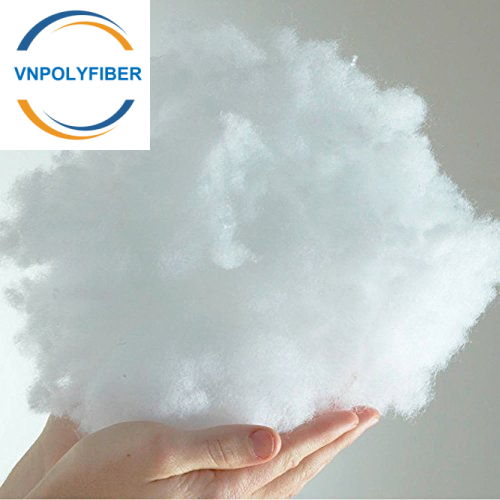
Down alternative fill is usually constructed with a polyester microfiber fill that simulates the pillowy feeling of authentic down SNOWE, and it achieves this through the physics of extreme fineness. At 0.9D–1.2D, a microfiber filament is approximately 1/100th the diameter of a human hair and 1/20th the diameter of a silk strand. That microscopic scale produces a fiber with an enormous surface area relative to its weight—the same structural principle that makes natural down clusters such efficient insulators.
Hollow polyester down-like fiber has a thin, delicate feel—soft, good insulation, and not easy to penetrate—and has the soft feel of natural duck down with comparable warmth performance. Because its effect is comparable to down but the price is relatively low and cost-effective, it is the most commonly used alternative to natural down. Weihighpsf
The Two Critical Performance Indicators of Down-Like Fiber
Anyone who has sourced microfiber polyester staple fiber from a factory knows that not all down-like fiber is equal. The two most prominent indicators of hollow polyester down-like fiber are smoothness and elasticity. As the two are contradictory properties, it is difficult to control and coordinate during production—achieving a fiber with both good slipperiness, high fluffiness, and no static electricity in the same product is what separates premium suppliers from average ones. Weihighpsf
This tension between the two properties is the core manufacturing challenge of down-like microfiber:
- Too smooth (high OPU): The fiber becomes slippery, fibers slide past each other, loft collapses, and fill becomes difficult to distribute evenly in machines.
- Too elastic (high CPI, low OPU): The fiber grips itself, clumps during filling, causes static electricity, and feels coarse rather than silky.
The finest microfiber polyester staple fiber balances both—delivering the slick, feather-like glide of natural down alongside the springy resilience that gives a pillow or comforter its recovery after compression. This balance is achieved through precise control of three process variables: silicone oil pickup (OPU), crimp per inch (CPI), and drawing tension during production.
Microfiber vs. Natural Down: An Honest Comparison
When comparing down vs. down-alternative bedding, the latter is not necessarily the lesser material. Down alternative offers similar comfort to down, but its hypoallergenic fill allows allergy sufferers to snuggle in without issue, and it is also typically the less expensive option. Parachute Home
Here is the full picture—including where natural down genuinely wins and where microfiber as a down alternative fiber has a clear edge:
Warmth and Fill Power
The warmth that down provides with minimal quantity is matched by no other fill. One ounce of down is warmer than one ounce of microfiber. Down alternative comforters can provide just as much warmth, but much more fill is required, which makes synthetic microfiber comforters heavier on the body. Canadian Down and Feather
“Fill power” refers to the number of cubic inches one ounce of down or synthetic filling is able to expand. A good down duvet will have a fill power of 550–750. Due to the naturally higher fill power of down, duvets can be warmer with less filling, making them lightweight. Down alternative duvets need to be filled with much more synthetic material to reach the same warmth level. Peacock Alley
The takeaway for manufacturers: microfiber as a down-like fiber requires higher fill weights to achieve equivalent warmth. This is a real cost and weight consideration, but for most mid-market and premium applications, the trade-off is acceptable given all the other advantages microfiber offers.
Softness and Hand Feel
Microfiber is soft like down but slightly different in feel. Down traps a lot of air, so it can be compressed significantly with applied pressure. Microfiber is denser, trapping less air, for more of a plush feel. Canadian Down and Feather A useful analogy from the industry: if down is cotton candy, microfiber is marshmallow—both are soft, but they feel different in the hand and under compression.
For consumers who prefer a dense, plush feel over the airy lightness of down, microfiber actually wins on perceived comfort.
Moisture and Washability — Microfiber’s Decisive Advantage
This is where down alternative fiber decisively outperforms natural down in practical use. Natural down is extremely sensitive to moisture—it collapses, clumps, and loses all insulating properties when wet and requires specialist cleaning or dry cleaning to restore its loft properly.
PrimaLoft is hydrophobic, meaning it does not absorb water, so it is easier and quicker to dry. DOWNLITE This hydrophobic property is shared by all quality microfiber polyester staple fiber—it is an inherent characteristic of the polymer, not a special treatment. Microfiber fill wicks moisture away from the body during sleep and dries rapidly after washing—making it the practical choice for everyday bedding that needs to survive home laundering.
Down alternatives can be easily washed in a standard washing machine, whereas some down inserts can only be dry cleaned. Boll & Branch For hospitality buyers, retail brands, and consumers alike, this is a significant operational advantage.
Allergens — A Growing Consumer Priority
Natural down harbors a genuine allergen risk. Its protein structure can trigger reactions in sensitive individuals, and its fibrous structure is more prone to trapping dust mites, mold, and skin cells. Down alternative fill is a great hypoallergenic alternative to traditional down. Since down alternative uses synthetic materials, it is far less likely to collect allergens that cause bedroom allergies. Casper Sleep
For manufacturers supplying the healthcare, hospitality, and children’s product sectors—where hypoallergenic certification is increasingly required—microfiber as a down alternative fiber is the only practical choice.
Price and Supply Stability
Microfiber is significantly less expensive than natural down. Canadian Down and Feather Natural down pricing fluctuates with livestock conditions, seasonal availability, and ethical sourcing requirements. Microfiber polyester staple fiber pricing is linked to PET polymer feedstocks—more stable, more predictable, and far more scalable for high-volume manufacturing.
For brands managing margin pressure in competitive bedding and apparel markets, the cost stability of microfiber as a down-like fiber is a genuine strategic advantage.
Durability: Where Down Still Has an Edge
Down duvets are known to last a long time and, with proper care, can be used for up to 10–15 years. Microfiber duvets don’t have the same longevity compared to down duvets. Maholi: Over many years of use and washing, microfiber fill can gradually lose some loft as filaments compact. This is a legitimate limitation that manufacturers and product developers should communicate honestly to end consumers.
That said, for most real-world use cases — especially in hospitality, where bedding is replaced on commercial cycles, or in retail, where consumers upgrade bedding every 3–5 years — the longevity advantage of natural down is academic.
Types of Microfiber Down Alternative Fiber: What’s on the Market
Not all down-like fiber sold in the market is identical. Buyers should understand the key product variants:
Solid Microfiber (Standard Down-Like Fiber)
The most common form. Fine solid filaments at 0.9D–1.2D, siliconized, crimped, and cut to length. This is the workhorse of the down-alternative fill market—used in the majority of mid-market and premium pillows, comforters, and jacket fills globally.
Hollow Microfiber
A hollow core is added to the already-fine filament. Microfiber fill is lightweight, hypoallergenic, easy to care for, and highly breathable, making it a good choice for people who tend to sleep hot. SNOWE The hollow structure adds an insulating air pocket inside each filament, pushing warmth performance closer to natural down without increasing fiber weight. Preferred for premium outerwear and high-specification bedding.
Cloud Down / Velvet Down (Premium Variants)
There are high-level upgrade products on the market such as cloud down and velvet down—in fact, these are generally classified within the same down-like fiber category. Weihighpsf: These are marketing names used by Chinese manufacturers for premium microfiber grades with tighter denier control, higher OPU precision, and optical white color—targeting the luxury bedding and outerwear segments.
Cluster Fiber Fill (Ball Fiber)
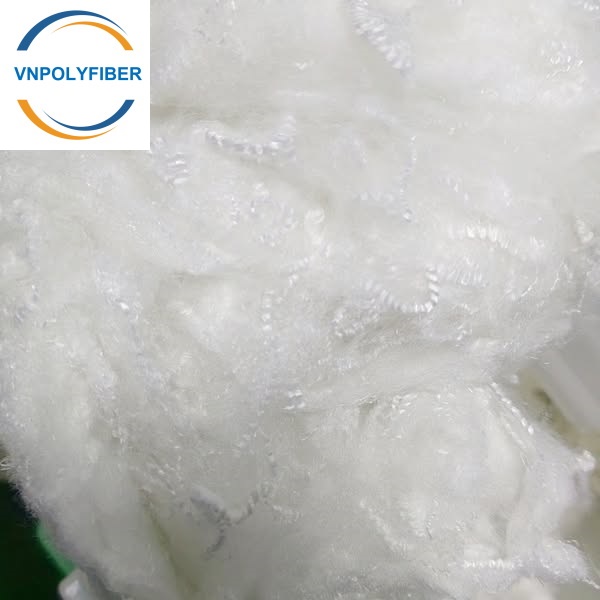
A distinct product that sits alongside microfiber in the down alternative fiber category. Cluster fiber fill is a synthetic filling made of small balls of polyester fibers. It is soft, fluffy, breathable, resilient, and hypoallergenic — a good alternative to down, as it does not clump or bunch and has high filling power. Cluster fiber has a lightweight balled form, allowing air to pass freely through the fiber, maintaining its plump form without clumping or matting even through repeated use and washing. Vnpolyfiber
Cluster fiber is processed differently from standard microfiber fill and is well suited for premium pillows and duvets where a more “down cluster”-like structure is desired in the finished product.
The Siliconization Factor: Why the Finish Matters as Much as the Fiber
One thing that distinguishes a true down-like fiber from standard polyester fill is the silicone finish—known in the trade as OPU (Oil Pickup, measured as a weight percentage). This is not a cosmetic treatment. It is what makes the fiber behave like down during filling and in use.
Polyesters can vary from the size of the fiber to whether it is single or multihollow core; even topical treatments on the fibers can vary greatly. DOWNLITE The silicone coating:
- Gives the fiber its characteristic slick, smooth surface that allows individual filaments to glide past each other—essential for even fill distribution in high-speed filling machines
- Prevents static electricity build-up during processing and in finished products
- Contributes to the soft, silky hand feel that consumers associate with down-alternative bedding
- Reduces fiber-to-fiber friction, preventing clumping and balling in use
The silicate layer on the fiber makes it silky and smooth—a feature that is valuable when it comes to finding a snug pillow—and also prevents dust mite and bacteria accumulation. Hedafiber
Getting OPU right is one of the most important quality parameters when sourcing microfiber polyester staple fiber for down-alternative applications. Too low, and the fiber clumps and generates static. Too high, and the fiber becomes excessively slippery, making fill distribution inconsistent. The optimal range for most down-alternative applications is 0.15%–0.35% OPU.
Key Specifications for Sourcing Down-Like Microfiber
For procurement managers and textile engineers, these are the parameters to specify and verify when sourcing microfiber polyester staple fiber for down-alternative fill applications:
| Parameter | Recommended Range | What It Controls |
|---|---|---|
| Fineness (Denier) | 0.9D / 1.1D / 1.2D | Softness and down-like hand feel; 0.9D = finest, closest to natural down |
| Cut Length | 32mm / 38mm / 51mm | Must match your filling machine requirements |
| Crimp per Inch (CPI) | 10–14 CPI | Loft and air-trapping volume |
| Oil Pickup (OPU) | 0.15%–0.35% | Smoothness, anti-static, processing behavior |
| Tenacity | 3.5–4.5 g/denier | Fiber integrity during high-speed carding and filling |
| Moisture Regain | < 1% | Quick drying, mildew resistance |
| Color | White / Optical White | Important for end products with light shell fabrics |
Hollow polyester down-like fiber products generally fall in the 0.9D–1.2D range. The common cut length is 25 mm, though individual customers choose 32 mm or 51 mm for spinning applications. Weihighpsf At VNPolyfiber, we offer 32mm, 38mm, and 51mm — the three lengths that cover the broadest range of commercial filling and carding equipment.
Who Uses Down Alternative Fiber — and Why
Premium bedding brands use microfiber as their core down alternative fill because it gives them a product that competes with down on hand feel while being machine washable and hypoallergenic. Parachute’s down alternative products are made from 100% hypoallergenic microfiber fill, which allows its down alternative bedding products to be a cozy alternative to down. Parachute Home
Hospitality and hotels have largely moved to microfiber-filled pillows and duvets for operational reasons: machine washable at high temperatures, no allergen liability, consistent performance across thousands of units, and a cost structure that supports commercial replacement cycles.
Outdoor and performance apparel brands rely on microfiber as a down-like fiber for puffer jackets, ski insulation, and travel pillows where moisture resistance is non-negotiable. EnviroLoft, a thicker strand of polyester fill, is popular for hospitality bedding due to its durability and price point. DOWNLITE illustrates how different denier grades of down alternative fiber serve different segments.
Vegan and ethical brands choose microfiber down alternatives because they contain no animal products and avoid the ethical controversy around live plucking that has plagued the natural down supply chain. Animal-conscious or vegan shoppers may also prefer alternative options since most are made without animal products. YumeRest
VNPolyfiber: Your Source for Premium Down-Like Microfiber PSF
At VNPolyfiber, we supply microfiber polyester staple fiber in both virgin and recycled (rPET) grades to bedding manufacturers, outerwear brands, and fill processors across more than 30 countries. Our microfiber range is engineered for consistent down-like performance—tight OPU control, precise CPI, and verified denier on every batch.
Specifications:
| Parameter | Available Options |
|---|---|
| Denier | 0.9D, 1.1D, 1.2D |
| Cut Length | 32mm, 38mm, 51mm |
| Structure | Solid / Hollow |
| Grade | Virgin / Recycled rPET |
| Color | White, Optical White |
| Finish | Siliconized, Slick, Dry, FR, Antibacterial, Low Shrinkage |
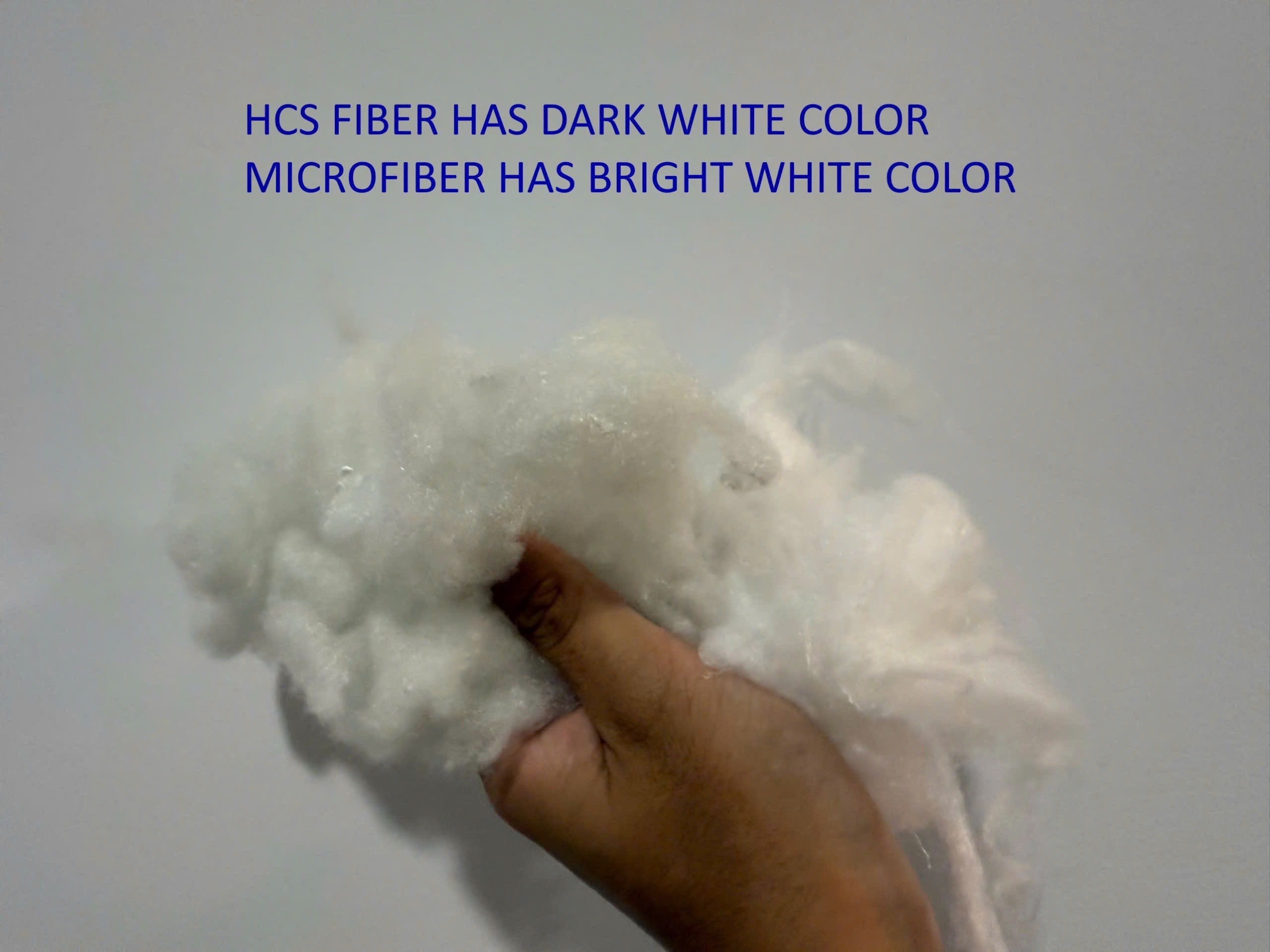
We also offer hollow conjugated fiber (HCS) in 6D–15D for manufacturers who want to blend microfiber with a bulkier hollow fiber for combined softness and resilience—a popular approach for premium pillow and comforter specifications.
👉 Request a Sample or Quote | View All Products | Contact Our Team
Frequently Asked Questions
Is “down-like fiber” the same as microfiber? Yes. “Down-like fiber,” “down fiber,” and “down alternative fiber” are all commercial terms describing microfiber polyester staple fiber (0.7D–1.2D) when used as a fill material to replace natural down. The term emphasizes what the fiber does, rather than what it is.
What is the difference between microfiber fill and regular polyester fill? Standard polyester fill runs from 1.5D to 15D or higher. Microfiber is anything finer than 1.5D — most commonly 0.9D to 1.2D. The finer diameter produces dramatically better softness, moisture-wicking, and a down-like hand feel. Regular polyester fill is cheaper but coarser and cannot replicate the softness of microfiber.
Can down-like microfiber truly replace natural down in premium products? For most bedding and apparel applications, yes—with the understanding that you need higher fill weights to match equivalent warmth, and the feel will be slightly denser (more marshmallow than cotton candy). For ultralight technical applications demanding extreme warmth-to-weight ratios, premium goose down still holds an edge. For everything else, microfiber as a down alternative fiber is the stronger commercial choice.
What certifications should I look for when buying microfiber PSF? Look for GRS (Global Recycled Standard) for recycled grades, OEKO-TEX Standard 100 for harmful substance safety, and ISO 9001 for quality management. VNPolyfiber’s products are available with GRS and OEKO-TEX certification.
Conclusion
Microfiber as a down-like fiber and down-alternative fiber is no longer a compromise—it is the first choice for the majority of the world’s bedding and premium apparel production. Its combination of softness, warmth, moisture resistance, washability, hypoallergenic properties, and cost stability makes it practically and commercially superior to natural down in almost every real-world manufacturing context.
The key is sourcing it right: specifying the correct denier, cut length, OPU, and CPI for your application and working with a supplier who controls these parameters consistently across every batch.
Contact VNPolyfiber to discuss your microfiber polyester staple fiber requirements—samples, specifications, pricing, and lead times are available on request.

Technical Parameter
For textile engineers and procurement managers, the quality of microfiber is determined by its physical parameters. Consistency in these specs ensures that the fiber behaves predictably during high-speed carding and filling processes.
| Parameter | Recommended Range | Why It Matters for Down-Like Performance |
|---|---|---|
| Fineness (Denier) | 0.9D / 1.1D / 1.2D | Finer = softer hand feel; 0.9D is the closest to natural down softness |
| Cut Length | 32mm / 38mm / 51mm | Must match your carding and filling line specifications |
| Crimp per Inch (CPI) | 10–14 CPI | Higher CPI = more loft and air trapping; essential for down-like volume |
| Oil Pickup (OPU) | 0.15%–0.35% | Controls static build-up and ensures smooth processing on carding lines |
| Tenacity | 3.5–4.5 g/denier | Prevents filament breakage during high-speed processing |
| Moisture Regain | < 1% | Ensures quick drying and resistance to mildew in the finished product |
FAQ
1. What do you offer?
We supply a comprehensive range of fibers, including recycled hollow conjugated (both siliconized and non-siliconized) polyester staple fiber, hollow fiber, microfiber, virgin polyester staple fiber, and low-melt fiber.
2. What is it used for?
Our fibers are versatile and widely utilized across both the filling and non-woven industries, providing essential loft, durability, and texture for various consumer and industrial applications.
3. Are you a factory or a trading company?
We are primarily a manufacturer specializing in polyester staple fiber with years of industry expertise. To better serve our clients, we also operate a dedicated trading division that allows us to act as a one-stop solution provider.
In addition to our own fiber production, we source high-quality textile components (such as yarn and low-melt fibers) and finished goods (including foam, pillows, cushions, toys, and down/feather products) to ensure our customers have access to a comprehensive supply chain.
4. Where is your factory location?
To maintain a robust and flexible global supply chain, our manufacturing facilities are strategically located throughout Asia, specifically in Vietnam, China, Malaysia, Thailand, and Indonesia. If you would like to visit one of our sites, please contact your sales representative, and we will be happy to arrange transportation for you.
5. Can you accept free sample?
Yes, we provide free hand samples for quantities under 1 kilogram. Once a price is confirmed, we can prepare and dispatch your sample within 2–3 business days. Please note that while the sample is free, the freight costs are the responsibility of the client.
6. Can you provide ODM service?
Absolutely. We specialize in ODM (Original Design Manufacturing). This means we can customize the material composition, dimensions, quantity, packaging, and branding to meet your specific requirements. Your logo and unique specifications will be integrated into the final product.
7. How about your quality? What’s the minimum order Quantity (MOQ)?
We invite you to place a trial order to experience our quality firsthand. Our standard MOQ is 23,000 kilograms per order.
Regarding pricing, we maintain a no-bargain policy. We believe in transparency and efficiency, so we provide our most competitive offer upfront to save you time and ensure a straightforward procurement process.
8. Can I mix different items in one order?
Yes, for your convenience, we allow for a maximum of two different items to be mixed within a single container.
9. How can you guarantee the product quality?
Quality is the cornerstone of our business. We employ an experienced QC team that monitors every stage of production, from raw material inspection to the final manufacturing process. We utilize a range of advanced testing instruments to ensure our fibers meet strict industry standards.
Our business philosophy is simple: We aim to serve one customer 1,000 times, rather than 1,000 customers once. We prioritize long-term partnerships built on consistent excellence.
10. What’s the payment terms?
L/C at sight, 30% TT in advance are mostly accepted; other terms shall be negotiable by both sides
For more information, please feel free to contact :
Tony Tan
Mobile number: +84 90 466 5251 (Whatsapp/Wechat/Viber/Signal)