Thermally Bonded Nonwoven Fabric: The PSF-to-Product Guide — Process, Fiber Specifications and Applications
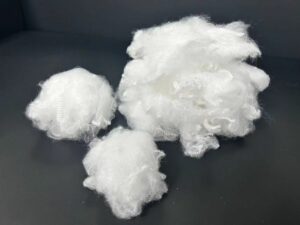
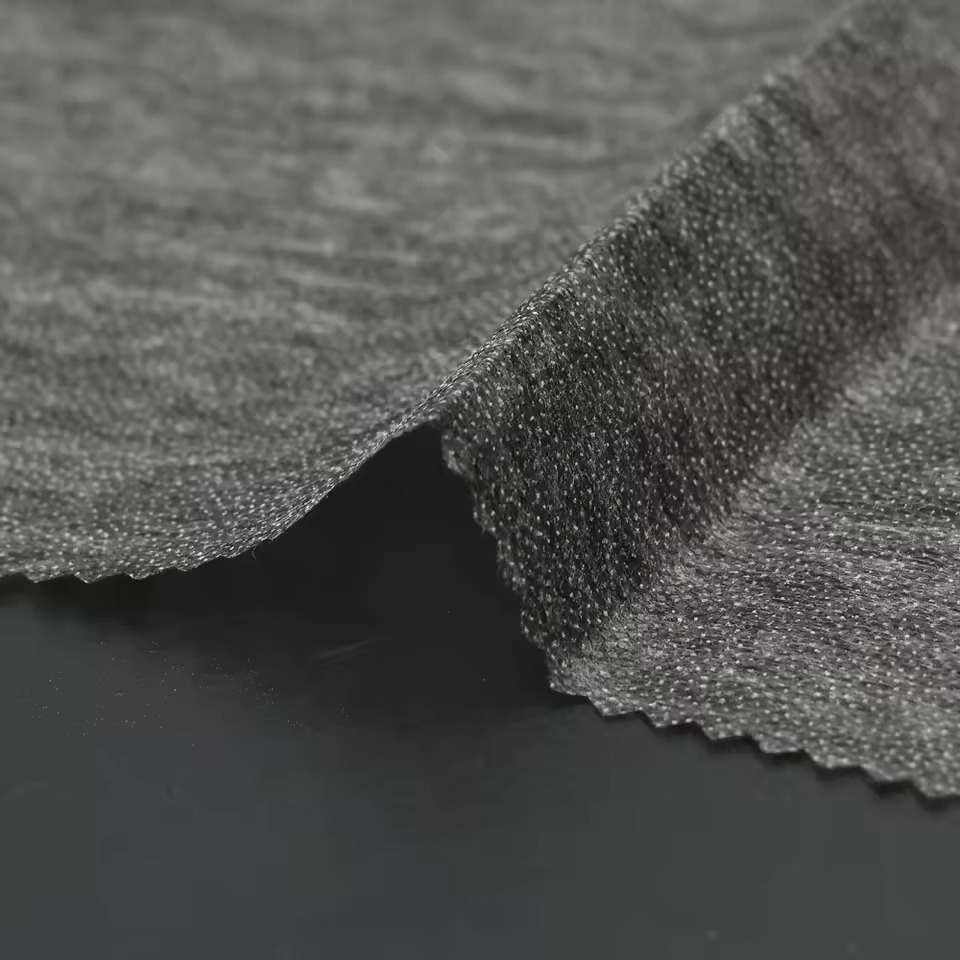
Thermally bonded nonwoven fabric is the product category most directly and extensively fed by polyester staple fiber (PSF) — specifically hollow conjugated siliconized (HCS) fiber and low-melt bicomponent (LMF) fiber. Every quilted jacket with polyester insulation, every pillow filled with batting rather than loose fill, every mattress topper, every stuffed toy with wadding fill, and every thermal insulation layer in a car door panel is almost certainly a thermally bonded nonwoven product.
This guide is written from the PSF supplier perspective — explaining precisely how fiber specification determines thermally bonded nonwoven properties, which fiber combinations produce which product characteristics, the technical differences between through-air bonding and calendar bonding, and the complete application guide from hygiene coverstock to automotive insulation. For nonwoven manufacturers and product developers specifying fiber, and for buyers specifying finished wadding or batting products, this is the reference guide.
VNPOLYFIBER supplies the complete fiber input package for thermally bonded nonwoven production: HCS siliconized PSF (0.9D–15D), solid PSF (1.5D–12D), and LMF bicomponent fiber (2D–6D) — in both virgin and GRS-certified recycled grades, with OEKO-TEX Standard 100 Class I and Class II certification. We also supply thermally bonded nonwoven wadding as a finished product from our manufacturing network.
The Thermal Bonding Process: How PSF Becomes Wadding
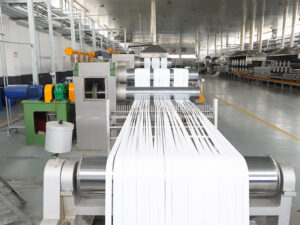
Thermal bonding converts a blend of structural PSF and low-melt LMF bico fiber into a coherent, lofty, resilient fabric through the application of controlled heat — no chemical binder, no water jets, no needles. The process:
- Fiber blending: HCS or solid PSF (the structural fiber, typically 75–85% of the blend) is combined with LMF bico fiber (15–25% of the blend) in the opening and blending system. The LMF sheath-core construction — with a co-PET or PE sheath melting at 110–130°C and a PET or PP core remaining solid — is critical: only the sheath melts during bonding, the core maintains structural integrity.
- Carding: The fiber blend is carded into a uniform web. For thermally bonded products, the carding is optimized for fiber randomization (for isotropic strength) and weight uniformity — critical for consistent wadding properties across the roll width.
- Cross-lapping (for heavy weights): To achieve basis weights above approximately 100 gsm, the carded web is cross-lapped before the thermal bonding oven — the same process as needlepunch. Target gsm determines the number of layers.
- Thermal bonding oven: The cross-lapped web passes through a through-air bonding oven — a chamber where heated air is drawn through the web from above and below by suction fans. Air temperature is precisely controlled to melt the LMF sheath (typically 130–160°C oven temperature) without melting the structural fiber core or the HCS main fiber (PET melting point 255°C+). The melt flows by capillary action to fiber crosspoints, and when the web exits the oven and cools, the LMF bonds solidify.
- Cooling and winding: The bonded web is cooled to ambient temperature to set the bonds, then wound onto jumbo rolls. Finished wadding is cut to customer specifications: roll goods, pre-cut sheets, or shaped insulation pieces.
The critical process control parameter: oven temperature profile. Too low, and LMF bonds are incomplete — the wadding has poor cohesion and sheds fiber. Too high, and LMF over-melts, filling the inter-fiber spaces with molten polymer — the wadding becomes dense and stiff rather than soft and lofty. The correct temperature window for each LMF grade is narrow (typically ±10°C) and must be maintained consistently for uniform product quality.
HCS Fiber Selection Guide for Thermal Bonding
The HCS (hollow conjugated siliconized) fiber specification is the primary determinant of the finished thermally bonded product’s softness, loft, warmth, and feel. The key selection parameters:
| Denier | Character | Best Applications for Thermally Bonded Products |
| 0.9D–1.5D | Ultra-fine microfiber | Luxury down-alternative insulation; finest, softest batting for premium outerwear and premium bedding toppers. Closest to natural down in warmth-to-weight ratio. |
| 2D–3D | Fine soft fiber | Premium insulation wadding for mid-layer outerwear; premium mattress toppers; children’s products requiring OEKO-TEX Class I softness. Very soft, lightweight batting. |
| 4D–6D | Standard premium | Standard specification for quality outerwear insulation (most branded outdoor jacket fill); standard mattress topper; stuffed toy fill wadding. Best balance of softness, loft, and cost. |
| 7D | Standard | Entry-level outerwear insulation; standard mattress quilting layer; automotive door panel insulator; budget home textile. Cost-optimized standard grade. |
| 10D–12D | Firm / structured | Firmer insulation batting; car seat back padding; structured furniture padding; acoustic insulation applications where density matters more than softness. |
| 15D | Coarse / heavy | Heavy automotive insulation panels; industrial thermal and acoustic batting; packaging insulation. Firmest, densest thermally bonded construction. |
LMF Bico Fiber: The Bonding Component
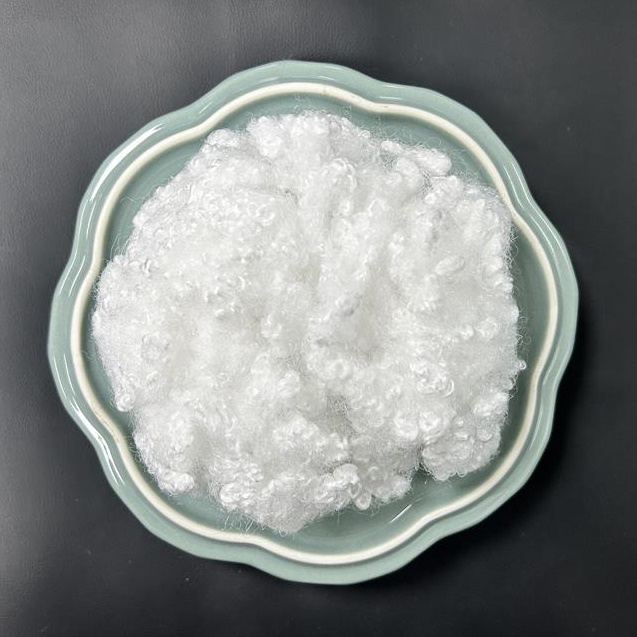
Low-melt fiber (LMF) — also called bico fiber, bicomponent fiber, or thermal bond fiber — is the essential bonding component of thermally bonded nonwoven production. Without LMF, pure HCS or solid PSF fiber cannot be thermally bonded because the structural fiber’s melting point (255°C+) is too high to achieve bonding without damaging the fiber structure.
| LMF Specification | Detail and Commercial Significance |
| Sheath polymer | Co-PET (copolyester) at 110–130°C melt point — most common for wadding. PE (polyethylene) at 130–135°C — used for some hygiene applications. Provides the bonding melt while core remains intact. |
| Core polymer | PET (most common) or PP — provides structural integrity through the bonding process. Remains solid when the sheath melts. |
| Denier of LMF | Typically 2D–6D × 51–64 mm for wadding applications. Finer LMF denier = more bonding points per unit weight = softer, more uniform bonding. Standard wadding LMF: 4D × 51 mm. |
| Blend ratio | 15–25% LMF in the fiber blend is standard for most wadding applications. Less than 15% — insufficient bond strength, fiber shedding. More than 25% — over-bonding, reduced loft and softness. |
| Sheath melt point | Must be ≥30°C below the processing temperature of the structural fiber but ≥30°C above the maximum product use temperature. This window determines processing safety margin. |
| OEKO-TEX certification | LMF for children’s wadding products must be OEKO-TEX Standard 100 Class I certified — this covers both the LMF and the finished bonded product. |
Through-Air Bonding vs Calendar Bonding
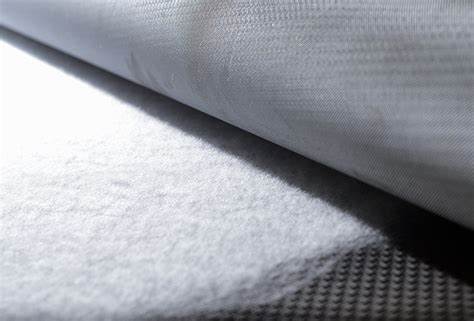
| Dimension | Through-Air Bonding (TAB) | Calendar Bonding |
| Heat application method | Heated air drawn through web by suction — uniform temperature throughout web thickness | Heated rollers press against web surface — heat conducted from surface inward |
| Bond distribution | Distributed throughout web thickness — bonds at interior fiber crosspoints | Surface bonds predominantly — interior relies on pressure bonding |
| Loft and softness | Very high — no compression during bonding; fibers remain in open, lofty structure | Lower — roller pressure compresses web during bonding; denser, firmer product |
| Typical applications | Premium insulation wadding; mattress toppers; soft hygiene coverstock | Flat nonwovens for interlining, carpet backing, hard-bonded insulation |
| Basis weight range | 30–400 gsm effectively (through-air); heavier weights for cross-lapped | 20–150 gsm effectively for standard applications |
| Investment and running cost | Higher — large oven, precise air temperature control | Lower — simpler equipment; but more limited product range |
Application Guide: Thermally Bonded Nonwoven Products
| Product | Basis Weight | Fiber Specification and Key Requirements |
| Premium down-alternative jacket | 60–180 g/m² | 1.5D–3D HCS + 4D LMF at 20%. GRS recycled option popular. Very soft, lightweight. Sewn-through or baffle quilting. |
| Standard outerwear insulation | 80–200 g/m² | 4D–6D HCS + 4D LMF at 20%. Most common outdoor garment fill spec. Good warmth-to-weight ratio. |
| Sleeping bag fill | 100–250 g/m² | 2D–4D HCS + 4D LMF. Temperature rating requires minimum loft specification (e.g., 80mm uncompressed loft for -5°C bag). |
| Mattress topper | 200–400 g/m² | 4D–7D HCS + 4D LMF. Resilience after compression is critical. GRS recycled popular for sustainable bedding brands. |
| Mattress quilting layer | 100–200 g/m² | 4D–7D HCS or solid + LMF. Stitched to mattress cover — must survive quilting without layer separation. |
| Stuffed toy fill wadding | 80–200 g/m² | 4D–6D HCS + LMF. OEKO-TEX Class I mandatory. Pre-cut to shape preferred for toy manufacturers. |
| Automotive door panel | 100–400 g/m² | 7D–12D solid or HCS + LMF. FR-treated grades for passenger safety. NRC acoustic absorption specified. |
| Automotive headliner | 80–200 g/m² | 4D–7D HCS + LMF. Low odour specification (VDA 270). Dimensional stability for moulding process. |
| Hygiene top sheet (through-air) | 15–30 g/m² | Fine 1.5D–2D bico PE/PET fiber web. Soft, hydrophilic. Through-air bonded for maximum softness in diaper coverstock. |
Sustainability: Recycled PSF in Thermal Bonding
GRS-certified recycled polyester staple fiber (rPSF) is fully compatible with thermal bonding production — the recycled fiber processes through the carding and through-air bonding oven in the same way as virgin fiber, with equivalent bonding performance when the LMF blend ratio and oven temperature are correctly specified. Recycled content in thermally bonded wadding provides several commercial advantages:
- Brand positioning: ‘Made with GRS-certified recycled polyester’ is increasingly a retail requirement for sustainable bedding, outerwear, and toy brands — thermally bonded wadding with GRS certification enables this claim.
- GHG reduction: 60–70% lower GHG emissions per kg of rPSF versus virgin — measurable, reportable reduction in Scope 3 Category 1 emissions for brands with SBTi-aligned targets.
- OEKO-TEX compatibility: GRS-certified rPSF with OEKO-TEX Standard 100 certification (Class I for children’s, Class II for adults) meets both recycled content and chemical safety requirements simultaneously — a common dual requirement from sustainable brand buyers.
Conclusion
Thermally bonded nonwoven fabric is the product category where PSF specification has its most direct and measurable impact on finished product performance. The denier of the HCS fiber determines softness and warmth-to-weight ratio; the LMF blend ratio and sheath melt point determine bond strength and cohesion; the basis weight determines insulation thickness; the through-air bonding process preserves the loft that makes premium wadding different from low-quality alternatives.
VNPOLYFIBER supplies the complete fiber package for thermally bonded nonwoven production — HCS in every denier from 0.9D to 15D, LMF bico from 2D to 6D, solid PSF for blending, and dope-dyed grades — in virgin and GRS-certified recycled grades, all with OEKO-TEX Standard 100 certification. We also supply finished thermally bonded wadding from our manufacturing network. Contact us for fiber specifications, wadding samples, certifications, and quotations.