Down Alternative Fill Materials: Microfiber Fill vs. Cluster Fiber Fill — The Complete Comparison Guide
Natural goose down has been the gold standard of luxury bedding fill for centuries—unmatched in warmth-to-weight ratio, loft, and that distinctive cloud-like feel that premium duvet and pillow buyers recognize immediately. But for the majority of the global bedding market, down’s price, its allergy potential, its animal welfare implications, and its demanding care requirements make it the wrong choice. The bedding industry’s answer has been the development of sophisticated synthetic down alternatives—and the two that most closely replicate down’s feel and performance are microfiber fill and cluster fiber fill.
These two fill materials are often confused or used interchangeably in marketing language, but they are genuinely distinct in their structure, manufacture, performance characteristics, and ideal applications. Understanding the real differences between microfiber fill and cluster fiber fill — and how each compares to natural down — is essential knowledge for bedding manufacturers, pillow brand buyers, textile sourcing teams, and anyone designing or purchasing sleep products.
This guide provides the most complete available comparison of these three fill categories: what each is, how it is made, how it performs across every relevant dimension, which applications each suits best, and the fiber specification decisions that determine product quality within each category.
Understanding the Benchmark: What Makes Natural Down Special
To evaluate any down alternative meaningfully, you first need to understand precisely what properties make natural down so difficult to replicate—because those are the properties that microfiber and cluster fiber fills are engineered to approach.
Down is the soft, fluffy undercoat of ducks and geese—the layer beneath the outer feathers that provides thermal insulation for the bird. Unlike feathers, which have a rigid central quill, down consists entirely of soft filaments radiating from a central point (a ‘plumule’), forming a three-dimensional cluster with no hard parts. This cluster structure is what gives rise to its unique combination of properties:
- Three-dimensional cluster architecture: Each down cluster is a spherical network of soft filaments that collectively trap an enormous volume of still air relative to its weight. Still air is the most effective natural insulator — and down is more efficient at trapping it per gram than any other natural or synthetic material.
- Fill power — the defining quality metric: Fill power measures the cubic inches an ounce of down occupies under standardized conditions. Higher fill power (600–900+) indicates larger clusters that trap more air with less weight. This is the primary quality indicator for down: a 900 fill power goose down duvet can deliver the same warmth as a 550 fill power duck down duvet at approximately half the fill weight.
- Compressibility and loft recovery: Down compresses almost completely under pressure and expands back to full loft when released—a resilience property that most synthetic fills cannot fully match over extended periods of use and washing.
- Breathability: The open cluster structure allows moisture vapor and body heat to move through the fill freely, preventing the heat build-up that causes overheating during sleep. This breathability is the property that synthetic fills most struggle to replicate.
The fundamental challenge of down alternatives is this: natural down’s three-dimensional cluster architecture, formed by biological processes over the bird’s lifetime, is extraordinarily difficult to engineer synthetically. Every synthetic fill technology is essentially an attempt to recreate or approximate this cluster architecture using manufactured fiber—with different levels of success and different tradeoffs.
Microfiber Fill: The Premium Synthetic Option
What Is Microfiber Fill?
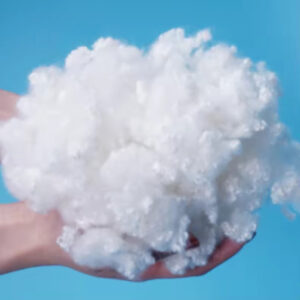
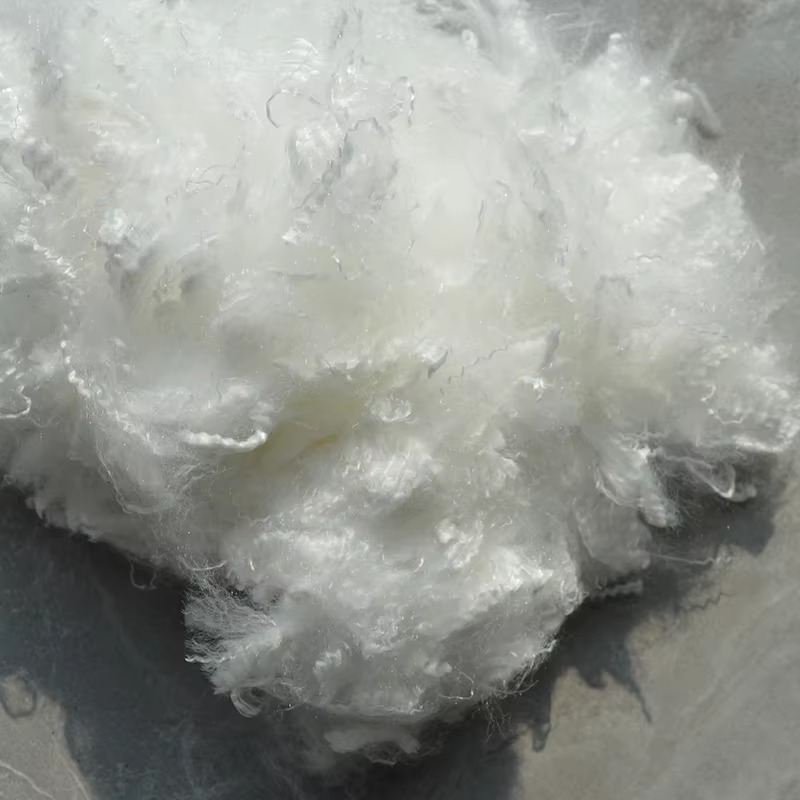
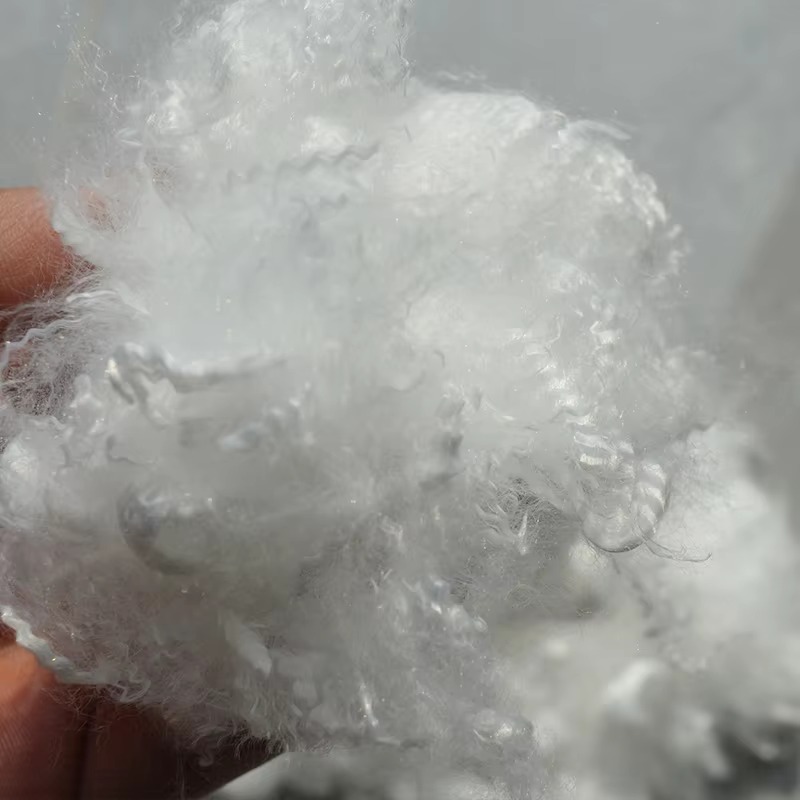
Microfiber fill for bedding applications is polyester staple fiber produced at very fine deniers—typically 0.7D to 1.5D, well below the 1 denier threshold that defines ‘microfiber’ (fibers of 1 denier or less). At these fine deniers, the fiber diameter is smaller than the width of a human hair, producing a fill material with exceptional softness, very high surface area per gram, and a distinctive smooth, silky-cool touch that is the closest synthetic approximation to the feel of down clusters against skin.
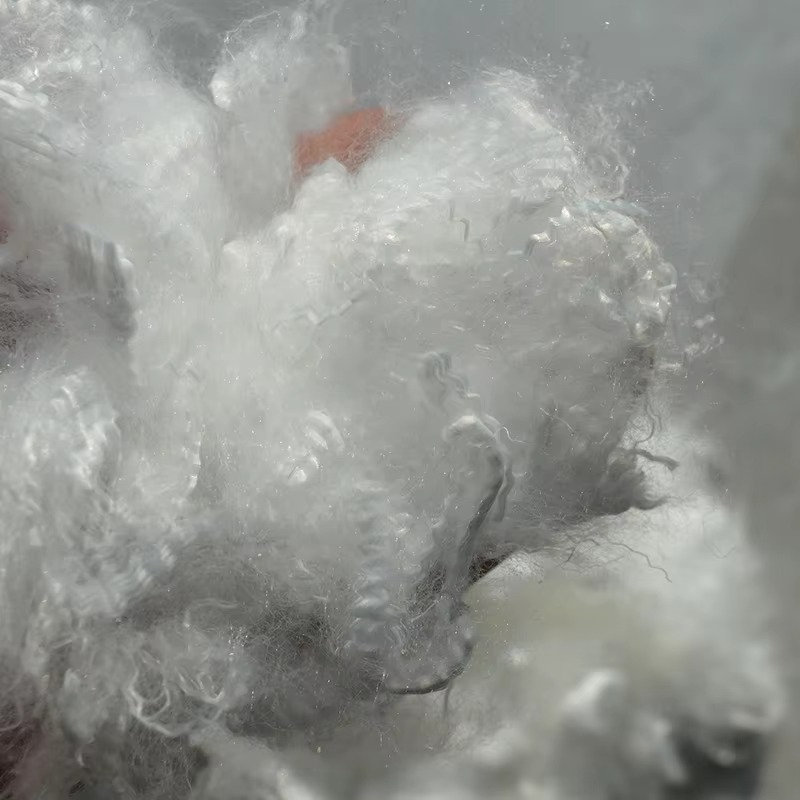
The structural key to microfiber fill’s performance is its very fine individual fiber diameter combined with a siliconized surface finish and — in premium versions — a hollow cross-section and 3D conjugate crimp. At 0.9D denier with a hollow conjugate siliconized construction, microfiber fill achieves a combination of fineness, lightness, and loft recovery that approaches down’s feel more closely than standard denier (6D–15D) HCS fill.
How Microfiber Fill Is Made
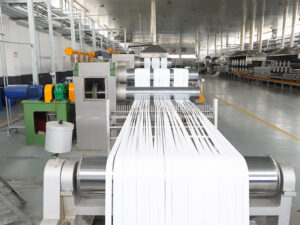
Microfiber PSF for fill applications is produced by melt-spinning PET polymer through spinnerets with very small annular (hollow) or solid orifices, then drawing the filaments at controlled ratios to achieve the target denier without breaking the fine filaments. The technical challenge of fine-denier production increases significantly below 1 denier—maintaining filament integrity and consistent denier through the spinning and drawing process requires tighter process control than standard HCS production.
The spun filaments are typically hollow (for maximum warmth-to-weight) and conjugate-crimped (for 3D spiral loft recovery). The silicone surface finish is applied to achieve the smooth, non-clumping, free-flowing character that gives microfiber fill its distinctive silky feel and processability in filling machines. GRS-certified recycled microfiber fill is commercially available, using rPET feedstock at fine deniers—combining the sustainability credential with the premium fill performance.
Key Properties of Microfiber Fill
Property | Microfiber Fill Performance |
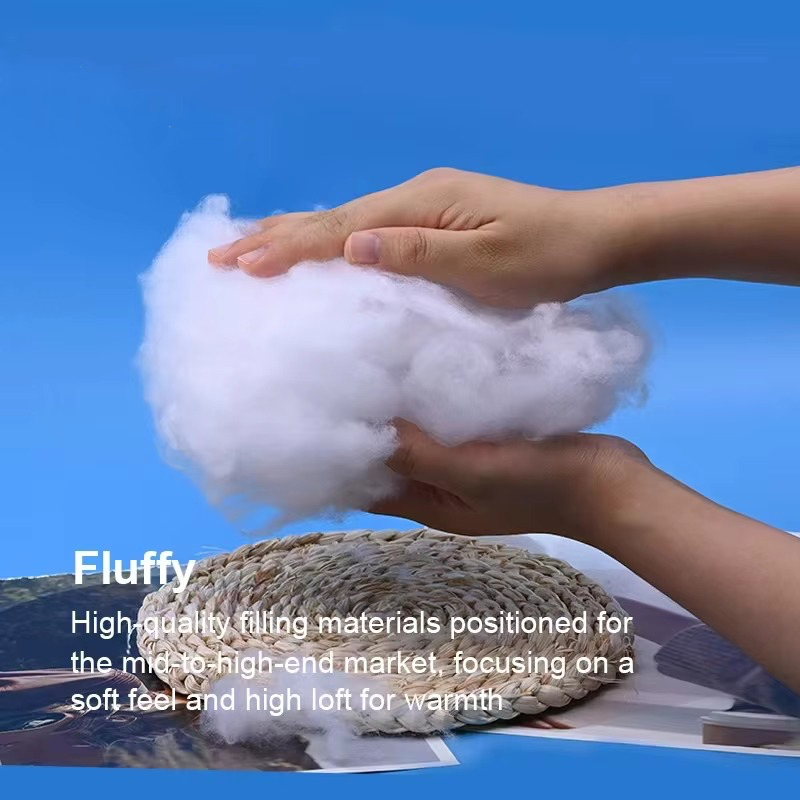
Softness and hand feel | Exceptional—the finest denier microfiber fill (0.7D–0.9D) produces a silky, smooth fill that mimics the skin-contact feel of down more closely than any other synthetic fill. The fine fiber diameter creates the soft, fluid drape that characterizes premium down-alternative products. |
Warmth-to-weight | Very good — the hollow cross-section and fine fiber diameter create a high warmth-per-gram ratio compared to standard solid fiber. While not matching Down’s fill power efficiency, premium microfiber fill significantly outperforms standard 6D–15D HCS fill at equivalent weight. |
Loft recovery | Good to excellent with 3D conjugate crimp—hollow microfiber with conjugate crimp springs back reliably after compression, maintaining loft through use and washing. Slightly less resilient than down’s cluster structure over the very long term. |
Breathability | Good — the fine fiber diameter and open fill structure allow better air circulation than standard weight polyester fills. However, still somewhat less breathable than natural down clusters, particularly at higher fill weights. |
Hypoallergenic | Excellent — no animal proteins, no dust mite habitat risk. Fully synthetic. Safe for down-allergic users and suitable for OEKO-TEX Class I certification for children’s products. |
Washability | Excellent — machine washable and tumble dryer safe. Dries faster than standard fill due to non-absorbent polyester. Maintains softness and loft through repeated laundering. |
Clumping resistance | Good to very good with silicone finish—siliconized microfiber resists clumping and distributes evenly within a duvet or pillow cover. Requires refluffing less frequently than down in typical use. |
Vegan and cruelty-free | 100% — no animal products involved in production. Suitable for vegan product certification. |
Price vs. down | Significantly lower — 50–70% less expensive than equivalent quality down fill, depending on specification and fill weight. |
Microfiber Fill Denier Guide: Choosing the Right Specification
The denier of microfiber fill is the most important specification decision—it determines softness, warmth, weight, and price:
Denier | Grade | Key Characteristics | Typical Applications |
0.7D–0.8D | Ultra-premium microfiber | Finest denier, maximum softness and silky feel, closest to down touch, and highest processing cost | Ultra-premium pillows and duvets; luxury hotel bedding; premium brand down alternative products |
0.9D | Premium microfiber | Optimal balance of softness, loft, and cost; the most specified premium fill grade; excellent conjugate crimp achievable | Premium consumer pillows; high-quality duvet fill; premium sportswear insulation |
1.2D–1.5D | Fine microfiber | Noticeably softer than standard fill; good warmth-to-weight; affordable premium option; widely available with GRS certification | Mid-premium pillows and duvets; quality home textile fill; outerwear insulation |
Note: A denier below 1.0 is technically classified as ‘microfiber. ‘ Fiber between 1.2D and 1.5D is fine-grade standard fiber rather than true microfiber in the strict technical definition but is marketed as ‘microfiber fill’ by many bedding brands due to its significantly softer feel compared to 6D–15D HCS. For specification purposes, always confirm the actual denier with your supplier.
Cluster Fiber Fill: The Down Cluster Mimic
What Is Cluster Fiber Fill?
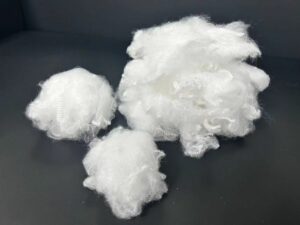
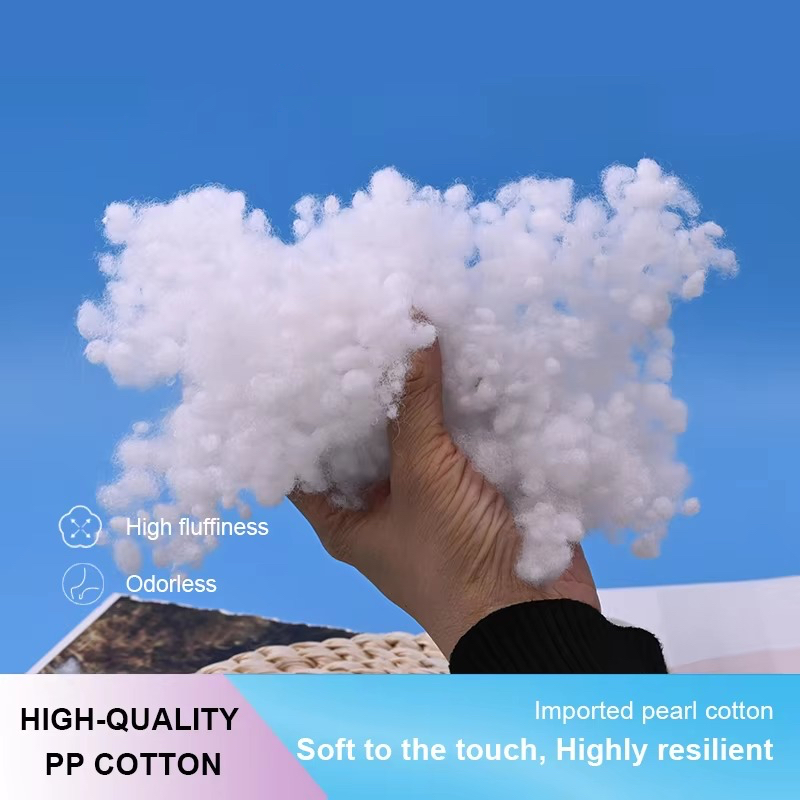
Cluster fiber fill—also called fiber ball fill, cluster fill, or cluster puff—is a premium synthetic fill format in which fine polyester fiber is processed into small spherical clusters rather than remaining as loose staple fiber. Each cluster is a ball of entangled, air-trapping fiber approximately 8–20 mm in diameter, designed to mimic the three-dimensional cluster structure of natural down.
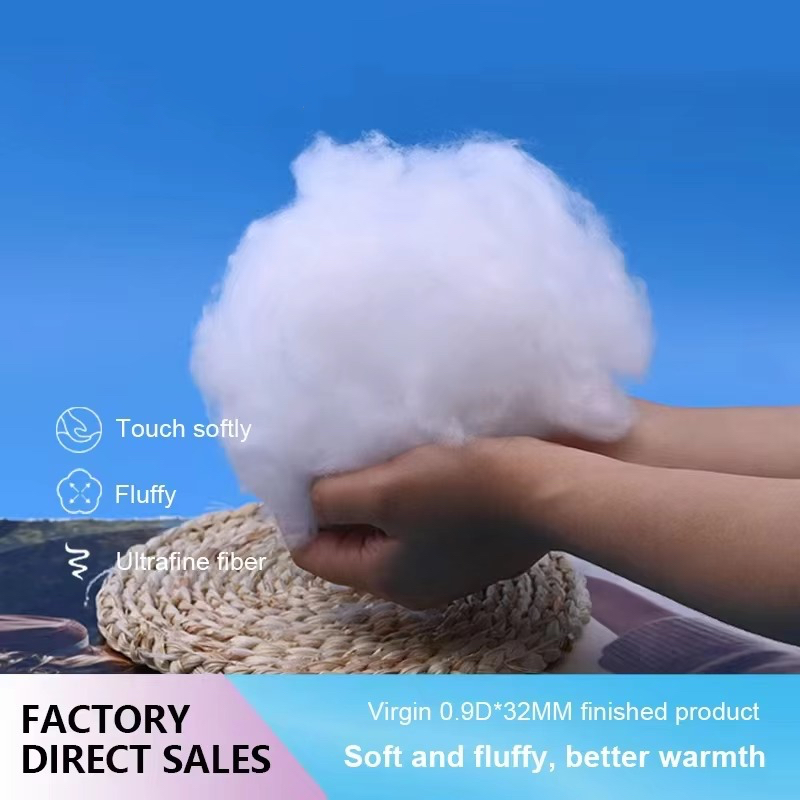

This cluster architecture is the key differentiator of cluster fiber fill from conventional loose-fiber microfiber fill. By forming the fiber into individual spherical units, cluster fill creates a fill mass where each unit behaves somewhat like an individual down cluster—free-flowing, lofty, and independently mobile within the product. This gives cluster fill its distinctive feel: more three-dimensional and airy than loose fiber fill, with a lighter, more cloud-like character that more closely resembles the feel of genuine down products.
How Cluster Fiber Fill Is Made
Cluster fiber fill is produced by processing fine-denier hollow siliconized polyester fiber (typically 0.7D–2D, the same fiber used as premium microfiber fill) through a fiber ball machine—a specialized piece of equipment that agitates and rolls loose fiber in a controlled airstream, causing the individual fibers to naturally coil and entangle around each other into compact spherical balls.
The critical raw material inputs for high-quality cluster fill are fine denier (finer fibers produce tighter, denser balls with better loft recovery); hollow cross-section (for warmth and lightness within each ball); 3D conjugate crimp (which drives the natural rolling and entanglement during ball formation); and silicone finish (which provides the low inter-fiber friction needed for the fiber to roll into compact, stable balls during processing and maintain free-flowing behavior in the finished product).
Cluster size can be controlled by adjusting machine speed, fiber feed rate, and processing time—producing fine clusters (8–12 mm) for soft, premium pillow fill or larger clusters (15–20 mm) for lofty duvet fill. Ball uniformity is a key quality indicator: high-quality cluster fill has consistent ball size and density; lower-quality products show irregular balls with uneven distribution and poor loft retention.
Key Properties of Cluster Fiber Fill
Property | Cluster Fiber Fill Performance |
Softness and hand feel | Very soft and airy — the clustered ball structure creates a fill that feels lighter, more three-dimensional, and more cloud-like than equivalent loose-fiber fill. The best clusters fill closely, approximating the airy, whisper-soft feel of premium down. |
Loft and fill power equivalent | Excellent — among synthetic fills, cluster fiber achieves the highest loft-per-gram performance. The spherical clusters create more inter-ball air space than loose fiber packing, significantly increasing the volume of still air trapped within the fill mass. |
Loft recovery | Excellent — the ball structure gives each cluster its own internal resilience. When compressed, the individual balls spring back more readily than equivalent loose fiber fill, maintaining loft through use. Superior to loose microfiber fill in long-term loft retention. |
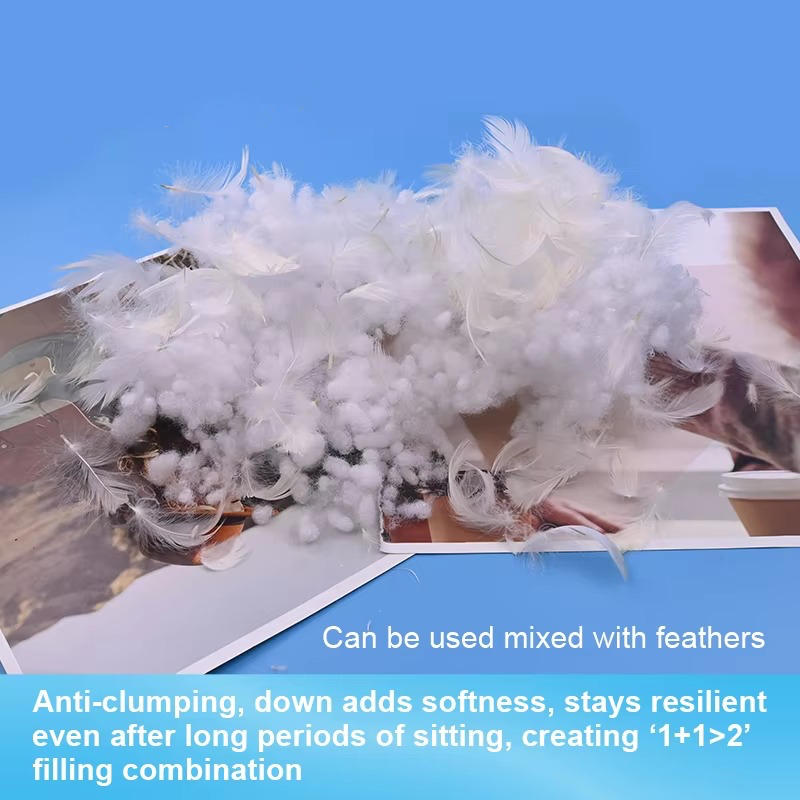
Clumping resistance | Outstanding — the most significant advantage of cluster fill over loose fiber. Individual balls cannot mat together in the way that loose fibers can. Even after repeated washing, cluster fill redistributes freely within the product shell, maintaining even fill distribution without baffling. |
Free-flowing behavior | Excellent — the spherical ball units flow freely within a duvet or pillow shell, redistributing naturally with movement. This gives cluster-fill products a dynamic, responsive feel that closely mimics down’s movement behavior within a shell. |
Breathability | Good—the inter-ball air spaces in the fill mass allow better air circulation than dense loose-fiber fill at equivalent weight. Slightly less breathable than premium down clusters but meaningfully better than standard HCS fill. |
Washability | Excellent — machine washable and quick-drying. The ball structure typically maintains better integrity through multiple wash cycles than loose fiber fill, with less loft loss after washing. A key practical advantage over natural down (which requires specialized care). |
Hypoallergenic | 100% — same hypoallergenic profile as all polyester fills. No animal proteins. Safe for down-allergic users and vegan-certified. |
Price vs. loose microfiber fill | Higher—the fiber ball production step adds processing cost to the base fiber cost. Premium cluster fill is typically priced 20–40% above equivalent-denier loose microfiber fill, reflecting the additional manufacturing complexity. |
Price vs. natural down | Significantly lower — typically 60–80% less expensive than equivalent quality down fill, with superior washability and hypoallergenic properties. |
The Complete Four-Way Comparison: Down vs. Microfiber Fill vs. Cluster Fill vs. Standard HCS
Dimension | Natural Down | Microfiber Fill (0.9D) | Cluster Fiber Fill | Standard HCS (7D) |
Softness | ★★★★★ | ★★★★☆ | ★★★★☆ | ★★★☆☆ |
Warmth/weight ratio | ★★★★★ | ★★★★☆ | ★★★★☆ | ★★★☆☆ |
Loft/fill power | ★★★★★ | ★★★★☆ | ★★★★☆ | ★★★☆☆ |
Loft recovery | ★★★★★ | ★★★★☆ | ★★★★★ | ★★★★☆ |
Clump resistance | ★★★☆☆ | ★★★★☆ | ★★★★★ | ★★★★☆ |
Breathability | ★★★★★ | ★★★★☆ | ★★★★☆ | ★★★☆☆ |
Washability | ★★☆☆☆ | ★★★★★ | ★★★★★ | ★★★★★ |
Hypoallergenic | ★★☆☆☆ | ★★★★★ | ★★★★★ | ★★★★★ |
Durability | ★★★★★ | ★★★★☆ | ★★★★☆ | ★★★★☆ |
Vegan / cruelty-free | No | Yes | Yes | Yes |
Care complexity | High (specialist) | Low (machine wash) | Low (machine wash) | Low (machine wash) |
GRS recycled grade | N/A | Available | Available | Available |
Price | $$$$$ | $$$ | $$$$ | $$ |
Best for | Ultra-premium luxury | Premium soft pillows, apparel insulation | Premium duvets, hotel bedding, high-end pillows | Standard fill pillows, cost-sensitive products |
★★★★★ = Outstanding ★★★★☆ = Excellent ★★★☆☆ = Good ★★☆☆☆ = Fair
Microfiber Fill vs. Cluster Fiber Fill: Which Is Right for Your Product?
The choice between microfiber fill and cluster fiber fill comes down to the specific performance priorities of your product, your target price point, and your manufacturing setup. Here is the decision framework:
Choose Microfiber Fill When:
- Maximum softness is the primary priority—fine-denier microfiber (0.9D) delivers the softest, most silky skin-contact feel of any synthetic fill, important for pillows and slim-fill items where the fill is close to skin
- You are filling apparel products (down-alternative jackets, sleeping bag liners, outdoor insulation) where the fill must flow through filling nozzles easily and distribute evenly in quilted baffles without machine-processing into balls
- Budget positioning is mid-premium—microfiber fill provides a genuine quality upgrade from standard HCS fill at a more accessible price point than cluster fill
- OEKO-TEX Class I certification for children’s products is required—fine denier hollow siliconized microfiber is routinely certified to the strictest chemical safety standards
- Your filling machines are optimized for loose staple fiber—cluster fill requires different filling equipment (open-blowing or conveyor filling) than standard loose fiber
Choose Cluster Fiber Fill When:
- Down-like loft and airiness is the primary priorities—cluster fill’s spherical ball structure creates the most down-like fill behavior of any synthetic option, important for premium duvets and high-loft pillows
- Anti-clumping performance is critical—products that will be used and washed repeatedly (hotel pillows, everyday duvets) benefit enormously from cluster fill’s superior anti-clumping character vs. loose fiber
- You are targeting the premium natural-alternative segment at a price point that supports a processing premium over standard HCS fill
- Your product will be marketed with ‘down-alternative’ or ‘vegan down’ positioning where the closest approximation to down’s cluster structure is commercially valuable
- The product is a duvet or comforter where fill needs to distribute and redistribute freely within a large shell—cluster fill’s free-flowing ball units are better suited to large-area applications than dense loose fiber
Fill Weight and TOG Rating Guide
For consumer-facing products, the fill weight and TOG (thermal overall grade) rating are the primary product differentiation dimensions. Here is how microfiber fill and cluster fill translate to standard bedding ratings:
TOG Rating | Season Use | Approximate Down Fill Weight | Microfiber Equivalent | Cluster Fill Equivalent |
4.5 TOG | Summer / cooling | 100–150 g/m² | 200–250 g/m² | 170–220 g/m² |
7.5 TOG | Spring/Autumn | 200–250 g/m² | 350–420 g/m² | 300–370 g/m² |
10.5 TOG | All-season | 280–350 g/m² | 450–550 g/m² | 400–480 g/m² |
13.5 TOG | Winter | 400–500 g/m² | 600–750 g/m² | 520–650 g/m² |
Note: These fill weights are approximate and vary significantly based on fiber denier, hollowness, crimp quality, and shell construction. Fine denier (0.9D) microfiber and high-quality cluster fill require less fill weight than standard HCS to achieve equivalent TOG ratings because of their superior warmth-per-gram efficiency.
Fiber Specifications That Determine Fill Quality
Whether you are buying microfiber fill or cluster fiber fill, these are the fiber specifications that directly determine the quality of your end product. Understanding them enables you to specify precisely rather than relying on supplier claims alone:
For Microfiber Fill
- Denier: 0.7D–0.9D for ultra-premium; 1.2D–1.5D for premium. Confirm actual denier rather than marketing label (‘microfiber’ can refer to anything below 1D or even up to 2D in some markets).
- Crimp type: 3D spiral conjugate crimp for maximum loft recovery. 2D mechanical crimp is acceptable for lower price points but produces inferior loft recovery over time.
- Hollow vs. solid: Hollow (single or 4-hole) for warmth and lightness. Solid microfiber is used in some applications (cleaning cloths, high-density nonwovens), but hollow is correct for fill applications.
- Silicone finish level: Higher silicone content for a smoother, more slippery feel and better anti-clumping. Slick finish variants offer maximum smoothness for the most down-like feel.
- Staple length: 25–32 mm for the finest microfiber grades (shorter than standard 51–64 mm HCS, optimized for fine filling machine processing).
For Cluster Fiber Fill
- Base fiber denier: 0.7D–2D for quality cluster fill. The base fiber must be fine enough to roll into tight, stable balls during the ball production process. Coarser fiber (3D+) produces loose, unstable balls with poor loft retention.
- Ball diameter: 8–12 mm balls for premium pillow fill (tighter structure, denser, softer feel); 15–20 mm balls for duvet fill (larger clusters, more air space, higher loft). Specify target ball size for your application.
- Ball consistency: Request samples and check for uniformity — high-quality cluster fill has consistent ball size and density with no loose fiber tails. Inconsistent balls indicate poor process control.
- Fill power equivalent: The best cluster fiber fills from reputable manufacturers achieve the equivalent of approximately 500–700 fill power in terms of warmth-to-weight performance—significantly above standard HCS fill.
- Loft stability test: Reputable suppliers can provide wash-and-dry loft retention data — how much loft the fill retains after 10, 20, and 30 wash cycles. This is the best indicator of long-term performance quality.
Flammability and Regulatory Compliance
Flammability regulations are a critical compliance consideration for any filling material used in domestic furnishings, bedding, and upholstery. Requirements vary significantly by market:
- UK Furniture and Furnishings (Fire Safety) Regulations 1988: Cluster fiber filling used in domestic upholstered furniture must pass specific ignition resistance tests involving a smoldering cigarette test and a butane flame test (Schedule 2, Part I). Compliant filling can carry the prescribed label stating compliance. This is a UK-specific regulation with no equivalent harmonized EU standard—check requirements separately for each market.
- US flammability requirements: Cal TB 117-2013 (California) is the most stringent US standard for residential upholstered furniture filling — it applies to polyester fill. Federal standards also apply to children’s sleepwear and mattresses.
- EU regulations: No harmonized EU standard exists for furniture filling flammability. Individual EU member states may have national standards. EN 597 applies to mattresses.
- Flame Retardant (FR) Fiber: Inherently FR polyester fill—produced with flame-retardant chemistry built into the polymer—is available for markets and applications where standard fill fails flammability requirements. FR cluster fiber and FR microfiber fill are commercially available with appropriate test certifications. These grades are required for some hospitality, aircraft, and commercial furniture applications.
Always verify the specific flammability requirements of your target market and application before specifying fill material. VNPOLYFIBER can supply FR-treated microfiber and standard microfiber fill grades with third-party test certifications for target market compliance.
Applications Guide: Which Fill for Which Product
Product Category | Recommended Fill | Key Reason |
Premium down-alternative pillow | Cluster fiber fill (0.9D–2D) | Ball structure gives the most down-like feel and anti-clumping behavior; refluffs easily |
Hotel/hospitality pillow | Cluster fiber fill or 0.9D microfiber | Durability through industrial laundering; consistent loft; premium appearance requirement |
Budget pillow (retail) | Standard HCS (6D–7D) | Best cost-performance ratio for price-sensitive retail positioning |
Premium duvet / comforter | Cluster fiber fill (large ball, 15–20 mm) | Lofty, cloud-like character; free-flowing within shell; excellent wash durability |
All-season duvet | 0.9D–1.5D microfiber fill | Warmth-to-weight efficiency; soft feel; available across fill weight range |
Down-alternative jacket insulation | 0.9D–1.5D microfiber fill (loose) | Flows through apparel filling machines; distributes in quilted baffles; compressible |
Children’s toy and plush fill | 7D HCS siliconized + OEKO-TEX Class I | Safety certification critical; softness and hypoallergenic properties required |
Luxury cushion cover insert | Cluster fiber fill or microfiber | Down-like feel; no quill-poke risk; washable for domestic use |
High-end sleeping bag liner | 0.9D microfiber fill (loose) | Compressibility and warmth-to-weight similar to down at lower cost |
Mattress topper fill layer | LMF bonded wadding or standard HCS | Bonded or loose fill for consistent support surface rather than lofty fill |
Sustainability: Recycled Microfiber and Cluster Fill
Both microfiber fill and cluster fiber fill are available in GRS-certified recycled grades (rPET), produced from post-consumer PET bottles. The sustainability profile of recycled microfiber and cluster fill:
- 60–70% lower GHG emissions per kg compared to virgin PET fiber production — the same benefit as standard recycled HCS fiber
- Approximately 25 standard 500 ml PET bottles provide the feedstock for each kilogram of recycled microfiber or cluster fill—a quantifiable and brand-communicable plastic waste diversion story
- GRS Transaction Certificates provided per shipment — the chain-of-custody documentation required for verified sustainability claims, sustainability reporting, and retailer compliance programs
- OEKO-TEX Standard 100 certification available alongside GRS—confirming absence of harmful chemical residues in both virgin and recycled grades for consumer product safety
The recycled microfiber fill and cluster fill category is growing rapidly as major bedding brands commit to recycled content targets. Brands including those in premium hospitality, outdoor gear, and sustainable fashion segments are increasingly specifying GRS-certified fine-denier and cluster fill as the standard for their sustainability-positioned product lines. The zero-performance compromise compared to virgin grades makes this the most commercially straightforward sustainability upgrade available in bedding fill materials.
How to Sample and Evaluate Fill Quality
Before committing to commercial volumes of microfiber or cluster fiber fill, a structured sample evaluation process ensures you are selecting the right specification for your end product:
- Request fiber samples alongside product samples: Evaluate the raw fiber or cluster ball alongside the finished fill—check ball consistency (uniformity of cluster fill) and fiber fineness (softness between fingertips for microfiber).
- Conduct the hand feel test: Fill a standard pillowcase with a fixed weight of sample fill (e.g., 500g). Compare the feel, loft, and softness between different denier grades and formats. The difference between 0.9D and 7D fill is immediately apparent even without measurement equipment.
- Run a wash-and-dry cycle test: Fill a test pillow, measure initial loft height, wash at 40°C (machine, gentle cycle), tumble dry at low heat, and remeasure loft. High-quality fill should retain at least 80–85% of initial loft after the first wash, stabilizing further in subsequent cycles.
- Check anti-clumping performance: Wash and dry the test pillow 5 times and inspect the fill for clumping, matting, or uneven distribution. This directly predicts real-world durability in customer use.
- Request certification documents: Confirm GRS TC (recycled grade), OEKO-TEX certificate number and scope, and any flammability test reports relevant to your market.
VNPOLYFIBER’s Microfiber and Cluster Fill Range
VNPOLYFIBER supplies both fine-denier microfiber fill and cluster fiber fill (fiber ball fill) across a range of specifications—in both virgin and GRS-certified recycled grades, with OEKO-TEX Standard 100 certification available:
- Hollow Siliconized Microfiber Fill: 0.9D, 1.2D, and 1.5D; 25–51 mm staple lengths; raw white; 3D conjugate crimp; siliconized and slick finish variants. Virgin and GRS-certified recycled.
- Cluster Fiber Fill (Fiber Ball): Produced from 0.9D–2D hollow siliconized base fiber; ball diameter range 8–20 mm; ultra-premium and standard grades. Available with GRS chain-of-custody documentation.
- Standard HCS Fill (7D, 15D): Our flagship fill fiber for mainstream pillow and duvet applications—available in the full siliconized, non-siliconized, and slick finish range.
We supply samples of all fill grades for product qualification before commercial commitment. Contact us with your target product specification — denier, fill weight, application, and certification requirements — and we will match you to the right fill grade with full technical and certification documentation.
Conclusion: The Right Synthetic Fill for Every Application
Microfiber fill and cluster fiber fill represent the two most sophisticated down alternative technologies available in commercial-scale polyester fiber production—each addressing different performance priorities with different structural approaches to the same fundamental challenge of approximating natural down’s unique cluster architecture.
Microfiber fill (0.9D–1.5D hollow siliconized) delivers maximum softness and skin-contact luxury—the smoothest, most silky synthetic fill experience available, with excellent warmth-to-weight efficiency for its weight. It is the right choice for premium pillows, down-alternative apparel insulation, and any product where the softness of individual fiber against skin is the primary differentiator.
Cluster fiber fill delivers maximum loft, anti-clumping performance, and free-flowing behavior — the most down-like fill structure available synthetically, with the best performance in high-loft duvets, hotel bedding, and premium pillow products where the three-dimensional, airy character of down fill is the target. Its superior anti-clumping and wash durability make it the preferred choice for products subject to intensive use and laundering.
Both are available in GRS-certified recycled grades that deliver equivalent fill performance with verified sustainability credentials — making the upgrade from virgin fill to recycled fill a zero-compromise sustainability improvement for any brand committed to responsible raw material sourcing.