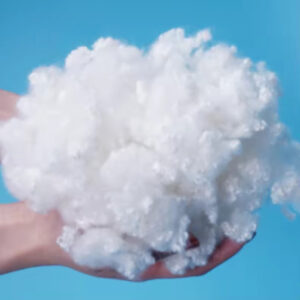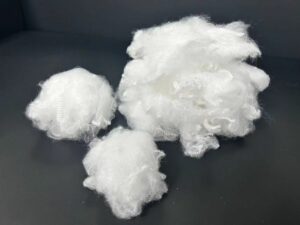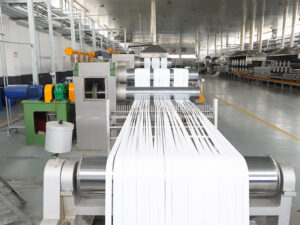
What Is Bicomponent Fiber?
Bicomponent fiber — also written as bi-component fiber, and sometimes called conjugate fiber — is a synthetic fiber manufactured by extruding two chemically distinct polymers simultaneously through the same spinneret. Rather than blending the polymers into a single homogeneous material, the two polymers retain their individual identities within the fiber cross-section, each occupying a defined spatial region.
The defining characteristic of a bicomponent fiber is that it inherits meaningful properties from both of its constituent polymers. By carefully selecting the polymer combination and the cross-sectional architecture, fiber engineers can create a single fiber that is simultaneously, for example: soft on the outside and rigid on the inside; bondable at low temperatures yet dimensionally stable at high ones; hydrophilic on one side and hydrophobic on the other; or capable of self-crimping under heat.
This design freedom is why bicomponent fiber technology has become a cornerstone of modern technical textiles, nonwoven fabrics, and fiber-reinforced composites. A single bicomponent fiber can do the job of two materials — simplifying manufacturing, reducing costs, and opening up product possibilities that were previously out of reach.
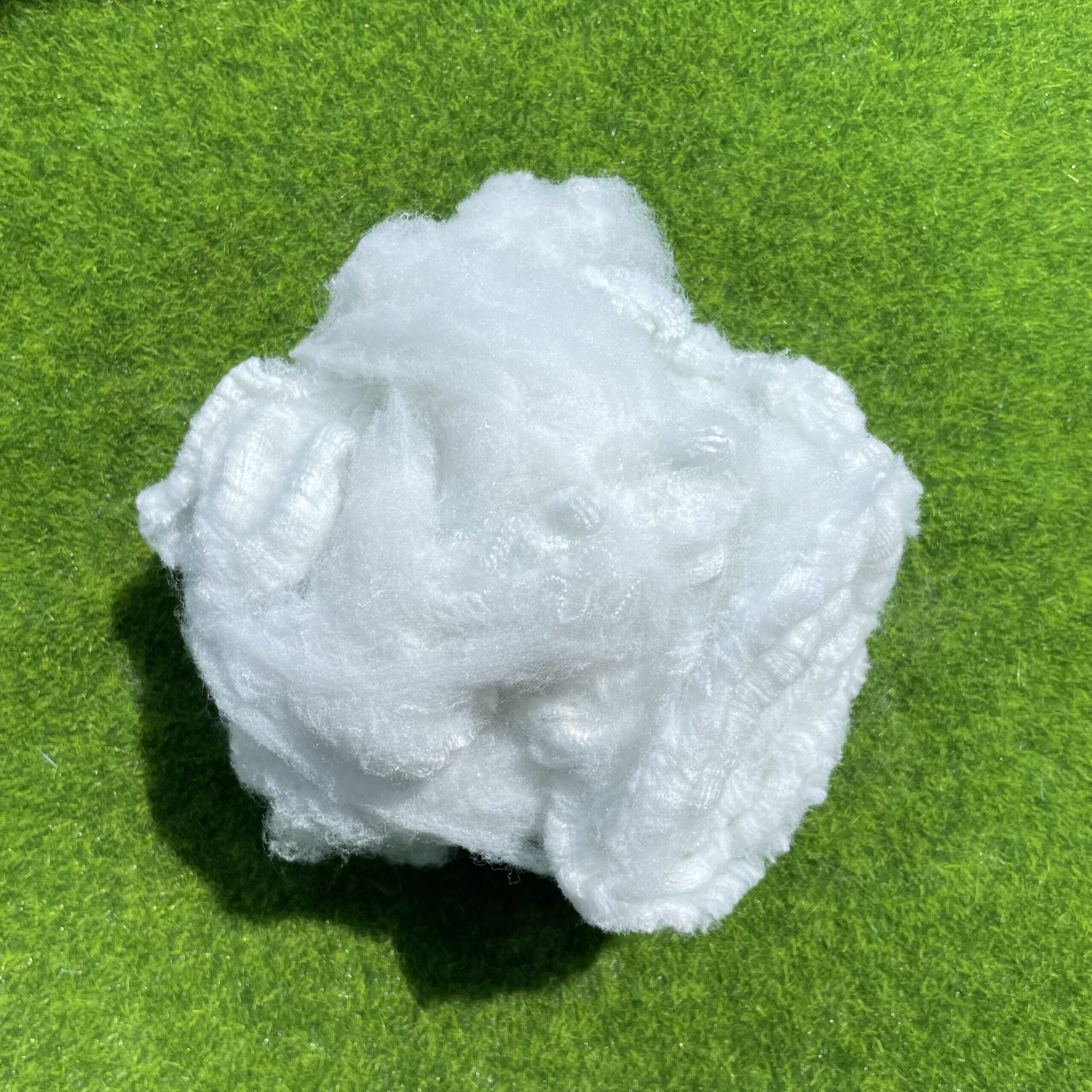
A Brief History of Bicomponent Fiber Development
The concept of bicomponent fiber emerged in the 1960s, when Japanese and American fiber scientists began exploring ways to combine two polymers into a single extruded strand. Early commercial development focused on self-crimping fibers for textile applications — exploiting the differential shrinkage of two side-by-side polymers to produce a natural spiral crimp without mechanical texturing.
Through the 1970s and 1980s, bicomponent fiber technology evolved rapidly as the nonwoven fabric industry expanded. Thermal bonding applications — using a low-melting sheath polymer to bond a high-melting core fiber matrix — became one of the most commercially significant uses of bicomponent fiber, replacing adhesive bonding in hygiene products, automotive interiors, and filtration media.
Today, bicomponent fiber manufacturing is a sophisticated, highly engineered process capable of producing fibers with precisely controlled cross-sectional geometries, melt temperatures, and surface chemistries. The global bicomponent fiber market continues to grow, driven by expanding applications in hygiene, automotive, filtration, and high-performance apparel.
Bicomponent Fiber Cross-Section Types
The spatial arrangement of the two polymers within the fiber cross-section — the fiber architecture — determines the fiber’s mechanical, thermal, and functional behavior. There are several standard bicomponent fiber configurations, each suited to different applications:
| Architecture | Cross-Section | Key Mechanism | What It Produces — Primary Applications |
| Sheath-core (concentric) | Inner core surrounded by outer sheath | Sheath melts at lower temperature, bonds surrounding fibers. Core maintains structural integrity. | Thermal bonding binder fiber (LMF): co-PET/PET sheath-core for wadding and batting; PE/PP sheath-core (ES fiber) for hygiene coverstock. The most commercially produced bicomponent architecture by volume. |
| Sheath-core (eccentric) | Off-centre core within sheath | Differential shrinkage between components creates 2D helical crimp on thermal activation | Self-crimping fiber for stretch applications; some hosiery and elastic nonwoven applications. |
| Side-by-side | Two polymers arranged in two equal halves | Differential shrinkage between the two components creates permanent 3D helical conjugate crimp | Premium fill fiber: the conjugate 3D spiral crimp of HCS siliconized fiber is produced by side-by-side bicomponent spinning. Also used for self-crimping spunbond. |
| Islands-in-the-sea (IIS) | Many ultrafine ‘island’ filaments in a ‘sea’ matrix | Sea is selectively dissolved after fabric formation, releasing island filaments | Microfiber production: ultrafine filaments (0.001–0.1 denier) for synthetic suede (Alcantara-type), microfiber cleaning cloth, and microfiber synthetic leather substrate. |
| Segmented pie (splittable) | Pie-shaped segments of alternating polymers | Mechanical or chemical splitting along segment interfaces releases very fine individual segments | Ultrafine fiber from conventional spinning without sea dissolution; microfiber spunlace; cleaning textiles; fine filtration fabrics. |
| Tipped trilobal | Standard trilobal with different polymer at lobe tips | Tip polymer has different dyeability or optical properties from body | Differential dyeing effects (two-tone fabrics); special optical effects in fashion fiber. |
1. Sheath-Core (Concentric and Eccentric)
The sheath-core configuration is the most widely used bicomponent fiber architecture in industrial applications. One polymer forms the outer sheath; the other forms the inner core. The two polymers do not mix — they are co-extruded as distinct, concentrically arranged layers.
In a concentric sheath-core fiber, the core is centered within the sheath, producing a uniform, symmetrical cross-section. This is the standard configuration for thermal bonding fibers (low melt fiber / LMF), where the low-melting sheath activates under heat to bond with neighboring fibers while the high-melting core preserves fiber structure and length.
In an eccentric sheath-core fiber, the core is deliberately offset from center. Because the two polymers have different thermal shrinkage properties, this asymmetry generates a helical self-crimp when the fiber is heat-treated — producing a naturally crimped fiber without mechanical texturing. Eccentric sheath-core fibers are used extensively in high-loft nonwovens for bedding, insulation fill, and cushioning.
2. Side-by-Side (S/S)
In side-by-side bicomponent fibers, the two polymers are arranged as two distinct lobes running the full length of the fiber — like two cylinders bonded along their length. This configuration produces strong differential shrinkage when heated, generating a highly consistent 3D helical crimp. Side-by-side fibers are valued in applications requiring excellent bulk, softness, and elasticity, such as premium fiberfill, high-loft nonwovens, and performance textiles.
Self-Crimping Side-by-Side Bicomponent: The Conjugate Crimp for HCS Fiber
While sheath-core bicomponent fiber is optimized for thermal bonding, side-by-side bicomponent fiber serves a completely different function — generating the three-dimensional helical (conjugate) crimp that gives premium hollow conjugated siliconized (HCS) fill fiber its superior loft recovery compared to mechanically crimped solid fiber.
In side-by-side bicomponent spinning, two PET polymer streams with slightly different intrinsic viscosities (IV) — and therefore slightly different shrinkage rates as they cool — are extruded side by side through the same spinneret orifice. As the fiber is drawn and heat-treated, the differential shrinkage between the two components causes the fiber to coil into a permanent three-dimensional helical spiral, like a tiny coil spring at the microscopic level. This crimp is geometrically locked into the fiber’s crystal structure during the drawing and heat-setting process.
The result is fundamentally different from the two-dimensional zigzag of mechanical crimp. When compressed — as happens when someone sleeps on a pillow — the conjugate 3D helical crimp deforms elastically and then springs back to full extension when pressure is released. Mechanical 2D crimp, by contrast, gradually relaxes under sustained compression and does not fully recover. This is the measurable, physical reason why premium HCS conjugate-crimped fill fiber maintains pillow loft over years of use while standard solid mechanically-crimped fill fiber progressively flattens.
Note that while side-by-side bicomponent spinning produces the crimp mechanism, the finished HCS fiber is not typically described as a ‘bicomponent fiber’ in commercial usage — it is described by its performance characteristics (hollow, conjugate, siliconized). The bicomponent aspect is the production method, not the commercial identity of the product.
3. Islands-in-the-Sea (I/S)
Islands-in-the-sea (I/S) bicomponent fiber consists of multiple thin “island” filaments of one polymer embedded within a continuous “sea” matrix of a second polymer. After the bicomponent fiber is formed and processed into a fabric, the sea polymer is dissolved away using a solvent, leaving behind an array of ultra-fine filaments — often in the nanometer to sub-micron diameter range.
This process is the primary industrial route to producing microfibers and nanofibers at commercial scale. Islands-in-the-sea bicomponent fiber technology enables the manufacture of ultra-fine fiber products including high-performance synthetic suede (such as Alcantara), high-efficiency filtration media, and advanced medical textiles. The sea polymer is typically selected for easy dissolution — PVA (polyvinyl alcohol) is commonly used as the sea in water-soluble I/S systems.
4. Segmented Pie (Citrus Cross-Section)
Segmented pie bicomponent fibers have a cross-section divided into alternating wedge-shaped segments of two polymers — resembling the slices of an orange or pie. After fabric formation, mechanical action (hydroentanglement, needlepunching) or chemical treatment separates the segments, splitting each fiber into multiple ultra-fine fibers with triangular cross-sections.
The resulting microfibers have a very high surface area, excellent wicking and moisture management, and exceptional softness. Segmented pie bicomponent fibers are widely used in synthetic suede, high-performance sportswear, wiper fabrics, and filtration textiles.
5. Other Configurations
Beyond the four primary architectures, specialized bicomponent fiber designs include tipped trilobal (for enhanced light reflection and silk-like aesthetics), hollow configurations (for thermal insulation and reduced weight), and multi-island variants with dozens or even hundreds of island filaments per fiber cross-section. As fiber engineering advances, new cross-sectional geometries continue to emerge for specialized technical applications.
Fiber Type | Key Characteristics & Primary Applications |
Sheath-Core (Concentric) | Thermal bonding (LMF), uniform surface chemistry, soft-touch nonwovens, hygiene, automotive |
Sheath-Core (Eccentric) | Self-crimping, high-loft nonwovens, fiberfill, bedding, insulation |
Side-by-Side | Strong self-crimping, bulk & elasticity, premium fiberfill, performance textiles |
Islands-in-the-Sea | Ultra-fine / nano fibers after sea dissolution, synthetic suede, high-efficiency filtration, medical |
Segmented Pie | Splittable microfibers, synthetic suede, sportswear, wipers, filtration |
Bicomponent Fiber Types: Quick Reference Comparison
| Type | Architecture | Key Polymers | Primary Function | Main Applications |
| LMF (co-PET/PET) | Sheath-core | co-PET sheath / PET core | Thermal bonding binder for polyester wadding | Quilted jacket insulation, mattress topper, duvet batting, stuffed toy fill, automotive insulation |
| ES fiber (PE/PP) | Sheath-core | PE sheath / PP core | Thermal bonding binder for hygiene nonwoven | Diaper coverstock, feminine hygiene, adult incontinence, baby wipe substrate |
| PE/PET | Sheath-core | PE sheath / PET core | Soft thermal bonding, hygiene-compatible | Fine hygiene nonwoven, medical coverstock, some apparel applications |
| Conjugate / HCS | Side-by-side | PET / lower-IV PET | Self-crimping — generates 3D helical conjugate crimp | Premium fill fiber (HCS) for pillows, duvets, sleeping bags, high-loft wadding |
| Sea-island (IIS) | Islands in sea | Nylon or PET islands / soluble sea | Produce ultrafine microfilaments after sea dissolution | Synthetic suede (Alcantara-type), microfiber cleaning cloth, premium synthetic leather substrate |
| Segmented pie | Pie segments | Alternating PET and PA or PP | Splitting to produce fine microfiber without sea dissolution | Microfiber spunlace, cleaning textiles, filtration fabrics |
| Eccentric sheath-core | Off-centre core | Various polymer combinations | 2D helical self-crimping on thermal activation | Some stretch applications, hosiery, elastic nonwoven |
Polymers Used in Bicomponent Fiber Manufacturing
The selection of the two polymer components is as critical as the fiber architecture. The polymer pairing must be chosen to achieve the desired functional contrast between the two components — whether that is a difference in melting point, a difference in shrinkage behavior, a difference in solubility, or a difference in surface energy.
The most commonly used polymers in bicomponent fiber manufacturing include:
- Polyethylene Terephthalate (PET): The most widely used fiber polymer globally. High melting point (~260°C), excellent strength, dimensional stability, and recyclability. Typically used as the core or high-melting component.
- Co-polyester (CoPET): A modified polyester with a deliberately reduced melting point (typically 110–180°C). Used as the sheath in thermal bonding (LMF) bicomponent fibers, paired with a PET core.
- Polypropylene (PP): Lightweight, chemically resistant, moisture-repellent. Low melting point (~165°C) relative to PET, making it useful as both a bonding component and a sea polymer. Widely used in hygiene, geotextiles, and automotive applications.
- Polyethylene (PE): Very low melting point (~130°C), excellent softness and flexibility. Used as the sheath in PP/PE bicomponent fibers for gentle-touch hygiene and medical applications.
- Polyamide / Nylon (PA): High strength, good abrasion resistance, moderate moisture absorption. Used in performance textile and filtration bicomponent fibers, often as the island component in I/S systems.
- Polyvinyl Alcohol (PVA): Water-soluble polymer used as the sea component in I/S bicomponent fibers. Dissolves in hot water during processing to release island microfibers.
- Polylactic Acid (PLA): Bio-based, biodegradable polymer derived from plant starch. Growing use in sustainable bicomponent fiber applications where end-of-life biodegradability is a priority.
- Thermoplastic Polyurethane (TPU): Elastic, durable, abrasion-resistant. Used in bicomponent fibers for stretch textiles, sportswear, and specialty filtration.
How Bicomponent Fibers Are Manufactured
The manufacturing of bicomponent fiber requires specialized extrusion equipment capable of handling two polymer melts simultaneously and delivering them to a spinneret that combines them in the desired cross-sectional configuration.
Step 1: Polymer Preparation
Each polymer is dried (to remove moisture that would cause hydrolytic degradation), melted in separate extruders, and metered precisely to maintain the correct polymer ratio — typically expressed as a percentage by weight (e.g., 50/50, 60/40 core/sheath).
Step 2: Bicomponent Spinning
The two molten polymer streams are fed into a bicomponent spinneret — a precision-engineered die with a complex internal distribution system that delivers each polymer to the correct zone within each spinneret hole. For sheath-core fibers, concentrically arranged die channels ensure the sheath polymer fully envelops the core. For side-by-side fibers, side-by-side channels unite the two streams at the die exit. For I/S fibers, a multi-channel spinneret pack distributes the island polymer into the flowing sea.
Step 3: Quenching and Drawing
The extruded bicomponent filaments are quenched in an air or water bath to solidify both polymers, then drawn (stretched) to orient the polymer chains and develop the desired tensile strength and elongation properties. The differential properties of the two polymers are preserved throughout this process.
Step 4: Crimping and Cutting (for Staple Fiber)
For staple fiber applications (nonwovens, blended yarns, fiberfill), the continuous bicomponent filament tow is mechanically crimped to add crimp (texture) for better fiber cohesion and web formation, then cut to the desired staple length — typically 32mm, 51mm, or 64mm for nonwoven applications.
Step 5: Finishing
Finish oils are applied to the fiber surface to control friction, static, and processability on downstream equipment (carding machines, air-lay systems, wet-lay equipment). The finish is carefully formulated to be compatible with both polymer components and the intended end-use application.
Key Applications of Bicomponent Fiber Across Industries
Hygiene and Personal Care
Bicomponent fiber is an essential material in the global hygiene industry. Concentric sheath-core CoPET/PET or PE/PP bicomponent fibers are the primary thermal bonding fiber in diapers, adult incontinence products, feminine care products, and wet wipes. The soft PE or CoPET sheath melts during hot-air bonding to create a gentle, strong nonwoven topsheet or acquisition layer, while the core fibers preserve the fabric’s loft, resilience, and structural integrity.
Side-by-side and eccentric sheath-core bicomponent fibers provide the natural crimp and loft needed for the absorbent core components of hygiene products. The self-crimping capability eliminates the need for separate mechanical crimping of the fiber, simplifying manufacturing and reducing energy consumption.
ES Fiber (PE/PP): The Hygiene Nonwoven Standard
ES fiber — a sheath-core bicomponent fiber with a polyethylene (PE) sheath and polypropylene (PP) core — is the global standard for through-air bonded hygiene nonwoven fabrics. The abbreviation ‘ES’ originates from the Japanese textile industry (from the fiber product name used by Chisso Corporation, now JNC Corporation, who pioneered this fiber commercially). Despite this Japanese origin, ES fiber is now produced globally and is specified universally in hygiene nonwoven technical standards.
The rationale for PE/PP over other bicomponent combinations in hygiene applications is specific to this market’s requirements:
- PP core provides lightness: Polypropylene has a density of 0.91 g/cm³ — lighter than water, and the lightest of all standard synthetic fibers. This gives ES fiber the lowest weight-per-unit-coverage of any standard thermal bonding fiber, which is critically important in hygiene products where overall product weight and thickness is a quality metric.
- PE sheath provides soft bonding: Polyethylene bonds at approximately 130–135°C — the same oven temperature range standard for hygiene coverstock through-air bonding lines. PE bonding produces a softer, more flexible bond than co-PET/PET bonding at equivalent temperatures, which is important for skin-contact comfort in diaper and feminine hygiene applications.
- PP core cannot be conventionally dyed: This is a limitation — ES fiber must be solution-dyed if color is required. However, hygiene nonwoven is almost always white, making this a non-issue in practice.
Commercial specifications for hygiene ES fiber: typically 1.5D–3D (fine denier for soft skin contact), 38–51 mm staple length, with hydrophilic finish applied after thermal bonding (or incorporated in the sheath as a durable hydrophilic additive). Through-air bonding oven temperature: 135–145°C for PE/PP. OEKO-TEX Standard 100 Class I certification is the mandatory baseline for any diaper or infant hygiene application.
Key applications: diaper top sheet (coverstock — the layer touching baby skin); diaper back sheet (inner face of the outer barrier layer); feminine hygiene pad coverstock; adult incontinence product coverstock; baby wipe substrate (as the soft substrate layer). In all these applications, ES fiber produces the nonwoven structure that contacts skin — making OEKO-TEX certification and skin-safety testing non-negotiable requirements.
co-PET/PET Bicomponent (LMF): The Wadding and Batting Standard
The most widely produced thermal bonding bicomponent fiber for wadding, batting, and home textile applications is the co-PET/PET (copolyester sheath / standard PET core) construction — the core of what is commercially called low-melt fiber (LMF). Unlike ES fiber’s PE/PP construction optimized for hygiene, co-PET/PET LMF is optimized for blending with standard polyester structural fiber (HCS, solid PSF) to produce the thermally bonded nonwoven batting used in quilted jackets, mattress toppers, duvets, stuffed toys, and automotive insulation.
The copolyester sheath is formulated by introducing a third monomer (typically isophthalic acid or diethylene glycol) into the standard PET polymerization to disrupt the polymer chain’s crystallinity and reduce its melting point below that of standard PET. By varying the type and proportion of comonomer, manufacturers can produce co-PET sheath polymers with melting points of 110°C, 120°C, 130°C, or 150°C — giving nonwoven producers a range of bonding temperatures to match their equipment and product requirements.
The critical performance advantage of co-PET/PET LMF over alternative binder systems is the combination of bonding temperature control (precisely defined sheath melt point from DSC testing), chemical cleanliness (no liquid binder residues), and compatibility with standard polyester processing equipment (same fiber opening, carding, and oven systems as standard PSF). This compatibility with existing production lines is why co-PET/PET LMF was adopted so rapidly across the nonwoven wadding industry and why it remains the dominant binder fiber for these applications globally.
Automotive Interiors
The automotive industry relies on bicomponent fiber across a wide range of interior components. Thermal bonding bicomponent fibers (LMF) bond fabric facings to foam substrates in headliners, door panels, and trunk liners — replacing solvent-based adhesives and reducing VOC emissions inside the vehicle cabin. High-loft eccentric sheath-core bicomponent fibers form the acoustic insulation layers in floor carpets, wheel arches, and engine compartment liners, absorbing road noise and improving the acoustic quality of the vehicle interior.
As electric vehicles (EVs) push manufacturers to maximize acoustic performance and reduce component weight, the demand for bicomponent fiber in automotive applications is accelerating. LMF-bonded composite panels offer an excellent weight-to-stiffness ratio — critical for extending EV range.
Filtration
Bicomponent fiber enables the production of highly efficient filtration media across air and liquid filtration applications. Thermal bonding bicomponent fiber creates a stable, open three-dimensional fiber network with controlled pore size — ideal for HVAC filters, industrial dust collection, and automotive cabin air filters. Islands-in-the-sea and segmented pie bicomponent fibers, after splitting or dissolution, produce ultra-fine fiber filtration media with exceptional particle capture efficiency, used in HEPA-grade filtration and liquid microfiltration systems.
Furniture, Bedding, and Fiberfill
Self-crimping side-by-side and eccentric sheath-core bicomponent fibers are the backbone of modern fiberfill products — the loose, lofty fill material used in pillows, duvets, stuffed toys, and upholstered furniture cushions. Their natural, resilient crimp provides excellent bulk recovery after compression, a key quality indicator for premium bedding and comfort products.
In mattress manufacturing, thermal bonding bicomponent fibers are blended with standard PET or recycled PET fibers and thermally bonded into the quilting layers, comfort layers, and edge support components of the mattress. The resulting nonwoven structures are durable, resilient, and free from chemical binders.
Geotextiles and Civil Engineering
Bicomponent fiber nonwovens serve as geotextiles in road construction, land reclamation, coastal protection, and slope stabilization projects. The thermal bonding capability of LMF bicomponent fibers creates highly durable nonwoven geotextiles with excellent dimensional stability, tear resistance, and long-term outdoor durability. The absence of chemical binders also means these products are compatible with ground-contact applications without risk of leaching harmful compounds into the soil or groundwater.
Medical Textiles
In medical applications, the cleanliness of bicomponent fiber thermal bonding — no adhesives, no chemical binders, no solvents — is a major advantage. Bicomponent fiber nonwovens are used in surgical gowns, drapes, sterile packaging, wound care dressings, and filtration media for pharmaceutical manufacturing. The ability to sterilize these products without adhesive off-gassing is critical for patient safety and regulatory compliance.
High-Performance Apparel and Sportswear
Segmented pie and side-by-side bicomponent fibers, after splitting, produce the ultra-fine microfibers used in high-performance sportswear, synthetic suede, and moisture-management fabrics. The very high surface area of these split microfibers provides exceptional wicking, rapid drying, and a uniquely soft hand feel. Synthetic suede fabrics made from islands-in-the-sea bicomponent fibers are used extensively in automotive interiors, luxury fashion, and upholstery applications.
Bicomponent Fiber vs. Conventional Single-Component Fiber
Why choose bicomponent fiber over a conventional single-polymer fiber? The answer lies in the functional capabilities that bicomponent architecture uniquely enables:
Property | Single-Component Fiber | Bicomponent Fiber |
Thermal Bonding | Requires separate binder or adhesive | Self-bonding via low-melt sheath — no adhesive needed |
Crimp | Mechanical crimp only — can relax under heat | Self-crimping via differential shrinkage — permanent and resilient |
Surface Properties | Uniform — limited to one polymer | Dual — e.g. hydrophilic outer / hydrophobic core |
Microfiber Production | Not possible at commercial scale without blending | Direct route via I/S or segmented pie splitting |
Design Flexibility | Limited to properties of single polymer | Near-unlimited combinations of two polymer property sets |
Recyclability | Straightforward for monomaterial | Best when polymers are compatible (e.g. CoPET/PET) |
Sustainability and Environmental Considerations
Bicomponent fiber technology offers meaningful environmental advantages compared to conventional adhesive-bonded systems — but the sustainability story is nuanced and depends heavily on the polymer combination chosen.
Adhesive Elimination
The most immediate environmental benefit of thermal bonding bicomponent fiber (LMF) is the complete elimination of chemical adhesives, solvent-based binders, and their associated VOC emissions. This applies throughout the product lifecycle — from manufacturing (reduced solvent use, simpler waste streams) through use (lower off-gassing in indoor environments such as car cabins, mattresses, and furniture) through end-of-life disposal.
Energy Efficiency
Thermal bonding with low-melt bicomponent fibers requires significantly less energy than traditional adhesive systems, because bonding occurs at lower temperatures (100–200°C for CoPET sheath activation versus much higher temperatures for some adhesive cure systems) and the process is continuous, high-speed, and requires no solvent evaporation.
Recyclability
Recyclability of bicomponent fiber products depends on the polymer combination. CoPET/PET bicomponent fiber — the most widely used thermal bonding fiber — is fully compatible with PET recycling streams, because both components are polyester-family polymers. Products made from this fiber can, in principle, be returned to the polyester recycling chain. PP/PE bicomponent fibers are similarly advantaged within the polyolefin recycling stream. Cross-family polymer combinations (e.g., PET core with PP sheath) are harder to recycle and are an area of active development in the fiber industry.
Bio-Based and Biodegradable Bicomponent Fibers
The emergence of bio-based polymers — particularly PLA (polylactic acid) derived from corn starch or sugarcane — is opening a new frontier in sustainable bicomponent fiber. PLA can be engineered with a range of melting points, making it a candidate for bio-based LMF sheath polymers paired with conventional or bio-based PET cores. PLA-based bicomponent fibers are commercially available for hygiene and agricultural applications, where end-of-life composting or biodegradation is a priority.
While bio-based bicomponent fibers are currently higher in cost than petroleum-based alternatives, improving agricultural feedstock economics and growing regulatory pressure on single-use synthetic products are expected to accelerate adoption in the coming years.
How to Select the Right Bicomponent Fiber for Your Application
With such a wide range of bicomponent fiber types, polymer combinations, and fiber specifications available, selecting the right product for a given application requires systematic evaluation of several key parameters:
- Define the required functional contrast. What property difference between the two polymers is needed? Melting point difference (thermal bonding)? Shrinkage difference (self-crimping)? Solubility difference (microfiber release)? Surface chemistry difference (wettability gradient)? The answer to this question determines the appropriate fiber architecture and polymer pairing.
- Select the appropriate fiber architecture. Concentric sheath-core for thermal bonding; eccentric sheath-core or side-by-side for self-crimping; islands-in-the-sea or segmented pie for microfiber production.
- Choose polymer components. Match the polymer pair to the functional requirements, process compatibility (bonding temperature, solvent system), and sustainability goals (recyclability, bio-based content).
- Specify fiber denier and staple length. Match denier (fiber fineness) and cut length to the downstream processing equipment — carding, air-lay, or wet-lay — and the finished fabric’s required properties (softness, strength, filtration efficiency).
- Determine blend ratio. For thermal bonding applications, the proportion of LMF bicomponent fiber in the blend (typically 15–50% by weight) determines bond strength, fabric stiffness, and open structure. Higher LMF content increases bond strength but may reduce softness and loft.
- Validate with trials. Always confirm fiber selection through production trials on your specific equipment, validating bonding performance, fabric properties, and process stability before committing to production.
The Global Market for Bicomponent Fiber
The global bicomponent fiber market has experienced robust, sustained growth over the past decade, and market forecasts indicate continued expansion driven by several powerful demand drivers:
- Hygiene product volume growth in Asia, Africa, and Latin America — driven by rising incomes, urbanization, and increasing diaper adoption rates in developing markets.
- Automotive sector demand for lightweight, adhesive-free interior materials, accelerated by the shift to electric vehicles and tightening VOC regulations globally.
- Expanding filtration requirements in air quality, water treatment, and pharmaceutical manufacturing — driving demand for high-efficiency bicomponent fiber filtration media.
- Infrastructure investment in emerging markets creating geotextile demand for road construction, flood management, and coastal protection.
- Premium bedding and comfort product growth, particularly in Asia-Pacific, driving demand for high-quality self-crimping bicomponent fiberfill.
- Sustainability mandates pushing manufacturers toward LMF-bonded, adhesive-free, and potentially recyclable nonwoven constructions.
Asia-Pacific — led by China, India, Vietnam, South Korea, and Japan — dominates global bicomponent fiber production and consumption, accounting for the majority of worldwide capacity. The region’s large and rapidly expanding hygiene, automotive, and nonwoven manufacturing industries position it as the primary growth engine for bicomponent fiber demand over the next decade.
Conclusion: Bicomponent Fiber as a Foundation of Modern Technical Textiles
Bicomponent fiber is one of the most consequential innovations in the history of synthetic fiber engineering. By combining two polymers in a single, precisely engineered strand, it delivers functional capabilities that no single-component fiber can match — enabling thermal bonding without adhesives, self-crimping without mechanical texturing, and microfiber production without complex blending and separation processes.
From the sheath-core architecture of thermal bonding LMF fibers to the ultra-fine filaments released from islands-in-the-sea cross-sections, every bicomponent fiber type represents a carefully optimized balance of material science, process engineering, and application knowledge. The result is a family of materials that underpins billions of products used daily around the world.
As sustainability expectations intensify, as automotive electrification redefines interior material requirements, as hygiene markets expand across developing economies, and as filtration demands grow in response to air and water quality challenges, bicomponent fiber is well positioned to remain a foundational material of global manufacturing for decades to come.
To explore how our bicomponent fiber products can meet your specific application requirements, we welcome you to connect with our technical team for a consultation.